
When you're going through a tough time, the last thing you need is a headache trying to figure out your rights at work. So, how long is compassionate leave in the UK? The short answer is there's no single, fixed number. It's really a combination of a basic legal minimum and whatever your specific employer's policy is.
Your Quick Guide to Compassionate Leave Duration
Think of compassionate leave like a first-aid kit. UK law provides the essential bandages – that's your legal right to a "reasonable" amount of unpaid time off for dependants. But many companies add more to the kit, offering a set number of paid days to give their employees proper support when they need it most.
This guide will walk you through both sides of the coin, so you can navigate the process without any confusion. We'll cover the legal baseline and then look at what more generous, company-specific policies usually offer. Understanding these two layers is the key to knowing what you’re entitled to.
For a deeper dive into how these durations are decided, you can check out our detailed guide on compassionate leave length and policies.
The Core Components of Compassionate Leave
At its heart, compassionate leave is built on two simple pillars: its purpose (why you need it) and who is eligible to take it. Getting your head around these concepts is the first step to figuring out how much time you might be able to request.
This diagram breaks down that basic structure, showing how the reason for the leave and an employee's eligibility are the real starting points for any policy.
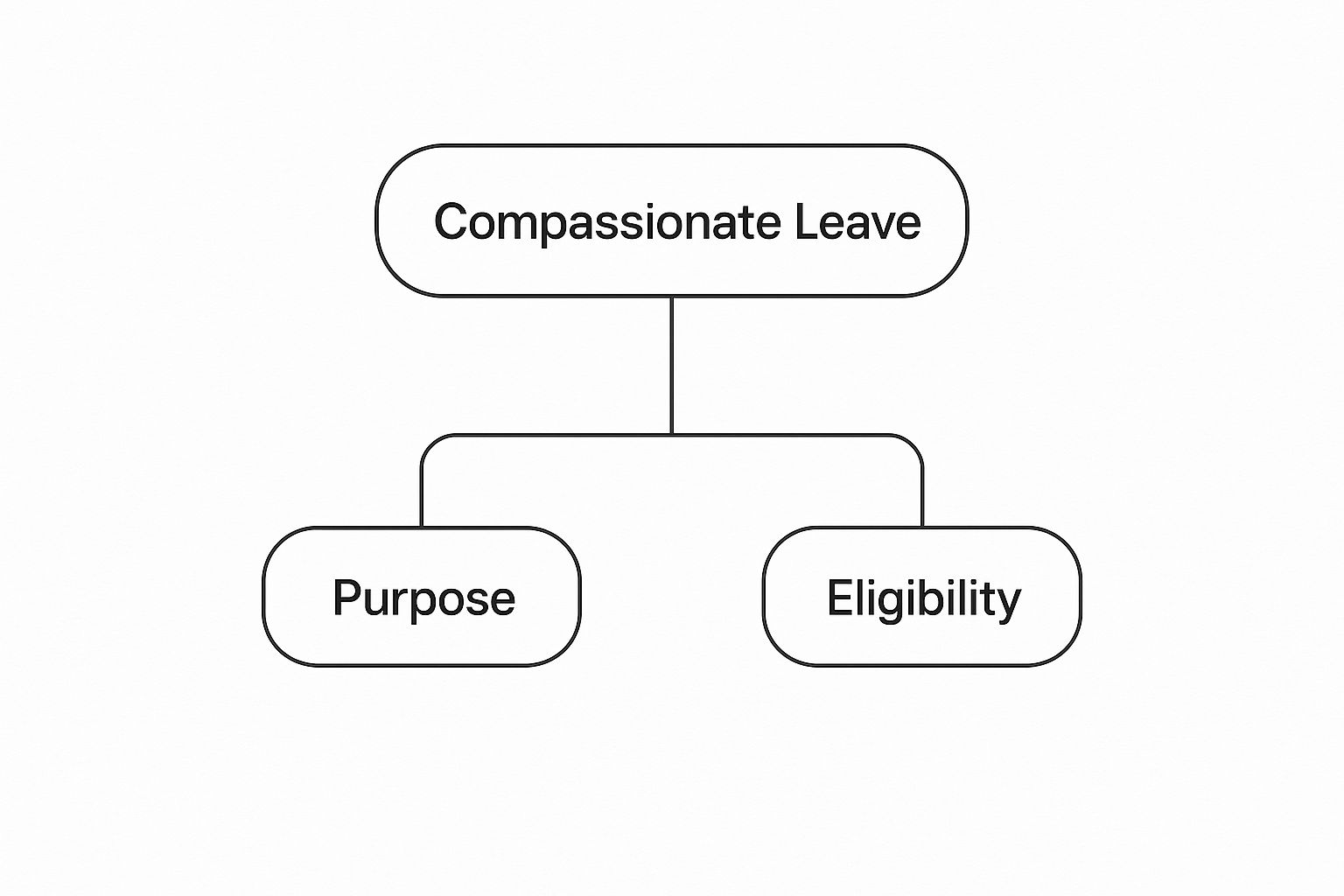
As the visual shows, before you can even talk about how long the leave is, the situation has to fit the criteria. This usually means an emergency involving a dependant. This is the foundational reason why there isn't a one-size-fits-all answer – the specific circumstances of your situation directly influence what's considered a "reasonable" amount of time off.
What UK Law Actually Guarantees for Time Off
If you've ever typed "how long is compassionate leave" into a search engine, you've probably noticed the answers can be a bit vague. There's a good reason for that: UK law doesn't officially use the term "compassionate leave" at all.
Instead, the legal right you have is to a "reasonable" amount of unpaid time off to handle unexpected emergencies involving a dependant. This is your safety net, granted under the Employment Rights Act.

Think of it less like a structured holiday and more like an emergency stop-gap. It’s there to give you the breathing room to sort out an immediate crisis, like arranging urgent care for a sick child or dealing with the immediate aftermath of a parent's passing. That word "reasonable" is intentionally flexible, as what's needed will always depend on the individual situation.
Who Qualifies as a Dependant?
The law is actually quite broad on this point, and it covers more people than you might think. It isn't just about your immediate family.
You have a legal right to take this time off for:
- Your spouse, civil partner, child, or parent.
- Someone who lives in the same house as you (but not a tenant or lodger).
- Anyone who reasonably relies on you for help in a crisis. This could be an elderly neighbour you often take to hospital appointments, for instance.
This framework is designed to make sure you can manage urgent family matters without putting your job at risk. But it's vital to remember that this statutory right is only for unpaid time off. To get the full picture, it's worth exploring the real meaning behind the term in modern workplaces.
The Evolving Legal Landscape
Thankfully, the ground is shifting. New laws are emerging that offer more structured and genuinely compassionate support for employees dealing with family crises. We're seeing some significant updates set to take effect from 6 April 2025.
One of the biggest changes is the introduction of neonatal leave and pay. This will offer up to 12 weeks of support for parents whose newborns need extended hospital care right after birth.
Alongside this, the Paternity Leave (Bereavement) Act will become a day-one right, removing the previous 26-week service requirement for bereaved partners. This change is also expected to dramatically increase the leave from two weeks up to a potential 52 weeks for those who have lost a mother or child around the time of birth. These changes signal a clear move towards legally recognising the profound impact of family emergencies and loss on people's lives.
How Much Compassionate Leave Do Companies Really Offer?
While UK law provides a basic safety net, it doesn't actually specify how long compassionate leave should be or if it should be paid. This leaves the final decision in the hands of individual companies, creating a real mix of policies out there. So, when you're wondering "how long is compassionate leave?", the most straightforward answer is found in your employer's handbook.

Thankfully, most businesses go beyond the unpaid statutory minimum and offer a set number of paid days. The common industry standard usually sits somewhere between three to five days. This allowance, however, often isn't a one-size-fits-all deal; it’s frequently tiered based on your relationship with the person involved.
Tiered Policies Explained
A tiered approach is probably the most common way you'll see compassionate leave structured. It's designed to offer what's perceived as an appropriate level of support based on the closeness of the relationship.
- Immediate Family: For the loss of a spouse, child, or parent, companies usually offer the maximum time off, often five days.
- Close Relatives: For grandparents, siblings, or in-laws, the allowance might be a little less, maybe around three days.
- Other Relatives or Close Friends: For more distant relatives or close friends, one or two days might be granted, often at a manager's discretion.
This structure gives everyone a clear and consistent framework to work with, but it's starting to be questioned. The reality is that grief doesn't fit neatly into predefined boxes. A rigid policy can sometimes fall short of what an employee genuinely needs to handle practical arrangements and their own emotional wellbeing.
A recent analysis found that while over 10% of UK employees took compassionate leave in the past year—a 40% rise in usage—the average length taken was only 1.6 days.
This statistic hints at a potential gap between what people need and what they're either being offered or feel comfortable taking. It shows that while more people are using this type of leave, the duration is still surprisingly short. You can dig deeper into how these statistics compare year-over-year to see the broader trends. This discrepancy is exactly why many forward-thinking companies are starting to ask themselves if the standard three-to-five-day policy is really enough.
Understanding If Compassionate Leave Is Paid
When you’re dealing with an emergency, the last thing you want to be worrying about is your paycheque. It’s a critical question for anyone needing time away from work: will I get paid for compassionate leave? The answer, unfortunately, isn't always a simple yes or no.

Here's a detail that often surprises people: the legal, statutory right to ‘time off for dependants’ is completely unpaid. That’s right. The law is there to protect your job so you can’t be let go for taking the time, but it does nothing to protect your income.
But there’s good news. Most employers recognise that the legal minimum just isn't good enough. As a result, they create their own company policies that offer a period of paid compassionate leave. This is where you'll find the real answer to how much time you can take and whether it's covered.
Common Company Pay Models
Most businesses have a clear, often tiered, structure in place to manage paid leave. This keeps things fair and makes sure everyone knows where they stand.
A typical company policy often looks something like this:
- A Set Number of Paid Days: It's common to see between three and five days of fully paid leave offered, particularly for the death of an immediate family member.
- Using Other Allowances: If you need more time after those initial paid days, you might be asked to dip into your annual leave allowance.
- Unpaid or Flexible Options: For longer absences, a good employer might offer extra unpaid leave or a temporary flexible working arrangement to help you ease back in when you're ready.
The only way to know for sure is to check your employee handbook or have a direct conversation with HR. They can give you a clear picture of your company’s specific policy on paid compassionate leave, so you understand exactly what your financial situation will be.
Why Standard Policies Often Fall Short
On paper, a standard compassionate leave policy seems perfectly reasonable. Most offer a neat and tidy three to five days, giving both managers and staff a clear structure to follow. The problem is, this rigid, one-size-fits-all approach often misses the mark completely.
There’s a massive disconnect between what a policy says and what a grieving person actually needs.
Grief isn’t a straightforward process you can tick off a checklist in a few days. It’s messy. It’s unpredictable. Sure, a few days off might be enough to handle the immediate practical things, like arranging a funeral. But that’s just the tip of the iceberg. The emotional journey and the hit to a person's mental health last far, far longer.
The Mismatch Between Policy and Reality
Look at the evidence, and you’ll see a huge gap between what companies typically offer and the time people genuinely need to get back on their feet. While most UK employers provide a few days of paid leave, it’s rarely enough.
One recent study threw this into sharp relief. It found that over half (55%) of employees took up to eight weeks to feel anything close to normal at work after a loss. For 13%, it took even longer. The same research revealed that 21% of employees felt they needed more time off than they were given.
This data tells a clear story: a few days off is just a sticking plaster. And while compassionate leave provides that immediate relief, it's also worth thinking about the wider context, like the importance of family caregiver wellbeing and respite care, to see where policies could offer more sustained support.
A truly compassionate approach isn't about counting days. It's about recognising that recovery is deeply personal. It might involve more than just time off, like offering access to counselling or being flexible with work arrangements when they return.
To build a more supportive workplace, it helps to start with the basics. If you're looking for a good foundation, check out our quick guide explaining what compassionate leave is.
Common Questions About Compassionate Leave
When you're trying to wrap your head around compassionate leave, especially how long it might last, a lot of practical, real-world questions pop up. The answers usually sit somewhere between UK law and your own company's policy. Let's break down the most common queries to give you some clear, straightforward answers.
Do I Need to Provide Proof for Compassionate Leave?
This is probably the most frequent question, and the answer really hinges on why you're taking the time off. If we're talking about your statutory right to 'time off for dependants,' the law doesn't require you to provide proof. You do, however, need to tell your employer why you’re absent.
It gets a bit different when it comes to a company's own paid compassionate leave policy. Your employer might ask for some form of evidence. The good news is, most employers handle this delicately; they understand it's rarely appropriate to ask for something like a death certificate straight away.
The best thing to do is always check your employee handbook or have a quiet word with HR. That's where you'll find out exactly what your workplace requires.
Can My Employer Refuse My Request?
When it comes to your statutory rights, the answer is a firm no. An employer cannot refuse your right to take a 'reasonable' amount of unpaid time off for a genuine emergency involving a dependant. Denying this would be a serious misstep in employment law.
Where things get a bit more nuanced is with the paid leave offered by your company. While they have to stick to their own policies, they do have some discretion over what they consider a reasonable request beyond the legal minimum. If you feel a refusal is completely unreasonable, it could potentially be grounds for a grievance.
To steer clear of any issues, open and prompt communication with your manager is always the best path forward. Explain the situation clearly and give them an idea of how much time you think you'll need. This kind of transparency helps them understand what's going on and makes it easier for them to support you.
Does Compassionate Leave Cover Pets or Close Friends?
This is an area where company policies are slowly starting to change, but the legal answer is very black and white. Legally, compassionate leave doesn't cover pets or friends.
The statutory right to time off is strictly for dependants – think a spouse, child, parent, or someone who lives in your household and relies on you for care. This legal definition does not extend to friends or pets.
However, many forward-thinking companies are starting to recognise the huge emotional impact of losing a beloved pet. It’s becoming more common to find specific policies for pet bereavement, often allowing for a day of leave. Time off for a close friend is less common, but a manager might grant it at their discretion. The only way to know for sure is to check your company's policy.


