
When it comes to compassionate leave in the UK, one of the first questions people ask is, "How long do I get?" The answer isn't as straightforward as you might think. There’s no single, fixed duration set in stone.
The law simply states that employees are entitled to a 'reasonable' amount of unpaid time off to handle emergencies involving a dependant. But what exactly does 'reasonable' mean? In reality, it often comes down to your employer's specific policy rather than a strict legal rulebook. This means the time you're actually granted can vary quite a bit from one company to another.
How Long Is Compassionate Leave in the UK?

To get a clearer picture, it’s helpful to think about compassionate leave in two distinct parts.
First, you have the legal minimum. Think of this as a safety net designed to help you manage the immediate, practical tasks that arise during an emergency. This could be anything from arranging or attending a funeral to dealing with an unexpected breakdown in childcare. This is the baseline right that every employee is guaranteed.
Then, you have the supportive leave that many compassionate companies choose to offer, which is often paid. This is where employer discretion and company culture really shine through. It’s a move beyond just the practical necessities, acknowledging the very real emotional need for time to grieve and process a loss.
A Look at Typical Compassionate Leave Durations
In practice, the amount of time you get often depends on your relationship to the person who has passed away or is seriously ill. While there's no official rule, there are some common patterns. Research often shows that UK employers typically offer between one and five working days of bereavement leave.
Here’s a general idea of what you might expect, though remember this can vary.
| Relationship | Typical Leave Duration |
|---|---|
| Spouse, partner, or child | 3-5 days |
| Parent or sibling | 2-5 days |
| Grandparent or grandchild | 1-3 days |
| Other close relative | 1-2 days |
| Close friend or colleague | 1 day (often for funeral) |
For close relatives like a parent, partner, or child, it's fairly standard for good employers to grant several days of paid leave. For more distant family members or friends, this is often shorter—perhaps a day or two—and you might be asked to use annual leave to supplement it.
Understanding the difference between the legal baseline and your company's own policy is absolutely essential. While the law provides that crucial safety net for emergencies, it’s your employer’s approach that will ultimately shape the support you receive during a difficult time.
Key Takeaway: The law ensures you have time for urgent practicalities, but the true length of your compassionate leave—especially paid leave for grieving—is determined by your company's policy.
It's so important to familiarise yourself with both your statutory rights and your employer's specific rules. For a deeper dive into the fundamental principles, our complete guide to understanding compassionate leave meaning is a great place to start. Getting this foundation will give you confidence before you need to approach your manager.
The Reality of Compassionate Leave in UK Workplaces
Beyond official policies and legal minimums, what’s really happening with compassionate leave on the ground in UK workplaces? The data tells a compelling story. We're seeing a growing need for this kind of support, but it's clashing with the reality of how little time people actually take off.
Recent statistics paint a very clear picture. In 2024, over 10% of employees took compassionate or bereavement leave. That’s a huge jump from just 7% in 2023, marking an almost 40% rise in people needing this crucial support. This trend suggests that personal crises are becoming more openly acknowledged in the workplace.
The Growing Gap
But here’s where things get interesting. Despite this sharp increase, the average time taken for compassionate leave has barely budged. It’s holding steady at just 1.6 days – the exact same figure as the previous year, even with so many more people using it.
This contrast shines a light on a critical issue. While more employees feel able to ask for compassionate leave, it seems that powerful pressures—be it financial worries, company culture, or a fear of falling behind—are cutting their time to grieve short.
It’s important not to mix this up with statutory time off for dependants, which is designed for unforeseen emergencies. If you're fuzzy on the details, our guide on what dependant's leave is can clear things up.
The short duration of compassionate leave suggests many are only taking enough time to handle the immediate, practical tasks, rather than having the space to properly process their loss. For businesses aiming to build a genuinely supportive environment, understanding this gap is the first step. It shows that just having a policy isn't enough; the culture has to empower people to truly use it.
Understanding Your Legal Right to Time Off

When people talk about a right to compassionate leave in the UK, they’re usually referring to a specific piece of legislation: the right to time off for dependants. This is your legal safety net, provided under the Employment Rights Act 1996.
It gives every employee the right to take a 'reasonable' amount of unpaid time off work to handle an emergency involving someone who depends on them. This is the bare minimum an employer must offer. The crucial words here are 'emergency' and 'dependant'.
So, who exactly does the law consider a dependant? It's probably a wider group than you think.
Who Is a Dependant?
The legal definition here is designed to cover the key people who genuinely rely on you. It’s not just about your immediate family. It typically includes:
- Your spouse, civil partner, or child (if they are under 18).
- A parent.
- Someone living in the same house as you (though not a tenant or boarder).
- Anyone who reasonably depends on you for help in a crisis, such as an elderly neighbour you look after.
This means the law recognises that your support network isn't always confined to your household. The key thing is that the person relies on you to step in when the unexpected happens.
The right to time off for dependants is specifically for taking practical action, not for grieving. It’s there to give you the space to handle the immediate fallout of a crisis, like making funeral arrangements or sorting out a sudden breakdown in care.
An 'emergency' is something that’s sudden or unexpected. For instance, if a dependant passes away, you have a right to time off to manage the necessary arrangements. But if you knew about a hospital appointment weeks ago, that wouldn't legally count as an emergency.
Getting to grips with this distinction is vital. It clarifies what the law is there to protect: your ability to act fast in a crisis for someone who needs you. While this legal right provides a foundation, a truly supportive company will build on it with a more comprehensive policy, often including paid leave.
How Different Scenarios Affect Compassionate Leave
Every situation calling for compassionate leave is deeply personal, and there's no single "right" amount of time off. The reasonable duration can shift dramatically depending on the circumstances, so it helps to understand what to expect when you approach your employer.
The length of your compassionate leave—and whether it’s paid—often comes down to your relationship with the person involved. The passing of an immediate family member like a spouse, child, or parent will almost always warrant more time than the loss of an extended relative or close friend.
Immediate Family vs. Extended Relatives
When a close family member passes away, many companies with solid policies offer around three to five days of paid leave. This acknowledges both the huge emotional weight of the loss and the practical duties that often fall to immediate family, like making funeral arrangements.
For an extended relative, such as a cousin or uncle, or even a very close friend, the allowance is usually shorter. You might be offered one or two days, with one day specifically for attending the funeral. In these cases, it’s not uncommon for employers to suggest using annual leave if you feel you need more time.
The infographic below gives a bird's-eye view of how UK organisations typically handle paid and unpaid leave.
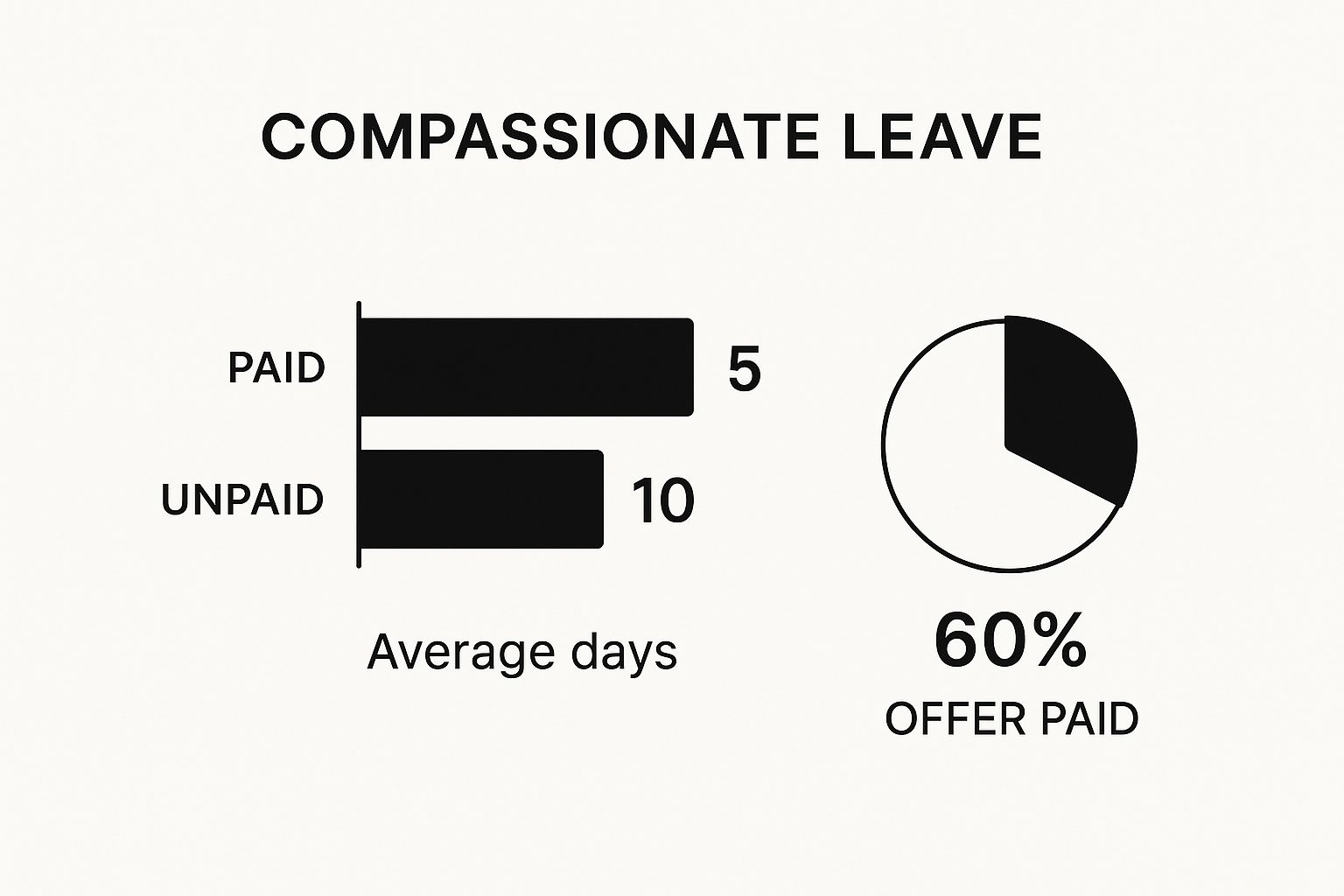
As you can see, while a good portion of companies (60% of organisations) offer some form of paid leave, the average duration is often much shorter than what people actually need. This gap is what pushes many employees into taking unpaid leave to get the time they require.
To give you a clearer picture, this table shows how different bereavement scenarios might play out.
Comparing Common Compassionate Leave Scenarios
This table compares likely outcomes for different bereavement situations to help you understand what to expect from your employer.
| Scenario | Likely Leave Duration | Paid or Unpaid? | Key Consideration |
|---|---|---|---|
| Spouse or Child | 3-5 days, often more | Typically paid | This is a statutory right. Most employers offer more than the minimum. |
| Parent or Sibling | 3-5 days | Usually paid | Considered immediate family; time is for grief and arrangements. |
| Grandparent | 1-3 days | Often paid, varies by policy | Some policies class grandparents as immediate family, others don't. |
| Extended Family | 1 day (for funeral) | Can be paid or unpaid | Check your company handbook. You may need to use annual leave for more time. |
| Close Friend | 1 day (for funeral) | Usually unpaid | Granted at the manager's discretion. Often requires using annual leave. |
Remember, these are just general guides. A good employer will always consider the individual circumstances.
Unexpected Illness or Injury
Compassionate leave isn't just for bereavement. It also covers a sudden, serious illness or injury to a dependant. This could mean caring for a child who's had an accident at school or supporting a parent after a major health scare like a stroke or heart attack.
In these situations, the leave is focused on the immediate crisis. You might get one or two days right away to sort out the emergency and arrange ongoing care. After that, the conversation may shift to longer-term options like flexible working arrangements. Your employer's response will really depend on the severity of the situation and their specific policy. Clear and open communication is absolutely vital here.
The Future of Bereavement Leave in the UK

For a long time, the UK's legal approach to bereavement leave has felt like a bit of a patchwork quilt. There are minimal statutory guarantees, which means many employees are left relying on their employer's goodwill during one of the toughest times of their lives.
Thankfully, it looks like a significant shift is on the horizon. There's a growing understanding that the current system just isn't built for the complex reality of grief. Lawmakers are now pushing for more consistent and compassionate support, moving away from a 'one-size-fits-all' emergency leave towards something more structured and human.
This isn't just talk, either. The government has taken notice of these shortcomings. A proposed amendment to the Employment Rights Bill, introduced in July 2025, aims to properly expand statutory bereavement leave. The goal is to finally formalise the right to this leave, clearly defining how long compassionate leave should be and which relationships qualify.
A New Chapter for Compassionate Support
This legislative push feels like the start of a new chapter for employee support in the UK. The aim is to build a system that is clear, fair, and reliable, taking away the uncertainty that so many people currently have to deal with.
By setting up a stronger legal foundation, these changes will help businesses of all sizes create much clearer policies. It’s a move that benefits everyone. And for those needing extra help, connecting with bereavement and grief support groups can offer real comfort and community.
The core idea behind the reforms is simple: grieving employees deserve certainty and compassion from the law, not just from their employers. This ensures a consistent baseline of support across the country.
Ultimately, this legal evolution shows a much deeper appreciation for employee wellbeing. For businesses, getting ahead of these changes isn’t just about staying compliant; it's about building a workplace that is genuinely supportive. A great first step is to create a clear and kind bereavement leave policy now, before you’re required to.
Answering Your Compassionate Leave Questions
Trying to figure out compassionate leave can feel like reading a map in the dark. It's completely normal to have questions about your rights and what you can expect from your employer. This section tackles the most common queries with direct, clear answers to help you understand how long compassionate leave can be and how it all works in practice.
Is Compassionate Leave Paid in the UK?
This is usually the first question on everyone's mind. The short answer is that, legally, the right to time off for dependants is unpaid. Your employer isn't required by law to pay you for this time.
The only statutory exception is Parental Bereavement Leave, which covers paid time off after the tragic loss of a child. That said, many forward-thinking companies have their own policies that offer paid compassionate leave, often somewhere between two to five days. Your first port of call should always be your employment contract or company handbook to see what your specific entitlements are.
Can an Employer Refuse Compassionate Leave?
No, an employer cannot legally refuse your right to take a 'reasonable' amount of unpaid time off to handle a genuine emergency involving a dependant. It's a fundamental statutory right.
What they can do, however, is discuss the situation with you to figure out if the time you've requested is 'reasonable' for the circumstances. If your reason doesn't quite fit the legal definition of an emergency, they might suggest using annual leave instead. This is exactly why clear and open communication is so important from the get-go.
Important Note: Remember, the right is to have the time off. An employer might question the length of the leave if it seems excessive for the immediate practical tasks at hand, but they can't issue a blanket refusal for a legitimate emergency.
Do I Need to Provide Proof for Compassionate Leave?
It’s perfectly reasonable for an employer to ask for some general details about what's happened. This helps them understand why you need the leave and confirm that it falls under the 'time off for dependants' right.
However, being asked for formal proof like a death certificate for short-term leave is highly unusual and would generally be seen as insensitive. Most employers approach these situations with trust and discretion. Still, company policies can differ, so it's always wise to know what your workplace expects.
What if I Need More Time Off?
If the standard leave your company offers just isn't enough to manage everything, don't panic. The best thing you can do is have an open and honest chat with your manager or HR.
You'll often find that employers are willing to work with you to find a supportive solution. This might look like:
- Using some of your paid annual leave.
- Arranging a period of unpaid leave.
- Exploring a temporary flexible working arrangement.
Being proactive and explaining your situation clearly is the most effective way to find a path forward that works for both you and your employer.


