
Yes, you absolutely get paid holidays on a zero-hour contract. Let's clear this up right away: UK law guarantees you the same fundamental right to paid annual leave as any other employee. The main difference is how you earn it. Instead of a fixed amount upfront, your holiday time simply builds up—or accrues—based on the hours you actually work.
Your Holiday Rights on a Zero-Hour Contract
Trying to figure out employment rights can sometimes feel like solving a puzzle, especially when your working arrangement is flexible. But when it comes to holiday entitlement on a zero-hour contract, the core principle is actually refreshingly simple: you are legally entitled to paid time off.
This isn’t some optional company perk or a contractual bonus. It's a fundamental right designed to make sure every worker can rest and recharge without taking a financial hit.
A good way to think about it is like having a "holiday pot" that you fill up with every single hour you work. The more hours you put in, the more paid time off you collect. This system keeps things fair by linking your leave directly to your contribution, no matter how unpredictable your schedule might be.
The Foundation of Your Entitlement
Your holiday rights are built on a solid legal framework that sees you no differently from someone on a fixed-hours contract. To get a grip on what you're owed, you just need to understand a few key elements:
- Statutory Minimum Leave: Every single worker in the UK is entitled to 5.6 weeks of paid holiday each year. This is the absolute minimum an employer has to provide.
- Pro-Rata Accrual: Because you don't work set hours, your 5.6 weeks of leave are calculated on a pro-rata basis. In simple terms, your entitlement is proportional to the hours you've actually worked.
- Equal Treatment: The law is crystal clear on this one. Your type of contract cannot be used as an excuse to deny you the fundamental rights given to other employees, and that absolutely includes paid annual leave.
This legal safety net ensures that having a flexible work schedule doesn't mean you lose out on essential benefits. If you want to dig deeper into how these principles apply in different scenarios, it's really helpful to read a complete guide to your rights.
To make this even clearer, here’s a quick summary of what the law guarantees you.
Your Core Holiday Rights at a Glance
| Right | What This Means for You | Legal Basis |
|---|---|---|
| Paid Time Off | You must be paid for the holiday you take. It's not just time off; it's paid time off. | Working Time Regulations 1998 |
| 5.6 Weeks' Leave | This is your statutory minimum entitlement per year, calculated pro-rata. | Working Time Regulations 1998 |
| Fair Accrual | Your holiday entitlement builds up fairly, based on the hours you work. | Employment Rights Act 1996 |
| Equal Treatment | You have the same holiday rights as permanent employees, just calculated differently. | Part-time Workers Regulations 2000 |
Knowing these core rights is the first step to making sure you're being treated fairly.
How Your Holiday Time Builds Up
So, how does this all work in practice? The most common way to calculate holiday accrual for zero-hour contracts is with a simple percentage.
Your holiday time is typically calculated at a rate of 12.07% of the hours you work. This figure isn't just pulled out of thin air—it comes from the 5.6 weeks of statutory leave, divided by the remaining 46.4 weeks of the year. For every 100 hours you put in, you earn just over 12 hours of paid leave.
The core takeaway is this: every single hour you work contributes to your paid holiday entitlement. It is earned, protected by law, and must be paid to you when you take your leave.
Understanding this foundation is your best tool for ensuring you get what you're owed. With this knowledge, you can confidently track your hours, check that your holiday pay is being calculated correctly, and take the paid rest you've rightfully earned.
Why Zero Hour Holiday Pay Became a Legal Focus

To really get to grips with your rights today, it helps to understand the journey that brought us here. The rules for holiday pay on zero-hour contracts didn’t just appear out of thin air; they were forged in response to a huge shift in the UK’s workforce.
Over the last couple of decades, the world of work changed dramatically. Sectors like hospitality, retail, and social care started relying heavily on flexible staff to keep up with customer demand. This led to a massive rise in zero-hour contracts, which were perfect for their adaptability.
But this boom created a big legal headache. As more and more people took on these flexible roles, a fundamental question popped up: how do you give traditional rights, like paid holidays, to someone with no fixed hours? This puzzle left thousands of workers in limbo and employers trying to navigate a very confusing legal landscape.
A Growing Need for Clarity
The lack of clear rules caused real problems on the ground. Some employers, genuinely unsure of how to calculate holiday pay, made honest mistakes. Others, however, took advantage of the confusion, leading to some pretty unfair practices. The result was a lottery – a worker’s right to paid leave often came down to how their boss chose to interpret some very vague guidelines.
This wasn't a small issue. As flexible working grew, so did the number of people affected. By 2017, government figures showed around 913,000 people were on zero-hour contracts, making up nearly 2.9% of the entire UK workforce. Concerns were rightly raised about the lack of security for these workers, especially when it came to holiday pay.
The core issue was simple: flexibility in working hours should not result in the loss of fundamental rights. The law needed to catch up with the modern workplace to ensure fairness for everyone.
With so many people on these contracts, the calls for clear, enforceable rules grew louder. It was time for the government and the courts to step in and formalise the rights of this new-look workforce.
Landmark Changes Solidified Worker Rights
The real turning point came from a series of legal challenges and updated government guidance. Landmark employment tribunal cases began setting crucial precedents, confirming that yes, zero-hour contract workers were absolutely entitled to the same statutory leave as any other employee.
These legal battles were a game-changer. They forced the law to become crystal clear and led to the creation of specific calculation methods to keep things fair. A few key principles were hammered out:
- Equal Entitlement: Workers on zero-hour contracts have a right to 5.6 weeks of paid holiday per year. This is exactly the same as full-time staff; it's just calculated in a different way.
- Proportional Accrual: You earn your holiday time based on the hours you actually work. This creates a direct and fair link between the work you put in and the leave you get out.
- Unlawful Practices: The courts officially outlawed dodgy practices like "rolled-up" holiday pay, where employers would just add a bit extra to the hourly rate instead of paying for actual time off.
This legal evolution turned a confusing mess into a regulated system. It gave employers the clarity they needed to meet their obligations and, most importantly, it empowered workers by cementing their holiday entitlement on a zero hour contract in law. For a deeper understanding of the rules as they stand today, you can find out more by reading our guide at https://www.leavewizard.com/holiday-entitlement-for-zero-hour-contracts/. This history is why today's calculations and rights are so clearly defined.
How to Correctly Calculate Your Holiday Pay
Right, let's get down to the practical part: making sure you're paid every penny you're owed. Calculating holiday pay for a zero-hour contract can feel a bit murky, but it really boils down to two main, legally sound methods. Getting your head around these is crucial to making sure your holiday pay is handled correctly.
One common shortcut, especially for shorter-term work, is the 12.07% method. This number isn’t just plucked out of thin air; it comes directly from the statutory 5.6 weeks of holiday. Think about it: you take the 52 weeks in a year and subtract the 5.6 weeks of leave, which leaves you with 46.4 working weeks. Divide 5.6 by 46.4, and you get 12.07%.
Essentially, this percentage is the slice of holiday entitlement you earn for every hour you work. It’s a straightforward conversion from work time into holiday pay.
This infographic breaks it down into a simple, three-step process to help you visualise how it all adds up.
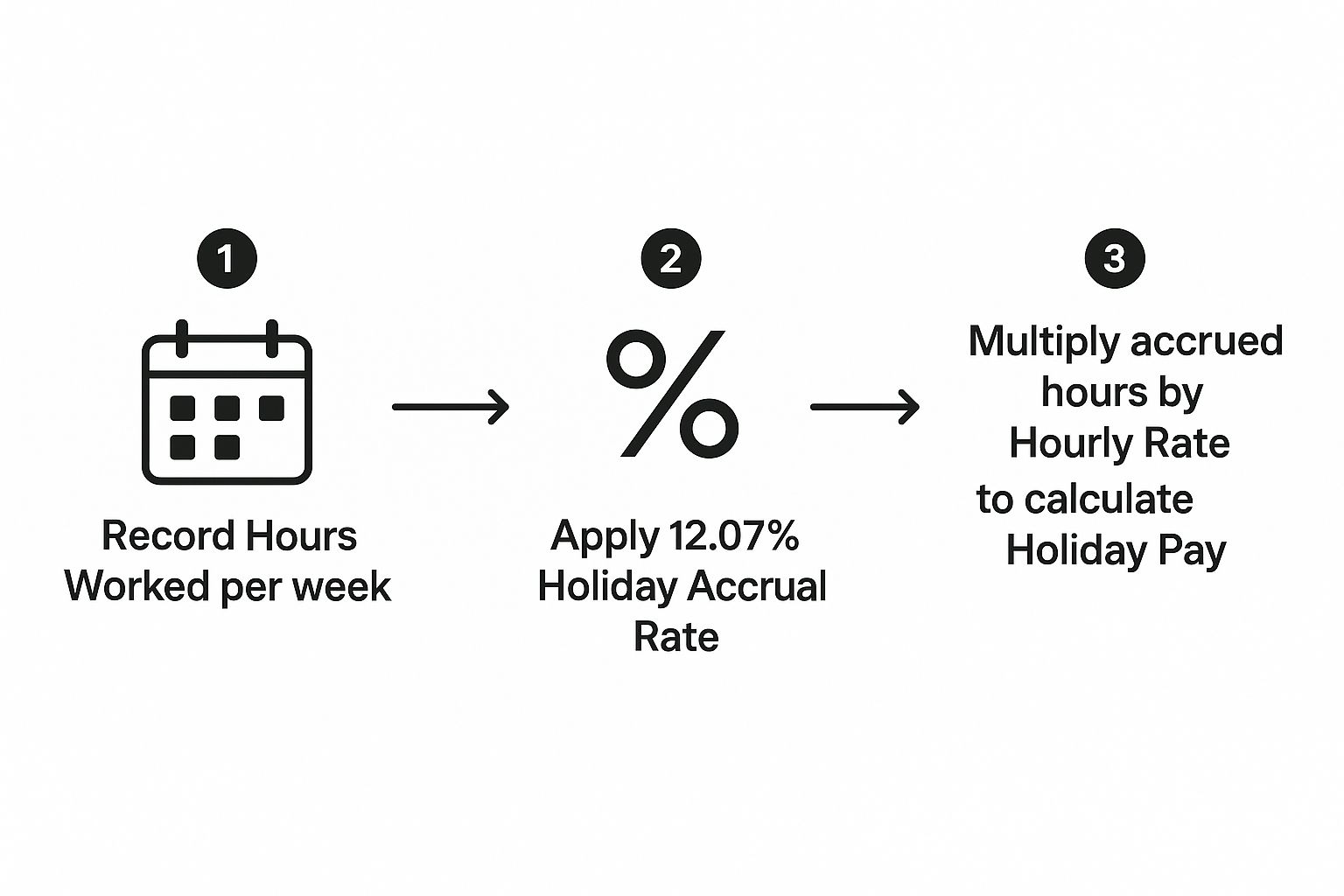
As you can see, it all starts with keeping a proper record of your hours. From there, you apply the standard rate to work out the final pay. Simple.
The 52-Week Reference Period Method
While the 12.07% figure is a handy rule of thumb, the government's official and preferred method is the 52-week reference period. This approach is built to give a much fairer and more accurate picture of what you'd typically earn, which is particularly important for workers whose hours and pay swing wildly throughout the year.
The process involves your employer looking back at the last 52 weeks in which you were actually paid. Any weeks where you didn't earn anything are skipped over. If you haven't been with them for a full 52 weeks, they simply use as many complete weeks of pay as you've got on record to figure out the average.
This stops your holiday pay from being unfairly dragged down by a recent quiet spell. For instance, a student who works flat-out over the summer but very little during term time will get holiday pay that reflects those busy, higher-earning periods, not just the quiet ones.
The whole point of the 52-week reference period is to land on an average weekly pay that genuinely reflects your normal earnings. This ensures your holiday pay is a fair replacement for the income you'd otherwise lose by taking time off.
This method lines up perfectly with the core principle that holiday pay is based on the hours you actually work. UK government guidelines are clear: this reference period makes sure the amount you're owed is at least 12.07% of the hours worked, matching the 5.6 weeks statutory entitlement. So, if you've clocked 1,000 hours in a year, you’re entitled to 120.7 hours of paid holiday.
A Practical Example Calculation
Let's put this into a real-world scenario. Imagine Alex, a gig economy driver with constantly changing shifts. To calculate one week of holiday pay, their employer would use the 52-week method like this:
- Gather the Data: First, they’d pull up the payslips from the last 52 weeks Alex was paid, ignoring any weeks they took off unpaid.
- Calculate Total Earnings: Next, they add up everything Alex earned over those 52 weeks. Let’s say it totals £15,600.
- Find the Weekly Average: Then, they simply divide that total by 52. In this case, £15,600 / 52 = £300.
- Determine Holiday Pay: That £300 average is exactly what Alex is legally owed for one week of paid holiday.
This calculation makes sure that Alex's seasonal spikes, like a hectic Christmas period, are baked into the average. It gives a much fairer result than just looking at a recent, and possibly slower, month. For a deeper dive into other pay calculations, you can explore some more simple methods that work for calculating holiday pay.
By understanding these official methods, you and your employer can be confident that holiday pay is being calculated legally and accurately, truly reflecting the way you work.
Putting Holiday Pay Theory into Practice

It’s one thing to understand the rules on paper, but it’s another thing entirely to see how they affect your own payslip. That’s where the real questions pop up. The very nature of zero-hour contracts means that work patterns can be all over the place, making the maths feel a bit tricky.
Let’s break it down with a few common examples. Walking through these scenarios will help you get a feel for how the calculations work and give you the confidence to check your own holiday entitlement on a zero hour contract. You’ll see exactly why the method used by an employer can make a big difference to your wallet.
Case Study 1: The New Starter
Let's meet Sarah. She’s just started a zero-hour job at a local café and has been there for about three months. Since she hasn't been on the payroll for a full year, her employer can't use the standard 52-week reference period. Instead, they have to look at the number of weeks she's actually worked.
Over her first 13 weeks, Sarah’s hours have varied, but her total earnings add up to £1,950.
- Average Weekly Pay: £1,950 (total pay) ÷ 13 (weeks worked) = £150
Simple as that. If Sarah decides to book a week off, she’s entitled to £150 in holiday pay. This approach ensures her holiday pay is a fair reflection of what she's been earning recently, even though she's new to the job.
Comparing Methods for Sporadic Work
Now for a slightly more complex situation. David is a warehouse operative who has been on a zero-hour contract for well over a year. His work is incredibly seasonal – he’s flat out in the autumn run-up to Christmas but things go dead quiet in January and February.
This is where the choice of calculation method becomes crucial. Let’s imagine David wants to take a week's holiday in March, just after that long quiet spell. What happens then?
The whole point of UK holiday pay law is to make sure people aren’t financially worse off for taking a break. The 52-week average method is designed to honour this by smoothing out those seasonal highs and lows in pay.
The table below really highlights why the 52-week average is not only fairer but also the legally correct approach for workers like David.
Holiday Pay Calculation Method Comparison
This quick comparison shows how the two methods would impact David, who has a classic seasonal work pattern.
| Scenario Detail | Calculation Using 12.07% Method | Calculation Using 52-Week Average Method | Recommendation |
|---|---|---|---|
| Worker with Seasonal Peaks (David) | This outdated method would only look at his recent, low earnings from the quiet January/February period. This would mean his holiday pay for that week would be unfairly low. | This method takes the full picture into account. It averages his earnings over the last 52 paid weeks, including the busy, high-earning pre-Christmas months. The result is a much fairer weekly figure. | The 52-week average method is the legally compliant choice. It guarantees David's holiday pay reflects his typical earnings across the whole year, not just a recent slow patch. |
As you can see, just using his recent low earnings would penalise David for taking a holiday when he did. The 52-week average gives a much more accurate and fair payment that truly reflects his contribution over the year.
Handling a Change in Pay Rate
Finally, what about when your pay goes up? Let’s look at Maria, who works in events. Six months ago, she got a promotion and her hourly rate jumped from £11.50 to £13.00. How does this play out in her holiday pay?
When her employer calculates her average weekly pay, they still use the 52-week reference period. This means the calculation will naturally include earnings at both her old and new rates.
- The maths will include her higher pay from the most recent 26 weeks.
- It will also include her earnings at the lower rate from the 26 weeks before her promotion.
Her average weekly pay will be a blend of the two rates, giving an accurate picture of her earnings over the entire year. As time goes on and more of the 52-week period is filled with her new, higher rate, her average holiday pay will gradually climb to match. It's a system designed for fairness, always basing your holiday pay on what you’ve actually earned.
Spotting Common Holiday Pay Mistakes
Knowing your holiday rights is one thing, but being able to spot when they're being overlooked is a whole other ball game. Both employers and zero-hour workers can easily fall into common traps, leading to incorrect pay and, down the line, potential legal headaches. Getting this right means paying close attention to the details.
These mistakes aren't always deliberate. Sometimes they're just old habits from outdated practices or a simple misunderstanding of the law. But the impact can be huge. By getting to grips with these frequent slip-ups, you'll be in a much stronger position to make sure everything is being handled fairly and legally.
Think of this as your field guide to the most common errors in zero-hour holiday pay. It'll give you the confidence to identify and challenge them if you need to.
The Unlawful Practice of Rolled-Up Holiday Pay
One of the most persistent and serious mistakes is something called rolled-up holiday pay. This is where an employer simply adds a bit extra to your hourly rate—say, an extra £1.24 on top of your £10.26 wage—and calls it your holiday pay.
While it might sound convenient on the surface, this practice is completely unlawful in the UK. The European Court of Justice put a stop to it because it actively discourages people from taking the paid rest they're entitled to. After all, the whole point of paid holiday is to take a break without a hit to your wallet.
Holiday pay has to be paid when you actually take your annual leave. An employer can’t just tack a bit extra onto your hourly rate to cover it. That completely defeats the purpose of making sure workers can afford to rest.
If your payslip shows this kind of system, your employer isn't following UK employment law. You are still entitled to be paid for any statutory leave you take, regardless of whether you've been receiving a "rolled-up" rate all along.
Using the Wrong Pay Reference Period
Another classic error is using the wrong timeframe to calculate your average pay. As we've established, the only legally correct way is to use a 52-week reference period, looking back over the last 52 weeks you actually got paid.
A common shortcut employers take is to use a much shorter period, like the last 4 or 12 weeks. This can put you at a serious disadvantage, especially if your hours fluctuate with the seasons. If you happen to take a holiday right after a quiet spell, a short reference period will give you unfairly low holiday pay that doesn't reflect what you earn across the whole year. The 52-week average exists specifically to smooth out those peaks and troughs.
Forgetting to Include All Your Earnings
Your holiday pay should match what you'd normally earn if you were working. This means the calculation for your average weekly pay needs to include a lot more than just your basic hourly rate. Many employers mistakenly leave out other regular payments, which can make a big difference.
By law, your average pay calculation must include:
- Overtime Pay: If you regularly work overtime, it absolutely has to be factored in.
- Commission Payments: Any commission that's directly tied to the work you do should be part of the mix.
- Bonuses: Certain bonuses, especially those linked to your performance, also need to be included in the calculation.
Leaving these extras out means you're being underpaid for your time off. The calculation must paint a true picture of your normal earnings, ensuring you don't face a financial penalty for taking a much-needed break. By keeping an eye out for these common mistakes, you're better equipped to protect your rights.
Practical Tips for Managing Holiday Entitlement
Moving past the legal bare minimum to a system that just works is the real goal here. For employers, getting a smooth process in place for zero-hour contract holiday pay builds trust and cuts down on those administrative headaches. And for workers, it’s about having the confidence that your rights are being looked after and you're getting paid correctly.
The secret sauce? Transparency and consistency. When everyone understands the process and can see the numbers clearly, potential conflicts just seem to melt away. Think of this section as a toolkit to make holiday leave management a straightforward, positive experience for both sides.
For Employers: Building a Fair System
Putting together a solid process is your best defence against mistakes and disputes. A bit of organisation upfront can save you a mountain of time and stress down the line. It's also a clear signal to your workforce that you value their contribution and take their rights seriously.
Here are a few best practices to get you started:
- Have a Clear Request Process: Make it incredibly simple for your team to ask for leave. Whether it's through a dedicated tool like LeaveWizard, a standard email template, or a simple form, the process needs to be easy to follow and the same for everyone.
- Use Capable Payroll Software: Let's be honest, manual calculations are a recipe for errors. Modern payroll systems can be set up to automatically track accrued hours and calculate holiday pay using the correct 52-week reference period, keeping you compliant without the guesswork.
- Provide Transparent Payslips: Your payslips should spell it out. They need to clearly show how many holiday hours have been accrued and the rate they were paid at. This simple act of transparency gets rid of ambiguity and helps people understand exactly how their pay is worked out.
Good management isn't just about ticking legal boxes; it's about building a foundation of trust. Clear, fair, and consistent processes show respect for your flexible workforce, which can do wonders for morale and retention.
For Workers: Tracking Your Entitlement
Keeping on top of your own records is empowering. It gives you the ability to check your employer’s figures and spot any potential issues early on, long before they turn into a bigger problem.
Here’s how you can effectively manage your own holiday entitlement on a zero-hour contract:
- Keep Your Own Log: It doesn't have to be complicated. A simple diary or spreadsheet where you jot down the hours you work each week is invaluable. This personal record is your go-to for checking against your official payslips.
- Review Your Payslips Carefully: Don't just glance at the final number at the bottom. Take a minute to check the hours worked, the pay rate, and how your holiday pay has been calculated and shown.
- Communicate Proactively: If something doesn’t add up, bring it up with your manager or HR department. A calm, professional conversation is always best, and having your own records to hand will make that chat much more productive.
By taking these straightforward steps, both employers and workers can make sure the system for managing holiday entitlement on a zero-hour contract is fair, transparent, and runs without a hitch.
Frequently Asked Questions
When it comes to holiday entitlement on a zero-hour contract, the theory is one thing, but the real-world situations are what really matter. Let's tackle some of the most common questions that pop up for both workers and employers.
What Happens If I Don't Work for Several Weeks?
This is a great question and a common point of confusion. The simple answer is that your accrued holiday entitlement is always protected, even during weeks you don't get offered any shifts. You never lose the paid leave you've already earned.
When it's time to calculate your holiday pay, the law is very specific about this scenario. Your employer has to look at the last 52 weeks you actually got paid. They are legally required to ignore any weeks where you earned nothing. If they need to, they'll look back even further than one year to build a full picture of 52 paid weeks.
This system is designed to make sure your holiday pay is a fair reflection of what you earn when you are working, preventing it from being watered down by unpaid gaps.
A quiet spell on your work schedule doesn't erase your holiday rights. The rules are built to protect what you've earned and ensure your payout is based on your actual working patterns.
Can My Employer Add Holiday Pay to My Hourly Rate?
Absolutely not. This practice is known as "rolled-up" holiday pay, and it's unlawful in the UK. The law is crystal clear: you must be paid for your holiday at the time you actually take the leave.
Think about it – the whole point of paid holiday is to let you take a proper break from work without taking a financial hit. Tacking an extra bit onto your hourly wage completely undermines this principle and can land an employer in serious legal trouble.
What Should I Do if My Holiday Pay Seems Incorrect?
If you suspect there's been a miscalculation with your holiday pay, the best first step is always to have a calm chat with your manager or someone in HR. It really helps if you come prepared with your own records of hours worked and your own stab at the calculation.
If that friendly approach doesn't sort things out, your next move could be to raise a formal grievance. For free, impartial advice, you can always get in touch with Acas (the Advisory, Conciliation and Arbitration Service). As a last resort, you might need to make a claim to an employment tribunal.


