
Yes, workers on a zero-hour contract are legally entitled to paid holidays. That’s the short answer.
The confusion usually pops up because of the fluctuating hours, but your fundamental right to paid time off is exactly the same as any other employee. You are entitled to 5.6 weeks of paid leave per year.
Your Holiday Rights on a Zero Hour Contract
Trying to figure out employment rights can feel like reading a map without a key, especially with something as flexible as a zero-hour contract. But here’s the most important thing to remember: UK law protects all workers, no matter what their contract says. Your right to paid annual leave is a legal requirement, not an optional extra.
Think of it like a 'pay-as-you-go' phone plan. Your usage (your working hours) might change from one week to the next, but the core benefits—like being able to receive calls, or in this case, earn holiday pay—are always built-in. This right ensures that every single hour you work is contributing towards your time off.
Why It Gets Complicated
The real challenge with zero-hour holiday entitlement isn't about if you get paid holidays, but how it's all calculated. Unlike a salaried employee who works the same hours every week, your work pattern is irregular. This makes a simple weekly or monthly calculation impossible.
This creates a few practical headaches for everyone involved:
- For Workers: It can be tough to keep track of how much holiday you've earned and what you should be paid for it. Without a clear picture, you might be missing out on what you're owed.
- For Employers: Calculating holiday pay accurately for a varied workforce means meticulous record-keeping and sticking to specific legal formulas to stay compliant.
The core issue stems from translating the statutory 5.6 weeks of leave into a fair monetary value for someone whose weekly pay is never the same. This is where specific calculation methods become essential.
In the UK, all workers legally get a minimum of 5.6 weeks of paid holiday each year, which is often capped at 28 days for those on a standard five-day week. Because of the irregular hours, employers often use a percentage-based method. Your holiday entitlement builds up at 12.07% of the hours you’ve worked.
This guide will break down these tricky details into clear, manageable steps. We’ll walk through the correct methods for calculating your holiday pay, explain your employer's obligations, and give you practical advice to make sure you get the paid leave you are rightfully owed. For a complete overview of your rights, check out our guide on zero-hour contract holiday entitlement.
How Holiday Pay Calculation Has Evolved
To get a proper handle on holiday entitlement for zero-hour contracts today, you need to understand how the rules have changed over the years. For a long time, one simple method was the go-to for payrolls across the UK. But a landmark court case completely tore up the rulebook, making those old habits not just outdated, but illegal.

This whole story is about moving from a convenient (but flawed) shortcut to a fairer, more accurate system. Getting your head around this journey is the key to keeping your business compliant and treating your flexible workforce the right way.
The Old Way: The 12.07 Percent Method
For ages, the standard approach was what everyone called the 12.07% method. It was born from a simple bit of maths: a standard year has 52 weeks, and statutory paid leave is 5.6 weeks. Take one from the other, and you're left with 46.4 working weeks.
The percentage came from dividing the holiday weeks by the working weeks: (5.6 ÷ 46.4) x 100 = 12.07%. This meant that for every hour someone worked, they earned holiday pay equal to 12.07% of that hour. It seemed logical, and it was certainly easy to apply, especially for workers whose hours were all over the place. You could just multiply the total hours worked in a pay period by 12.07% to get the holiday hours they’d earned. Simple.
But this method had a massive flaw hiding in plain sight. While it worked okay for people who worked fairly consistently all year round, it created deeply unfair results for anyone who only worked for part of the year. Think term-time workers or seasonal staff. They were getting a raw deal, ending up with far less holiday pay than they were legally entitled to.
The Turning Point: Brazel v Harpur Trust
The whole issue blew up with the landmark Supreme Court case, Brazel v Harpur Trust. The case was brought by a music teacher on a zero-hour contract who only worked during term time. Her employer, like many others, was using the 12.07% method to calculate her holiday pay.
The Supreme Court’s ruling was a bombshell: the 12.07% method was flat-out wrong for part-year workers. The judges pointed out that the Working Time Regulations are crystal clear: every worker is entitled to 5.6 weeks of paid leave. It doesn't matter how many weeks they actually work in a year. The 12.07% method was, in effect, prorating this right based on hours worked, which the court declared unlawful.
The ruling clarified that holiday entitlement is a solid 5.6 weeks, and the pay for that time off must be calculated using a worker's average weekly earnings over a specific reference period—not just as a simple percentage of hours worked.
This decision instantly made the old 12.07% calculation a compliance nightmare for a huge chunk of the flexible workforce. It forced a fundamental shift, pushing the legally correct 52-week average method into the spotlight.
For any employer using zero-hour contracts, understanding the important changes to calculating holiday pay is no longer optional; it's essential. This move from a simple percentage to an average pay calculation ensures that holiday pay genuinely reflects what a worker typically earns when they are working.
Mastering the 52 Week Average Method
After the seismic shift from the Brazel v Harpur Trust case, employers had to ditch the old, convenient percentage method. The law is now crystal clear: you must use the 52-week average method.
While it might sound a bit daunting, this approach is all about fairness. It makes sure a worker's holiday pay is a true reflection of their actual, recent earnings.
Think of it this way: instead of a one-size-fits-all percentage, you're creating a personalised snapshot of what that person typically earns. Let's break down this legal requirement into a straightforward, manageable task for your payroll.
Defining the Reference Period
First things first, you need to pin down the correct reference period. This is simply the 52-week block of time right before the worker takes their holiday.
So, if an employee takes a week off starting Monday, 15th July, your reference period would be the 52 weeks leading up to Sunday, 14th July. Easy enough.
But here’s the crucial bit. You have to ignore any weeks where the worker earned absolutely nothing. If your zero-hour worker had a few weeks with zero hours on the rota, those weeks don't count towards your 52.
This is where good record-keeping becomes your best friend. You'll likely need to look back further than 52 calendar weeks to find enough weeks where the employee was actually paid. The law gives you a buffer, allowing you to go back a maximum of 104 weeks to find the 52 paid weeks you need.
Calculating the Average Weekly Pay
Once you've identified the 52 weeks of pay, the rest is simple maths. You just add up the total earnings from those 52 weeks and divide that sum by 52. And there you have it – the worker's average weekly pay.
The Core Formula:
(Total Pay from the Last 52 Paid Weeks) ÷ 52 = Average Weekly Pay
This average figure is now the benchmark for their holiday pay. Each week of holiday they take must be paid at this calculated rate. It’s a fair system that stops a worker's holiday pay from being artificially low just because they took time off after a quiet spell.
The infographic below really brings home the difference between the old way and the new, legally required method.
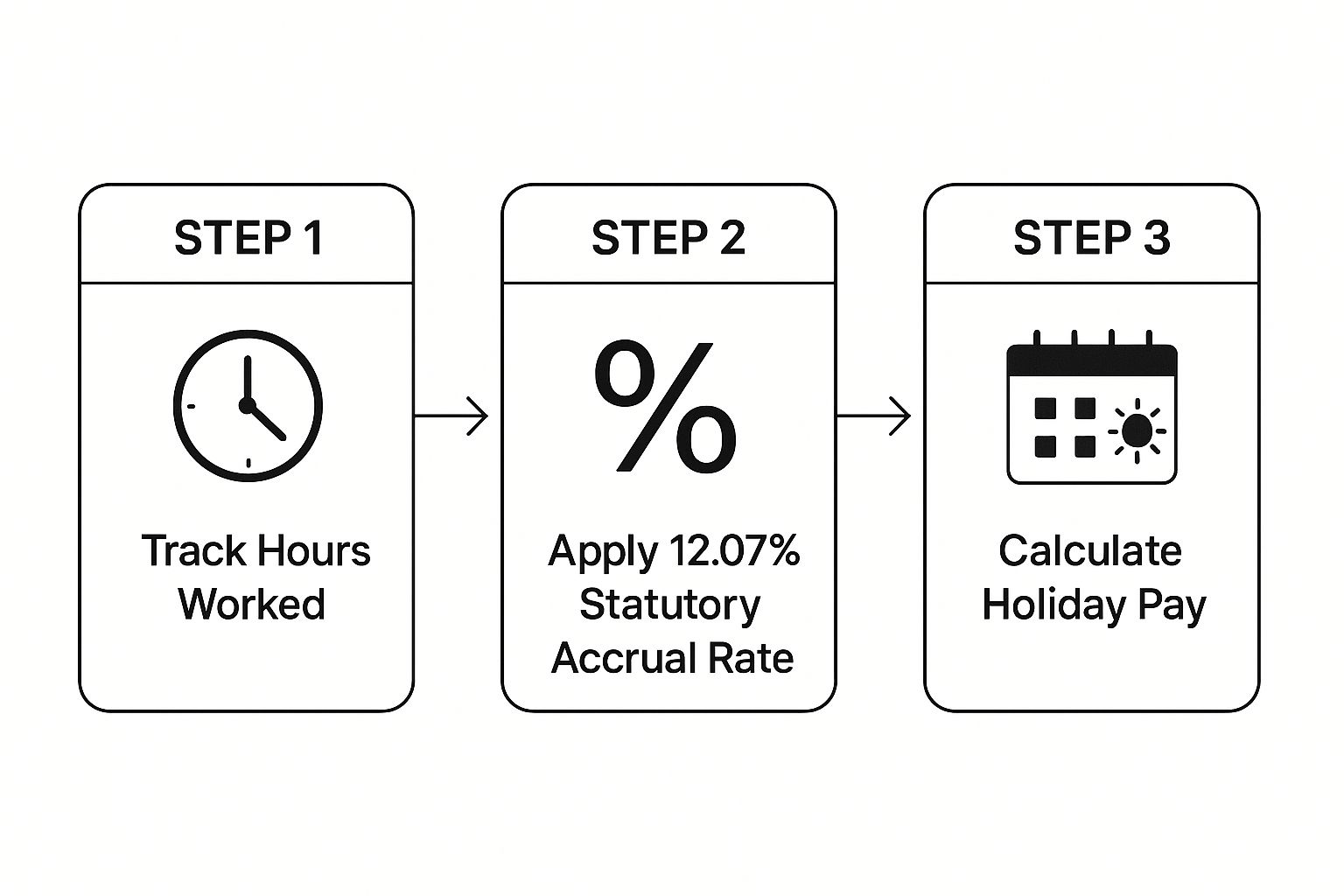
As you can see, the game has changed. We've moved away from the simple 12.07% shortcut to a much more robust method that’s properly tied to actual earnings.
To help clarify the differences, it's useful to see the two methods side-by-side.
Holiday Pay Calculation Methods Compared
| Feature | Outdated 12.07% Method | Current 52-Week Average Method |
|---|---|---|
| Legal Status | No longer legally compliant after Brazel v Harpur Trust | The current, legally required method in the UK |
| Calculation Basis | A fixed percentage of hours worked | Based on actual earnings over a recent period |
| How it Works | Multiplies hours worked by 12.07% to accrue holiday | Calculates the average pay over the last 52 paid weeks |
| Fairness | Can be inaccurate for workers with irregular hours or term-time work | Accurately reflects a worker's typical earnings |
| Reference Period | Accrued as the employee works | A rolling 52-week period (looking back up to 104 weeks) |
This comparison shows why the shift was so necessary. The 52-week average method provides a far more equitable outcome for people whose working patterns fluctuate.
A Practical Walkthrough Example
Let's see how this works in the real world. Imagine a student works flexible shifts at your café on a zero-hour contract.
-
Identify the Holiday Period: The student books a week off in August.
-
Define the Reference Period: You need to look at the 52 weeks immediately before their holiday begins.
-
Filter Out Unpaid Weeks: You check your records and find they had 8 weeks with no hours at all (maybe during exams or over Christmas). These 8 weeks must be ignored.
-
Find 52 Paid Weeks: To get a full 52 paid weeks, you have to go back a further 8 weeks into the past (so you’re now looking at the 60-week period before their leave).
-
Calculate Total Earnings: You add up the pay from those 52 specific weeks. Let's say the total comes to £8,320.
-
Find the Average: Now, you just divide the total by 52.
- £8,320 ÷ 52 = £160
The student’s average weekly pay is £160. So, for the one week of holiday they take, you must pay them £160. This method ensures their holiday pay properly reflects what they earn when they are working.
The way we calculate holiday entitlement for zero-hour contract workers has seen huge changes, largely thanks to the practical problems highlighted in the Brazel v Harpur Trust case of 2022. While the statutory minimum entitlement remains 5.6 weeks per year, the ruling clarified that holiday pay must be based on average weekly earnings over a 52-week period, not a simple percentage. If you want to dive deeper, you can find more insights in this complete guide to zero-hour contract rights on leavewizard.com. This process is now the standard for correctly managing holiday pay for zero-hour contracts, making sure it aligns with actual work patterns.
Employer Obligations for Zero Hour Contracts

Getting holiday entitlement right for your zero-hour contract workers isn't just good practice—it's the law. As an employer, you have a set of non-negotiable duties that protect your workers, your business, and your reputation.
Getting this right keeps you clear of legal trouble and shows your team they're valued. It all starts with the legal must-dos, before we move on to the best practices that truly set great employers apart.
Non-Negotiable Legal Duties
Think of your legal obligations as the absolute foundation of fair employment. These aren't optional extras; they're mandatory requirements under UK law. Getting any of these wrong can quickly lead to disputes, tribunals, and costly penalties.
Here are the essentials you simply must get right:
-
Meticulous Record-Keeping: You need to keep precise records of every single hour worked by your zero-hour contract staff. Without this data, it's impossible to correctly calculate holiday pay using the required 52-week average method.
-
Clear and Itemised Payslips: Every payslip has to show holiday pay as a separate, distinct item. It can never be bundled or "rolled up" into the hourly wage—a practice that is completely unlawful.
-
A Transparent System for Leave Requests: Your workers need a straightforward and accessible way to request their paid time off. Having a clear process ensures fairness and makes managing your staffing levels a whole lot easier.
These are the bare minimums. Following a landmark Supreme Court ruling, employers across the UK had to shift their approach, moving away from old, outdated calculation methods. Now, holiday pay must be based on an average of the hours worked over the last 52 weeks where the person actually earned pay, multiplied by the statutory 5.6 weeks of leave.
This ensures that pay properly reflects irregular working patterns. You can read more about how this legal shift has impacted UK employers on thehrdirector.com.
Best Practices for Forward-Thinking Employers
Meeting your legal duties keeps you on the right side of the law, but adopting best practices shows you genuinely value your flexible workforce. These steps go beyond the basics to build a more transparent, efficient, and positive environment for everyone.
Consider taking these actions to elevate how you manage holiday pay:
-
Leverage Modern Payroll Software: Let's be honest, manual calculations are a recipe for human error. Using up-to-date payroll or HR software automates the tricky 52-week average calculation, guaranteeing accuracy and freeing up huge amounts of admin time.
-
Conduct Regular Audits: Every so often, take a good look at your holiday pay process. A quick internal audit can help you spot potential mistakes or inconsistencies before they snowball into bigger problems, keeping your systems robust and defensible.
-
Establish a Written Holiday Policy: Don't leave things open to interpretation or word-of-mouth. A clear, written policy on holiday entitlement on zero hour contracts cuts through any confusion. This document should explain exactly how leave is earned, how to request it, and how pay is worked out, giving your staff real confidence in the system.
When you combine legal compliance with these thoughtful best practices, you build a system that isn't just fair—it fosters trust and loyalty. It sends a clear message that you're invested in your team's well-being, which is vital for holding onto great people in a flexible workforce.
Navigating Common Holiday Pay Scenarios
Legal theory is one thing, but the real world is rarely that neat. Once you’ve got your head around the 52-week average method, the next challenge is applying it to the messy situations that pop up day-to-day.
These are the scenarios that cause the most headaches for employers and workers. They don't always fit neatly into a formula, which is why having a clear, step-by-step approach is crucial for staying fair and compliant. Let's walk through the most frequent challenges.
Calculating Final Pay for a Departing Worker
One of the most common puzzles is figuring out the final payslip for a zero-hour worker who is leaving. By law, they’re entitled to be paid for any statutory holiday they've built up but haven't used.
This calculation is done on a pro-rata basis. It sounds complicated, but you’re just working out what fraction of the year they've worked and applying that same fraction to their total 5.6 weeks of annual holiday.
Here’s how to tackle it:
- Work out the Accrual Period: Pinpoint the number of days from the start of your holiday year to their last day of employment.
- Calculate Pro-Rata Holiday: Divide the days they've been employed in the holiday year by 365. Then, multiply that figure by the full 5.6-week entitlement. This tells you exactly how much holiday they've accrued in weeks.
- Get their Average Pay: Use the 52-week average pay method, looking back from their termination date, to find their average weekly pay.
- Work out the Final Payout: Multiply the holiday they've accrued (in weeks) by their average weekly pay. That’s the final holiday pay figure to add to their last payslip.
Handling Workers Employed for Less Than a Year
What about a new starter who has only been with you for a few months? You can't use a 52-week reference period because it simply doesn't exist yet.
In this everyday scenario, the law is refreshingly straightforward: you just adapt the reference period to the number of weeks they have actually worked.
For instance, if a worker has been with you for 12 weeks, you calculate their average weekly pay based on those 12 weeks. You add up their total earnings over that time and divide by 12. This figure then becomes the pay rate for any holiday they take.
This simple principle ensures that new starters are treated fairly from day one. Their holiday pay accurately reflects what they've been earning, even without a full year's worth of pay data to draw from.
Long-Term Sick Leave and Holiday Accrual
Long-term sick leave can make holiday entitlement for zero hour contracts feel particularly tricky. It helps to remember two key principles: holiday entitlement keeps building up even when a worker is off sick, and the 52-week reference period must exclude any weeks where they received zero pay.
Imagine a worker is on sick leave for 20 weeks and only receives Statutory Sick Pay (SSP). Crucially, SSP doesn't count as pay when calculating holiday pay. When they return and book a holiday, those 20 weeks on SSP must be ignored in the 52-week look-back period.
This means you might have to go back much further than 52 calendar weeks – up to a maximum of 104 weeks – to find 52 weeks of actual pay. This rule is in place to prevent a worker's holiday pay from being unfairly dragged down by a period of illness.
The table below is a quick-reference guide for these tricky situations and the right way to handle them.
Handling Common Zero-Hour Holiday Scenarios
| Scenario | Key Consideration | Recommended Action |
|---|---|---|
| Worker Leaving | Untaken statutory holiday must be paid out on a pro-rata basis. | Calculate entitlement based on the portion of the holiday year worked and pay it using their 52-week average pay rate. |
| New Starter | A full 52-week reference period is not available. | Adapt the reference period to the number of weeks the person has actually worked and been paid. |
| Long-Term Sick Leave | Holiday continues to accrue, but weeks with only SSP are not counted as 'paid weeks'. | Exclude weeks of sick leave from the 52-week average calculation, looking back further (up to 104 weeks) to find 52 weeks of normal pay. |
By facing these common challenges head-on with the proper legal framework, you can bridge the gap between knowing the rules and applying them with confidence.
Frequently Asked Questions

Even after you get your head around the 52-week average method, a few specific questions always seem to pop up when you're dealing with the day-to-day reality of zero-hour contracts. It's only natural. This section tackles some of the most common queries we see from both employers and workers, aiming to clear up any lingering confusion.
Getting these details spot on is crucial for staying on the right side of the law and, just as importantly, treating your flexible workforce fairly. Let's dive into three of the biggest sticking points.
Can My Employer Add Holiday Pay to My Hourly Rate?
In a word: no. This is completely unlawful. Some employers might be tempted to just add a little extra onto the hourly wage, calling it 'holiday pay'. This practice is known as 'rolled-up' holiday pay, and it was outlawed years ago for a very good reason—it actively discourages people from taking the time off they're entitled to.
The law is crystal clear on this. Holiday pay is for time taken as holiday. The whole point of paid leave is to let workers rest and recharge without worrying about a smaller pay cheque. Lumping it in with regular wages completely undermines this, creating a situation where people feel they simply can't afford to take a break.
What If I Haven’t Worked for a Full 52 Weeks?
This is a classic scenario, especially for new starters. The good news is, it's simple. If you haven't been with the company for a full 52 weeks, your employer just uses the number of weeks you have worked for the calculation. There's no need to wait for a full year of pay data to build up.
Let's say you've been on the books for 15 weeks and want to take a paid holiday. Your employer will calculate your average weekly pay based on those 15 weeks. They'll add up everything you've earned so far and divide it by 15. This makes sure your holiday pay is a fair and accurate reflection of your actual earnings right from the get-go.
This principle ensures fairness for new team members. The reference period is flexible and adapts to the length of employment, guaranteeing that holiday pay is always based on actual, recent earnings, no matter how long the worker has been with the company.
Are Bank Holidays Paid for Zero-Hour Workers?
There's no automatic legal right for any worker, including those on zero-hour contracts, to get paid time off for bank holidays. It all comes down to what's written in your employment contract.
Many employers include the eight UK bank holidays as part of the statutory minimum 5.6 weeks of annual leave. If that's the case for you, then taking a bank holiday off simply uses up one of your paid holiday days.
To actually get paid for it, though, it must be a day you would have normally been scheduled to work. If you're not usually rostered on for that particular Monday, for example, you wouldn't be paid for it—but you would keep that holiday day to use another time.
Putting Fairness and Compliance First
Handling holiday pay for your zero-hour contract team isn't just about crunching numbers; it’s a core part of being a fair and decent employer. Getting it right builds trust, strengthens your reputation, and helps you steer clear of expensive legal headaches.
The move away from old, inaccurate shortcuts to the legally required 52-week average isn't just a rule change. It's about making sure holiday pay properly reflects what your team has actually earned.
For employers, this means keeping meticulous records and being crystal clear with your people. Think of it less as an administrative chore and more as an investment in your workforce. Get a clear, written policy in place and make a habit of checking your processes to stay on the right side of the law.
For workers, the main takeaway is this: you are empowered. Get to know your payslips, understand your right to 5.6 weeks of paid leave, and don't ever be afraid to ask questions if something doesn’t add up.
At the end of the day, fairness is all about clarity. For help with staying compliant and to explore other tools for navigating employment law, it's worth checking out some comprehensive employment resources. When businesses genuinely embrace these principles, they build a foundation of trust that makes every team member feel valued, no matter what their contract says.


