
Think of a day in lieu as a sort of 'time bank' for your employees. When someone works extra hours—say, covering a shift on a bank holiday—they can be given paid time off at a later date instead of getting overtime pay. It’s a simple system that offers a huge amount of flexibility for both the company and the team.
What Is a Day in Lieu and Why Does It Matter?

The phrase "in lieu" is borrowed from French and simply means "instead of." In the workplace, a day in lieu—often called Time Off in Lieu (TOIL)—is paid time off given instead of paying an employee for working beyond their contracted hours. It's a straightforward but powerful idea for managing workloads and showing appreciation for that extra effort.
Picture this: one of your salaried employees has to work over a bank holiday weekend to hit an urgent deadline. Instead of messing around with a one-off overtime payment, which can add a layer of complexity to payroll, you offer them a full paid day off to take when things are quieter. That day off is their day in lieu.
So, Why Bother With Lieu Days?
Offering a day in lieu is more than just a substitute for overtime; it’s a smart way to manage your workforce. It helps everyone maintain a healthier work-life balance by making sure any extra hours worked are paid back directly as personal time for rest and recovery. This alone can be a game-changer in preventing employee burnout.
For the business, the perks are just as compelling:
- Better Cost Control: You can keep a lid on payroll costs by avoiding premium overtime rates, which can easily be 1.5x or even double an employee's standard pay.
- Greater Flexibility: It gives managers the ability to handle unexpected staff shortages or busy spells without immediately reaching for the company chequebook.
- Boosted Team Morale: Staff often really value having the choice between extra pay and extra time off. It makes them feel respected and that their contribution is properly recognised.
A well-managed day in lieu system shows that you understand an employee's most precious resource is their time. By giving that time back, you build a culture of mutual respect that’s often far more motivating than just a financial reward.
At the end of the day, a day in lieu system is a practical solution that balances business needs with employee well-being. It rewards dedication while giving your team the downtime they need to recharge, making it a hugely popular and effective alternative to just paying overtime.
Navigating the Legal Rules for Lieu Days in the UK

When it comes to offering days in lieu, understanding the UK’s legal landscape isn't just good practice—it's essential. Many employers fall into the trap of thinking staff have an automatic right to a day off for working a bank holiday, but that's a common myth. In truth, there is no statutory right to a day in lieu.
This right only exists if it's explicitly written into an employee’s contract. Without that crucial written agreement, your whole system is floating in a legal grey area, leaving your business wide open to disputes and misunderstandings. A clear, written policy is your first and best line of defence.
The Employment Contract Is Key
The bedrock of any compliant time off in lieu (TOIL) system is the employment contract. This legal document should be the single source of truth for how your company handles extra hours, putting an end to any ambiguity from day one.
Your contract needs to clearly spell out:
- Eligibility: Who is actually entitled to earn lieu time? Is it an all-hands-on-deck policy, or is it reserved for specific roles?
- Accrual Conditions: What specific situations trigger a lieu day? Is it just for working a bank holiday, or does it cover finishing a major project after hours?
- Approval Process: Who needs to give the green light for the extra hours before they're worked?
By cementing these rules in the contract, you build a transparent and legally sound framework. It transforms a casual handshake deal into a formal, reliable process that everyone can count on.
Working Time Regulations and Statutory Leave
Next up, you have to consider the Working Time Regulations 1998. These rules are there to protect employee health and safety by limiting working hours and guaranteeing proper rest. Offering a day in lieu can never get in the way of these fundamental rights.
For instance, your team must still get their statutory rest periods, like 11 consecutive hours of rest in every 24-hour period. Promising a day off next month doesn't cancel out the need for proper rest now.
It's also vital to remember that a day in lieu is totally separate from statutory annual leave. In the UK, most workers get 5.6 weeks of paid holiday per year. Lieu days are earned on top of this legal minimum and can't be used to meet that obligation.
The core principle is this: a day in lieu is a reward for extra work, not a substitute for legally mandated rest or holiday. Confusing the two can lead to serious compliance headaches and even a trip to an employment tribunal.
The High Cost of Poor Record-Keeping
If there's one thing you can't afford to get wrong, it's record-keeping. Having a meticulous, accurate log of every extra hour worked, every day earned, and every day taken is arguably the most critical part of a legally sound system. This documentation is your safety net if a dispute ever arises.
While there's no automatic right to a lieu day for working a bank holiday, if your contract offers it, you are legally bound to follow through. Employers often set time limits for using this leave, like within 3 to 12 months, to keep liabilities in check. UK government guidance is crystal clear on the duty to maintain accurate holiday pay records.
Without solid records, you’re risking:
- Disputes over accrual: An employee might claim they are owed more time than you’ve tracked.
- Financial liability: If someone leaves, you may have to pay out for their untaken lieu days. Good luck calculating that without any records.
- Tribunal claims: A lack of evidence puts you on the back foot immediately in any legal challenge.
Ultimately, getting the legal side of lieu days right in the UK boils down to three things: a watertight contract, total respect for working time regulations, and flawless record-keeping. Nail these, and you can offer a flexible benefit that’s both fair and bulletproof.
Deciding When and How to Offer a Day in Lieu
Figuring out the right moments to offer a day in lieu is crucial for making the system work for both your business and your team. This isn't just a tick-box exercise for managing bank holiday cover; it's a flexible way to recognise extra effort and keep morale high. The goal is to land on a clear, consistent approach that everyone understands and sees as fair.
The most common reason for offering a day in lieu is, of course, when someone has to work on a public holiday. But its usefulness goes much further than that. It’s a brilliant way to thank salaried staff who’ve pulled out all the stops to hit a critical project deadline, or to compensate someone for giving up their weekend for a mandatory work conference.
In every case, the principle is the same: you're giving back the personal time an employee has sacrificed for the company. This builds a culture of genuine appreciation and often means a lot more than just a bit of extra cash in their payslip.
Common Scenarios for Offering Lieu Time
While every company is different, some situations are just tailor-made for a day in lieu arrangement. Knowing what these are helps you apply your policy fairly time and time again.
Here are a few classic examples where TOIL fits perfectly:
- Bank Holiday Work: This is the most straightforward one. An employee works on a public holiday to keep things running, and in return, they get a paid day off to use another time.
- Major Project Deadlines: That final push before a big launch often requires extra evenings or even a weekend. Offering TOIL is a fantastic gesture to show the team their commitment hasn't gone unnoticed.
- Weekend Events or Travel: If you need an employee to attend a trade show, conference, or client meeting on a Saturday or Sunday, a day in lieu is the right way to make up for their lost weekend.
- Unexpected Staff Shortages: When someone steps up at the last minute to cover a shift for a sick colleague, TOIL is an immediate and fair reward for their flexibility and team spirit.
A Practical Process for Managing Lieu Days
A solid day in lieu system stands on a clear and simple process. Without one, you're heading for confusion, arguments, and a growing admin headache. The process needs to be transparent from start to finish, so managers and employees know exactly where they stand.
Here’s a step-by-step approach you can adapt for your own business:
- Pre-Approval is Essential: Before any extra work is carried out, the employee’s line manager must give it the green light. This simple step prevents people from racking up unauthorised hours and keeps you in control of when lieu time is earned.
- Accurate Time Logging: The employee needs to log the extra hours they've worked. This creates a clear, undeniable record that can be used to calculate the time they're owed.
- Formal Request to Use TOIL: When the employee wants to take their accrued day, they should put in a formal leave request through your company’s system – just like they would for annual leave.
- Managerial Approval of the Day Off: The manager then approves the request, checking it against team schedules and workloads to make sure there’s enough cover.
This structured approach turns what could be a messy, informal agreement into a professional and manageable process. Getting to grips with the many advantages of offering time off in lieu can help you tweak this process to perfectly match your company's culture.
A day in lieu is a widely used tool in UK workplaces, especially for sorting out public holiday cover. How it's handled can vary a lot between sectors. For example, public-sector organisations like the NHS frequently grant lieu days for bank holiday work, whereas many private companies might default to overtime pay. You can find out more about the legal side of things by checking out the holiday entitlement rules on GOV.UK.
Calculating Lieu Time Without the Headaches
Making the maths simple is the secret to a fair and transparent day in lieu system. When the calculations are clear, everyone understands how their extra effort translates into time off. That alone prevents a world of confusion and minimises disputes.
The most straightforward approach is a direct one-for-one exchange. A full-time employee is contracted for an eight-hour day and works a full eight-hour bank holiday shift. Easy. They earn one full day in lieu. This hour-for-hour model is the most common for a reason—it’s the simplest to manage.
But let's be realistic, work isn't always that neat. What happens when a salaried employee stays an extra three hours to finish a report? Or when a part-time team member covers just a few hours on a public holiday? This is where having a clear, consistent method is non-negotiable.
This flowchart can help you decide when a day in lieu might be the right option for different work scenarios.
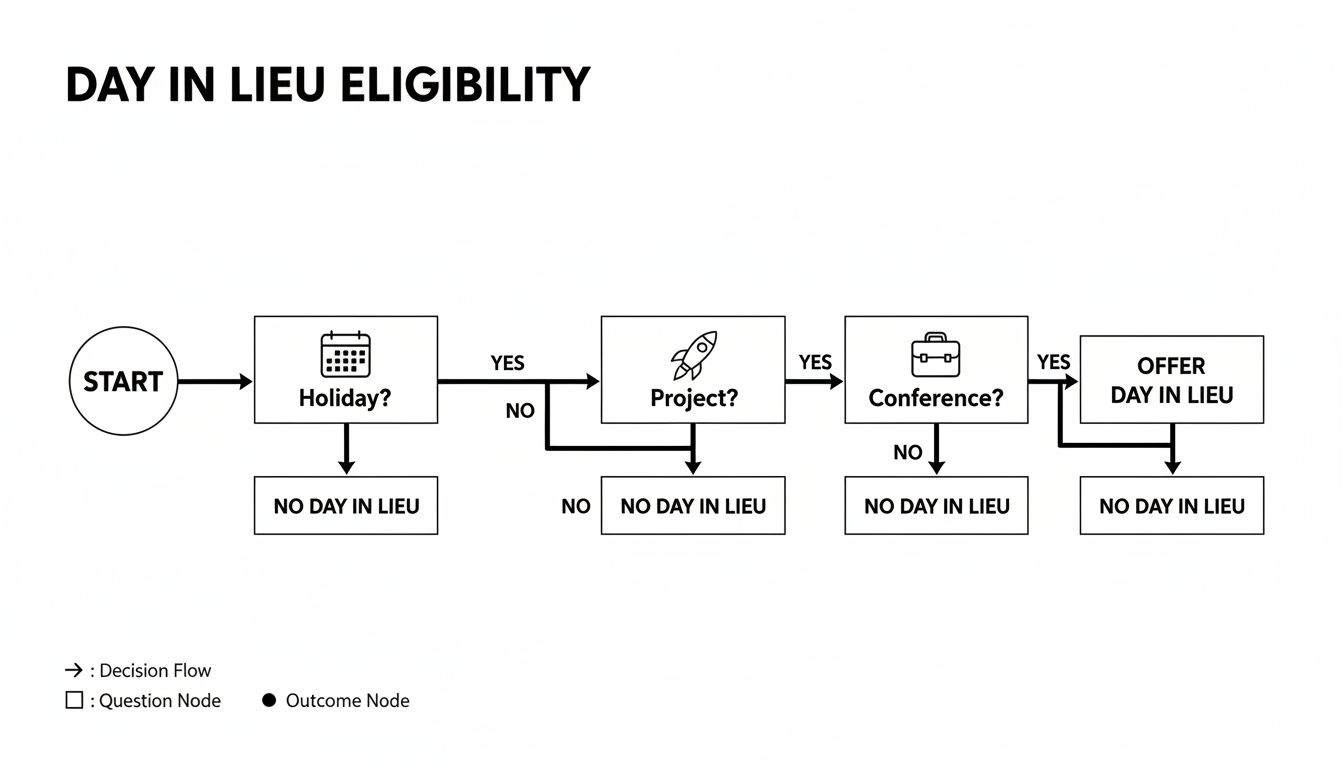
As the visual guide shows, lieu time can be triggered by anything from covering public holidays to rewarding that extra push on a major project.
Calculation Examples For Common Scenarios
Let's break down how to handle these different situations. A consistent approach is the only way to make sure everyone is treated fairly, regardless of their role or contract type.
-
Salaried Employee Working a Few Extra Hours
Imagine a salaried team member works an additional four hours one evening to meet a tight project deadline. If their standard workday is eight hours, they have earned half a day in lieu. The calculation is simply 4 hours worked ÷ 8-hour day = 0.5 days. -
Part-Time Employee Working a Bank Holiday
Now, think of a part-time employee who works three days a week (24 hours total). They're asked to work a four-hour shift on a bank holiday. In this case, they would accrue four hours of TOIL, which they could then use to take a four-hour block off a future workday.
Figuring out pro-rata leave for part-time staff can sometimes feel like a puzzle. To ensure your approach is always fair and accurate, it's worth reviewing our guide on how to calculate prorated leave at https://www.leavewizard.com/how-to-calculate-prorated-leave/, which provides detailed steps and examples.
Below are a few more practical examples showing how different working scenarios translate into earned lieu time.
| Employee Scenario | Extra Hours Worked | Lieu Time Earned |
|---|---|---|
| Full-time employee works a full bank holiday shift | 8 hours (on an 8-hour contract) | 1 full day |
| Salaried employee stays late to finish a report | 2 hours | 2 hours (or 0.25 of an 8-hour day) |
| Part-time employee covers a morning shift | 4 hours | 4 hours |
These examples highlight how a simple, hour-for-hour system can adapt to most situations you'll encounter.
The Importance Of Accurate Tracking
Of course, these calculations are only as good as the records you keep. Without a reliable way of tracking the extra hours people work, you're relying on memory and guesswork—a recipe for errors and disagreements.
To keep everything above board, you might want to explore modern time tracking software solutions. These tools can automate the process, giving you a clear and undisputed record of all overtime.
By establishing a clear formula—whether it's hour-for-hour or converting hours into portions of a day—you embed fairness directly into your company policy. This transparency is your best tool for building trust and ensuring the system works for everyone.
Ultimately, the goal is to create a simple, repeatable process. Whether an employee works an extra two hours or a full day, the method for calculating their earned day in lieu should be consistent and dead easy for anyone to understand. This removes any grey areas and makes the entire system feel fair and well-managed.
Building Your Company's Day in Lieu Policy

A solid, well-defined policy is the bedrock of any fair time off in lieu (TOIL) system. Without one, you’re basically winging it with informal chats and guesswork, a recipe that can quickly cook up inconsistency, confusion, and even legal headaches. Think of this policy as your practical blueprint, setting clear expectations for everyone involved and shielding the business from the financial burden of unmanaged leave.
Essentially, your policy is the official "rulebook" for your company's time bank. It makes sure the entire process—from earning to taking a day in lieu—is transparent, fair, and applied the same way for everyone. When you put it all down in writing, there's no room left for misunderstanding.
Defining Who Is Eligible for Lieu Time
First things first: you need to be crystal clear about who can actually earn a day in lieu. Is it a perk for all employees, or is it reserved for specific roles or departments? It's quite common for businesses to exclude senior managers, for instance, as they often have more control over their own working hours.
Your policy must spell out the eligibility criteria in no uncertain terms. This simple step prevents the awkward situation where an employee assumes they're racking up TOIL when it was never part of their deal. Be direct and you’ll sidestep future disputes.
Setting the Accrual Rate and Conditions
Next up, how do people earn this time back? The simplest and most popular method is a straight hour-for-hour exchange. If someone works four extra hours, they get four hours of TOIL in their bank. This one-to-one calculation keeps tracking simple and transparent.
Your policy also needs to detail the exact conditions that qualify for TOIL. Does it only kick in for working a bank holiday, or does it also cover staying late to get a critical project over the line? Defining these scenarios ensures the system isn’t taken for a ride and, crucially, that any extra work is always pre-approved by a manager. That layer of control is vital for managing workloads and preventing burnout.
Establishing Limits and Expiry Dates
One of the biggest hidden dangers of a TOIL system is letting leave pile up indefinitely. An employee could potentially bank weeks of time off, creating a massive financial and operational headache if they decide to take it all in one go or when they leave the company.
To stop this from happening, every policy needs two non-negotiables:
- An accrual cap: This puts a ceiling on how many lieu days or hours someone can have at any one time (e.g., no more than five days).
- An expiry date: This rule ensures employees use their banked day in lieu within a set period, like three to six months from the date it was earned.
A day in lieu policy isn't just about rules; it's about financial prudence. Some reports estimate that accrued TOIL and holiday liabilities can average 1–3 days per employee on company balance sheets, making clear expiry rules a crucial financial control.
The need to manage these balances is a real-world issue. In the UK, with around 65% of employees leaving some annual leave on the table each year, there's a clear pattern of time off accumulating. A day in lieu policy must actively fight this trend to stop liabilities from getting out of hand.
The Process for Requesting and Approval
Finally, your policy needs to map out the practical steps for actually using a day in lieu. To keep things simple and familiar, this process should look a lot like your standard procedure for booking annual leave.
The workflow is usually pretty straightforward:
- The employee puts in a formal request through your leave management system.
- The request clearly states that it's for a day in lieu.
- Their line manager reviews it, checking it against team schedules and business needs.
- The manager then approves or denies the request, always giving a reason if it's a "no."
By documenting this process, you guarantee every request is handled fairly and consistently. For a deeper dive, our comprehensive guide to creating a time off in lieu policy offers detailed templates and best practices you can tailor for your own business.
Frequently Asked-Questions About Days in Lieu
Even with the most crystal-clear policy, unique situations will always pop up. It’s just the nature of dealing with people. Addressing these common ‘what if’ scenarios head-on is the best way to apply your day in lieu rules fairly and consistently, preventing minor questions from snowballing into major disputes.
Let's dive into the practical answers for the questions we hear most often. Getting these edge cases right reinforces the fairness of your entire system and can be a big part of your overall strategies to reduce employee turnover.
What Happens to Lieu Days When an Employee Leaves?
This is probably the most critical question your policy needs to answer. An employee is leaving, and they’ve got a bank of accrued lieu days. What do you do?
The standard, and fairest, practice is to pay them for this time in their final paycheque. The calculation is straightforward: just multiply their normal hourly rate by the number of accrued lieu hours. If this isn't handled properly, it can easily lead to payment disputes and sour a departing employee's final impression of the company. A clear clause in your employment contract is your best defence here.
Think of accrued lieu time as a debt the company owes the employee. Just like outstanding holiday pay, this debt has to be settled when their employment ends. Clear documentation protects everyone and ensures a clean break.
Can an Employee Refuse to Take a Day in Lieu?
This one comes down entirely to what’s written in the employment contract.
If the contract clearly states that extra hours will be compensated with time off in lieu, then that's the deal. The employee has already accepted these terms by signing on the dotted line.
However, if your contract offers a choice between TOIL and getting paid for overtime, then the employee gets to pick. The key is to have these rules established and agreed upon before anyone works the extra hours.
- Contract Specifies TOIL: The employee is generally expected to accept the day in lieu as their compensation.
- Contract Offers a Choice: The employee is free to choose their preferred option.
- No Written Policy: This creates a messy grey area where disputes are almost guaranteed. It's always best to get it down in a formal, written agreement.
What if an Employee’s Request Must Be Denied?
Managers absolutely must have the right to approve or deny requests for taking a day in lieu. It's all about balancing the employee's needs with the needs of the business.
There will be times—smack in the middle of a critical project, during a peak sales period, or when half the team is already off—when you simply can’t afford to have someone away. The key to handling this without drama is clear and respectful communication.
When a manager has to say no, they should:
- Explain the Reason: Be transparent about why the request can't be approved right now (e.g., "We really need all hands on deck for the product launch that week").
- Suggest Alternatives: Don't just leave it there. Proactively suggest other dates that would work much better for the team.
- Reassure the Employee: Make it crystal clear that they won't lose their accrued time. Let them know you're committed to helping them find a suitable time to take it.
This approach transforms a potentially negative moment into a constructive one. It shows you value their hard work and respect their need for time off, even when business demands have to take priority for a moment. It’s all about maintaining trust and keeping the system working for everyone.
Your Next Steps for a Fair and Compliant System
A well-managed day in lieu system is much more than just another HR policy; it’s a powerful way to build trust and show your team you value their extra effort. When you get the essentials right—a crystal-clear policy backed by your employment contracts, accurate tracking, and honest communication—you create a system that’s transparent, legally sound, and actually works for everyone.
The goal here is to move past informal handshake agreements and build a process that’s both flexible and solid. When managed properly, offering a day in lieu can lift morale and help balance workloads far better than simply paying overtime. It sends a clear message: we respect your personal time.
Actionable Steps for Employers
To get your system up to scratch, your immediate focus should be on clarity and consistency. It’s time to start reviewing your current setup and asking some tough questions. Is your policy actually written down and legally watertight? Does everyone on the team know how it works?
Here are your key next steps:
- Review Your Policy: Dust off your current time off in lieu (TOIL) policy. If you don’t have one, making one should be a top priority. Make sure it clearly covers who is eligible, any caps on accrued time, and when the days expire.
- Check Your Contracts: The right to a day in lieu has to be spelled out in the employment contract. Double-check that your contracts line up with your policy to avoid wandering into any legal grey areas.
- Implement Accurate Tracking: Manual spreadsheets are a recipe for mistakes and disputes. Think about moving to a reliable system to log extra hours worked and lieu days taken. It creates a clear record that no one can argue with.
Understanding Your Rights as an Employee
For employees, knowing your rights is the first step to making sure you're compensated fairly for your time. Your employer’s policy is your main guide, but it's just as important to take ownership of your own records.
A fair day in lieu system is a two-way street. It requires employers to provide a clear framework and employees to understand and follow the process. This shared responsibility is what makes the system truly work.
Be proactive. Keep a personal log of any extra hours you work and check it against the company’s official records. When you want to request a day in lieu, always go through the proper channels and give as much notice as you can. This kind of collaborative approach helps build a system that’s transparent and runs smoothly for the entire organisation.


