
If you've ever managed a team, you know the feeling. Two employees might take the same number of sick days over a year, but the impact on the team can be worlds apart. This is where the Bradford Sickness Score comes in.
Think of it less as a simple count of sick days and more as a ‘disruption index’. Its whole purpose is to give managers a clearer picture of attendance patterns that might be causing friction without them even realising it.
Unpacking the Bradford Sickness Score
Let's paint a picture. Imagine two team members, Sarah and David, have both been off for 10 days in the last year.
Sarah was off for a single, two-week stretch to recover from a minor operation. The team knew she'd be away, planned around it, and work carried on smoothly.
David, on the other hand, was off for one day here, one day there, spread across ten different occasions. Each time, his absence was unexpected. Projects stalled, meetings were rescheduled, and his colleagues had to scramble to cover his work. The total number of days off is identical, but the disruption David's pattern caused was massive in comparison.
That's the exact problem the Bradford Sickness Score, often called the Bradford Factor, was designed to highlight. Developed back in the 1980s, it's a simple mathematical formula that cuts through the noise and puts a number on the impact of an employee's absence pattern.
The core idea behind the Bradford Factor is that shorter, more frequent, and unplanned absences are far more disruptive to a business than longer, continuous periods of leave.
Before we dive into the calculations, let's get a quick overview of what the Bradford Sickness Score is all about.
Bradford Sickness Score Concepts at a Glance
| Concept | Brief Explanation |
|---|---|
| Core Principle | Frequent, short-term absences are more disruptive than single, long-term absences. |
| Purpose | To provide a standardised metric for identifying potentially problematic absence patterns. |
| What It Measures | The impact of absence on operational stability, not just the total number of days taken. |
| Primary Use | As a trigger for supportive conversations and further investigation, not as a disciplinary tool on its own. |
This table shows that the score is a starting point, not an end result. It's a tool to open up a conversation.
Why Is It a Staple in UK HR Management?
So, why has this simple score become such a common tool for UK businesses? It’s all about creating a consistent, data-driven starting point for managing absence.
Instead of managers relying on gut feelings or trying to remember who was off when, the Bradford Factor provides a standard metric that can be applied fairly across the entire company. This helps spot trends that might need a closer look, whether that means offering an employee more support or tackling a performance issue.
A high score doesn't automatically mean someone is a bad employee. It's simply a flag. It signals that a pattern has emerged that warrants a chat.
This is especially helpful when you consider the real reasons people are off work. For example, understanding the prevalence of conditions highlighted in recent chronic pain statistics gives valuable context to the numbers. It allows HR and managers to approach these conversations with far more empathy and insight, shifting the focus from discipline to support.
The score really has three key functions:
- Highlighting Disruption: It puts a number on the impact of those choppy, unpredictable absences that are often the hardest to manage.
- Providing Consistency: It gives you an objective standard for everyone, which helps ensure fairness in how you apply your absence policies.
- Opening Dialogue: It acts as a clear trigger for managers to check in with their team members, find out what's going on, and offer support.
Once you grasp this, you see the Bradford sickness score for what it is: a tool that, when used properly, helps keep the business running smoothly while also creating opportunities to look after your people. Throughout this guide, we'll get into the nitty-gritty of how to calculate it, what the numbers mean, and how to navigate the crucial legal and ethical side of things.
Calculating The Bradford Sickness Score Step by Step
Alright, so we've covered the 'why'. Now let's get into the 'how'. This is where the Bradford Sickness Score really comes to life. The calculation itself is surprisingly simple, but it’s designed with a specific purpose: to highlight the impact of frequent, short-term absences over longer, single periods of sickness.
The formula looks like this: B = S² x D
Don't let that flash you back to your school maths lessons. It's much simpler than it looks. Let's quickly break down what each letter means for you as an HR manager.
The Two Key Ingredients in the Formula
To figure out any employee's Bradford score, you only need two pieces of data, usually tracked over a rolling 52-week period.
- S stands for 'Spells': This is the total number of separate times an employee has been off sick. Think of it as individual instances. It doesn't matter if someone is off for one day or two weeks – each separate block of absence counts as one spell.
- D stands for 'Days': This is the total number of days the employee was absent across all those spells. You just add up all the sick days within your chosen timeframe.
The magic – or the controversy, depending on your perspective – is in the 'S' value. By squaring the number of spells (S²), the formula gives much more weight to each new instance of absence. This is the crucial part that separates one long-term illness from lots of short, disruptive ones.
Putting the Calculation into Practice
The best way to really grasp this is to see it in action. Let's imagine two employees, Alex and Ben. Over the last year, they've both been off sick for a total of 10 days. On paper, that sounds identical.
But the pattern of their absence tells a very different story.
Employee 1: Alex
Alex had a nasty bout of flu and was off work for 10 consecutive days. A single, uninterrupted absence.
- Number of Spells (S) = 1
- Total Days Absent (D) = 10
Alex’s Bradford Sickness Score Calculation:
1² x 10 = 10
Employee 2: Ben
Ben suffers from recurring migraines and had five separate two-day absences over the same year.
- Number of Spells (S) = 5
- Total Days Absent (D) = 10
Ben's Bradford Sickness Score Calculation:
5² x 10 = 250
This side-by-side comparison makes it crystal clear. Even though both people missed the same amount of work, Ben’s score is a whopping 25 times higher than Alex's. The score isn't making a judgment on whether Ben's migraines are genuine. It's simply reflecting the reality that five separate, unplanned absences are far more disruptive to a team's workflow than one single, continuous period of absence.
This is what the score is designed to do: identify patterns that might warrant a supportive conversation.
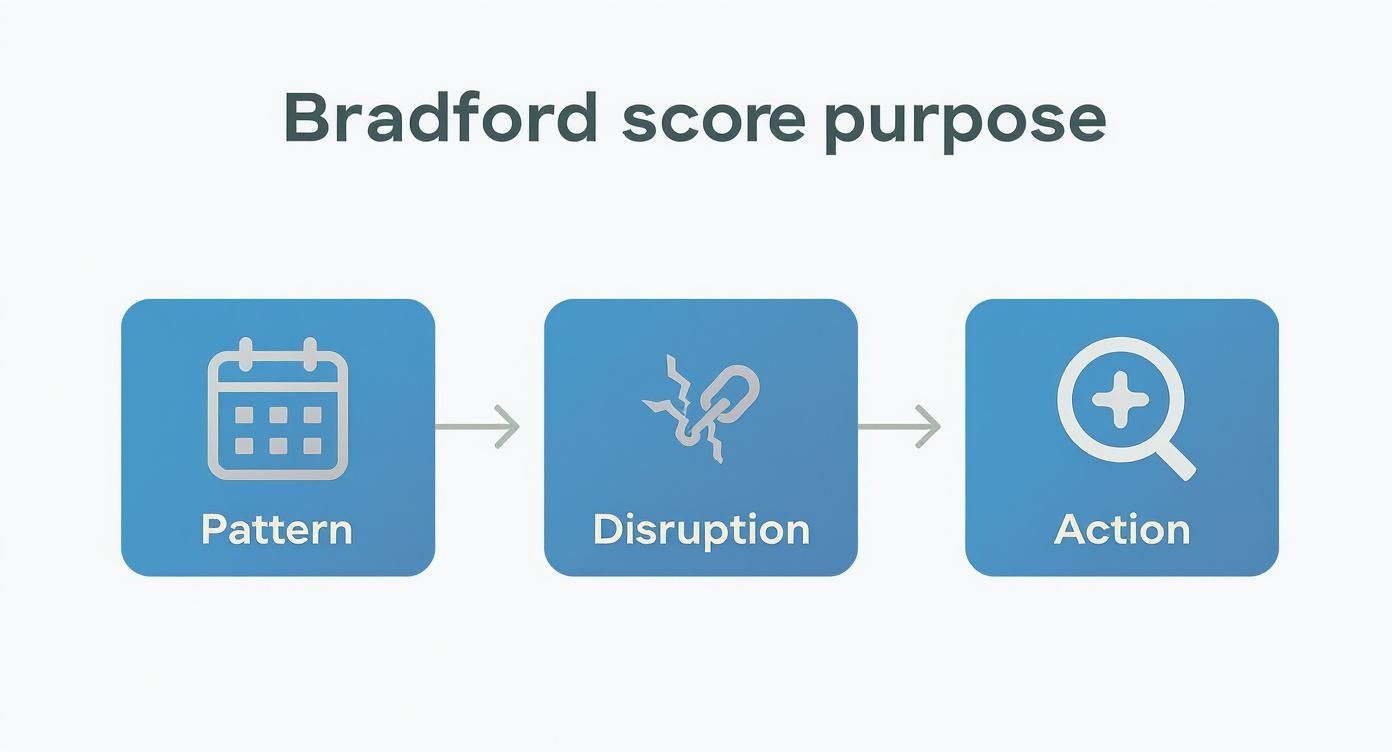
As the diagram shows, it’s about spotting a pattern, understanding its disruptive impact, and then taking action – which should always start with a conversation.
The formula's sensitivity is its main feature. A few short absences can quickly inflate a score, which is why it has become a popular, though sometimes controversial, tool in UK organisations for absence management.
Here in the UK, the Bradford Factor is a well-known metric. While the Chartered Institute of Personnel and Development (CIPD) notes that the average UK employee takes around 6 sick days a year, it's the frequency that can send a Bradford score soaring. Many companies set specific trigger points; a score over 500, for instance, could lead to formal action, which really underlines how seriously this metric is taken.
If you're looking to dive deeper into managing this, our complete playbook for HR leaders on calculating the Bradford score offers more strategies. Once you’re comfortable with the calculation, you're in a much better position to build a fair and consistent way of managing absence in your workplace.
How to Interpret Scores and Set Trigger Points

Calculating a Bradford sickness score is one thing, but the number itself doesn't do much on its own. To make it useful, you need a clear plan for what happens when a score hits a certain level. This is where trigger points come in.
Think of them as a traffic light system for managing absence. A low score is green—nothing to worry about. As the score climbs, it might hit a yellow trigger, signalling that it's time for an informal chat. A really high score flashes red, prompting a more formal review.
This simple framework turns raw data into a consistent management process. It ensures every manager responds to similar patterns of absence in the same way, creating fairness across the board. The goal isn't to punish people for being ill, but to spot disruptive patterns early and offer support.
Setting Your Organisation's Trigger Points
There are no official, legally mandated trigger points for the Bradford Factor. What works for a large manufacturing firm probably won’t suit a small creative agency. The right thresholds for your business will depend on your company culture, industry norms, and what you need to keep operations running smoothly.
That said, many UK businesses use a similar tiered approach as a starting point. It helps structure the response, moving from light-touch conversations to more serious interventions as scores increase.
Here's an example of what a typical framework might look like:
Example Bradford Score Trigger Points and Actions
This table outlines a common structure that many organisations adapt. It shows how different score ranges can prompt specific management actions, creating a clear and consistent process for everyone to follow.
| Bradford Score Range | Potential Management Action |
|---|---|
| 0 – 50 | No action needed. This is generally seen as a normal level. |
| 51 – 200 | An informal chat to check in or a note made on the file. |
| 201 – 400 | A formal verbal warning. The pattern is now a concern. |
| 401 – 600 | A first or written warning, indicating a serious issue. |
| 601+ | A final written warning or consideration for dismissal. |
Remember, these are just guides. The best trigger points are the ones you tailor to your own business, communicate clearly in your absence policy, and apply fairly to everyone. A score should always be the start of a conversation, not the final word.
The real-world impact of these triggers can be huge. The UK Prison Service, for example, reported a 25% drop in sickness absence after bringing in the Bradford Factor. However, this came with hundreds of dismissals, showing just how seriously high scores can be treated. It’s a stark reminder of the balance needed between managing absence and supporting your staff.
Beyond the Numbers: A Human Approach
One of the biggest mistakes is treating these triggers as rigid, automated rules. A high Bradford score doesn't tell you why an employee is frequently off sick. It could be an undisclosed chronic illness, a mental health struggle, or caring responsibilities they're finding hard to manage.
Jumping straight to disciplinary action based only on a number is a recipe for unfair treatment and can even land you in legal trouble. To get this right, you can read our detailed guide on Bradford Factor trigger points and best practices.
Instead, use a trigger point as a signal to open a dialogue. A return-to-work interview is the perfect opportunity to do this. It’s in that conversation that you’ll find the context the numbers are missing, helping you understand the real story and decide on the most appropriate and supportive next step.
Weighing the Pros and Cons of the Bradford Factor
The Bradford sickness score is a powerful tool, but like any tool in a manager's kit, it can be used constructively or destructively. Before you decide if it’s right for your organisation, you really need to look at both sides of the coin—its clear benefits and its very significant drawbacks.
On one hand, the formula gives you a straightforward, mathematical way to look at absence management. On the other, its rigid nature can lead to some pretty unfair outcomes if it isn't handled with a good dose of care and empathy.
The Advantages of Using a Bradford Sickness Score
For many managers, the biggest draw of the Bradford Factor is its objectivity. It’s a way to replace gut feelings and vague observations with hard data, creating a consistent framework that applies to everyone. That alone can be incredibly valuable in making sure things are fair.
The main benefits really boil down to this:
- A Clear Scale for Evaluation: It provides a simple, standardised method to assess absenteeism. This helps managers quickly spot those frequent, short-term absences that might otherwise fly under the radar.
- Identifies Disruptive Patterns: The formula is specifically designed to highlight the choppy, unpredictable kind of absence that causes the most operational headaches, allowing you to step in where it matters most.
- Creates Consistency: By applying the same calculation to every single employee, it helps ensure that everyone is managed under the same criteria, reducing any feelings of favouritism or bias.
- Data-Driven Conversations: A high score gives you a concrete starting point for a conversation. It shifts the discussion from a general concern to a specific, measurable pattern of absence.
This data-centric approach helps minimise disruption in the workplace. Fewer unexpected absences mean smoother operations, better team morale, and less pressure on the poor colleagues who have to pick up the slack from last-minute gaps.
The Disadvantages and Ethical Concerns
Despite its benefits, the Bradford Factor is often criticised, and rightly so, for its lack of nuance. Its greatest strength—that clean mathematical simplicity—is also its biggest weakness. A blind reliance on the score can quickly create a toxic culture and unfairly penalise vulnerable employees.
A Bradford sickness score reduces complex human situations to a single, cold number. Without context, it risks completely overlooking the real reasons behind an absence and missing the bigger picture of an employee's wellbeing.
The most significant drawbacks include:
- Penalises Chronic Illness and Disability: The formula inherently punishes frequent absences. This can unfairly discriminate against employees with long-term health conditions, disabilities, or mental health challenges that might require regular but short periods of time off.
- Encourages Presenteeism: Fearing a high score, employees may drag themselves into work when they are genuinely unwell. This not only harms their own recovery but also risks spreading illness to the rest of the team, ultimately damaging overall productivity. In fact, research shows UK businesses lost £5.6 billion in just one year due to workers faking wellness to avoid taking sick days.
- Ignores Legitimate Circumstances: It fails to account for real-life situations like caring for a sick child or a family emergency, which can lead to frequent, unavoidable absences. This can be particularly tough on working parents.
- Creates a Culture of Fear: If it's used as a blunt disciplinary stick, the Bradford Factor can destroy trust. It can create an environment where employees feel they are being watched and judged rather than supported.
Ultimately, the Bradford Factor should be seen as a diagnostic tool, not a verdict. A high score ought to trigger concern and a conversation, not an automatic penalty. By understanding both its strengths and limitations, you can use it as just one part of a wider, more compassionate absence management strategy that supports both your people and your business goals.
Right, let's talk about the tricky bit: staying on the right side of UK law when you're using the Bradford Factor.
Using the Bradford sickness score without a solid understanding of UK employment law is like trying to cross a minefield in the dark. While the formula itself is completely legal, applying it too rigidly can quickly land you in hot water, leading to discrimination claims and seriously damaging the trust you have with your team.
The trick is to see the score as just one piece of a much larger puzzle. It's a starting point, not the final word. Your approach needs to be guided by fairness, common sense, and your legal duties as an employer.
The biggest piece of legislation you absolutely must get your head around is the Equality Act 2010. This is the law that protects employees from being treated unfairly because of certain "protected characteristics," and a key one here is disability. It's not hard to see how a high Bradford score could be directly linked to a disability or a long-term health condition that causes frequent, short absences for things like appointments or flare-ups.
If you were to take disciplinary action based only on that high score, without digging any deeper into the reasons behind it, you could be facing a claim for disability discrimination. The law is very clear: employers have a duty to make reasonable adjustments for disabled employees, and that duty absolutely extends to how you manage absence.
The Duty to Make Reasonable Adjustments
So, what are "reasonable adjustments"? They're simply changes you make to remove or at least reduce a disadvantage a disabled employee faces at work. When it comes to the Bradford Factor, this could mean:
- Discounting certain absences: You might agree to ignore any absences that are directly related to an employee's disability, so they don't count towards their score.
- Adjusting the trigger points: A disabled employee might have a higher, personalised trigger score before any formal conversations are needed.
- Modifying their role: Could flexible working hours or small changes to their duties help them manage their condition and reduce their time off?
Ignoring this duty is a massive legal risk. An employment tribunal won't be impressed with a company that blindly follows a one-size-fits-all policy without ever stopping to consider an employee's personal situation, especially when a known disability is involved.
Creating a Fair and Legal Absence Policy
To use the Bradford score properly and ethically, you need to build it into a supportive and legally sound absence management policy. The goal is to create a system that's consistent enough to be fair to everyone, but flexible enough to be human.
Think of the Bradford Factor as a compass, not a calculator for punishment. Its real job is to point you towards a conversation, giving you a chance to understand the story behind the numbers before you even think about making a decision.
Let's look at a real-world example. When HM Prison Service brought in the Bradford Factor back in 2001, it was part of a huge strategy to manage high absence rates across its 48,000 staff. By 2006, they reported a 25% drop in sickness absence, but this wasn't just down to the formula. It was achieved alongside other supportive measures. Critics pointed out that a fear of being disciplined likely played a part, which just goes to show how vital a balanced approach is. You can read more about the history and impact of the Bradford Factor on Wikipedia.
Here are a few best practices to make sure your policy is up to scratch:
- Be Totally Transparent: Don't make it a secret. Clearly explain in your employee handbook how the score is calculated and what the trigger points are for a chat.
- Train Your Managers: This is non-negotiable. Managers must understand that a high score is a signal to start a supportive conversation, not to jump straight to a formal warning.
- Always Do Return-to-Work Interviews: This is probably the most important step. It's your chance to ask open questions, listen properly, and find out if there are any underlying issues that a number on a spreadsheet could never tell you.
- Keep Excellent Records: Write everything down. Document every conversation, any adjustments you've offered, and the decisions you've made. This creates a clear paper trail and proves you've followed a fair process.
By putting communication and support first, you can use the Bradford score as it was meant to be used: as a simple tool to spot patterns and open up a dialogue. That's how you manage absence effectively and humanely.
How Software Can Automate Bradford Score Tracking
Let's be honest: manually calculating the Bradford sickness score for every single employee is a real drain on your team's time. It's a fiddly process, often tangled up in spreadsheets, manual data entry, and a high risk of human error—especially as your company grows. This administrative headache often means scores are out of date, inconsistent, and hard to act on quickly.
This is exactly where technology steps in and offers a much smarter way forward. Modern HR software can completely automate the process, shifting your absence management from a reactive chore into a proactive, strategic part of your business. By plugging directly into your leave and attendance records, these systems get rid of the manual work for good.
Freeing Up Your HR Team for What Matters
The real win with automation isn't just about saving time; it's about changing the entire focus of your HR function. When HR teams and line managers are freed from the drudgery of spreadsheet maintenance, they can put their energy into the human side of absence management. Instead of crunching numbers, they can have supportive, meaningful conversations with employees.
Automation handles the tedious bits, allowing your team to:
- Focus on People, Not Paperwork: Spend time understanding the reasons behind absences rather than just calculating scores.
- Ensure Consistency: Apply your absence policy fairly and evenly across the entire organisation, without needing manual oversight.
- Make Data-Driven Decisions: Use accurate, real-time data to inform your strategy and properly support employee wellbeing.
An effective employee absence management software becomes a genuine partner in this process, making sure everything is fair and efficient. This helps you build a culture based on trust and support, not one that feels like it’s built on manual monitoring and suspicion.
The Power of Automated Alerts and Reporting
One of the biggest game-changers with software is the ability to set up automatic alerts and get instant insights from reporting dashboards. You can easily configure the system with your organisation's specific Bradford score trigger points.
When an employee's score crosses a predetermined threshold, the system automatically notifies the relevant manager. This ensures that important conversations happen at the right time, every single time.
This proactive approach means patterns are never missed. Managers get timely pings, empowering them to step in and address potential issues before they grow into bigger problems.
On top of that, reporting dashboards give you a clear, visual overview of absence trends across the whole company. You can instantly see which departments might be struggling with high absence rates or spot organisation-wide patterns that could point to deeper issues, like employee burnout or low morale. For businesses looking to fine-tune these workflows, exploring various business process automation tools can provide great insights into picking the right software.
By automating your Bradford score tracking, you turn a complex administrative task into a streamlined, strategic function. It gives you the data you need to manage absence effectively while freeing up your team to focus on what really matters: fostering a healthy and productive workplace.
Got Questions About The Bradford Sickness Score?
Because the Bradford score is such a common tool in the HR world, it naturally brings up a lot of questions. Getting clear, straightforward answers is key to using it responsibly and fairly in your organisation. Let's tackle some of the most common queries that land on the desks of managers and HR pros.
We’ll look at where the system stands legally in the UK, what the numbers actually mean in the real world, and the crucial importance of handling exceptions with a bit of empathy and common sense.
Is the Bradford Sickness Score Legal in the UK?
Yes, using the Bradford Factor is perfectly legal here in the UK. No specific law stops employers from using this formula to get a handle on employee absence. The catch, however, is all in how you apply it. The key is to make sure it's used fairly and doesn't end up being discriminatory.
The biggest legal tripwire is the Equality Act 2010. If an employee has a disability that leads to frequent, short-term absences, a rigid, computer-says-no Bradford Factor policy could indirectly discriminate against them. Employers have a legal duty to make "reasonable adjustments" for disabled staff, which might mean discounting their disability-related absences from the score or tweaking their trigger points.
The Bradford score is a legal tool, but its application must be human. Using it as the sole reason for disciplinary action without considering underlying health conditions or disabilities is a significant legal risk.
What Is a Good or Bad Score?
Honestly, there's no universal rule for what makes a "good" or "bad" Bradford score. It all comes down to the trigger points your company decides to set in its own absence policy. What one business considers fine, another might see as a red flag.
That said, a general consensus has formed across industries, which can be a useful starting point:
- Under 50: Most companies would see this as a perfectly normal score, requiring no action.
- 51 – 200: This is often the first trigger point, prompting an informal chat or a supportive check-in to see if everything is okay.
- 201+: This is usually where the formal process kicks in, perhaps starting with a verbal warning and escalating if the score continues to climb.
A score only becomes "bad" when it crosses a line that you've already clearly communicated to your employees. The number itself is just data; its meaning is created by the policy you build around it.
Should You Ever Make Exceptions?
Absolutely. In fact, you must. Making exceptions isn't just good management; it's often a legal and ethical requirement. A rigid, one-size-fits-all approach is the quickest way to create an unfair system and wreck team morale.
There are a few situations where making an exception is non-negotiable:
- Disabilities: As mentioned, any absences directly linked to a known disability should be handled with care. This often means discounting them from the final score entirely.
- Pregnancy-Related Illness: Sickness connected to pregnancy should not be counted towards an employee’s total when considering disciplinary action.
- Serious or Chronic Illness: A string of hospital appointments for a serious condition needs to be treated very differently from a pattern of sporadic, unexplained absences.
Think of the Bradford sickness score as a conversation starter, not a final verdict. Its real job is to flag a pattern that warrants a closer look. It gives you a reason to check in, understand the full picture, and offer support—not to just automate punishments.


