
The Bradford Score offers a surprisingly simple way to get a handle on the impact of employee absence. It’s built on a key insight many managers know from experience: it’s the frequency of absence, not always the total duration, that causes the most headaches.
This is where the S² x D formula comes in. It stands for Spells squared, multiplied by total Days, and it’s designed to highlight how frequent, short-term absences can be far more disruptive than a single, planned long-term leave.
What Is the Bradford Score and How Does It Work?

At its heart, the Bradford Factor is a management tool used by UK organisations to spot potentially disruptive patterns of employee absence. The logic is something most team leaders will recognise instantly. Ten separate one-day absences are often much harder to manage than one continuous two-week absence. Why? Because those short, unplanned days off create repeated workflow interruptions and last-minute scheduling scrambles.
The Bradford scoring calculation puts a number to this disruption. It’s typically calculated over a rolling 52-week period, giving you a consistent, year-long view of an employee's attendance record.
For a deeper dive into the fundamentals, you might want to check out our complete guide to measuring employee attendance.
Understanding Spells and Days
To use the formula correctly, you have to get the two main components right. It’s pretty straightforward once you’ve done it a couple of times.
- Spells (S): This is just the number of separate instances of absence. Each continuous period of time off counts as one spell, whether it’s for one day or ten.
- Days (D): This is the total number of days an employee was absent across all their spells within that 52-week window.
The real eye-opener with the Bradford Factor is how it penalises frequency. This is where you see the disruptive impact of recurring short-term absences really clearly.
Let’s look at a couple of quick examples. Imagine an employee is absent for a total of 10 days over the year.
If those 10 days were all in one continuous spell of sickness, their score would be 10 points (1² × 10).
But, if those same 10 days were spread across ten separate one-day absences, the score rockets to 1,000 points (10² × 10). This immediately flags a much greater operational headache for the business.
Bradford Score Examples At a Glance
This table really drives home how dramatically the score can change based on the pattern of absence, even when the total days off are identical.
| Total Days Absent | Number of Spells (Instances) | Calculation (S² x D) | Final Bradford Score |
|---|---|---|---|
| 10 | 1 | 1² x 10 | 10 |
| 10 | 3 | 3² x 10 | 90 |
| 10 | 5 | 5² x 10 | 250 |
| 10 | 10 | 10² x 10 | 1,000 |
As you can see, the score escalates quickly with each separate instance, highlighting the kind of pattern that is often hardest for teams to manage.
The real power of this metric isn't just in the score itself, but in the conversations it starts. A high score is an invitation to understand what's happening with an employee, not a direct path to disciplinary action. It helps shift the focus from reactive problem-solving to proactive employee support.
Alright, let's get down to the brass tacks of how the Bradford Score actually works in the real world. Theory is one thing, but seeing it in action is what really makes it click.
To show you what I mean, we'll look at two employees, Alex and Ben. Imagine that over the last year (a 52-week period), both of them have been off work for a grand total of five days. On the surface, that sounds identical, right? But how they took those days off tells a completely different story.
This is where the formula really shines. It helps you see the difference between a one-off issue and a pattern of disruption, giving you a solid, numerical basis for your absence management.
Alex’s Calculation: A Single Absence
First up is Alex. He came down with a nasty flu and took one continuous spell of five days off to get back on his feet. From a manager's perspective, a single block of absence like this is usually much easier to plan around. You know he's off for the week, you can arrange cover, and things carry on.
Here’s the breakdown of Alex's score:
- Spells (S): 1 (just that one period of absence)
- Total Days Absent (D): 5
- Formula: S² x D
The calculation is pretty simple: 1 x 1 x 5 = 5. Alex’s final Bradford Score is a very low 5. This reflects what we already know intuitively: his absence wasn't a major disruption and isn't something to be concerned about.
Ben’s Calculation: Five Separate Absences
Now, let's look at Ben. He was also absent for a total of five days, but his situation was completely different. Ben’s time off happened on five separate occasions throughout the year, each for just a single day. Think about that from an operational standpoint—five separate days of last-minute scrambling for cover. That pattern is far more disruptive and creates repeated, unplanned headaches for the team.
Here’s how Ben’s score is calculated:
- Spells (S): 5 (five separate instances of being off)
- Total Days Absent (D): 5
- Formula: S² x D
Ben's calculation paints a much starker picture: 5 x 5 x 5 = 125. His final Bradford Score is 125.
The contrast is crystal clear. Even though both employees were away for the same number of days, Ben's score is 25 times higher than Alex's. This is the whole point of the Bradford Factor—it numerically highlights the massive business impact of frequent, short-term absences over longer, single spells of sickness.
This simple diagram breaks down the process visually, making it easy to remember.
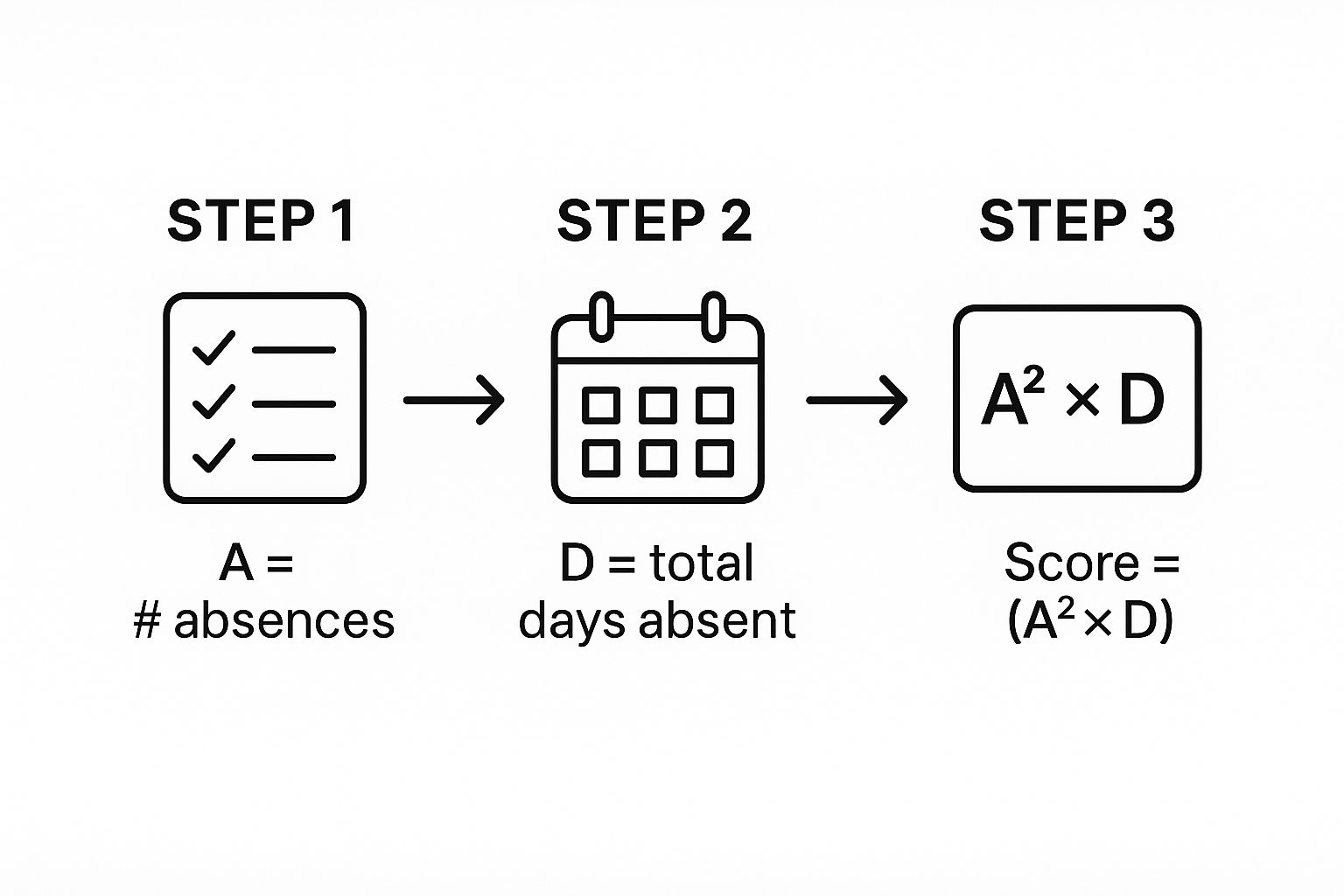
Of course, doing this manually for every employee can get tedious fast. For those who want to sidestep the maths and avoid any chance of human error, you can learn more about how LeaveWizard automates all Bradford Factor calculations for you. It's a real time-saver.
Setting Fair and Effective Trigger Points

Let's be honest, a Bradford Factor score is just a number on a spreadsheet until you give it some real-world meaning. The whole point of tracking these scores is to set up a clear, consistent framework of trigger points. Think of these as predetermined scores that flag a specific management response, helping you shift from just passively collecting data to taking proactive, meaningful action.
Without these thresholds, a score of 125 is just noise. With them, it becomes a clear signal to sit down and have a supportive chat with an employee. This approach builds consistency and fairness right into your absence management process, as every single person is measured against the same transparent standard. The aim isn't to catch people out, but to create a predictable and fair system for everyone.
The most effective trigger point systems I've seen are designed to open a dialogue, not just to kick-start disciplinary procedures. They act as an early warning system, helping you spot underlying issues like stress, low morale, or health problems before they have a chance to escalate.
Building Your Trigger Point Framework
So, what does this look like in practice? Every organisation has its own culture, so your thresholds really need to be adapted to fit your specific environment. That said, a common tiered approach gives you a solid foundation to build from. You can get into the nitty-gritty of how to set up and communicate these levels by exploring these Bradford Factor trigger points in more detail.
To give you a starting point, here is a fairly typical structure you could adapt for your own attendance policy.
Example Bradford Factor Trigger Point System
A sample framework of trigger points and the corresponding management actions. This should be adapted to fit your organisation's specific attendance policy.
| Score Range | Potential Action | Purpose |
|---|---|---|
| 0 – 50 | No Action Required | This range is generally considered normal and doesn't suggest a problematic pattern of absence. |
| 51 – 200 | Informal Chat / Return-to-Work | A friendly conversation to check in and understand the reasons behind the absences. |
| 201 – 400 | First Formal Warning | A documented meeting to discuss the impact of absences and agree on an improvement plan together. |
| 401 and above | Final Warning / Review | A serious review that could lead to further disciplinary action if no improvement is seen. |
This kind of tiered structure creates a clear pathway. It makes sure your response is always proportional to the score, starting with supportive, informal measures and only escalating if a disruptive pattern of absence continues without a valid underlying reason.
Let's be honest, trying to track employee absence with a manual spreadsheet is a disaster waiting to happen. As your team grows, what started as a simple grid quickly turns into a tangled mess. It’s not just a time sink; it’s frustratingly easy to make a mistake, which can throw the fairness of your entire attendance policy into question.
This is exactly where modern HR software can be a game-changer.
Tools like LeaveWizard completely take the headache out of calculating the Bradford Factor. Forget wrestling with formulas and cross-referencing calendars. The system does all the heavy lifting for you. It logs absence spells and days automatically, crunches the numbers for the score in real-time, and can even be set up to ping a manager when an employee’s score hits a trigger point. This hands back countless hours to your team to focus on more strategic work.
Just look at how a simple dashboard can give you an instant, clear picture of absence data.
This kind of overview lets managers see every score at a glance, knowing that each calculation is perfectly accurate and applied consistently across the whole organisation.
Key Benefits of Automation
The most obvious wins are saving time and ensuring accuracy. But the real value goes much deeper than just efficiency.
By automating these calculations, you give managers instant dashboard visibility into attendance trends. This data is no longer buried in a spreadsheet; it’s an accessible tool for spotting patterns and making better strategic decisions.
For anyone looking to really streamline their entire approach, this guide on employee absence management in Jira offers a fantastic deep-dive into integrating your systems.
Ultimately, switching to an automated system gives you several crucial advantages:
- Guaranteed Accuracy: You completely remove the risk of human error in calculations. This ensures every employee's score is correct and, most importantly, fair.
- Time Savings: Think of all the hours your HR team and line managers will get back. No more manually inputting dates or double-checking formulas.
- Proactive Management: Real-time notifications mean managers can step in with support right when it's needed. This allows for prompt, helpful conversations when trigger points are met, leading to much better outcomes for everyone.
Navigating Legal Risks and UK Best Practices

While the Bradford Factor is a genuinely useful tool for spotting absence trends, you have to handle it with care to avoid landing your business in legal hot water. Think of it as a management guide, not a rigid rulebook. If you apply a bradford scoring calculation inflexibly without looking at the story behind the numbers, you could easily face discrimination claims.
The biggest tripwire here is disability. Under the Equality Act 2010, UK employers have a legal duty to make reasonable adjustments for staff with disabilities. That means penalising someone for absences that are a direct result of their known disability is a definite no-go and could be seen as discrimination.
Applying The Score Fairly
To stay on the right side of the law, you absolutely need a transparent attendance policy. This policy should spell out exactly which types of absence are not included in the Bradford Factor calculation. This isn't just about ticking legal boxes; it's about being fair.
Your policy needs to explicitly exclude absences related to:
- Disability: Any time off linked to a condition that falls under the Equality Act.
- Pregnancy: All sickness or appointments related to pregnancy.
- Dependents: Leave taken to handle an emergency involving a dependent.
- Bereavement: Compassionate leave after the death of a loved one.
By making these exclusions crystal clear, you ensure the score is only flagging patterns of unscheduled, non-protected absence. It keeps the tool effective while building a supportive, and more importantly, lawful workplace culture.
The key takeaway is this: the Bradford Factor should start a conversation, not an automatic disciplinary process. It’s a flag for managers to dig a bit deeper and find out what’s really going on, not a blunt instrument for punishment. Consistent, fair application is your best defence against any legal challenge.
When used correctly, the system's potential is obvious. For example, when HM Prison Service introduced the formula to prompt early interventions, they saw absence rates drop by 25% by 2006. You can learn more about the Bradford Factor's impact in the UK workplace on sense.hr.
Common Questions About the Bradford Score
When you first start using the Bradford Factor, a few common questions always seem to pop up. Getting clear on these from the beginning helps you apply the Bradford scoring calculation fairly and consistently across your team. It’s all about using the score as a tool for insight, not just as a number.
What is a "Good" Bradford Score?
One of the first things managers want to know is what a "good" score actually looks like. In a perfect world, the ideal score is zero—meaning perfect attendance.
However, in reality, that's rarely achievable. A score under 50 is generally considered very low and isn't a cause for concern. The real goal isn't to chase a company-wide score of zero, but to establish reasonable thresholds that trigger supportive conversations, not automatic disciplinary action.
Is the Bradford Factor Discriminatory?
This is a crucial point. Can the Bradford Factor discriminate against employees with chronic illnesses or disabilities? The short answer is yes, it absolutely can if you apply it rigidly without any context.
If an employee's recurring absences are linked to a disability as defined by the Equality Act 2010, then penalising them based on a raw score could easily lead to a discrimination claim.
Employers have a legal duty to make reasonable adjustments. This often means discounting disability-related absences from the calculation entirely and focusing on occupational health support instead.
Should I Use the Score for Authorised Absences?
Managers often wonder if they should factor in things like holidays or compassionate leave. The answer is a firm no.
The Bradford Factor is specifically designed to identify patterns in unplanned, short-term absences, like sickness. Applying it to pre-approved annual leave, maternity leave, or compassionate leave would completely misuse the tool and unfairly penalise your staff. It’s vital to keep these categories separate to maintain a fair and effective attendance policy. The system is there to spot disruptive patterns, not to punish people for taking approved time off.


