
Getting your head around UK annual leave can feel a bit tricky, but it all boils down to one simple rule. Every full-time worker in the UK is legally entitled to 5.6 weeks of paid holiday each year. Think of this as the absolute minimum—it's the foundation for everything else.
Your Core Annual Leave Entitlement Explained

At its heart, UK employment law is designed to give you a clear-cut right to paid time off. That statutory minimum of 5.6 weeks isn't just a suggestion; it's a universal right for almost everyone, from permanent employees to agency staff. An employer can always be more generous, but they can never, ever offer less.
So, what does that look like in real terms? For most people working a standard five-day week, 5.6 weeks works out to be 28 days of paid annual leave. The maths is straightforward: 5.6 weeks multiplied by 5 working days equals 28 days. This is the holiday allowance you’ll see in the vast majority of full-time contracts across the country.
To put it simply, here is a quick overview of the minimum entitlement for a standard full-time employee.
UK Statutory Annual Leave At a Glance
| Entitlement Type | Minimum Amount | Common Implementation |
|---|---|---|
| Statutory Minimum (Weeks) | 5.6 weeks | The legal baseline for all full-time workers. |
| Statutory Minimum (Days) | 28 days | The typical calculation for a 5-day work week. |
| Bank Holidays | 8 days | Often included within the 28-day total. |
This table shows the basic legal requirements, but how bank holidays are handled can change your total days off.
What About Bank Holidays?
This is where things can get a little confusing. Are bank holidays included in that 28-day minimum, or do you get them on top? The short answer is: it depends entirely on your employer's policy.
Legally, employers can include the 8 public bank holidays (in England and Wales) as part of your statutory 28 days. Many do. However, a more generous employer might give you 28 days plus the bank holidays, bringing your total time off to 36 days. You can learn more about how UK annual leave works and is calculated on the government's official site.
Your employment contract is the ultimate source of truth here. It must spell out whether your entitlement is inclusive or exclusive of bank holidays. This one detail makes a huge difference to your actual time away from work.
This baseline entitlement is the cornerstone of understanding annual leave entitlements UK. Whether you're working full-time, part-time, or on a zero-hour contract, every calculation for paid time off starts with this fundamental 5.6-week rule. Nailing this concept is the first, most crucial step to making sure you get the paid rest you've rightfully earned.
Calculating Leave for Part-Time and Atypical Workers
Figuring out annual leave for your full-time staff is usually pretty straightforward. But what about part-timers, or people on more flexible contracts? This is where things can feel a bit more complex, but the core principle is simple: fairness. UK law is built on the idea of pro-rata, which just means everyone’s holiday is directly proportional to the time they work.
Think of the full-time holiday entitlement as a whole pie. A part-time worker simply gets a slice of that pie that matches their working pattern. They are still entitled to the same 5.6 weeks of paid leave, but what a 'week' looks like is tailored to their specific schedule.
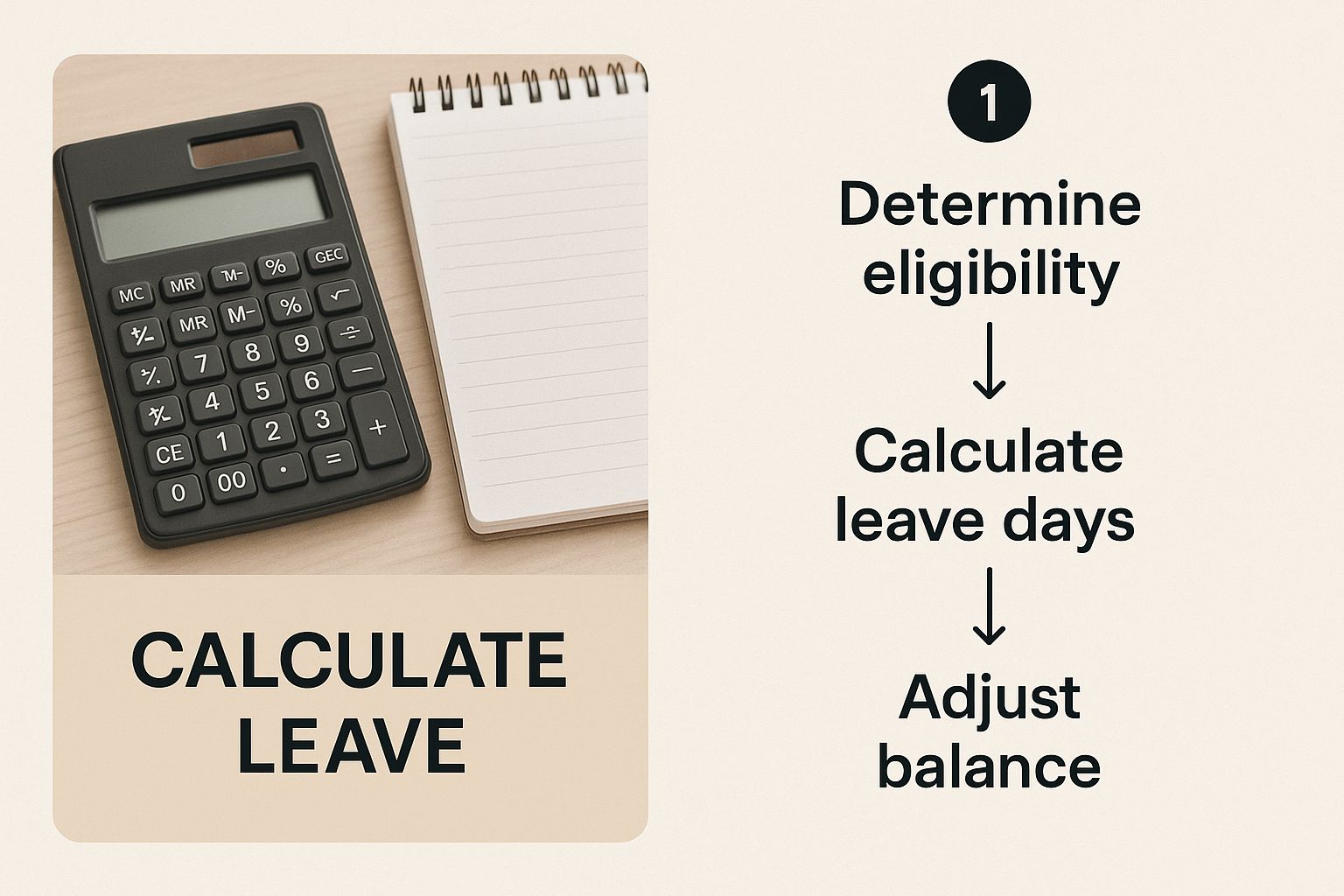
As you can see, it all starts with the full-time standard and then gets adjusted based on the individual’s actual working days or hours.
Pro-Rata Calculations for Part-Time Staff
For a part-timer who works the same days each week, the maths is nice and simple. Just multiply the number of days they work per week by 5.6.
Let's say you have an employee who works three days a week. Their holiday entitlement would be 16.8 days for the year (3 days × 5.6 weeks). This calculation ensures they get the same amount of time off, relative to their hours, as their full-time colleagues. It’s all about making sure everyone gets a proper chance to rest and recharge.
Handling Zero-Hour and Casual Contracts
Calculating holiday for workers with irregular hours, like those on zero-hour or casual contracts, needs a different approach. Since you can't predict their working hours, a fixed day-based calculation just won't work.
Instead, their holiday entitlement is based on the hours they’ve actually clocked in. For years, the go-to method was using a simple percentage, calculating holiday entitlement as 12.07% of the hours worked.
Good news for clarity: for leave years starting on or after 1 April 2024, the rules for irregular-hour and part-year workers have been updated. The government has officially brought back rolled-up holiday pay as a compliant option and formalised the accrual method based on 12.07% of hours worked in a pay period.
When it comes to paying them for this time off, businesses now have to use a 52-week reference period. This means you look back at the last 52 weeks in which the employee actually earned money to work out their average weekly pay. That average then becomes the amount they get paid for each week of holiday they take. For a deeper dive, our guide covers https://www.leavewizard.com/holiday-calculation-for-part-time-workers/ in more detail.
Getting these calculations right, especially for your non-standard workers, really depends on having a solid system in place. Keeping accurate records isn’t just good housekeeping—it’s a legal must-have to make sure every single team member gets the time off they’re entitled to. For more on this, check out these effective strategies for navigating employee absences and tracking attendance.
How Bank Holidays Affect Your Annual Leave

Here’s where things often get a bit murky. When it comes to annual leave entitlements UK, one of the biggest points of confusion is how bank holidays fit into the picture. Most of us just assume they are a given—paid days off on top of our regular holiday allowance.
But the legal reality might catch you by surprise.
Believe it or not, there's no automatic legal right for an employee to get a paid day off on a bank holiday. The power is entirely in the employer's hands, and the final word is always what’s written in your employment contract. That document is your single source of truth for how your company treats public holidays.
This flexibility means different businesses take different routes, so it’s vital you know exactly where you stand.
Common Approaches to Bank Holidays
Most businesses tend to handle bank holidays in one of three ways. Getting your head around these will clear up any confusion and tell you precisely what your total time off for the year looks like.
- Included in Statutory Leave: This is the most common setup. The eight bank holidays (in England and Wales) are simply counted as part of your minimum 28-day entitlement. So, if you don't work on those days, you're left with 20 days of leave to book whenever you like.
- Offered in Addition to Leave: Some companies offer a more generous package, giving you bank holidays as extra paid days off. This means you’d get 28 days of annual leave plus the eight bank holidays, bringing your total paid time off to a rather lovely 36 days.
- Working on Bank Holidays: If you're in retail, hospitality, or healthcare, working on a bank holiday is often just part of the job. When this is the case, your contract has to clearly state that you're required to work. You don't lose the day's holiday, though—you get a day off ‘in lieu’ to take at another time.
The key takeaway is simple: your employment contract has all the answers. It must spell out, in no uncertain terms, whether your holiday entitlement is inclusive or exclusive of bank holidays. Without that clarity, it's a recipe for disputes.
Why a Clear Policy Is Non-Negotiable
For any employer, having a crystal-clear policy on bank holidays isn't just good practice; it's essential for keeping staff happy and staying on the right side of the law. It stops confusion in its tracks, manages everyone's expectations, and gives you a solid framework for planning cover during busy periods.
For employees, it provides total certainty about how much time off they really have for the year. No guesswork needed.
And what if you're part-time? Your bank holiday entitlement is calculated on a pro-rata basis, just like the rest of your annual leave. This is the only way to ensure fairness for everyone, no matter their working pattern.
If you're curious about the history behind these days off, you can check out these 10 interesting facts about UK bank holidays.
Understanding the Rules on Carrying Over Unused Leave
What happens to all those holiday days you don’t manage to use by the end of the year? It's a question every manager and employee asks eventually, and the answer isn’t a simple "use it or lose it".
The UK rules for carrying over annual leave are designed with a primary goal in mind: making sure people actually get the rest they need. But, they also build in some much-needed flexibility for when life throws a curveball.
At the heart of it, you need to think of the statutory 5.6 weeks of annual leave as being split into two distinct pots:
- The first four weeks (that’s 20 days for a full-timer): This chunk comes from the EU's Working Time Directive. The default legal position is firm on this one: this leave cannot be carried over into the next leave year. The whole point is to push employees to take this time off for their health and wellbeing.
- The extra 1.6 weeks (the other 8 days): This is the additional leave granted under UK law. Here, things are more flexible. You and your employee can agree to carry this portion over, but only if it's written into their employment contract or your official company policy.
Many companies also offer contractual holiday entitlement on top of the statutory minimum. Whether an employee can carry over these extra days is completely down to your company's policy. Make sure it's crystal clear in your contracts.
Key Exceptions to the Carry-Over Rule
While the basic rule is that those first four weeks must be taken within the year, the law gets that life doesn’t always stick to the plan. There are a few crucial situations where employees are legally allowed to carry over untaken leave, even from that core four-week pot.
The main exceptions kick in when an employee simply couldn't take their holiday because they were on:
- Long-term sick leave: If a serious illness stops an employee from taking their holiday, they can carry over up to four weeks of statutory leave. There's a catch, though: this carried-over leave must be used within 18 months from the end of the leave year it was accrued in.
- Family-related leave: This covers statutory maternity, paternity, adoption, or shared parental leave. Any untaken statutory holiday from the year can be carried over to the next one.
It's absolutely vital for businesses to have a clear, fair, and legally sound carry-over policy. This isn't just about ticking boxes; it prevents disputes, ensures fairness for people facing tough personal situations, and protects their fundamental right to rest.
Establishing a Fair Carry-Over Policy
As an employer, a clear framework is your best friend. Your policy needs to spell out exactly how many days can be carried over, the deadline for using them in the new leave year, and what happens in exceptional cases like long-term sickness.
Here’s a quick comparison to help you visualise how these rules play out in different situations.
Annual Leave Carry-Over Scenarios Compared
| Scenario | Statutory Requirement | Common Company Policy |
|---|---|---|
| Standard Year-End | The first 4 weeks (20 days) cannot be carried over. The remaining 1.6 weeks (8 days) can be carried over by agreement. | Often allows carrying over a limited number of days (e.g., 5 days) from the extra 1.6 weeks or contractual leave, with a deadline to use them (e.g., by 31st March). |
| Employee on Sick Leave | Can carry over up to 4 weeks of untaken leave. This must be used within 18 months of the end of the leave year. | Policy should reflect the legal requirement, specifying the 18-month deadline and procedure for requesting this carry-over. |
| Employee on Maternity/Family Leave | Can carry over all untaken statutory leave (5.6 weeks) to the next holiday year. | Policy should align with the law, ensuring employees returning from family leave don't lose their holiday entitlement. |
Getting these rules right helps manage everyone's expectations and ensures you're applying the rules consistently across the whole team. To help you draft a policy that works, it's worth exploring the finer details of whether you can carry over leave for an employee and all the factors you need to weigh up. A well-defined policy really is the cornerstone of good, fair leave management.
How Leave Accrues During Sickness and Family Leave
An employee’s right to paid holiday doesn’t just stop when they’re away from work for other reasons. This is a crucial bit of UK employment law that protects your team during major life events, making sure they don't miss out on vital rest.
One of the most important rules to get your head around is that statutory holiday entitlement continues to build up (accrue) even when someone is on extended sick leave. Think of it like a savings account; even though the employee isn't actively working, their holiday pot keeps growing at the normal rate.
This principle is a fundamental protection. It means an employee coming back from a long spell of illness still has their paid leave available, letting them take a proper break before diving back into work.
Sickness and Carrying Leave Over
So, what happens if someone is off sick for so long they can’t possibly use their holiday by the end of the leave year? The law is pretty clear on this common scenario.
If an employee is unable to take their statutory holiday because of sickness, they have the right to carry it over. To be specific, they can carry forward up to four weeks (that’s 20 days for a full-timer) of their leave.
There's a time limit, though. This carried-over leave must be used within 18 months from the end of the leave year it was accrued in. It's a rule that strikes a fair balance, giving the employee plenty of time to use their holiday while ensuring it doesn't just pile up forever.
An employee on sick leave can actually choose to take their paid annual leave during their sickness absence. You can't force them to, but if they ask, you should pay them their usual holiday pay instead of Statutory Sick Pay (SSP) for that period.
Accrual During Maternity and Other Family Leave
This same principle of continuous accrual applies to all types of statutory family leave. An employee keeps building up their full holiday entitlement while they are on:
- Maternity Leave
- Paternity Leave
- Adoption Leave
- Shared Parental Leave
This means someone on a full year of maternity leave will come back to work with a full year's worth of holiday waiting for them. Because they were unable to take it while on leave, they are legally entitled to carry over their entire statutory 5.6 weeks into the next holiday year.
Getting these situations right is vital for being a compassionate and legally compliant employer. It shows your people you support them during big life moments and that you respect their fundamental right to paid rest, no matter what.
Of course. Here is the rewritten section, crafted to sound like an experienced human expert.


