
In the UK, the law gives most full-time workers 5.6 weeks of paid holiday per year. This works out to a minimum of 28 days off, and your employer can choose to include bank holidays within this total. It’s a fundamental right designed to give everyone a chance to rest and recharge.
Your Core Annual Leave Entitlement Explained
Getting your head around annual leave is the first step to making sure you're getting the time off you're entitled to. Think of it as a legally protected "rest account" that you build up throughout the year. This isn't just a nice-to-have company perk; it's a legal requirement to protect employee wellbeing and prevent burnout.
The foundation for this is set in stone by UK law. It guarantees most full-time employees 5.6 weeks of paid leave each year, which translates neatly to 28 days if you work a standard five-day week. Part-time workers get the same deal – they’re entitled to the same 5.6 weeks, just calculated on a pro-rata basis. This ensures fairness, no matter your working pattern. For a deeper dive into the rules, Vacation Tracker's guide on UK annual leave is a great resource.
The 5.6 Week Rule Demystified
The phrase "5.6 weeks" can feel a bit abstract, but it's really just a simple multiplier. Whatever your normal working week looks like, you get 5.6 times that number in paid days off. It’s a straightforward approach that keeps things fair for everyone.
Here’s how it breaks down for some common work schedules:
- Full-Time (5 days a week): 5 days × 5.6 weeks = 28 days
- Part-Time (3 days a week): 3 days × 5.6 weeks = 16.8 days
- Part-Time (2 days a week): 2 days × 5.6 weeks = 11.2 days
To give you a quick overview, here's how the minimum entitlement shapes up based on your work week.
Statutory Minimum Leave at a Glance
This table provides a quick summary of the minimum paid holiday days you are entitled to based on your weekly work schedule.
| Days Worked per Week | Minimum Paid Holiday Days (5.6 Weeks) |
|---|---|
| 5 Days | 28 Days |
| 4 Days | 22.4 Days |
| 3 Days | 16.8 Days |
| 2 Days | 11.2 Days |
| 1 Day | 5.6 Days |
As you can see, the principle remains the same—everyone gets their 5.6 weeks, just scaled to their hours.
This infographic helps to visualise how that statutory minimum creates the foundation for holiday planning across the whole team.
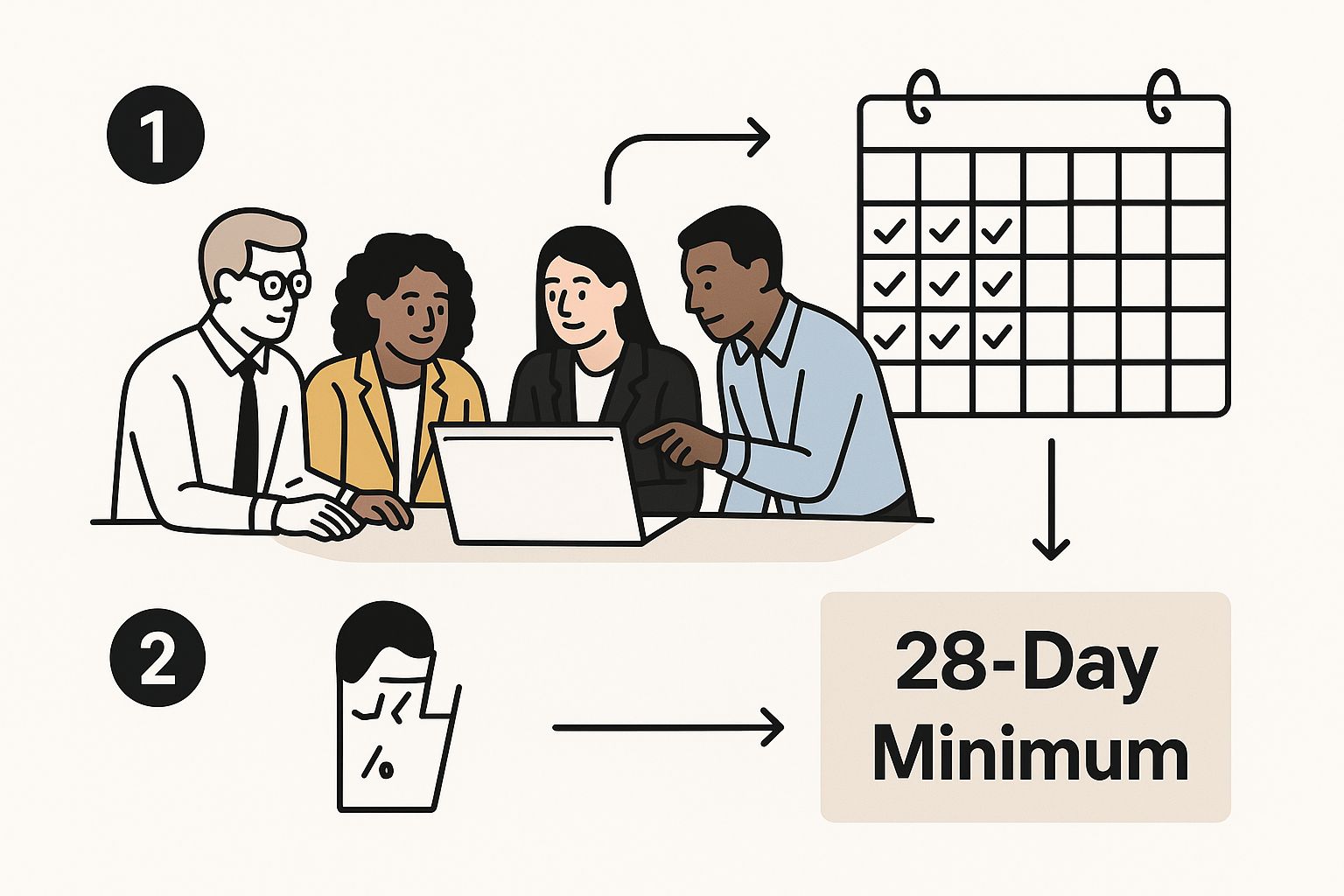
The image really brings home that universal baseline of 28 days for full-timers, which is the starting point for all other calculations.
What About Bank Holidays?
This is where things often get confusing. People wonder if they get bank holidays on top of their 28 days. In England and Wales, there are typically eight public holidays, so it's a fair question.
The simple answer is: not automatically. Your employer can include bank holidays as part of your statutory 28-day entitlement. The key is to check your employment contract, which must state whether bank holidays are included or are given in addition to your leave.
If your contract says "28 days of annual leave including bank holidays," it means that when a bank holiday comes around, one day is simply ticked off your 28-day total. If it says "20 days of annual leave plus bank holidays," you're still getting the same statutory minimum, it's just worded differently.
Contractual vs Statutory Leave
While the law sets a floor, it doesn't create a ceiling. Many companies offer more generous leave packages to attract and keep good people. This extra time off is known as contractual leave.
- Statutory Leave: The legal minimum of 5.6 weeks. This is non-negotiable.
- Contractual Leave: Any additional leave your employer offers on top of the legal minimum.
For example, a company might offer 33 days of holiday, including bank holidays. In this case, you're getting your 28 statutory days plus an extra 5 contractual days. Always check your contract to understand your full allowance and the rules for booking both types of leave.
How to Calculate Holiday for Any Work Pattern
Once you've got your head around the basic 5.6-week rule, the next challenge is applying it to your own situation. Working out your exact annual leave entitlement can feel a bit like heavy-duty maths, but it's actually pretty straightforward once you know the right formula. It’s all about turning those weeks into a concrete number of days or hours you can book off.
Think of this section as a practical workshop. We'll walk through how to calculate holiday allowance whether you’re part-time, on a zero-hours contract, or work irregular hours. We’ll break down the pro-rata method with clear, real-world examples to help you feel confident in your numbers.

Calculating for Part-Time Staff
For employees who work a set number of days each week—just fewer than five—the calculation is refreshingly simple. This is what’s known as a pro-rata calculation, which is just a fancy way of saying your holiday is proportional to the time you work.
The formula is a piece of cake:
(Number of days worked per week) x 5.6 = Your total annual leave in days
Let's see it in action:
- Scenario: Sarah works three days a week.
- Calculation: 3 days × 5.6 weeks = 16.8 days of paid holiday per year.
It’s that simple. This method makes sure part-time workers get the same proportional benefit as their full-time colleagues, keeping everything fair across the board.
Calculating for Irregular and Casual Hours
But what about staff whose hours chop and change from one week to the next? This is the reality for casual workers, many shift workers, and anyone on a zero-hours contract. Trying to calculate leave in 'days' doesn't really work here, so instead, we calculate it in hours based on what they've actually worked.
For these workers, holiday entitlement builds up—or accrues—based on the hours they clock in. The standard way to do this uses an accrual rate of 12.07%.
Where does 12.07% come from? It might seem like a random number, but there's a clear logic. The standard year is 52 weeks, and statutory leave is 5.6 weeks. This leaves 46.4 working weeks (52 – 5.6). If you divide the holiday weeks by the working weeks (5.6 ÷ 46.4) and multiply by 100, you land on 12.07%. This percentage is the slice of holiday you earn for every hour you work.
The formula looks like this:
(Total hours worked in a pay period) x 12.07% = Holiday hours accrued
Here's how it plays out:
- Scenario: David is on a zero-hours contract and worked 80 hours last month.
- Calculation: 80 hours × 0.1207 = 9.656 hours of paid leave earned for that month.
You simply repeat this calculation for each pay period. Over a full year, this method ensures the worker accrues their full 5.6 weeks of holiday, perfectly scaled to the hours they’ve put in. If you want to dive deeper into this, you can learn more about the UK annual leave calculation formula in our comprehensive guide.
Using the Government Holiday Calculator
While doing the maths yourself is great for understanding the principles, it’s easy for a small mistake to creep in. Thankfully, you don’t have to rely on pen and paper alone.
The UK government offers a free and straightforward online tool to help you double-check your figures.
- Visit the GOV.UK website: Just pop "calculate holiday entitlement" into your search engine.
- Enter your details: The calculator will guide you through, asking for information about your work pattern, like how many days or hours you work per week.
- Get an instant result: It crunches the numbers and gives you an accurate calculation of your statutory holiday entitlement.
This tool is a lifesaver for both employees wanting to verify their allowance and employers who need to stay compliant. It acts as the official benchmark for annual leave rules, taking all the guesswork out of the equation and making sure everyone gets the right amount of paid time off.
Managing Leave During Special Circumstances
Work and life don't always run on a predictable schedule. Thankfully, UK law gets this and makes sure your right to paid holiday is protected during major life events. Your leave entitlement doesn't just pause when you're away for a long time; it keeps building up, so you don't lose out on that all-important downtime.
Getting your head around these rules is the key to navigating what can be tricky situations with confidence. Let's break down how it works for a few common scenarios.
Leave for Maternity, Paternity, and Adoption
When you're on maternity, paternity, adoption, or shared parental leave, your employment contract keeps ticking along as normal. That means your statutory holiday entitlement continues to accrue (or build up) at the usual rate, just as if you were in the office.
Think of it this way: someone on a full year of maternity leave would still earn their full 28 days of statutory holiday. Since taking that holiday during parental leave isn't really practical, it's very common to carry it over. Many new parents choose to tack this accrued leave onto the end of their parental leave, which is a great way to extend their time with family while still being fully paid.
A recent study even found that in 2024, women in the UK took an average of 74 days of maternity leave, and their holiday rights were fully protected the entire time. You can find more insights like this in the latest annual leave trends from Timetastic.co.uk.
Managing Long-Term Sickness Absence
Similar rules are in place if you find yourself on long-term sick leave. You continue to build up your statutory holiday entitlement throughout your absence. This is a vital protection that stops employees from being penalised for something completely out of their control.
A key rule here is that if you can't take your holiday within the leave year because you're off sick, you are legally allowed to carry over up to four weeks (20 days for a full-time employee) of your statutory leave. This must then be taken within 18 months of the end of the leave year in which it was earned.
This provision makes sure that illness doesn't steal your right to paid rest and recovery. For employers, it’s really important to have a clear policy on this. Our guide offers more detail on how an employer can manage carrying over leave for an employee and stay fully compliant.
What Happens When You Leave a Job
When your time with a company comes to an end, you're entitled to be paid for any statutory holiday you've earned but haven't taken. This ensures you’re compensated for all the leave you're owed right up to your final day.
The calculation for this is usually pretty straightforward and is done on a pro-rata basis. Your employer will figure out how much of the leave year you've worked and calculate the proportional amount of your annual holiday entitlement.
Here’s a simple breakdown of how that works:
- Calculate the fraction of the year worked: This is simply the number of days you were employed in the current leave year, divided by 365.
- Determine accrued holiday: Multiply that fraction by your full annual entitlement (e.g., 28 days).
- Subtract leave already taken: Your employer will then deduct any holiday you've already used during that leave year.
- Final payment: The remaining days are then paid out in your final salary at your normal rate of pay.
For example, imagine you leave a job exactly halfway through the leave year (at 182.5 days). You'd have accrued half of your annual leave, which is 14 days for a full-time employee. If you'd only taken 5 days of holiday by then, your employer would owe you payment for the remaining 9 days in your final pay packet. It’s a fair system that ensures a clean break and settles all outstanding leave.
The Practical Rules for Booking Your Time Off
Knowing your holiday entitlement is one thing, but how do you actually go about booking that well-earned time off? There are a few practical rules to follow, and getting your head around them is vital for both employees and managers. It’s not about jumping through hoops; it’s just about making sure everyone is on the same page and plans can be made without any last-minute chaos.
Think of it like booking a popular restaurant. You can't just turn up expecting a table on a Saturday night – you need to give them a heads-up. The world of annual leave works on a similar principle. The general rule of thumb is that you need to give notice that is at least twice as long as the holiday you plan to take.

Giving and Receiving Notice
This "double notice" rule is a two-way street. It creates a simple, fair structure that helps both sides plan effectively.
- For employees: If you want to take one week off (that's five working days), you'll need to put in your request at least two weeks (ten working days) beforehand. Simple as that.
- For employers: Likewise, if a manager needs to turn down your request for a solid business reason, they have to give you notice, too. Their notice period must be at least as long as the leave you asked for. So, to refuse a one-week holiday request, they need to let you know at least a week in advance.
This system is designed to prevent nasty surprises. An employer can’t just cancel your holiday the day before you’re due to fly. Crucially, they also can't keep refusing requests to the point where you can't take your minimum statutory leave for the year. Having a clear, formal process, like sending an email, is always the best bet. If you need a hand with that, our guide on how to request annual leave via email has some great templates.
The Problem with Rolled-Up Holiday Pay
You might have heard of 'rolled-up' holiday pay. This is where an employer bumps up your regular wage—usually by 12.07%—instead of paying you when you’re actually on holiday.
While it might sound convenient, this practice has been unlawful for quite some time. The big problem is that it actively discourages people from taking the breaks they're entitled to. After all, if you're getting the money anyway, you might be tempted to just keep working.
There's a very narrow exception for workers with highly irregular hours, where working out standard holiday pay is a real headache. Even in these rare cases, the rolled-up amount has to be clearly marked as holiday pay on the payslip. For almost everyone else, this is a definite no-go.
Carrying Over Unused Leave
So, what happens when you get to the end of the leave year and still have a few days left? Can you just roll them over? Well, it all depends on your contract and the type of leave we're talking about.
UK law sets a basic minimum. You're legally allowed to carry over up to 1.6 weeks (that's eight days for someone working full-time) of your statutory leave, but only if you have a written agreement with your employer. The other four weeks of statutory leave are generally a "use it or lose it" deal – they have to be taken within the leave year.
That said, many companies are more generous. Your employment contract might let you carry over more than the legal minimum, often with strings attached, like having to use them up by March of the new leave year.
Here’s a quick breakdown of the rules:
| Type of Leave | Can it be Carried Over? | Conditions |
|---|---|---|
| First 4 Weeks of Statutory Leave | No (Except in specific cases like long-term sick leave) | Must be taken within the leave year. |
| Additional 1.6 Weeks of Statutory Leave | Yes | Requires a written agreement with your employer. |
| Contractual Leave (Above Statutory) | Yes | Subject to the rules in your employment contract. |
When in doubt, always dig out your company handbook or contract to see what specific rules apply to you. A clear policy stops that end-of-year panic and makes sure everyone knows exactly where they stand.
Employer Best Practices for a Healthy Leave Culture
Getting the legal minimums right for annual leave is one thing, but building a culture where people feel they can actually take that time off is what sets a truly great employer apart. A generous holiday policy is just words on paper if your team feels too swamped or pressured to ever book a break.
Fostering a healthy leave culture isn't just a "nice-to-have"; it's a strategic move. It's how you prevent burnout, boost real productivity, and build a team that's engaged and resilient. This means shifting your mindset from seeing holidays as a cost to recognising them as a vital investment in your people. When people take proper, restorative breaks, they come back with fresh ideas and energy. Ignore this, and you’re paving the way for exhaustion, dipping productivity, and a slump in morale.
Address the Trend of Underused Leave
It's a worrying trend, but more and more employees are failing to take their full holiday allowance. Despite the UK's statutory entitlements, the data shows a significant drop in usage. In 2023, the average UK employee took just 33.9 days of annual leave (including bank holidays). That's a noticeable fall from 36.7 days in 2022 and 38 days in 2020.
This isn't a sign of super-dedication; it's a massive red flag for burnout. One of the simplest, most effective things you can do to protect your team's mental health and keep performance strong is to actively encourage them to use their leave.
Create a Clear and Accessible Holiday Policy
The foundation of a great leave culture is a policy that’s clear, fair, and easy for everyone to get their head around. Ambiguity is your enemy here—it just leads to confusion and a feeling that things aren't fair, especially when multiple people want time off during Christmas or the summer holidays.
Think of your policy as a practical user guide, not a dense legal text. It needs to clearly spell out:
- The leave year: When does your holiday year run from and to?
- Booking procedures: How much notice do people need to give?
- Approval process: Who signs off on requests, and how will they hear back?
- Peak season rules: How do you handle popular holiday periods fairly?
When these rules are written down and easy to find, it takes all the guesswork out of the process. It empowers both managers and their teams to plan ahead without any stress.
Communicate and Lead by Example
A policy document can only do so much. The real culture is shaped by what people see happening every day. Senior leaders and managers have to be the ones championing the importance of taking a proper break. When your team sees their boss logging off and going on holiday—and properly switching off—it sends a powerful message that downtime isn't just allowed, it's encouraged.
The best leave policies are backed by a culture that actively pushes people to rest. This means managers should be having proactive chats about holiday plans, keeping an eye on remaining balances, and making sure workloads are managed so people can go on leave without worrying.
Even small things, like having a strict "no-emailing-people-on-holiday" rule, can make a huge difference. It shows genuine respect for their time off and helps them fully disconnect. For companies wanting to make this even smoother, tools like Robotic Process Automation in Human Resources can take the administrative headache out of managing leave and other HR tasks.
Getting your holiday policy right is a balancing act. It's easy to fall into common traps, but just as easy to adopt practices that build trust and make your company a better place to work. Here’s a quick look at the do's and don'ts.
Annual Leave Policy Do's and Don'ts
| Best Practice (Do) | Common Mistake (Don't) |
|---|---|
| Proactively encourage leave. Managers should regularly check in on holiday balances. | Create a culture of presenteeism. Don't praise employees for never taking a day off. |
| Lead by example. Senior staff should take their full holiday allowance and disconnect. | Contact employees on leave. Avoid sending emails or messages unless it's a true emergency. |
| Have a clear, simple policy. Make it easy for everyone to find and understand the rules. | Allow policies to be vague. Don't leave rules open to interpretation, causing confusion. |
| Plan cover effectively. Ensure workloads are managed so people can relax on their break. | Understaff during peak periods. Don't leave the remaining team feeling overwhelmed. |
Ultimately, a strong policy isn't about rigid rules, but about creating a framework of trust and respect for your employees' well-being.
Beware the 'Unlimited Leave' Pitfall
On paper, an "unlimited" holiday policy sounds like the dream perk. The reality can be quite different. Without clear guidelines and a culture that genuinely supports it, this approach can seriously backfire.
In some companies, the lack of a specific number creates anxiety and peer pressure. People aren't sure what's "acceptable," so they end up taking less time off than they would with a traditional allowance, fearing they'll be judged. If you're exploring this path, tread carefully. You'll need to set clear minimum leave expectations and track usage to make sure everyone is actually taking enough time to recharge. The goal is flexibility, not anxiety.
Your Annual Leave Questions Answered
Let's be honest, navigating the rules around annual leave can sometimes feel like trying to solve a puzzle. Even when you think you've got the basics down, a unique situation pops up that leaves everyone scratching their heads. This section is all about tackling those common queries head-on.
Think of this as your go-to FAQ for those tricky "what if" scenarios. We’ve rounded up the questions we hear the most to give you clear, straightforward answers and help you handle specific situations with confidence.
Can My Employer Refuse My Holiday Request?
In short, yes, your employer can legally refuse a holiday request, but their power isn't absolute. They can't just say "no" for the sake of it. There must be a solid business reason, like making sure there's enough cover during a really busy period or preventing too many team members from being off at once.
There's also a strict rule about notice. If they do refuse your request, they have to tell you at least as long before the holiday as the length of the leave you asked for. So, if you booked one week off, they must give you at least one week's notice of the refusal.
Crucially, an employer can't use this right to stop you from taking your minimum statutory holiday entitlement over the year. A fair and transparent company policy is key here, and it should clearly explain how these situations are handled to keep things clear and avoid disputes.
This system creates a balance, allowing businesses to manage their operational needs while still respecting your fundamental right to take a break.
What Happens if I Start or Leave a Job Mid-Year?
When you join or leave a company partway through its holiday year, your leave is worked out on a pro-rata basis. It’s a fair system that simply means you get a portion of the annual leave that matches the amount of time you’ve actually worked for the company.
If you're leaving a job, your employer will calculate exactly how much holiday you've earned up to your final day. If you have any of this accrued leave left to take, you're entitled to be paid for it. This is often called a 'payment in lieu of holiday' and will usually be included in your final payslip.
On the flip side, what if you’ve taken more holiday than you’ve actually earned by your leaving date? Your employer might be able to deduct the value of that extra time from your final pay. But here's the catch: they can only do this if there's a specific clause in your employment contract that allows for it. No clause, no deduction.
How Does Annual Leave Work for Zero-Hours Contracts?
People on zero-hours contracts are absolutely entitled to the same 5.6 weeks of paid holiday as everyone else. The tricky part is figuring out the calculation when working hours aren't fixed from one week to the next.
The standard way to do this is by using the 12.07% method. This percentage is worked out by dividing the statutory 5.6 weeks of holiday by the remaining 46.4 working weeks of the year. Essentially, for every hour someone on a zero-hours contract works, they earn a little over seven minutes of paid holiday.
Here’s how that looks in practice:
- Scenario: An agency worker clocks 60 hours in a month.
- Calculation: 60 hours x 12.07% (or 0.1207) = 7.24 hours of paid leave earned for that month.
This calculation is done for each pay period. When the worker wants to take their holiday, they get paid for the hours they've built up at their normal hourly rate. This ensures their annual leave entitlement in the UK is fair and directly reflects the hours they’ve put in.
Can My Employer Force Me to Take Leave on Certain Dates?
Yes, they can. Your employer has the right to tell you when to take some, or even all, of your annual leave. This is quite common in certain industries, like a factory that has a set shutdown period over Christmas or a company that closes its doors between Christmas and New Year.
However, just like with refusing leave, they have to play by the rules when it comes to notice. If an employer wants to make you take leave, they must give you notice that is at least double the length of the holiday they're requiring.
For example, if the business is closing for one week and wants everyone to use their annual leave, they need to give you at least two weeks' advance warning. This sort of policy should always be clearly communicated, ideally in your contract or the company handbook, so there are no last-minute surprises and everyone can plan accordingly.


