
Sending a request for annual leave by email is a standard part of professional life, but doing a little prep work can make a world of difference. It often means the difference between a quick "yes" and a delayed or complicated approval. A bit of planning shows you're not just thinking about your holiday, but about your team too.
Setting the Stage for an Easy Approval

Before you even open a new email draft, a few simple checks can smooth out the entire process. This groundwork demonstrates to your manager that you’re being considerate of team workloads and ongoing projects. It frames your request as a well-thought-out plan rather than an impulsive decision.
Know Your Company's Policy
Every company handles time off a little differently. Your first port of call should always be the employee handbook or the HR portal to get reacquainted with the rules.
Pay close attention to a few key details:
- Notice Period: How much of a heads-up do you need to give? A common rule of thumb is providing notice that’s at least double the length of the leave you want to take.
- Blackout Periods: Are there times when leave is off-limits? This could be during the end of a financial quarter, a major product launch, or your company's busiest season.
- Request Process: How does your company actually want you to submit the request? Some use specific software, like LeaveWizard, while others are happy with a direct email to your manager. Following the proper simple steps for an efficient leave approval process is non-negotiable.
Confirm Your Leave Entitlement
Next up, double-check how much annual leave you actually have left. It’s always slightly awkward to ask for two weeks off only to discover you've only got four days in the bank. Most companies have an online portal where you can see your remaining balance in seconds.
Just as a reminder, in the UK, full-time workers are legally entitled to a minimum of 28 days of paid annual leave. This figure often includes the 8 UK bank holidays, but some employers offer these on top of your allowance. It’s always smart to confirm your exact entitlement before you start booking flights.
A well-planned request is a respectful request. By checking team schedules and project timelines first, you show your manager that you value the team's workflow and are committed to minimising disruption.
Check the Team Calendar
Finally, be proactive and have a quick look at the shared team calendar. Is anyone else already booked to be away during your preferred dates? Requesting time off that clashes with a colleague's approved holiday immediately creates a scheduling puzzle for your manager.
By spotting and avoiding potential overlaps, you make their decision so much easier. This small act of consideration shows you’re thinking about team capacity and reinforces your reputation as a thoughtful, organised colleague.
Writing a Clear Subject Line and Opening

Let's be honest, your manager's inbox is a battlefield. To win their attention, your request annual leave email needs a powerful first impression. That starts with the subject line. Think of it as the email's headline – it needs to be instantly clear and informative.
A vague subject like "Question" or "Time off" just creates extra work for your manager, forcing them to open it to understand its purpose. It's a small thing, but it can get your request deprioritised. A great subject line, however, does the opposite. It delivers all the key information at a glance, making their job easier and showing you're on top of things.
Crafting the Perfect Subject Line
The best approach is to be direct and professional. The goal is to give your manager everything they need to know before they even click open. A simple, effective formula includes the nature of the request, your full name, and the specific dates you need off. This small step makes your email easy to find and action later.
Here are a few solid examples that work every time:
- Annual Leave Request – Sarah Jenkins – 15-26 July
- Holiday Request for David Chen (5-9 August)
- Time Off Request: Aisha Patel (27-31 May)
See how clear those are? There’s no ambiguity. This approach respects your manager's time and frames your request as a simple administrative task, not a complex problem that needs solving. It sets a professional and efficient tone right from the start.
Mastering Your Email's Opening
Once they've opened the email, that direct and polite tone needs to continue. Ditch any long, rambling introductions. You need to get straight to the point while still being courteous. Your opening sentence should simply confirm the subject line and formally state your request.
If you're looking for broader advice on workplace communication, getting a handle on how to effectively phrase professional emails offers some brilliant insights that can be applied to all sorts of professional situations, including this one.
A strong opening paves the way for the rest of your email, where you’ll lay out your handover plan. It confirms the email's purpose without sounding blunt or demanding, creating a natural flow into the important details.
Your opening should be a polite declaration, not a hesitant question. Instead of "I was hoping to maybe take some time off," try a confident and clear "I would like to request annual leave from [start date] to [end date]." This directness is a sign of professionalism.
Here are a couple of excellent ways to phrase your opening:
- "Please accept this email as a formal request for annual leave from Monday, 15th July to Friday, 26th July."
- "I would like to request a week of annual leave, from Monday, 5th August, returning to work on Monday, 12th August."
These examples are polite, direct, and leave no room for misunderstanding. They give your manager the necessary information right away, allowing them to process your request efficiently. By getting both the subject and the opening right, you ensure your annual leave request gets the positive and prompt attention it deserves.
Detailing Your Leave and Planning a Smooth Handover
Once you've got your clear, concise opening, the body of your email is where you really get to shine. This is your chance to show your manager you're not just thinking about your time off, but also about the team's success while you're away. It’s about demonstrating true professionalism.
First thing’s first: be crystal clear with your dates. Ambiguity is your enemy here. State your last working day and the exact date you’ll be back at your desk. It’s a simple detail, but it removes any guesswork and sets clear expectations for everyone.
The process of requesting leave is more than just picking dates off a calendar, as this breakdown shows.
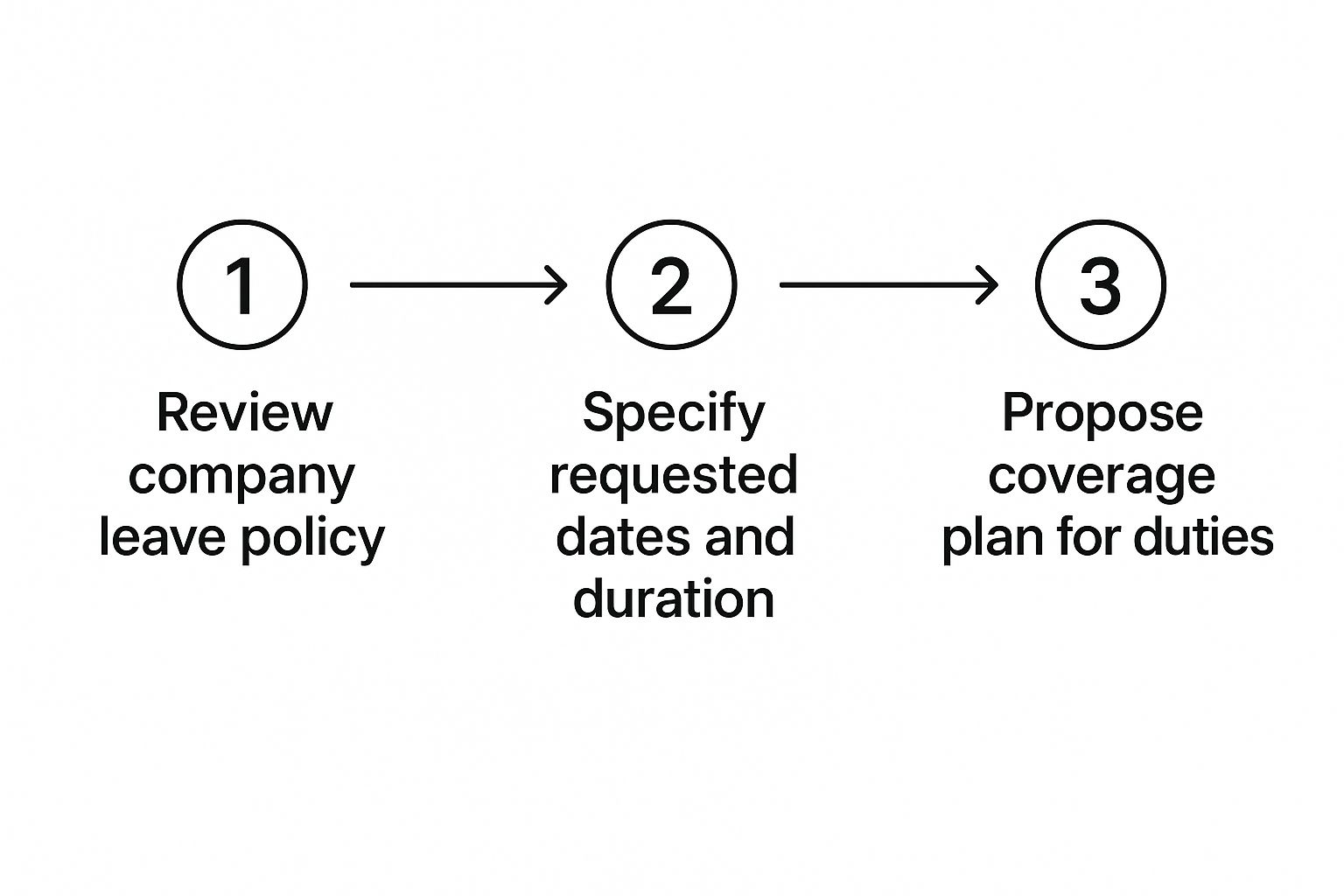
As you can see, thinking ahead about your handover is just as vital as locking in your dates. It reframes your request from a potential disruption into a well-managed, straightforward absence.
Building a Proactive Handover Plan
A solid handover plan is your secret weapon for getting that leave request approved without any back-and-forth. It sends a powerful message to your manager: "I've thought this through, and everything is under control." You don’t need a novel-length document, just a clear framework that shows initiative.
Think of your plan in three key parts:
- Your Big Rocks: What are the major projects on your plate? Jot down a quick one-line status update for each, and be sure to flag any deadlines that might pop up while you’re out.
- The Day-to-Day Stuff: What are your regular, routine tasks? Who’s going to keep those wheels turning?
- Your Go-To Person: Suggest a colleague (or two) who will be the point of contact for your essential duties. And this is crucial: you absolutely must chat with them and get their okay before you put their name in the email.
Doing this prep work shows a massive amount of respect for both your manager and your colleagues. It turns what could be a headache for them into a simple, manageable event.
Your goal is to make saying 'yes' as easy as possible. A well-considered handover plan anticipates your manager's questions and provides solutions before they even have to ask, showcasing your reliability and forward-thinking.
How to Phrase Your Handover Proposal
Once you’ve got the plan sorted, you need to lay it out clearly and concisely in your email. You can introduce it with a simple phrase, something like, "To ensure a smooth workflow during my absence, I've outlined a handover plan below:"
To give you a better idea, here’s how you could structure it:
- Project Titan: The client feedback is due on the 18th. I will complete my initial review before my leave and have briefed Maria on the next steps.
- Weekly Reporting: David has kindly agreed to compile and send the weekly sales report.
- Client Enquiries: For any urgent client queries, Maria and David will be the main points of contact. They'll have access to all my handover notes.
This approach is direct, organised, and professional. It tells your manager you’re not just disappearing; you’re actively managing your workload to support the team. Presenting this level of detail upfront in your request annual leave email practically guarantees a quick and positive response.
Professional Email Templates for Any Situation

Sometimes, the easiest way to figure out how to write your own annual leave request email is to see a few good examples.
While your company might have its own official system or use specific holiday request form templates, the examples below give you a solid starting point for pretty much any scenario. You can easily tweak them to match your company's vibe and your own unique situation.
The goal is always the same: be professional, clear, and considerate. Let's look at three common situations and break down why these templates work so well.
The Classic Formal Request
This is your go-to template for more traditional, corporate settings, or maybe when you don't know your manager all that well. It's polite, covers all the necessary details, and avoids being overly casual. Think of it as the safe, respectful, and professional option.
Subject: Annual Leave Request – [Your Name] – [Start Date] to [End Date]
Body:
Dear [Manager's Name],
Please accept this email as my formal request for annual leave from [Start Date] to [End Date]. I will be returning to the office on [Return Date].
To ensure a smooth workflow during my absence, I have already coordinated with [Colleague's Name] to cover my essential duties. I will also finalise a detailed handover document outlining the status of all current projects before my departure.
I will make sure all my urgent tasks are completed before I leave. Thank you for considering my request.
Best regards,
[Your Name]
This approach is effective because it’s direct and shows you've already thought ahead by arranging cover and planning a handover. It immediately puts your manager's mind at ease.
The Informal Follow-Up Request
This one’s perfect for when you've already had a quick chat with your manager about your holiday plans. The email is just the formal step needed for the records, so you can keep it much more relaxed and to the point. It simply confirms your conversation, making the whole process feel natural and efficient.
Subject: Following up on Holiday Request – [Your Name]
Body:
Hi [Manager's Name],
Following our chat earlier, I'd like to formally request annual leave from [Start Date] to [End Date].
As we discussed, [Colleague's Name] will be the point of contact for my main projects while I’m away. I’ll make sure everything is in a good place before I sign off.
Thanks again,
[Your Name]
Why does this work? It's quick, respects the informal groundwork you've already laid, and gets the request officially logged without any unnecessary fluff.
No matter which template you use, the goal remains the same: communicate clearly, show you've planned ahead, and make the approval process as simple as possible for your manager. This kind of consideration goes a long way in strengthening professional relationships.
The Strategic Request During a Busy Period
Asking for time off when everyone’s flat out requires a bit more tact and planning. This template shows you’re aware of the team's workload and have already figured out how to minimise any disruption. It frames you as a thoughtful team player, not someone checking out at a critical time.
Subject: Annual Leave Proposal – [Your Name] – [Dates]
Body:
Hi [Manager's Name],
I would like to request annual leave from [Start Date] to [End Date].
I realise this is a busy period with [mention specific project or reason], so I’ve developed a thorough plan to ensure my absence doesn't impact our team's progress. I will complete [specific key task] and [another specific key task] before my leave begins. [Colleague's Name] has kindly agreed to oversee [specific responsibility], and I have prepared detailed notes to support them.
I’m happy to discuss this further to make sure the handover is completely seamless.
Best,
[Your Name]
This is a powerful approach because it anticipates and directly addresses your manager’s potential concerns. It proves you’re proactive and just as committed to the team's goals as they are.
Common Mistakes to Avoid When Requesting Time Off
Sending an annual leave request might feel like a simple task, but a few small oversights can easily turn it into a headache for you and your manager. To make sure your request gets a quick 'yes', it’s worth knowing what pitfalls to sidestep.
One of the most common slip-ups is not giving enough notice. Dropping a last-minute request for a week off lands your manager and team in a tricky spot, forcing them to scramble to cover your work. It’s always best to check your company policy, but a solid rule of thumb is to give notice that’s at least twice the length of the leave you’re planning.
This isn’t just about ticking a box for HR; it’s professional courtesy. It shows you respect your team's time and are mindful of their workload.
Being Vague or Making Assumptions
Another classic mistake is being fuzzy on the details. An email that just says, "I'd like to take some time off in August," doesn't really help anyone. Always lock in the specifics: your proposed start date, your final day off, and the date you’ll be back at your desk. Crystal clear dates leave no room for mix-ups.
Just as problematic is assuming your leave is a done deal the second you hit send. Never book flights or make non-refundable plans until you've got that explicit, written confirmation from your manager. A request is just that—a request—until it's been officially approved.
Here are a few assumptions that can cause real trouble:
- Automatic Approval: Don't think that just because you have the leave days, your request for specific dates will be rubber-stamped.
- Coverage is Obvious: Never assume your colleagues will magically know what needs doing. A clear handover plan is essential.
- Informal Chats are Enough: A quick chat in the kitchen is great, but it’s no substitute for a formal, written request that creates a paper trail.
These little missteps are what lead to scheduling clashes and a lot of unnecessary stress.
Forgetting the Importance of a Proper Handover
Speaking of handovers, this is the final hurdle where people often stumble. Simply saying you'll be away isn't enough. You need to proactively explain how your key responsibilities will be managed while you're out. Forgetting to arrange cover or brief your colleagues properly just creates more work for them and shows a lack of consideration.
It's interesting to note that while getting the request process right is important, many people don't even use all their allocated time off. Despite a typical allowance of around 22-23 days in the UK, workers recently left an average of 5 holiday days unused each year. UK leave statistics also show that just over 50% of UK employees took a full, consecutive week off, which suggests we’re not great at taking proper breaks.
Never underestimate the power of a well-structured request. By being clear, providing ample notice, and outlining a handover plan, you're not just asking for time off—you're demonstrating your reliability and professionalism.
Ultimately, your goal is to make your absence feel completely seamless. By sidestepping these common mistakes in your request annual leave email, you're showing your manager that you’re an organised, responsible, and thoughtful team member. That makes saying 'yes' the easiest decision in the world for them.
Got Questions About Annual Leave Requests? We've Got Answers.
Even with a simple process, questions always pop up. When it comes to writing your annual leave request email, knowing how to handle different situations is key. It helps you approach your manager with confidence and the right information.
Let's break down some of the most common queries we see.
How Much Notice Should I Give for an Annual Leave Request in the UK?
Your company's handbook is always the first place to look, but there’s a solid rule of thumb in the UK: give notice that's at least twice as long as the time you want off.
So, if you’re planning a one-week holiday (that’s 5 working days), you should aim to get your request in at least two weeks beforehand (10 working days). For a bigger two-week trip, giving a full month's notice isn't just polite; it's often expected. Giving your manager a good heads-up makes planning much smoother for everyone, which is why they really value getting enough notice for staff leave requests.
What Should I Do if My Annual Leave Request Is Denied?
It's always a bit disappointing to hear 'no', but don't panic—it might not be the final word. The best first step is to calmly and professionally ask your manager for a bit more detail on why it was turned down.
Usually, it comes down to a few common reasons:
- Team Workload: There might be a big project deadline looming or it’s just a hectic period for the business.
- Holiday Clashes: Someone else on the team might have already booked the same dates.
- Short Notice: Your request might have come in a little too late for them to arrange cover.
Once you know the 'why', you can start looking for a 'how'. Maybe you could suggest different dates? Or perhaps you could offer to put together an even more thorough handover plan to ease their concerns. Keeping the conversation open and focused on finding a solution is always the best way forward.
Think of a denied request as the start of a conversation, not the end of one. If you go in with a collaborative mindset, you're much more likely to find a solution that works for both you and the business.
Can I Request Annual Leave During My Notice Period?
You can absolutely ask to use your accrued annual leave during your notice period. However, your employer doesn't have to say yes.
They can decline it for practical business reasons, like needing you on hand to finish up projects or conduct a proper handover with the person taking over your role. If they do approve your request, you'll be paid for those days as usual. If they say no, UK law is on your side: they must pay you for any statutory holiday time you've earned but haven't taken by the time you leave.


