
An absence or sickness policy is much more than just a formal document. It's the framework that outlines your company’s approach when an employee can't work due to illness or injury. It spells out everything from notification procedures to sick pay entitlements, making sure everyone—managers and staff alike—handles sickness consistently and fairly. Think of it as the foundation for maintaining stability and meeting your legal duties.
Understanding the Impact of Absence on Your Business

Employee absence can quietly chip away at your business's productivity, morale, and bottom line. When a team member is unexpectedly off, the effects ripple outwards. For a small business, these ripples can feel more like waves, disrupting carefully planned work and putting a real strain on your limited resources.
Without a clear plan, managers are left scrambling to find cover. This often piles the pressure on the rest of the team, increasing their workloads and leading to burnout and resentment. It’s a vicious cycle.
The financial hit is more than just the cost of sick pay. The hidden costs add up quickly:
- Lost Productivity: It's not just the absent employee's tasks that go undone. Temporary cover is rarely as efficient, causing a drag on output.
- Overtime Pay: Other team members often have to work extra hours to pick up the slack, which can really inflate your wage bill.
- Administrative Burden: Managers end up sinking valuable time into rearranging schedules, communicating changes, and handling all the related paperwork.
- Lowered Morale: Constantly having to cover for absent colleagues is a surefire way to demotivate your team, and it can even lead to higher staff turnover.
Recognising the Warning Signs
Spotting negative trends early is absolutely crucial. An increasing absence rate is one of the clearest signs that something isn’t right.
To calculate your absence rate, just divide the total number of lost workdays by the total number of available workdays in a given period, then multiply that by 100. If that figure starts creeping up, it’s time to investigate potential causes, like workplace stress, low engagement, or even health and safety issues.
Getting to the bottom of why people are off is key. For example, implementing effective workplace stress management strategies for neurodivergent employees can make a massive difference in fostering a healthier, more supportive environment and, in turn, reducing absenteeism.
A proactive approach to absence management isn’t just about reacting when someone calls in sick. It's about creating a workplace where employees feel supported and valued. That’s what truly boosts attendance and commitment.
Making the Business Case for a Formal Policy
The scale of this issue across the UK is huge. Recent data shows a dramatic surge in sickness absence, with employees taking an average of 9.4 days off in 2025—the highest level recorded since 2010. This sharp rise from pre-pandemic levels points to a fundamental shift in workforce health, making a solid policy more critical than ever.
By tracking your own absence data, you can build a powerful case for formalising your approach. When you present managers with clear figures on lost productivity and rising costs, the need for an absence sickness policy becomes undeniable.
It shifts the conversation from a chore to an essential tool for business stability. You can learn more about how employee absence impacts your business in our detailed guide. Ultimately, a well-defined policy provides the structure you need to manage sickness fairly, minimise its impact, and protect your bottom line.
Navigating Legal Requirements for Sickness Policies
Before you even think about writing your absence policy, you need to get your head around the legal side of things. Honestly, getting this wrong is one of the quickest ways to find yourself in hot water, facing tribunals or even discrimination claims. A solid policy isn't just a list of company rules; it’s your way of showing you're fair, compliant, and treating your team correctly.
The legal stuff around employee sickness can feel a bit tangled, but it really boils down to a few key areas. Think of these as the non-negotiables for any UK employer. Your entire policy has to be built on this foundation, because ignoring these duties isn't an option and leaves your business wide open to risk.
Understanding Statutory Sick Pay
Let’s start with the absolute basics: Statutory Sick Pay (SSP). This is the minimum payment required by law for eligible employees who are off sick for four or more consecutive days. The government sets the rates and rules, and they do change, so it's something you need to keep an eye on.
Your policy has to reflect these SSP rules, even if you offer a much better company sick pay scheme. It's vital that everyone knows how to claim SSP and what conditions they need to meet. For a proper deep-dive into the numbers, our guide on how to calculate Statutory Sick Pay is a great resource to make sure you're always spot on.
The Equality Act and Your Duty of Care
Beyond the pay, two huge legal concepts shape how you manage absence: your duty of care and the Equality Act 2010. Your duty of care simply means you have to do everything you reasonably can to protect the health, safety, and wellbeing of your staff. This definitely extends to managing sickness absence in a supportive and sensible way.
The Equality Act is especially critical when an employee's absence is linked to a long-term health issue or disability. A condition is legally considered a disability if it has a ‘substantial’ and ‘long-term’ negative impact on a person’s ability to carry out normal day-to-day activities.
This is where reasonable adjustments come into play. If an employee has a disability, you are legally required to make changes to their job or workplace to help them stay in work or come back after an absence.
What’s ‘reasonable’? It always depends on the specifics, but it could involve things like:
- Altering working hours: Maybe allowing a later start time to manage medication side effects or attend appointments.
- Modifying duties: Removing a task that their condition makes particularly difficult, either temporarily or for good.
- Providing specialist equipment: An ergonomic chair, a different keyboard, or voice-to-text software, for instance.
- Allowing a phased return: Gradually building up hours and responsibilities after a long period off sick.
Your absence policy must be applied fairly to everyone, but the Equality Act demands that you sometimes treat disabled employees differently—and more favourably—by making these reasonable adjustments. A rigid, one-size-fits-all approach is a recipe for a discrimination claim.
Handling Chronic Conditions and Intermittent Absence
One of the trickiest things for many small businesses is managing those short, frequent absences caused by chronic conditions like arthritis, migraines, or mental health struggles. These might not lead to long spells off work, but they can result in a pattern of regular sick days.
Picture this: an employee with a chronic pain condition has a few one-day absences over a couple of months. A standard absence trigger system might flag this as a performance issue. But, if that condition qualifies as a disability, jumping straight to disciplinary action without first considering adjustments could land you in serious trouble.
The right way to handle this is to:
- Talk to the employee. A supportive return-to-work meeting is the perfect place to open up a conversation.
- Understand the impact. Find out how their condition affects them and what support could genuinely make a difference.
- Explore reasonable adjustments. Could more flexibility with home working on bad days help? Would a change in their workstation reduce strain?
- Document everything. Keep a record of your conversations, the adjustments you offered, and the employee's feedback. This paper trail is your proof that you've acted fairly and met your legal obligations.
Right, you’ve got the legal side of things sorted. Now it’s time to get down to the nitty-gritty and actually build the policy itself. This is where you turn those legal obligations into a straightforward, practical guide that your team can actually use day-to-day. A well-crafted policy gets rid of any grey areas, makes sure everyone is treated fairly, and protects both your staff and the business when someone is unwell.
Think of it as the user manual for sickness absence. It needs to be detailed enough to cover all the important bits, but simple enough that no one needs a law degree to figure it out. The aim is to create that one document everyone can turn to for quick, clear answers.
First Things First: Definitions and Scope
Before you dive in, you need to set the scene by defining what you mean by different types of absence. Getting this crystal clear from the start prevents a world of misunderstanding later on. Your policy should also state exactly who it applies to—for example, is it for all employees, or only those who have passed their probation period?
A crucial distinction to make is between authorised and unauthorised absence.
- Authorised Absence: This is pretty simple. It's when an employee is off sick and has followed all the right steps laid out in your policy for letting you know and providing any necessary paperwork.
- Unauthorised Absence: This happens when someone doesn't follow the rules. Maybe they didn't call in to report they were sick, or they failed to hand in a fit note when they were supposed to.
Drawing this line in the sand is vital because it dictates how you handle different situations, including any potential disciplinary action if an absence is unauthorised.
If you're starting from scratch, you might find that exploring AI tools for HR policy drafting can give you a solid head start, making sure you don't miss any essential clauses.
Laying Down the Law on Reporting Sickness
Let's be honest, this is one of the most critical parts of the entire policy. If people don't know how to report an absence, it can cause real operational headaches. Your procedure needs to be completely unambiguous about what an employee has to do if they're too ill to come to work.
There can be no room for doubt. Be specific:
- Who to Contact: Do they ring their line manager, an HR phoneline, or log it in an app? Name a specific person or role.
- How to Contact Them: Is a phone call a must? Are texts or emails okay? A direct phone call is usually best as it allows for a proper conversation.
- When to Contact Them: Give a clear deadline, like "at least one hour before your usual start time." This gives managers a fighting chance to arrange cover.
A good, clear clause might look something like this: "If you cannot attend work due to illness, you must telephone your line manager personally no later than 8:30 am on your first day of absence."
The Essentials: Policy Sections Checklist
To make sure your policy is robust and covers all the bases, it's helpful to think of it as a checklist of essential sections. Each part has a specific job to do, from defining terms to explaining pay.
Here’s a breakdown of the key clauses you absolutely must include in a comprehensive and legally compliant UK sickness policy:
Essential Sections for Your Absence Sickness Policy
| Policy Section | Purpose and Key Details to Include |
|---|---|
| Introduction & Scope | State the policy's purpose (fairness, consistency) and specify who it applies to (e.g., all staff, post-probation). |
| Definitions | Clearly define key terms like "authorised vs. unauthorised absence," "fit note," and "self-certification." |
| Reporting Procedure | Detail the who, what, when, and how of reporting sickness. Include contact person, method (phone call), and deadline. |
| Certification | Explain the rules for self-certification (first 7 days) and when a medical fit note is required (after 7 days). |
| Sick Pay Entitlements | Outline both Statutory Sick Pay (SSP) eligibility and any Company Sick Pay (CSP) you offer, including rates and duration. |
| Return to Work | Describe the return-to-work interview process, its purpose (support, not interrogation), and how you'll handle fit note recommendations. |
| Managing Absences | Cover how you'll manage both short-term (e.g., trigger points) and long-term sickness (e.g., welfare meetings, reasonable adjustments). |
| Record Keeping | Briefly state that absence records will be kept confidentially and in line with data protection laws (UK GDPR). |
| Related Policies | Link to other relevant documents, such as your Disciplinary Policy or Health & Safety Policy. |
Having a structure like this ensures you don't miss anything important and creates a logical flow that's easy for everyone to follow.
Getting the Paperwork Right: Self-Certification and Fit Notes
After that initial phone call, the next step is certification. For shorter spells of sickness, UK law is quite straightforward and allows for self-certification.
An employee can self-certify for the first seven calendar days they are off sick (this includes weekends and non-working days). You should have a simple, standard form for this, which they fill out when they get back. It just needs to document why they were off and the dates.
If someone is off for more than seven days, they'll need to provide medical evidence. This comes in the form of a Statement of Fitness for Work, which everyone knows as a fit note, from their GP or another healthcare professional. Your policy has to spell this out clearly, and also explain that failing to provide one could mean their sick pay is stopped.
A fit note is more than just a piece of paper saying someone is sick. It might suggest an employee 'may be fit for work' if certain changes are made. Your policy should confirm you’ll review these suggestions and discuss them with the employee, which ties back into your legal duty to make reasonable adjustments.
Being Transparent About Sick Pay
Finally, your policy must be completely clear about sick pay. This section needs to cover the legal minimum as well as any enhanced company pay you provide.
- Statutory Sick Pay (SSP): It’s good practice to briefly reiterate the basic eligibility rules for SSP, so everyone knows the baseline.
- Company Sick Pay (CSP): If you offer a better scheme (and many small businesses do to stay competitive), lay it all out. Specify exactly how much an employee gets (e.g., full pay, half pay) and for how long. This is often tiered based on how long they've worked for you.
For example: "Employees with over two years of service are entitled to four weeks of full pay, followed by four weeks of half pay, inclusive of any SSP entitlement."
Being upfront about pay manages people's expectations from the get-go and helps avoid arguments later on. If you need a more detailed walkthrough, our guide can help you create a professional sick leave policy template that covers all of these components and more.
By getting these core pillars—definitions, reporting, certification, and pay—nailed down, you’ll have a solid policy framework that makes managing employee health and wellbeing so much simpler.
Putting Your Sickness Policy into Practice
Having a well-written absence sickness policy is a fantastic start, but its real power is unlocked in how you apply it day-to-day. Consistent and fair management is what transforms that document into a genuine tool that supports your employees and protects the business. This means knowing how to handle both short and long-term absences with care, using return-to-work interviews effectively, and maybe even using a bit of tech to keep everything organised.
The financial reality of not managing absence is pretty stark. The cost of sickness absence for UK employers rocketed to an estimated £103 billion in 2023. What's crucial to realise is that smaller businesses feel this pain more acutely. For companies with around 60 employees, absence costs can eat up 11.2% of their basic pay bill—a much bigger slice of the pie compared to larger firms. You can dig into more of the real financial impact of employee absenteeism in the UK to understand the stakes.
This simple flow chart breaks down the core steps for managing a typical absence according to your policy.
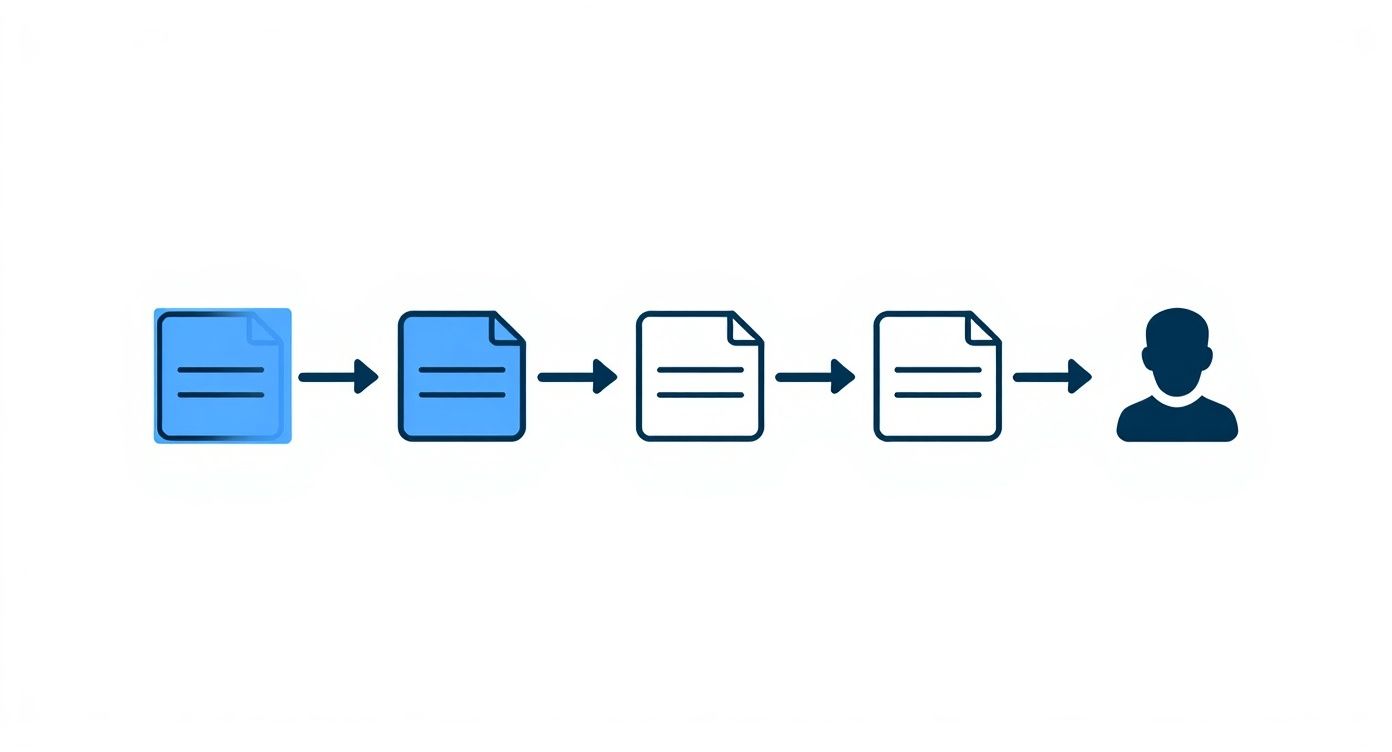
From that first phone call to the employee's return, having a clear and consistent process ensures nothing gets missed and everyone is treated fairly.
Managing Short-Term Sickness
Short-term absences, those lasting just a few days, are by far the most common. While they often seem straightforward, they can sometimes reveal underlying issues if they start forming a pattern. The key is to manage them proactively, and your single most effective tool for this is the return-to-work interview.
This isn't a formal interrogation; think of it more as a supportive catch-up. It has a few important goals:
- Welcome the employee back: It’s a simple gesture that shows you care and that they were missed.
- Confirm they're fit for work: You need to be sure they are genuinely ready to get back to their duties.
- Update them on what's new: A quick rundown of any important updates they missed helps them settle back in.
- Spot any patterns: This is your chance to gently explore if there are recurring issues. If an employee is frequently off on Mondays, a friendly return-to-work chat is the perfect, low-pressure setting to ask if everything is okay.
A structured yet informal approach is what you're aiming for. Use a simple form to jot down the date, the reason for absence, and any actions you both agreed on. This little bit of documentation is vital for spotting trends and proving you've followed a fair process if someone's absence record ever becomes a concern.
Handling Long-Term Absence and Phased Returns
When an employee is off for a longer period—typically four weeks or more—your approach needs to be more structured and supportive. Maintaining regular, sensitive contact is absolutely crucial. It helps the employee feel connected and valued, not isolated and forgotten.
As they prepare to come back, you might need to think about a phased return. This is where an employee gradually builds back up to their normal hours and duties. It's often a recommendation on a GP's fit note or from an occupational health advisor.
Case Study: A small marketing agency had a designer off for six weeks following surgery. Her fit note recommended a phased return. The manager sat down with her and mapped out a four-week plan. It started with three half-days working from home, then progressed to three full days in the office, and so on, until she was comfortably back to her full-time contract. This supportive, flexible approach made all the difference and ensured a successful, sustainable return to work.
Using Tools to Automate and Track Absence
Trying to track sickness manually, especially as your team grows, quickly becomes a mess of spreadsheets and forgotten conversations. Spreadsheets are notoriously prone to errors, and it's nearly impossible to get a clear, big-picture view of absence trends. This is where dedicated absence management software can be a game-changer.
Tools like LeaveWizard can automate the entire process, from an employee logging their sickness on an app to their manager approving return-to-work dates. But the real power is in the data and insights they give you.
Having this clear, visual data allows managers to spot patterns instantly and make informed decisions without having to dig through paperwork. These systems can automatically flag when an absence trigger point is reached—like a certain number of absences in a set period—prompting a manager to schedule a supportive chat.
It helps you shift from being reactive to proactive, providing support before a minor issue becomes a major problem and ensuring your absence sickness policy is applied consistently for everyone.
Communicating, Enforcing, and Reviewing Your Policy
A brilliant absence policy is completely useless if it’s just gathering dust in a folder nobody ever reads. To make it a living, breathing part of your company culture, you have to get it in front of people, enforce it fairly, and check in on it regularly. This is how you make sure it stays effective, compliant, and actually understood by everyone on the team.
The initial rollout is your first big chance to get it right. For your existing team, a short, informal briefing session is far better than a dry email. Walk them through what’s new, especially around how they need to report an absence and what the deal is with sick pay. A simple one-page summary or a quick-reference guide they can pin to a noticeboard is a great follow-up.
When new people join, make discussing the policy a standard part of their induction. Don't just hand them a document; talk them through it.
Ensuring Fair and Consistent Enforcement
When it comes to enforcement, fairness is everything. The rules have to apply equally to everyone, from the newest starter to the most senior manager. If they don't, you're opening yourself up to claims of favouritism or even discrimination. Consistency is your best friend here, and it’s your strongest defence against any legal challenges down the line.
So, what happens when someone breaches the policy, like not calling in on time? Your first move should always be a conversation, not a formal warning. Use it as a chance to gently remind them of the procedure and, just as importantly, to check if there was a legitimate reason they couldn't follow it. Life happens.
To stay on top of absence levels proactively, many businesses use trigger points. These are just pre-agreed thresholds that prompt a supportive chat with an employee, not a disciplinary one. Some common systems include:
- Frequency-based triggers: For example, having three separate absences within a six-month period.
- Duration-based triggers: Hitting a total of, say, ten days of sickness absence in a rolling year.
When an employee hits a trigger, it’s a cue for an informal welfare meeting. This is a chance to discuss their health, see if there are any patterns, and explore what support the business can offer to help them out.
Keeping Your Policy Relevant and Up to Date
Your absence policy is not a "set it and forget it" document. Employment law is constantly shifting, your business needs will evolve, and feedback from your own team can shine a light on areas that need a bit of a polish. That's why a regular review cycle is absolutely essential to keep it fit for purpose.
An annual review is a good benchmark. Seriously, schedule it in your calendar and stick to it. This regular check-up ensures you remain compliant with any legal updates and that the policy still feels right for your company’s goals and culture.
A policy review isn’t just a legal box-ticking exercise. It's an opportunity to adapt to the changing needs of your workforce and show that you're a responsive and caring employer. Small tweaks can make a huge difference to employee morale and engagement.
Gathering feedback is a massive part of this process. Chat with your managers—what's working for them and what isn't? Are the procedures easy to follow? Are the trigger points actually effective or just creating admin? You might even consider anonymous employee surveys to get honest input on how the policy feels from their side of the fence.
It’s also smart to keep an eye on national trends to give your review some context. For instance, the persistent gap between public and private sector sickness rates highlights very different approaches to workplace health. The Office for National Statistics reported a public sector absence rate of 2.9% in 2024, which is quite a bit higher than the 1.8% in the private sector. This kind of data underscores the ongoing challenges in managing workforce health and makes it even more important to ensure your policy is both robust and supportive. You can dig deeper into UK sickness absence statistics and their implications to see how you stack up.
Got Questions About Your Sickness Policy?
When you get into the nitty-gritty of managing absence, the same practical questions tend to pop up. Let's tackle some of the most common queries from UK small business owners, giving you clear, straightforward answers to handle those tricky situations with fairness and confidence.
What’s the Difference Between SSP and Contractual Sick Pay?
This is probably one of the most fundamental things to get right in any UK sickness policy. Think of it this way:
Statutory Sick Pay (SSP) is the absolute legal minimum you have to pay eligible employees. It kicks in when they're off sick for four or more days in a row. The government sets the rate, and it usually changes each year, so you'll need to keep an eye on it.
Contractual Sick Pay (CSP), on the other hand, is an extra benefit you choose to offer. It's part of the employment contract and is almost always more generous than SSP. For instance, you might decide to offer full pay for the first few weeks of sickness. If you do offer CSP, it has to be at least equal to what the employee would have received under SSP for the same period. Your policy must be crystal clear about which scheme you operate and exactly what an employee needs to do to qualify.
Can I Discipline an Employee for Taking Too Many Sick Days?
The short answer is yes, but you have to tread very carefully. Taking disciplinary action over high absence levels is only really an option if your policy clearly defines what "too many" actually means. A lot of businesses use a trigger system, like the Bradford Factor, to help identify problematic patterns objectively.
Before you even think about formal action, you absolutely must:
- Hold return-to-work interviews to understand the reasons for each absence.
- Check if there are any underlying health conditions at play.
- Keep your duties under the Equality Act 2010 front and centre.
If the absences are linked to a disability, you are legally required to consider making reasonable adjustments. Jumping straight to a disciplinary hearing without doing this could easily land you in hot water for discrimination. It's all about having a fair, consistent, and well-documented process laid out in your policy.
How Should I Handle Work-Related Stress?
When an employee is signed off with work-related stress, your response needs to be both sensitive and proactive. Your duty of care as an employer is paramount. It’s important to maintain regular, supportive contact, but without ever making them feel pressured to come back before they're ready.
Your main goal here is to figure out what's causing the stress. Getting an occupational health assessment can be a game-changer; it gives you impartial, expert advice on the employee's fitness for work and what adjustments might help.
Before the employee even thinks about returning, you need a solid plan to tackle the root cause. That might mean changing their workload, shifting some responsibilities, or even bringing in a mediator if there's a conflict with a colleague. A phased return to work is nearly always a good idea in these situations.
Do I Have to Accept a GP’s Fit Note?
A "Statement of Fitness for Work" – the proper name for a fit note – is strong medical evidence, and in almost all cases, you should accept it. The note will tell you if the employee is 'not fit for work' or if they 'may be fit for work' with some changes.
If it says they 'may be fit for work', the GP will suggest adjustments like:
- Changing their hours
- Amending their duties
- A phased return to work
- Adapting the workplace itself
You aren't legally bound to make the exact changes suggested, but you do have to give them serious thought. If you genuinely can't accommodate the GP's advice, the employee is treated as 'not fit for work', and you should write down exactly why the changes weren't practical. Simply ignoring the advice on a fit note is a big legal risk, especially if the employee's condition could be classed as a disability.


