
Put simply, an absence from work is any time an employee isn't at their job when they're supposed to be. It's a catch-all term that covers everything from a planned holiday to an unexpected sick day, setting it apart from times they simply aren't scheduled to work.
What Does Absence from Work Really Mean?

Imagine your business is a well-oiled machine, with every team member playing a crucial part. Planned time off, like annual leave, is just scheduled maintenance. It’s essential for letting people recharge, preventing burnout, and keeping the whole operation running smoothly for the long haul. Everyone knows it's happening, so you can plan around it.
An unplanned absence from work, on the other hand, is like a critical part suddenly breaking down. It throws a spanner in the works, forcing other components to pick up the slack and work harder than they should. This doesn't just slow everything down; it puts extra strain on the rest of the team, raising the risk of more problems down the line.
Key Types of Absence
To get a real handle on absence, you first need to know what you're looking at. Breaking it down helps you diagnose the root cause instead of just reacting to an empty desk. Absences usually fall into two main camps:
-
Authorised vs. Unauthorised: An authorised absence is one you've approved—think holiday leave or a scheduled doctor's appointment. An unauthorised absence is when someone doesn't show up without permission or a decent reason, like the classic no-call, no-show.
-
Short-Term vs. Long-Term: Short-term absences are typically brief, maybe a day or two, often due to a minor bug going around the office. Long-term absences stretch beyond a few weeks (usually four or more) and are often tied to more serious health issues or major life events.
Understanding these distinctions is the first step. It helps turn absenteeism from a daily headache into a powerful diagnostic tool for your business. A pattern of unauthorised, short-term absences could be a red flag for low morale, while a spike in long-term cases might point to burnout or workplace stress.
When you start seeing absence not just as a logistical pain but as a piece of data, you gain some incredible insights. It's a signal telling you something about your team's health, their wellbeing, and your company culture. By learning to read these signals, you can shift from constantly fighting fires to proactively building a stronger, more supportive workplace. That change in perspective is a game-changer for any manager wanting to boost both productivity and engagement.
The Real Reasons Employees Are Absent
To really get a handle on absence, you need to look past the surface-level excuse and understand what’s actually going on. Think of an absence less as a gap in the rota and more as a signal. An employee calling in with a headache could just be a one-off. But a pattern of recurring minor illnesses? That might be pointing to a bigger issue, like burnout or workplace stress.
Spotting these patterns is your first step towards getting ahead of the problem. Instead of just reacting every time someone calls in sick, you can start to identify and address the root causes, which usually fall into a few key categories.
Common Drivers of Employee Absence
While every situation is different, most unscheduled absences stem from a handful of common themes. Recognising these helps you see the bigger picture and offer the right kind of support. Some of the most frequent reasons include:
- Minor, Short-Term Illnesses: This is the big one, covering everything from the common cold and flu to stomach bugs. While usually brief, a sudden spike across your team could signal a bug doing the rounds or even low morale showing up in physical symptoms.
- Musculoskeletal Issues: Nagging problems like back pain, neck strain, and repetitive stress injuries are a leading cause of both short and long-term absence. These are often tied directly to the work environment itself, like poor ergonomic setups or physically demanding jobs.
- Mental Health and Wellbeing: This is a huge and growing reason for people being off work. Issues like stress, anxiety, and depression can be triggered by work pressures, personal challenges, or a mix of both. In fact, 79% of UK employers still see mental health as a primary cause of absence.
This infographic paints a clear picture of how absence from work hits businesses, both in the wallet and in lost productivity.
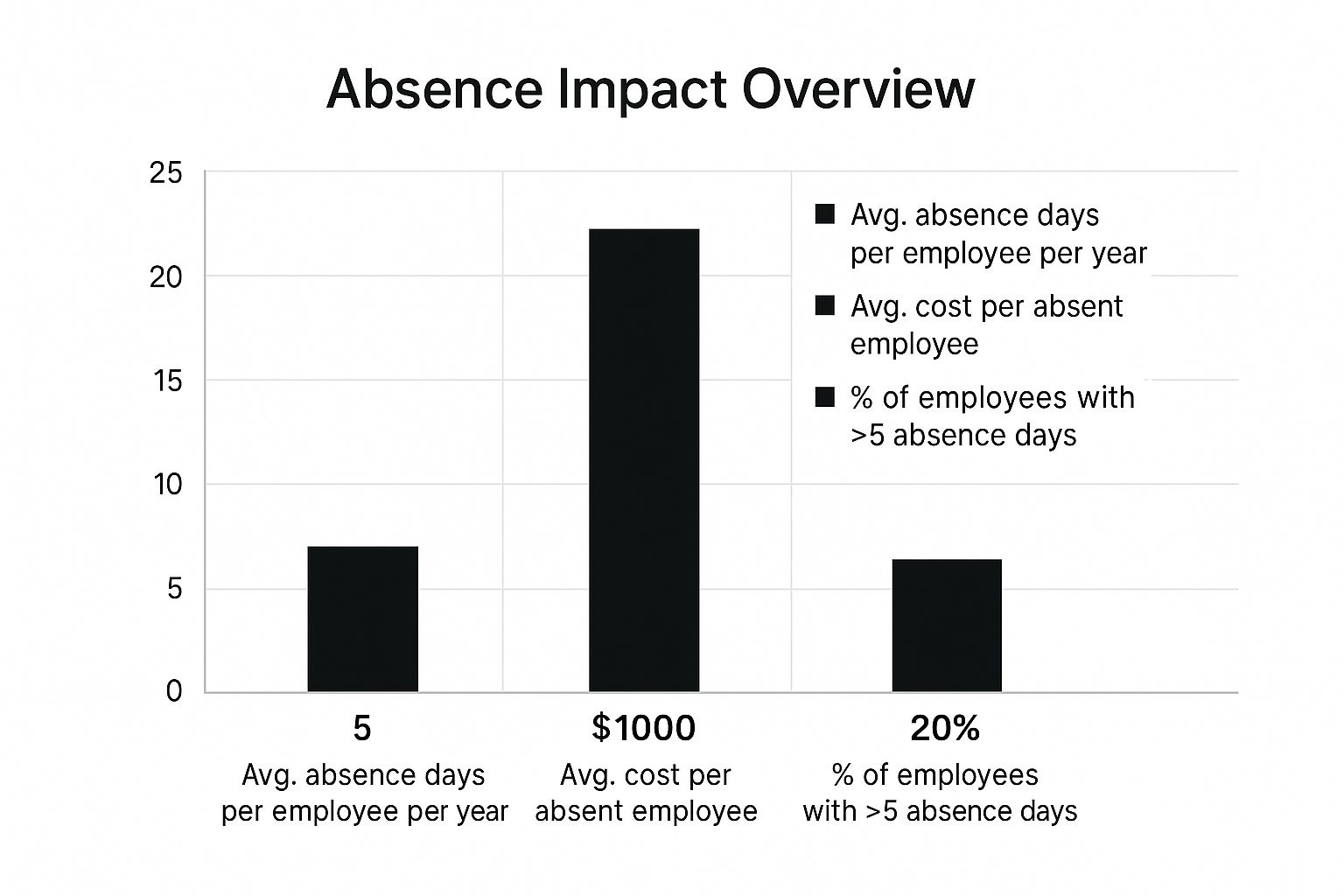
The data doesn't just show the direct costs; it underlines how common absence is, with a big chunk of the workforce taking repeated days off.
The Rise of Stress and Burnout
Workplace stress needs a special mention because it's a massive contributor to both physical and mental health problems. Heavy workloads, impossible deadlines, and a lack of support can quickly lead to burnout, leaving an employee feeling completely drained—emotionally, physically, and mentally.
In 2023, UK absence rates hit 4%, the highest they've been in a decade, with an average of 4.8 working days lost per employee. While coughs and colds fuel short-term absence, it's mental ill-health and stress that are behind most long-term leave. The link between workplace pressure and significant downtime couldn't be clearer.
A culture where employees feel like they can never switch off is a breeding ground for absenteeism. If people are consistently working late or feel pressured to be available 24/7, their wellbeing will eventually take a hit, leading to more time off.
What's more, younger people in the workforce report higher levels of stress and are more likely to take time off for their mental health. This trend is a wake-up call for employers to adapt and provide better support systems. Building trust is key, as many younger employees don't feel comfortable opening up about stress to their line managers. For a deeper look into the top reasons for calling in sick and how to handle them, check out our guide.
Distinguishing Between Absence Types
Understanding the difference between short-term, long-term, and intermittent absence is vital if you want to manage it effectively. Each type tells a different story about what your employee might be going through.
The reasons behind a few days off versus a few months off are often worlds apart. This table breaks down the typical causes for each, helping you spot the difference.
Common Causes of Short-Term vs Long-Term Absence
| Cause Category | Examples in Short-Term Absence | Examples in Long-Term Absence |
|---|---|---|
| Physical Health | Colds, flu, migraines, minor injuries, food poisoning | Serious illness (e.g., cancer), recovery from surgery, chronic conditions |
| Mental Health | A single "mental health day" due to high stress, acute anxiety | Clinical depression, severe burnout, stress-related disorders |
| Personal/Family Issues | Emergency childcare, urgent home repair, family illness | Caring for a seriously ill relative, bereavement, personal crisis |
By sorting absences into these categories, you can move from simply tracking days off to actually diagnosing the underlying problems. A pattern of frequent, short absences might call for a chat about an employee's workload or wellbeing. In contrast, a single long-term absence requires a proper support plan, with regular check-ins and a phased return to work. It’s a much smarter way to prevent problems down the line.
How Absenteeism Impacts Your Bottom Line

When an employee is off sick, the first thing you probably notice is the direct cost of their sick pay. But that’s just scratching the surface. The real financial damage of an unscheduled absence from work ripples through an organisation, hitting everything from team productivity right through to customer happiness.
It’s a costly mistake to see absenteeism as just an HR problem. In reality, it’s a core business issue that chips away at your profits. Every empty desk sets off a chain reaction of hidden costs that add up far quicker than you might think.
The Obvious Financial Drains
Let's start with the costs that are easy to spot on a spreadsheet. These are the direct, tangible expenses that appear on your accounts every time someone is unexpectedly away.
- Sick Pay and Benefits: This is the most straightforward cost – paying an employee who isn't working. It includes their salary and the continuation of benefits like pensions and private health insurance.
- Overtime for Colleagues: To keep things moving, the rest of the team often has to step up and work extra hours. This leads to higher overtime bills and puts them at risk of burnout.
- Temporary Staff Costs: For vital roles or longer absences, you might need to bring in temporary cover. That means agency fees, time spent on training, and accepting that a temp is rarely as productive as a permanent team member.
While these direct costs are significant, they often distract from the deeper, more damaging impacts that aren't so easy to measure.
Uncovering the Hidden Costs of Absence
The true financial toll of absenteeism is what’s happening beneath the surface. These indirect costs can be far more destructive to your business in the long run, affecting morale, output, and even your company's reputation.
An unscheduled absence is never just one person's problem. It’s a team problem that triggers a domino effect of disruption, lost momentum, and added pressure on everyone left to pick up the pieces.
This disruption shows up in a few key ways. Team productivity takes an immediate nosedive as workflows are interrupted and projects grind to a halt. Colleagues who are already busy have to spread themselves even thinner to cover the basics, which can lead to mistakes, missed deadlines, and a big drop in their own output.
The scale of this is staggering. In Great Britain during 2023/24, around 33.7 million working days were lost due to work-related ill health and non-fatal workplace injuries. Stress, depression, and anxiety accounted for a massive 16.4 million of those days, highlighting the powerful link between employee wellbeing and attendance.
The Ripple Effect on Culture and Operations
Beyond lost productivity, frequent absence from work slowly poisons team morale. When reliable employees are constantly picking up the slack for others, resentment starts to build, creating a toxic "us vs. them" atmosphere. This can fracture team spirit and foster a culture where people feel undervalued and overworked.
Managers feel the strain, too. Their time gets hijacked from important, strategic work and redirected to administrative firefighting—shuffling rotas, reassigning tasks, and dealing with the fallout. This admin burden is a major operational drag.
Eventually, this disruption hits your customers. Slower response times, delayed projects, and a drop in service quality are the inevitable results of an understaffed team. This can tarnish your reputation and lead to lost business.
Absenteeism isn't just about the direct cost of a day's work; it fuels wider operational friction that quietly drains profitability. To get a better sense of how other inefficiencies can affect your finances, it’s worth exploring topics like the real cost of manual operational processes. Ultimately, managing absence isn't just a compliance task—it's a critical strategy for protecting your productivity, culture, and financial health.
Turning Absence Data Into Actionable Insights
Just logging that an employee is off sick isn't enough. The real magic happens when you turn that raw data into a clear story about your team's health and wellbeing. Measuring absence effectively transforms you from a manager who just reacts to problems into a proactive leader who can spot and solve issues before they get out of hand.
This isn't about needing a degree in statistics or buying expensive software. It’s about using a few simple, powerful metrics to understand the patterns hiding in plain sight within your attendance records. By tracking the right numbers, you can start to diagnose problems like departmental burnout, gaps in management, or even widespread low morale.
Key Metrics for Measuring Absence
So, how do you start turning that data into real decisions? You need to know what to measure. A handful of key formulas can give you a surprisingly deep understanding of what's really going on in your organisation. Think of these metrics as your diagnostic tools, helping you pinpoint where and why absences are happening.
It’s a bit like a doctor checking vital signs. A high temperature on its own doesn’t tell you the exact illness, but it’s a clear signal that something is wrong and needs a closer look. The same goes for your absence metrics.
To get you started, here’s a breakdown of the most common formulas and what they can tell you about your workforce's attendance patterns.
Key Metrics for Measuring Employee Absence
| Metric | Formula | What It Tells You |
|---|---|---|
| Overall Absence Rate | (Total Lost Days ÷ Total Possible Workdays) × 100 | This gives you a high-level view of absenteeism across the whole organisation. It's your baseline for tracking trends over time. |
| Frequency Rate | Total Number of Absence Instances ÷ Total Number of Employees | This shows how often people are absent, regardless of how long each absence is. A high rate can point to underlying issues like low engagement. |
| Bradford Factor | (Number of Instances)² × Total Days Absent | This one specifically highlights disruptive, frequent, short-term absences. A high score for one person can be a major red flag for managers. |
These simple calculations are the first step to uncovering the story your absence data is trying to tell you.
From Calculation to Interpretation
Once you have these numbers, the real work begins. A high overall absence rate is obviously a problem, but a metric like the Bradford Factor helps you dig deeper. It was specifically designed to identify patterns of frequent, short-term absences—the kind that are often far more disruptive than one single period of long-term leave.
For example, an employee who takes one continuous two-week absence has a much lower Bradford Factor score than someone who takes seven separate two-day absences, even though the total days off are the same. That second pattern is far more damaging to team planning and productivity. You can explore how your own company's data could reveal these hidden patterns by digging deeper into what your data could tell you about leave and absence.
Collecting data is only the first step. The goal is to use these insights to ask better questions: Is one department showing a higher absence rate? Are absences spiking on Mondays and Fridays? Does a particular team have a high Bradford Factor score?
Answering these questions allows you to move from simply recording an absence from work to truly understanding its root cause.
Putting Insights Into Practice
Armed with this information, you can start making targeted, meaningful interventions. If you notice a hotspot in one department, for instance, you could investigate the workload, management style, or team dynamics. Recurring short-term absences might trigger a supportive conversation about an employee's wellbeing rather than an immediate disciplinary process.
The process for turning data into action is refreshingly straightforward:
- Collect Consistently: Make sure you have a reliable system for recording all absences, noting the dates and reasons.
- Calculate Regularly: Run your key metrics monthly or quarterly to establish a baseline and spot any new trends.
- Analyse Patterns: Look for hotspots, recurring days (like the classic Monday spike), or individuals with concerning scores.
- Initiate Conversations: Use the data as a starting point for supportive, fact-based discussions with teams and individuals.
- Implement Solutions: Address the underlying issues, whether that means adjusting workloads, offering flexible working, or providing additional support.
This data-driven approach takes the guesswork out of managing absence, helping you build a more resilient, present, and engaged workforce.
Navigating UK Absence Rules and Policies

Managing an absence from work fairly is one thing, but doing it within the tight boundaries of UK employment law is completely non-negotiable. Get this wrong, and you could be facing serious legal and financial headaches. This isn’t about being heavy-handed; it’s about having a clear, consistent, and legally sound framework that protects both your people and your business.
Think of UK employment law as the official rulebook. You can’t just invent your own approach to handling absence. You have to follow established legal standards that ensure every employee is treated fairly and gets the support they’re entitled to, from sick pay to reasonable adjustments. Getting a firm grip on these core responsibilities is the first step toward managing absence with confidence.
Core Legal Obligations for UK Employers
At the heart of managing absence are several key legal duties you simply must fulfil. These aren't optional extras but fundamental requirements of being an employer in the UK. Nailing these basics forms the foundation of any fair and compliant absence management process.
Your key responsibilities include:
- Paying Statutory Sick Pay (SSP): If an employee is eligible, you are legally required to pay them SSP for up to 28 weeks.
- Respecting the Equality Act 2010: You must not discriminate against an employee because of a disability, which can often be the underlying reason for long-term or frequent absences.
- Upholding a Duty of Care: You have a legal responsibility to ensure the health, safety, and wellbeing of your employees while they're at work.
These duties create a vital safety net, making sure employees are supported during periods of ill health while giving employers a clear structure to operate within.
Understanding Fit Notes and SSP
When an employee is off for more than seven consecutive days, they need to provide a 'fit note' from a healthcare professional. This document is a crucial piece of the puzzle. It doesn’t just confirm someone is unwell; it often advises on what they can do, perhaps suggesting a phased return to work or adjusted duties.
For most employers, the fit note is also the trigger for paying Statutory Sick Pay (SSP). This is the minimum amount you must pay eligible employees who can't work due to illness. It’s important to remember that SSP is a legal floor, not a ceiling—your own company sick pay policy might offer more generous terms. Accurate record-keeping is absolutely essential here. For a deeper dive, our guide to managing sickness absence offers more detailed advice on handling these procedures correctly.
The Equality Act and Reasonable Adjustments
The Equality Act 2010 becomes particularly important when an absence is linked to a disability. A disability is defined as a physical or mental impairment that has a ‘substantial’ and ‘long-term’ negative effect on someone's ability to do normal daily activities.
If an employee's absence is connected to a disability, your legal duty to make reasonable adjustments kicks in. This means you must take practical steps to remove or reduce any disadvantages a disabled employee faces at work.
A reasonable adjustment isn't about giving someone special treatment; it's about levelling the playing field to ensure they have the same opportunities to succeed at work as everyone else.
Examples of reasonable adjustments could be:
- Allowing more flexible working hours.
- Providing specialist equipment, like an ergonomic chair.
- Redistributing minor tasks the employee finds difficult.
- Adjusting absence trigger points in your policy for disability-related leave.
The sickness absence rate in the UK labour market recently stood at 2%, a figure that highlights its impact on productivity. Interestingly, public sector employees were 60% more likely to report sick days than their private sector counterparts, while managers took 40% fewer sick days than other staff.
By staying on the right side of UK law, you build a workplace founded on trust and fairness. This not only minimises legal risks but also fosters a supportive culture where people feel valued, even when they're unable to work.
Proactive Strategies to Reduce Employee Absence
Switching from reacting to absence to actively preventing it is a game-changer. It’s all about creating a workplace where people feel supported, valued, and actually want to show up. Instead of just dealing with the fallout of an empty desk, a proactive approach gets to the heart of what causes people to miss work, building a more resilient and engaged team in the process.
This isn’t about trying to ban sick days – people get ill, that's life. It's about tackling the avoidable absences, the ones driven by burnout, low morale, or a non-existent work-life balance. By focusing on your culture, support systems, and smart management, you can build an environment where absenteeism naturally starts to fall.
The Power of Return-to-Work Interviews
One of the simplest yet most effective tools you have is the return-to-work interview. Don’t think of this as an interrogation or a disciplinary meeting. It's a supportive, informal chat that happens as soon as an employee is back at their desk after any time off.
This conversation does a few critical things:
- It shows the employee you noticed they were gone and that you care.
- It lets you check if they're genuinely well enough to be back.
- It opens the door for them to bring up any underlying issues that might have caused the absence.
- It helps you spot patterns, like recurring small illnesses that could signal a bigger problem brewing.
By addressing absences straight away, you send a clear message that attendance matters. These quick chats can uncover hidden stressors, workload problems, or personal challenges, giving you the chance to offer support before a small issue snowballs into a long-term absence.
Championing Flexibility and Wellbeing
In today's world, a rigid work schedule is a major source of stress and, you guessed it, absence. Offering flexible working arrangements is a brilliant way to empower your team to juggle their personal and professional lives without needing to call in sick unexpectedly.
This could look like flexible start and finish times, compressed hours, or a hybrid working model. When people have some control over their schedule, they're much better equipped to handle school runs, appointments, or caring for a family member, which cuts down on last-minute days off.
Investing in genuine wellbeing initiatives goes far beyond just having a fruit bowl in the kitchen. It means tackling the real sources of workplace stress head-on with manageable workloads, clear communication, and solid support for mental health.
Real wellbeing support gets to the root causes of absence. Research shows younger workers, in particular, respond well to things like reasonable adjustments and mental health training. But there’s a worrying trust gap emerging. The number of 18-24-year-olds comfortable discussing stress with their manager dropped from 75% to just 56% in a single year. This really highlights how urgently managers need to build trust and create a psychologically safe space for their teams.
The Crucial Role of Line Managers
At the end of the day, your line managers are on the front line of managing absence. Their daily interactions, leadership style, and ability to keep communication open have a huge impact on their team's attendance. A manager who checks in regularly can often spot the early warning signs of stress or disengagement and step in before it leads to someone taking time off.
Beyond these direct interventions, a wider approach that includes fostering a positive work environment and implementing effective recruiting and retention strategies is key to overall team stability. By training your managers to lead with empathy, you give them the tools to build the strong, supportive relationships that are the foundation of a healthy, present, and productive team.
Frequently Asked Questions About Absence from Work
Getting your head around the ins and outs of employee absence can feel like a minefield. To help you act with confidence and fairness, here are some straightforward answers to the questions we hear managers asking all the time.
How Should I Handle Frequent, Short-Term Absences?
It’s funny, but a string of short, one-day absences can often cause more chaos than a single, longer period of leave. If you’re noticing this, the first thing to do is have a supportive return-to-work chat after every absence. This isn't about grilling them; it's about understanding what's going on.
Start looking for patterns. Are the absences always tacked onto a weekend? This might point to anything from burnout and workload issues to personal challenges. The key is to address the pattern directly but with empathy, framing the conversation around support, not accusation.
Can I Contact an Employee Who Is Off Sick?
Yes, you can, but there's a right way and a wrong way to do it. Staying in touch is actually a key part of your duty of care. It shows the employee you’re thinking of them and helps you plan for their eventual return.
The goal of any contact should always be to offer support and check on their wellbeing. It’s absolutely not about pressuring them to come back to work. It's a good idea to agree on how often you'll check in so they don't feel harassed.
This gentle contact helps you get a clearer picture of when they might be back and whether you’ll need to make any adjustments for them.
What Is the Difference Between Sick Pay and SSP?
This one trips a lot of people up, but it's quite simple.
Statutory Sick Pay (SSP) is the legal minimum that UK employers must pay to eligible employees who are off sick for four or more days in a row. The rate is set by the government.
Company (or contractual) sick pay, on the other hand, is a more generous payment scheme an employer might offer as part of their benefits package. Your employment contract and absence policy need to spell out your company's sick pay rules clearly, including how long it’s paid for and at what rate.


