
A 9 day fortnight is a clever twist on the traditional work schedule. Instead of the usual ten workdays every two weeks, employees work their full hours over just nine days. This simple change gives them an extra day off every other week, creating a three-day weekend without sacrificing pay or productivity.
What Is a 9 Day Fortnight and How Does It Actually Work?
Think about packing for a 10-day trip using a 9-day suitcase. You wouldn't leave anything important behind; you'd just pack a bit more efficiently. That's the core idea behind the 9 day fortnight. It’s all about reorganising work, not reducing it.
Instead of working five standard days each week, team members work slightly longer on nine days across a two-week period. This small daily extension adds up, creating a full day off every other week—usually a Friday. It’s a fantastic alternative to the four-day week, offering a much-needed boost to work-life balance without a massive operational shake-up.
The Simple Maths Behind the Schedule
Let’s look at a typical full-time employee in the UK on a 37.5-hour weekly contract. The numbers are surprisingly straightforward.
- Total Fortnightly Hours: 37.5 hours/week x 2 weeks = 75 hours
- Traditional Schedule: 75 hours ÷ 10 days = 7.5 hours per day
- 9 Day Fortnight Schedule: 75 hours ÷ 9 days = 8 hours and 20 minutes per day
By adding just 50 minutes to each of the nine working days, an employee earns an entire day off. This approach is quite different from other flexible arrangements because it doesn't cut total working hours. If you're curious about other models, it's worth exploring what annualised hours are and how they compare.
This flowchart neatly illustrates how rearranging hours over fewer days leads to a better life balance.
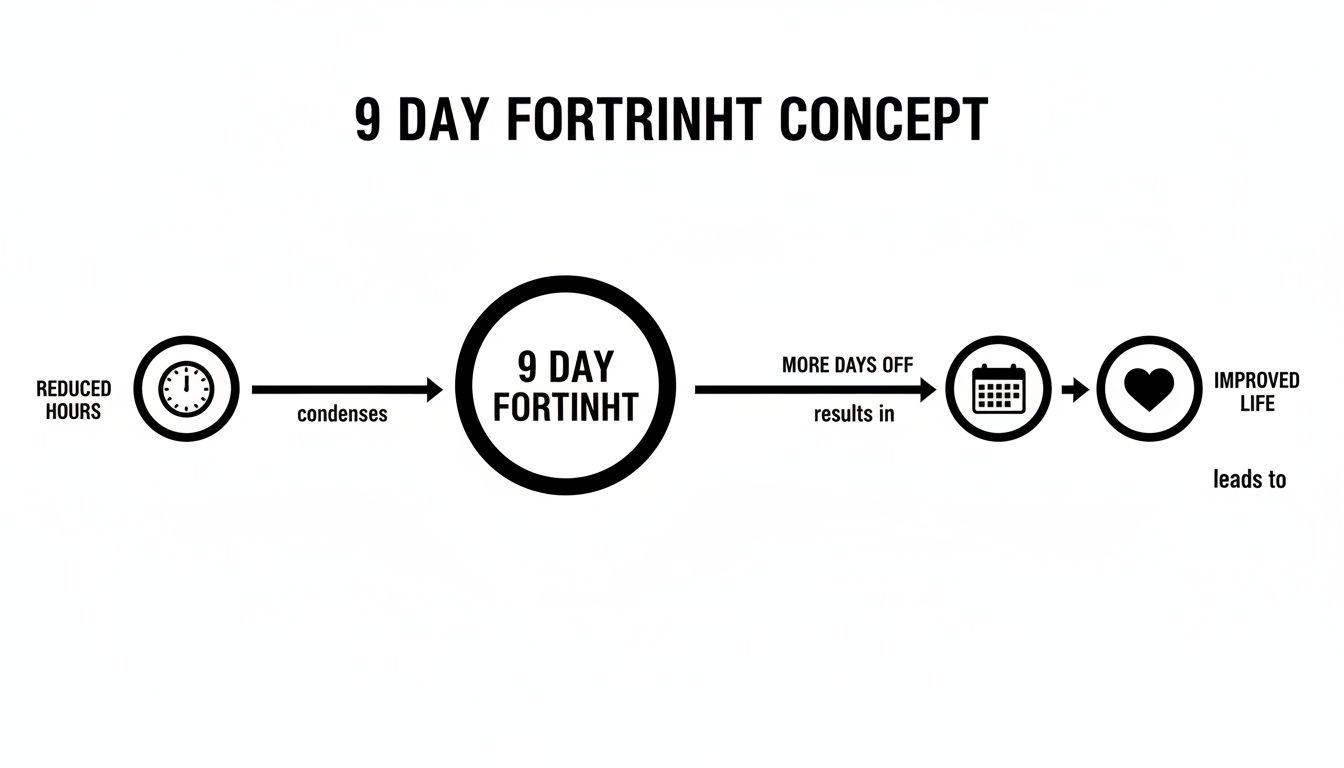
As the visual shows, a minor tweak to daily work hours directly translates into more personal time, which is a huge boost for overall wellbeing.
Why Is It Gaining Popularity?
The appeal of the 9 day fortnight is exploding, especially as businesses hunt for a competitive edge in the talent market. It’s a tangible benefit that goes way beyond salary, directly meeting the growing demand for better work-life integration.
The 9 day fortnight is emerging as a pragmatic and powerful tool for employee retention. It provides the flexibility modern workers crave without the operational overhaul required by a four-day week, making it an accessible strategy for small businesses to attract top talent.
The numbers back this up. In the UK, a massive 68% of professionals would think about switching jobs if a new employer offered a 9 day fortnight. That figure jumps to 72% among workers aged 20-29, who are placing a huge priority on a healthy balance between their careers and personal lives. This makes the model a strategic choice for companies wanting to build a loyal, motivated, and happy team.
9 Day Fortnight vs Traditional 5-Day Week at a Glance
So, how do the two schedules really stack up side-by-side? This table breaks down the key differences for a standard 37.5-hour work week, showing just how impactful the change can be.
| Metric | Traditional 5-Day Week (Per Fortnight) | 9 Day Fortnight (Per Fortnight) |
|---|---|---|
| Total Contractual Hours | 75 hours | 75 hours |
| Working Days | 10 days | 9 days |
| Days Off | 4 days (2 weekends) | 5 days (1 regular weekend, 1 three-day weekend) |
| Average Daily Hours | 7.5 hours | 8.33 hours (8 hours, 20 minutes) |
| Three-Day Weekends | 0 (excluding bank holidays) | 1 |
As you can see, the total work commitment remains identical. The only change is how those hours are distributed, unlocking an extra day of freedom for your team every two weeks.
Weighing the Benefits and Potential Risks
Switching to a 9-day fortnight is a big move. Like any major operational shift, it’s got a compelling list of upsides, but also a few potential snags you need to think about. Getting a clear picture of both sides is the only way to know if this model is truly a good fit for your company’s culture, your day-to-day operations, and where you're headed long-term.
For many businesses that take the leap, the rewards are well worth navigating the initial hurdles.
The most immediate and celebrated benefit is a huge improvement in employee wellbeing and morale. Think about it: an extra day off every other week is a powerful boost. It gives your team proper time for personal appointments, family life, hobbies, or just to switch off and recharge. This creates a workforce that’s more engaged, refreshed, and genuinely motivated when they are on the clock.
This improved work-life balance quickly becomes one of your best tools for attracting and keeping top talent. In a crowded job market, offering a 9-day fortnight can be the single thing that makes a brilliant candidate choose you over a competitor. It’s a tangible perk that shows you’re serious about your team’s welfare.

The Upside: A Closer Look at the Advantages
Beyond the boost in morale, the operational benefits can be surprisingly significant. Many businesses report a real increase in focus and productivity. With the promise of a three-day weekend just around the corner, employees are often far more driven to get their tasks done efficiently.
This isn't just a nice theory; there’s proof in the pudding. Take CharlieHR, a UK-based HR software firm. They brought in the 9-day fortnight back in 2022 and saw a remarkable 11% surge in productivity. Their story shows how compressing hours can sharpen focus without leading to burnout, a trend that’s becoming more common across the UK as adaptable working patterns gain traction.
Other key advantages for your business include:
- Reduced Absenteeism: With a built-in day for life admin, staff are less likely to call in sick or book last-minute time off for appointments, which means more reliable staffing.
- Lower Overheads: Depending on your setup, having the office closed or running on a skeleton crew on that alternate Friday can lead to real savings on utilities like electricity and heating.
- Enhanced Company Reputation: Offering forward-thinking work arrangements paints your brand as a modern, attractive employer. This can seriously improve public perception and help you attract even better candidates.
The Downside: Understanding the Potential Risks
Of course, the 9-day fortnight isn’t a magic bullet, and it’s vital to go in with your eyes open to the challenges. The most common concern is the risk of burnout from the longer working days. Stretching the day, even by less than an hour, can be draining. If you don't manage it carefully, you could easily wipe out the benefits of that extra day off.
The success of a 9 day fortnight hinges on managing energy, not just time. It requires a cultural shift towards focused work and clear boundaries to prevent the longer days from leading to employee fatigue.
Scheduling can also become a major headache, especially for any client-facing or customer service teams that need to be available five days a week. You can’t just shut up shop every other Friday if your customers expect a response. This usually means splitting your team into groups with staggered days off, which definitely adds a layer of admin.
It's crucial to think about these potential roadblocks:
- Implementation Strain: The initial switch takes real planning. You’ll need careful communication and a bit of administrative heavy lifting to amend contracts, update policies, and handle payroll changes.
- Client and Stakeholder Impact: You have to be upfront with clients and partners about your new working pattern. Managing their expectations from the start is key to making sure service levels don’t dip.
- Role Suitability: Let's be honest, not every role is a perfect match for longer days. Jobs that are physically demanding or require hours of intense, unbroken concentration might not be a good fit for this model.
Ultimately, a successful transition comes down to weighing these pros and cons in the context of your specific business. By seeing the risks coming and planning for them ahead of time, you can unlock the massive benefits of a 9-day fortnight and build a more productive and fulfilling place to work.
UK Legal and Payroll Compliance Explained
Moving to a 9 day fortnight is an exciting strategic shift, but it has to be built on a solid legal and financial foundation. The thought of navigating UK employment law and tweaking your payroll might seem a bit daunting, but with a clear plan, it's completely manageable. Getting these details right from day one saves a world of headaches later and keeps you fully compliant.
First things first, you need to make the change official. A quick chat and a handshake won't cut it; you must amend your employees' contracts of employment. This written variation needs to spell out the new working pattern, including the updated daily hours and the schedule for that glorious fortnightly day off. This creates a clear, legally binding record that protects both you and your team.
Keep in mind that under the Employment Relations (Flexible Working) Act, UK employees have the right to request flexible working arrangements from their very first day on the job. While a 9 day fortnight is often a company-wide decision, this law provides the backdrop, highlighting just how important it is to have a fair and transparent process.
Amending Contracts and Handling Overtime
When you change an employee's daily hours, you're also shifting the goalposts for calculating overtime. For instance, if the new standard day is 8 hours and 20 minutes, overtime only kicks in after an employee has worked past that point on a scheduled workday.
Your updated employment contract must be crystal clear about this to sidestep any future disputes. Make sure you specify the new standard hours and define exactly when overtime rates apply. This bit of proactive clarification ensures everyone is on the same page and helps you manage wage costs effectively.
A common pitfall is forgetting to update overtime policies to match the new compressed hours. To stay compliant and fair, your payroll system must be reconfigured to recognise the new, longer standard workday before it starts calculating overtime pay.
Managing Holiday Entitlement and Bank Holidays
One of the trickiest parts of this whole process is calculating annual leave, especially when bank holidays get involved. Full-time employees in the UK are entitled to a minimum of 5.6 weeks of paid holiday per year. When you're on a compressed schedule, it’s much simpler to calculate this entitlement in hours instead of days.
Here’s a simple way to look at it:
- Standard Entitlement: 5.6 weeks x 37.5 hours/week = 210 hours of annual leave.
- Taking a Day Off: An employee on a 9 day fortnight would simply deduct 8 hours and 20 minutes from their total leave balance for each day they take off.
- Bank Holidays: What if a bank holiday lands on an employee’s scheduled non-working Friday? They are still entitled to that day's leave. You have to let them take the equivalent hours (e.g., 8 hours and 20 minutes) at another time.
This approach ensures everything is fair and legally sound. Manually tracking all these hour-based calculations can get complicated fast, which is why many businesses opt for an automated system. If you want to get into the nitty-gritty, our detailed guide can help you correctly calculate holiday pay for all sorts of work patterns.
Ensuring Fairness for Part-Time Employees
It's absolutely crucial that part-time employees are treated fairly under the new model. If a part-time worker’s schedule isn't affected by the company-wide 9 day fortnight, their contract and holiday entitlement might not need to change at all.
However, if they also want to switch to a compressed working pattern, their hours and leave must be calculated on a pro-rata basis to avoid any hint of discriminatory practice. For example, an employee working 0.5 FTE (Full-Time Equivalent) would get half the total leave hours (105 hours) and would work a compressed schedule based on their own contracted hours. Keeping things equitable is essential for both legal compliance and happy team relations.
Your Step-by-Step Implementation Plan
Successfully introducing a 9 day fortnight is a bit like planning a journey. You wouldn't just jump in the car and hope for the best; you need a map, a clear destination, and planned stops along the way. A practical, phased approach is the only way to guarantee a smooth transition, minimise disruption, and set your new working model up for success.
This isn't just about tweaking schedules; it's about carefully managing a huge cultural shift. The rising popularity of compressed working weeks in the UK makes having a solid plan more important than ever. ONS data shows that these models are a growing trend, and a recent Hays survey found that 28% of employers are either implementing or considering a 9 day fortnight—that's even more than the four-day week at 22%. If you fancy digging into the data, you can discover more insights about flexible working trends from CIPD.
Phase 1: The Planning and Assessment Stage
Before you even think about announcing anything, you've got to do your homework. This is the foundation. It’s all about figuring out if this is truly feasible for your business and designing a model that fits your specific needs, not just copying what another company has done.
First, you need to conduct a role suitability analysis. Let’s be honest, not every job is a natural fit for longer days. Think about roles that are physically demanding or require intense, sustained concentration. You need a clear-eyed view of which positions can adapt easily and which might need a different approach.
Next, you have to pick a scheduling model that keeps the lights on.
- All-Hands Model: Everyone takes the same Friday off. It’s simple to manage, but it only really works if your business can afford to shut down completely for that day.
- Split-Team Model: This is the most common approach for a reason. You divide your staff into two groups (say, Team A and Team B). Team A gets the first Friday off, and Team B gets the second. This setup guarantees your business is fully operational every single day.
Finally, get a draft policy document down on paper. This should cover the proposed hours, the scheduling system, and the rules around things like leave and overtime. Having a draft ready makes the next phase so much clearer. For more help with this, check out our tips for managing flexible work arrangements with top strategies.
Phase 2: Communication and Feedback
How you roll this out is just as important as the change itself. Clear, honest, and two-way communication is your best tool for getting the team on board and tackling concerns before they turn into real problems.
Kick things off with an all-staff meeting to announce the plan. Explain the 'why' behind the decision—talk about the benefits like better work-life balance and deeper focus. Present your draft policy and be completely transparent about the fact that workdays will be longer.
A successful rollout is built on trust. Present the 9 day fortnight not as a final decree, but as a collaborative experiment you are embarking on together. This approach invites valuable feedback and fosters a sense of shared ownership.
After the big announcement, open up the channels for feedback. Use anonymous surveys, suggestion boxes, or small group sessions to get genuine opinions and hear people's worries. This feedback is gold—use it to fine-tune your draft policy and schedule before you go any further.
Phase 3: The Trial Period
Whatever you do, don't go straight from a plan to a permanent policy. A mandatory trial period, usually lasting between three and six months, is the most critical part of this whole process. It gives you a chance to test the model in the real world, collect data, and make adjustments without committing fully.
Before the trial starts, define what success looks like. How will you know if it's working? Your metrics should be balanced and cover a few key areas:
- Productivity Metrics: Keep an eye on output, project completion rates, and any KPIs that are relevant to each role.
- Employee Wellbeing: Use regular pulse surveys to measure stress levels, morale, and how people feel about their work-life balance.
- Operational Metrics: Monitor things like absenteeism rates, customer satisfaction scores, and response times to make sure service levels aren't slipping.
Throughout the trial, schedule regular check-ins with managers and staff. You need to know what's working and what isn't. Be prepared to be flexible and tweak the system based on what you learn.
Phase 4: Full Rollout and Integration
Once the trial is over and you’ve crunched the numbers, it’s time for the full rollout. This final phase is all about making the 9 day fortnight official and weaving it into your company's DNA.
First, finalise and formally issue the official 9 Day Fortnight Policy. This document should be updated with all the lessons you learned during the trial. Then, work with your legal and HR teams to issue the necessary amendments to employee contracts, making the new arrangement official.
Finally, make sure the new schedule is integrated into all your systems—from your payroll software to your project management tools. This step is what makes the change permanent. It's how you move it from being a temporary project to a core part of your company culture.


