
Ever wondered how many working days there are in a typical UK year? It’s one of those numbers that seems simple on the surface, but getting it right is crucial for just about every part of running a business.
The short answer is there are, on average, 253 working days in a year in the UK. This nudges up to 254 in a leap year. But think of this as a starting point, not a fixed rule.
Your Quick Answer to UK Working Days

Knowing the number of working days is the bedrock of your operational calendar. It’s the magic number you need for accurate payroll, fair annual leave calculations, and realistic project timelines. So, why isn't it the same every single year?
The final count always comes down to three key ingredients, each of which can change:
- Total days in the year: It’s either 365 or, every four years, 366.
- Weekends: This is the most stable part of the calculation. There are 52 weeks in a year, giving us 104 weekend days to subtract.
- Bank holidays: For England and Wales, we typically have 8 standard bank holidays, but this figure can and does change.
This section is your quick reference guide. We’ll give you the number and the simple maths behind it before diving into the nitty-gritty details that really matter for HR managers and business planners. The final number can shift slightly depending on when bank holidays fall and whether any special, one-off holidays pop up.
A perfect example was the extra bank holiday for the King’s Coronation in 2023, which brought the working day count down to 251 for that year in England. Because of these small variations, most UK organisations use a range of 251–254 days as a solid benchmark for planning.
For a full-time employee, this works out to roughly 1,850–1,860 total working hours a year. It's a useful figure to keep in mind and a world away from the work patterns of past centuries. You can discover more insights about UK working day calculations on leavetrackapp.com.
To make it even clearer, here’s a simple table breaking down the calculation for a standard year versus a leap year.
UK Working Days At a Glance
| Calculation Step | Standard Year | Leap Year |
|---|---|---|
| Total Calendar Days | 365 | 366 |
| Weekend Days to Subtract | 104 | 104 |
| Standard Bank Holidays | 8 | 8 |
| Average Working Days | 253 | 254 |
This quick breakdown gives you the baseline numbers we’ll be working with throughout the rest of this guide.
Getting to Grips with the Working Day Formula
Figuring out the number of working days in a year might sound like a headache, but the truth is, it boils down to a bit of simple subtraction. There’s no complex algorithm here, just a straightforward formula anyone can get their head around.
Think of the calendar year as a complete block. All you’re doing is chipping away the non-working days—all those weekends and bank holidays—to see what you’re left with. That final number is the solid core of working time you have, and it's absolutely vital for everything from project planning to managing your team's holiday requests.
At its heart, the calculation is beautifully simple: Total Days in the Year – Total Weekend Days – Total Bank Holidays = Total Working Days. This is your bedrock for getting a realistic handle on team availability.
This formula isn't just about getting a number; it's about bringing clarity and consistency to your business planning and taking the guesswork out of the equation.
Breaking Down Each Part of the Formula
Let's pull apart each piece of that sum to see how it works in the real world. You’ll find that two of the three components are pretty much fixed, which makes the whole thing a lot less daunting than it seems.
1. Total Days in the Year
This is your starting point—the total number of days on the calendar.
- In a standard year, this is always 365.
- When a leap year rolls around every four years, we add an extra day, making it 366.
2. Total Weekend Days
This part of the calculation is the most stable. A year has 52 full weeks.
- With two weekend days (Saturday and Sunday) for every week, we get a constant 104 weekend days to subtract. This figure rarely changes, giving you a solid foundation for your maths.
3. Total Bank Holidays
Here’s the only part of the formula that really changes. The number of official public holidays depends on where in the UK your business is based.
- England and Wales: You're typically looking at 8 standard bank holidays.
- Scotland: Usually gets 9 bank holidays.
- Northern Ireland: Has the most with 10 bank holidays.
Putting the Formula into Practice
Right, let's put these numbers to work with a practical example. We’ll calculate the working days for a standard, non-leap year for a company based in England.
Here’s how it breaks down, step-by-step:
- Start with the total days: 365
- Take away all the weekend days: 365 – 104 = 261
- Finally, subtract the bank holidays: 261 – 8 = 253
And there you have it. For a standard year in England and Wales, you’re left with 253 working days.
This simple process turns a vague question into a concrete number you can rely on for accurate payroll, fair pro-rata holiday calculations, and sensible project timelines. By mastering this formula, you give yourself the power to plan the year with genuine confidence, knowing all your calculations are built on solid ground.
How Bank Holidays and Leap Years Change the Math
So, we have a simple formula for calculating working days. It gives us a solid baseline, but let's be honest, the real world is rarely that neat. A few variables can pop up and shift the final number, which is why a one-size-fits-all answer just doesn't work. It’s also why any savvy UK business needs to recalculate this figure every single year.
The most famous culprit is the leap year. Popping up every four years, it adds an extra day—29th February—to the calendar. When this day lands on a weekday, which it often does, it directly adds one more working day to the year. This little tweak is enough to push the average from 253 to 254.
This simple visual shows how it all breaks down: start with the total days in the year, then subtract weekends and bank holidays to get your final number.
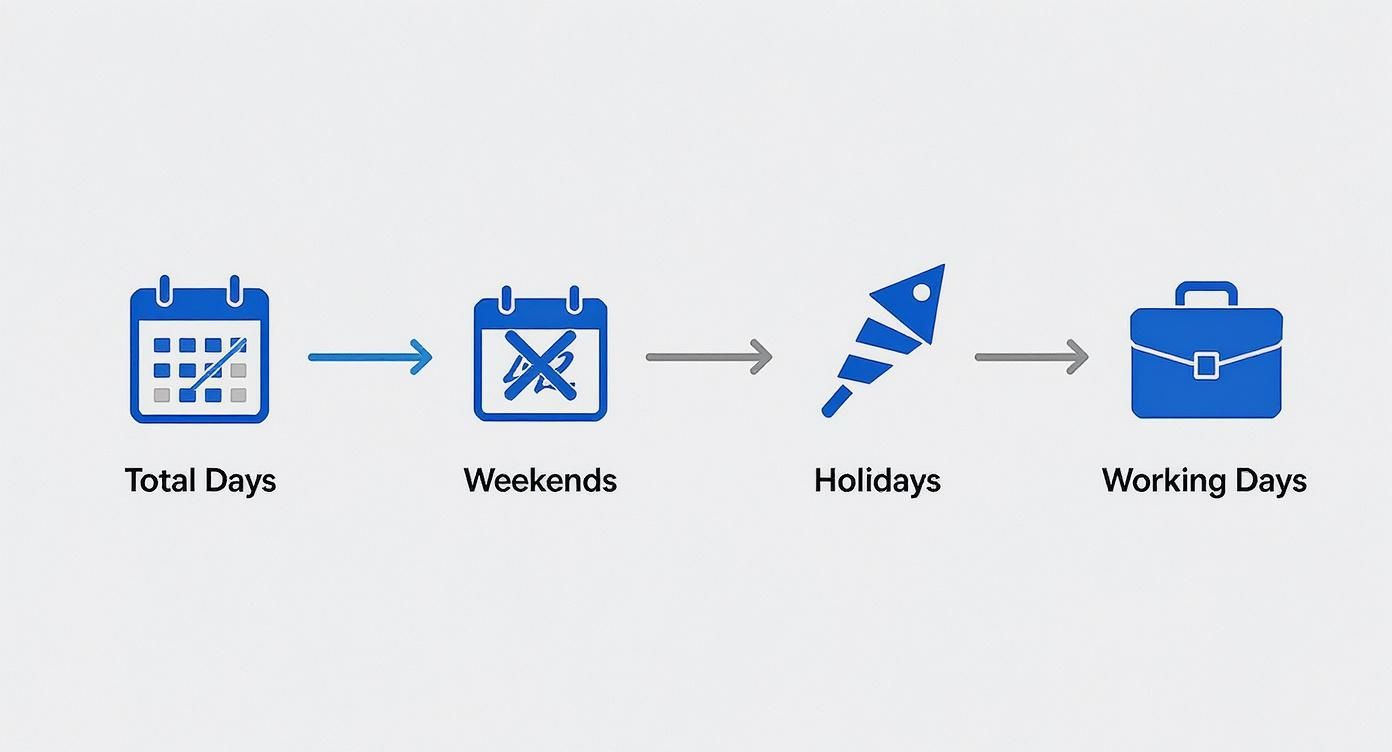
As you can see, the bank holidays are the final, and most unpredictable, piece of the puzzle.
Navigating Regional Bank Holiday Differences
One of the biggest reasons for the variation is that the UK doesn’t have a single, unified list of bank holidays. It’s a common misconception. While many days off are shared, each nation has its own unique dates, creating different working calendars depending on where you are.
- England and Wales share a standard list of 8 bank holidays.
- Scotland gets 9 bank holidays, including St Andrew's Day at the end of November.
- Northern Ireland observes 10 bank holidays, with its own unique days like St Patrick's Day and the Battle of the Boyne (Orangemen's Day).
These regional quirks mean a company with offices in Cardiff and Belfast has to juggle two different working day totals for accurate payroll and resource planning. It’s a detail that’s easy to miss but crucial to get right. You can dive deeper into the history and nuances with these 10 interesting facts about UK bank holidays.
To make this clearer, let's look at how the standard holidays stack up across the nations.
UK Bank Holiday Comparison
The table below gives you a side-by-side look at the official public holidays. Notice how some are consistent across the board, while others are specific to just one or two nations.
| Bank Holiday Name | England & Wales | Scotland | Northern Ireland |
|---|---|---|---|
| New Year's Day | Yes | Yes | Yes |
| 2nd January | No | Yes | No |
| St Patrick's Day | No | No | Yes |
| Good Friday | Yes | Yes | Yes |
| Easter Monday | Yes | No | Yes |
| Early May Bank Holiday | Yes | Yes | Yes |
| Spring Bank Holiday | Yes | Yes | Yes |
| Battle of the Boyne | No | No | Yes |
| Summer Bank Holiday | Yes | Yes | Yes |
| St Andrew's Day | No | Yes | No |
| Christmas Day | Yes | Yes | Yes |
| Boxing Day | Yes | Yes | Yes |
As you can see, your location in the UK directly impacts your annual working day count. Always be sure to use the correct holiday calendar for your specific nation to keep everything accurate and compliant.
Understanding Substitute Holidays
Another spanner in the works is the "substitute day" rule. This is a clever system that ensures you don't lose out on a public holiday just because it happens to fall on a weekend.
For example, if Christmas Day lands on a Saturday and Boxing Day is on a Sunday, the following Monday and Tuesday are designated as substitute bank holidays. These days off are then subtracted from the year's total, just like any other public holiday. It’s a simple but effective way to prevent the working year from being artificially inflated when dates clash.
The Impact of Special Occasions
Finally, the calendar can be thrown a real curveball by special one-off bank holidays. These are granted for significant national events, announced by the government, and they instantly change the maths for that specific year.
We’ve had a few of these recently:
- The Queen’s Platinum Jubilee in 2022.
- The State Funeral of Queen Elizabeth II, also in 2022.
- The Coronation of King Charles III in 2023.
Each of these events trimmed the total working days for that year, highlighting exactly why you can't just copy and paste last year's numbers. All these variables prove that recalculating the working days annually isn't just good practice—it's absolutely essential for running your business smoothly.
Why Accurate Working Day Counts Are Crucial for Business

Figuring out the exact number of working days in a year in the UK can feel like a small detail on a long to-do list. But this single number is actually the foundation for several critical parts of your business. Get it wrong, and you're not just looking at a minor spreadsheet error; you could be facing serious financial, legal, and operational headaches down the line.
Think of the working day count as the basic unit of time your business runs on. Just as a builder needs precise measurements to put up a solid wall, your business needs an accurate day count to build a stable operational plan. Relying on a rough guess or simply using last year's number is like building on shaky ground.
The Financial Impact on Payroll
The most immediate—and often most painful—hit from an incorrect working day count lands squarely on payroll. For salaried employees, this number is the key to working out their daily rate of pay.
This becomes incredibly important when someone leaves the company part-way through a pay period. To calculate their final salary correctly, you have to know exactly how many working days were in that month or year. An inaccurate figure can lead to overpaying them (which is a real hassle to get back) or underpaying them, which is a surefire way to damage morale and potentially trigger legal issues.
Getting payroll right is non-negotiable. An incorrect working day count can lead to miscalculated daily pay rates, affecting everything from final salary payments for leavers to accurate accruals for holiday pay, creating avoidable financial risk.
Of course, a solid handle on working days is just one piece of the puzzle. For a wider look at keeping your company's finances in order, these 10 Actionable Small Business Accounting Tips are well worth a read.
Ensuring Fair and Compliant Holiday Calculations
Over in HR, the total working days figure is the starting point for all pro-rata annual leave calculations. This is absolutely vital for treating your team members fairly and staying on the right side of the law, especially for anyone who doesn't work a standard, full year.
Just think about these common situations:
- New Starters: Someone who joins in April is entitled to a fair slice of the full year's holiday allowance, not the whole cake.
- Leavers: An employee leaving in September has earned a specific amount of leave based on the time they've worked.
- Part-Time Staff: Their holiday entitlement is based on the days they actually work, which has to be measured against the total working days available in the year.
Without a precise, year-specific total, these pro-rata calculations become pure guesswork. You could end up giving an employee too little holiday (a compliance risk) or too much (a direct cost to the business).
Driving Predictable Project Planning
For anyone managing projects or operations, the number of working days directly shapes every single timeline. It dictates how you allocate resources, when you can promise delivery, and what you can tell your clients.
Imagine you're mapping out a three-month project that kicks off in November. That November-to-January window is packed with bank holidays like Christmas, Boxing Day, and New Year's Day, giving you far less real working time than, say, May to July.
An accurate count lets managers build realistic schedules, assign staff effectively, and communicate deadlines they can actually hit. Using a vague estimate is how projects end up running late and over budget, which never fails to damage client trust and team morale. This number truly underpins the success of your entire operational calendar.
Calculating Pro-Rata Holiday for Your Team
Figuring out holiday entitlement for team members on non-standard schedules can feel like a headache, but getting it right is crucial. This is where pro-rata, or proportional, leave comes in. It’s all about fairness, making sure everyone from part-time workers to new starters and leavers gets the holiday allowance they're entitled to.
Think of it like this: your company's full annual leave entitlement is a whole cake. A full-time employee who’s there for the entire year gets the whole cake. But what about someone who only works six months, or just three days a week? They’re entitled to a fair slice, not the entire thing. To cut that slice accurately, you first need to know the total working days in a year uk.
Getting this calculation spot on isn't just good management; it's a legal must. A miscalculation can quickly lead to unhappy employees, payroll headaches, and even land you in a dispute. The secret is to have a clear, consistent formula you can apply every single time.
Calculating for Part-Time Employees
The most common reason you'll need to calculate pro-rata leave is for your part-time staff. It’s actually more straightforward than you might think.
In the UK, the statutory minimum holiday entitlement is 5.6 weeks. For a part-timer, you just need to multiply this by the number of days they work each week. This simple step ensures their entitlement is perfectly balanced against their full-time colleagues.
- The Formula: 5.6 weeks x (Number of days worked per week) = Annual leave entitlement in days.
Let’s take a real-world example. Say you have an employee who works 3 days a week:
- 5.6 weeks x 3 days = 16.8 days of annual leave.
This gives you a clear, compliant figure to work with. It's always a good idea to have a company policy on rounding. Most businesses choose to round up to the nearest half or full day – it’s a small gesture that employees really appreciate.
Calculating for Mid-Year Starters and Leavers
The other big one is managing leave for people who join or leave part-way through your holiday year. Their entitlement is simply based on the portion of the year they’ve actually worked for you.
To work this out, you’ll need two key numbers: the employee's full-time annual leave entitlement (e.g., 28 days including bank holidays) and the total number of working days in that specific year. From there, you can figure out what fraction of the full entitlement they've accrued.
Let's imagine a new starter joins on 1st July, and your holiday year runs from January to December. They’ll be working for exactly half the year (6 out of 12 months).
- The Formula (Monthly): (Full annual entitlement ÷ 12) x Number of months worked.
- Example: (28 days ÷ 12) x 6 months = 14 days of holiday.
You’d use the exact same logic for someone leaving the company. You calculate the leave they've built up to their final day to make sure their last payslip is 100% accurate. For a deeper dive into more complex situations and formulas, check out this complete guide on how to calculate prorated leave to keep your calculations spot on.
Mastering these straightforward formulas takes the guesswork out of holiday planning. It creates transparency with your team and, most importantly, keeps your business fully compliant with UK employment law.
How to Automate Working Day and Leave Calculations
Relying on a spreadsheet to calculate the working days in a year in the UK is a bit like walking a tightrope without a safety net. It's risky, time-consuming, and one wrong move—a misplaced formula or a forgotten bank holiday—can create massive payroll and compliance headaches.
Suddenly, you're losing hours of precious admin time just to fix a simple mistake. Manual processes are just so prone to human error, especially when you start juggling pro-rata entitlements or regional holiday differences.
Automation takes that risk off the table completely. A dedicated system doesn’t make typos, and it certainly doesn’t forget about leap years. It’s built for precision from the ground up.
Automation transforms leave management from a reactive administrative chore into a proactive, error-free system. It guarantees accuracy and frees up your team to focus on strategic work rather than manual data entry.
Modern HR software handles all these complex calculations in an instant. It automatically stays up-to-date with the latest bank holidays for England, Scotland, Wales, and Northern Ireland, and it seamlessly works out pro-rata leave for new starters or part-time staff.
Making the switch isn't just about saving time; it's about making sure your business is always compliant and your records are spot on. Exploring HR process automation is the logical next step for any business looking to boost efficiency and cut down on the admin burden.
Even with the formulas down, real-life scenarios always throw up a few curveballs. Let's tackle some of the most common questions that pop up when you're trying to figure out the exact number of working days in a year in the UK.
Do Working Days Differ Across the UK?
They certainly do. While England and Wales operate on the same calendar with 8 bank holidays, things look a little different elsewhere. Scotland gets 9 public holidays, thanks to St Andrew's Day, and Northern Ireland has 10, including St Patrick's Day.
What this means in practice is that a company based in Belfast will have a slightly different working year to one in Bristol. It's a small detail, but a crucial one – always make sure you're using the right regional holiday calendar for your calculations to be spot on.
How Do I Handle Part-Time Holiday?
When it comes to part-time staff, the focus shifts from the total working days in the year to their specific pro-rata holiday entitlement. The key figure here is the statutory minimum of 5.6 weeks.
The calculation itself is straightforward:
- 5.6 weeks × (number of days worked per week) = total holiday days.
So, if you have an employee who works 3 days a week, they’re entitled to 16.8 days of annual leave (5.6 × 3). This simple bit of maths ensures their holiday time is fair and proportional to their full-time colleagues.
If a bank holiday falls on a day your part-time employee normally works, they are entitled to that day off. This should be deducted from their total pro-rata holiday allowance to ensure fairness and compliance.
What Happens When a Bank Holiday Is on a Weekend?
It’s a classic British problem: a bank holiday lands on a Saturday or Sunday. When this happens, a 'substitute' day – almost always the following Monday – becomes the official public holiday instead.
This system ensures no one misses out on their well-deserved day off. For your calculations, you just treat this substitute day like any other bank holiday and subtract it from the year's total. It’s a simple fix that keeps the final count of working days accurate.


