
When it comes to UK annual leave entitlements, the law gives pretty much every worker a clear starting point. You’re legally entitled to a minimum of 5.6 weeks of paid holiday each year. This isn't just a nice-to-have; it's a fundamental right designed to make sure everyone gets proper rest and a decent work-life balance.
Your Basic UK Annual Leave Rights
Let’s cut through the legal jargon and get straight to what you need to know about your holiday rights.
For most people working a standard five-day week, that legal minimum of 5.6 weeks translates directly into 28 days of paid time off a year. Think of this as the absolute baseline—the minimum your employer must provide.
But here’s where it can get a little confusing: what about bank holidays? Your employer has a choice. They can either include the eight annual bank holidays as part of your 28-day entitlement or offer them as extra paid days off on top. Whichever way they do it, this has to be spelled out clearly in your employment contract.
Statutory vs Contractual Leave
It's really important to get your head around the two main types of annual leave. The easiest way to think about it is like building a house: one part is the foundation, and the other is an optional extension.
- Statutory Annual Leave: This is the legal minimum of 5.6 weeks. It's the non-negotiable foundation of your holiday rights, required by UK law to protect every worker's wellbeing.
- Contractual Annual Leave: This is any extra holiday your employer offers on top of the statutory minimum. These additional days are a contractual perk, often used by companies to attract and keep good people.
For instance, if your contract says you get 33 days of holiday including bank holidays, you're getting a better deal than the legal minimum. You have 25 days of contractual leave plus the 8 bank holidays. The statutory minimum would only be 20 days plus the 8 bank holidays.
Entitlement for Different Work Patterns
The right to paid holiday applies to everyone, but how it's calculated adapts to your specific work schedule. It’s all about making it fair.
Part-time employees, for example, get a proportional amount, often called 'pro-rata'. If someone works a three-day week, they’re legally entitled to 16.8 days of paid leave per year (3 days × 5.6 weeks). Simple as that.
For those with irregular hours, holiday time builds up based on the hours they actually work. This is often calculated using an accrual rate of 12.07% of hours worked. This system ensures fairness across the board, guaranteeing everyone gets the paid time off they've rightfully earned.
For a quick reference, here’s how the minimum entitlement breaks down for common work patterns.
Statutory Annual Leave by Work Pattern
| Working Days per Week | Weeks Entitlement | Minimum Days Entitlement |
|---|---|---|
| 5 Days | 5.6 weeks | 28 days |
| 4 Days | 5.6 weeks | 22.4 days |
| 3 Days | 5.6 weeks | 16.8 days |
| 2 Days | 5.6 weeks | 11.2 days |
| 1 Day | 5.6 weeks | 5.6 days |
This table gives you a clear snapshot of the legal floor for holiday pay. Remember, your employer can always offer more, but they can't offer less.
If you want to dive deeper into these calculations or explore more detailed scenarios, you can find a whole host of insights about UK annual leave entitlements on LeaveTrackApp.com.
Calculating Holiday for Part-Time and Irregular Hours
Things get a little more detailed when you step away from the straightforward world of full-time contracts. For part-time staff and those working irregular hours, the core principle of fairness is exactly the same, but the maths just looks a bit different. The goal is always to make sure everyone gets a proportional slice of paid time off.
This visual guide breaks down the fundamental difference between the legal minimum and what a company might offer on top.
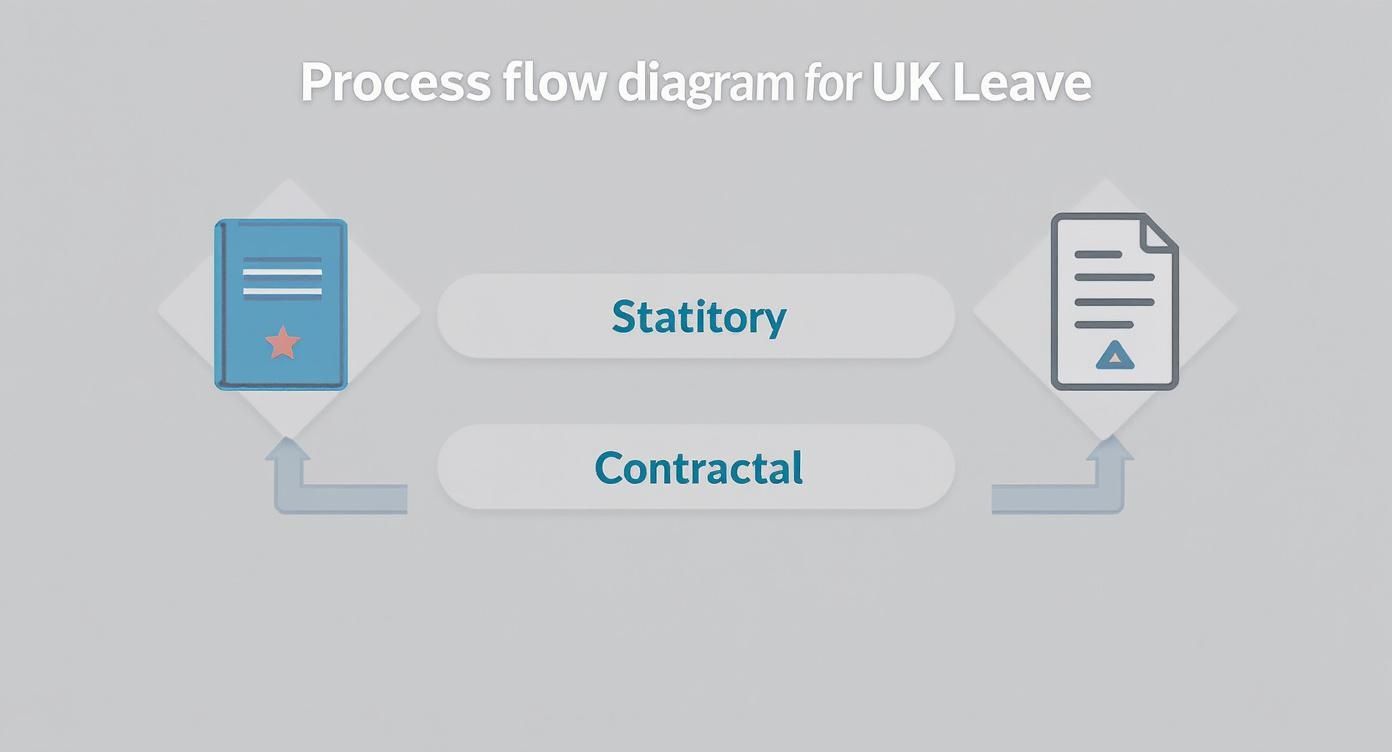
As the flowchart shows, statutory leave is the legal floor. Contractual leave is any extra holiday your company chooses to provide as a benefit.
Pro-Rata Holiday for Part-Time Workers
Let's start with part-timers who work a set number of days each week. Thankfully, this calculation is nice and simple. You just multiply the number of days they work per week by the statutory entitlement of 5.6 weeks.
- An employee working 3 days a week gets: 3 days × 5.6 weeks = 16.8 days of annual leave.
- Someone working 2 days a week gets: 2 days × 5.6 weeks = 11.2 days of annual leave.
This pro-rata method ensures part-time staff receive the same holiday entitlement, relative to the time they work, as their full-time colleagues. For a deeper dive, our guide explains how to calculate prorated leave with more complex examples.
The Accrual Method for Irregular and Zero-Hour Contracts
But what about workers whose hours chop and change from one week to the next, like casual staff or those on zero-hour contracts? For these situations, the entitlement is calculated as it's earned—or 'accrued'.
Think of it like a holiday savings pot. For every single hour an employee works, a tiny fraction of paid holiday time gets added to their pot.
The standard way to work this out is by using the 12.07% figure. This number isn't plucked from thin air; it comes from the 5.6 weeks of statutory holiday, divided by the remaining 46.4 working weeks of the year (52 weeks – 5.6 weeks = 46.4).
The 12.07% Rule in Action
If a zero-hour contract worker logs 50 hours in a month, their holiday accrual for that period is: 50 hours × 12.07% = 6.035 hours of paid leave.
This system makes sure their holiday entitlement is a direct reflection of the hours they've actually put in, creating a fair and compliant approach for flexible working patterns.
Calculating Holiday Pay for Variable Pay Workers
Another crucial piece of the UK annual leave entitlements puzzle is figuring out the rate of pay for holidays, especially for employees whose earnings fluctuate. This is common for staff who get commission, bonuses, or regular overtime.
For these workers, you can't just base their holiday pay on their basic salary. The law says it must reflect their average weekly pay over a 52-week reference period. Critically, this calculation must exclude any weeks where they received no pay at all.
This means you have to look back over the previous year to calculate what their true average "week's pay" is. It’s a vital step to ensure they don't lose out on expected income just because they’re taking a well-deserved break—and it keeps you fully compliant.
How Holiday Time Builds Up and When You Can Take It
Your annual leave doesn't just appear in a lump sum on day one. Instead, it builds up, or accrues, from the moment you start your job. Think of it like a savings account for time off, where you deposit a little bit more with every month you work.
This all happens within a defined period known as the ‘leave year’. This is simply the 12-month window during which you’re expected to take your holiday entitlement.
Your employer gets to decide when this leave year starts and ends. It doesn't have to follow the calendar year at all. Common examples include:
- January to December: The most straightforward option, aligning with the standard calendar year.
- April to March: A popular choice for businesses that want to match the UK financial year.
- Employee Start Date: A rolling year based on your individual start date, which can be a bit more complex to track.
Whatever system your company uses, it should be clearly spelled out in your employment contract.
The Rules for Booking Your Time Off
Once you’ve got some holiday banked, you’ll naturally want to book it. But there are a few rules of the road for both you and your employer to make sure the process is fair and doesn't leave teams in the lurch.
The key principle is giving enough notice. The standard rule of thumb is that you must give notice that is at least twice as long as the leave you want to take. So, if you're planning a week-long getaway, you need to put in your request at least two weeks beforehand. This gives your manager a reasonable amount of time to arrange cover and plan for your absence.
Notice Periods: A Quick Guide
- Requesting 1 week of leave? Give at least 2 weeks' notice.
- Requesting 2 weeks of leave? Give at least 4 weeks' notice.
- Requesting a single day off? Give at least 2 days' notice.
Can Your Employer Tell You When to Take Leave?
In a word, yes. Your employer has the right to require you to take your holiday on specific dates. A classic example is a company-wide Christmas shutdown where everyone is expected to use their annual leave.
However, the same notice principle applies in reverse. If they're telling you to take leave, they must give you at least twice as much notice as the period of leave they are making you take.
By the same token, an employer can refuse a holiday request. They can't do it on a whim, though; there must be a valid business reason. They also have to provide notice that's at least as long as the leave you requested.
Clear communication is the secret ingredient here. It helps manage everyone's expectations and ensures the whole process for the accrual of leave runs without any last-minute drama, keeping the workflow smooth for the entire team.
Managing Unused Leave and Carry Over Rules
As the end of the leave year approaches, one big question always pops up: what happens to any holiday days your team hasn't used? The rules around carrying over leave are a crucial part of managing UK annual leave entitlements, striking a balance between fairness for employees and preventing that last-minute rush for time off.
The default legal position is quite straightforward. The first four weeks of statutory leave, which come from the Working Time Directive, must be taken within the leave year. It's essentially a "use it or lose it" scenario, designed to make sure everyone gets a proper break for their health and wellbeing.
However, the remaining 1.6 weeks (that’s 8 days for a full-time employee) can be carried over into the next leave year. There's a catch, though: this is only allowed if there's a specific agreement in place, like a clause in the employment contract. Without that agreement, the "use it or lose it" rule applies to the full 5.6 weeks.
Exceptions for Carrying Over Leave
While the standard rules are pretty strict, there are some really important exceptions where employees have a legal right to carry over untaken holiday. These protections kick in when someone was physically unable to take their leave.
The main scenarios include being on:
- Long-term sick leave: If you're off sick and can't possibly use your holiday, you can carry over up to four weeks of statutory leave. This must be used within 18 months from the end of the leave year in which it was accrued.
- Maternity, paternity, adoption, or shared parental leave: Any statutory holiday you couldn't take because you were on family-related leave can be carried forward to the next year.
These exceptions ensure that people don't lose out on their holiday rights due to circumstances completely beyond their control. We also saw temporary rule changes during the pandemic, and you can get the full story on the COVID-19 annual leave carry over changes in our detailed guide.
Contractual Leave and Carry Over Policies
So what about any extra holiday days your company offers on top of the legal minimum? This is where your own company policy takes centre stage. This "contractual leave" is much more flexible, and employers can set their own rules for carrying it over.
For example, a company might allow employees to carry over up to five days of contractual leave, as long as it's used within the first three months of the new leave year.
This kind of flexibility allows businesses to manage workflows effectively while still offering a valuable perk. It’s also interesting to see that many UK workers don’t use their full allowance anyway. On average, employees leave around five days unused each year – that’s a whole working week! You can discover more insights into annual leave statistics and trends across the UK.
Holiday Pay When Starting or Leaving a Job
Working out annual leave when someone joins or leaves the team is a bread-and-butter task for any manager. But getting those calculations spot on is absolutely vital for staying on the right side of UK law. Your approach to UK annual leave entitlements has to be precise during these transition periods to keep things fair and avoid any awkward disputes over final pay. It all boils down to the pro-rata calculation.
When a new team member starts part-way through your company’s leave year, they don't get the full year's holiday allowance dropped in their lap on day one. Instead, their entitlement is calculated on a pro-rata basis for whatever is left of that leave year. Think of it as giving them a fair slice of the holiday pie based on how long they’ll actually be working.
This is a simple but effective way to make sure new starters get a proportional amount of leave, preventing them from being disadvantaged or accidentally taking too much time off too soon.
Calculating Entitlement for Leavers
The exact same pro-rata principle applies when an employee moves on. You have to figure out exactly how much holiday they've accrued right up to their very last day. This is a critical step for getting their final payslip right.
The most common situation is an employee leaving with a bank of unused, accrued holiday. This must be paid out to them in their final salary. This payment in lieu of holiday is a legal requirement, ensuring they're compensated for the time off they earned but didn't get to take.
Final Pay Calculation Example
An employee with a 28-day entitlement leaves exactly six months into the leave year. They've accrued 14 days (28 days / 12 months × 6 months). If they’ve only taken 10 days of leave, you must pay them for the remaining 4 days in their final salary.
What If an Employee Has Taken Too Much Leave?
Every now and then, the tables are turned: an employee leaves after having taken more holiday than they've actually earned. For instance, they might take a two-week holiday in February but hand in their notice in March.
In this scenario, you might be able to deduct the value of the excess holiday from their final pay. However—and this is a big one—this is only allowed if there's a specific clause in their employment contract that clearly permits such deductions. Without that contractual right, you can't legally reclaim the money.
This really shines a light on the importance of a well-drafted employment contract. A clear policy on leave entitlement upon termination protects both the business and the employee, setting crystal-clear expectations from the get-go. Managing these calculations accurately prevents financial mix-ups and ensures a smooth, compliant offboarding process every time, cementing your reputation as a fair and organised employer.
Why UK Workers Are Not Using Their Full Holiday Allowance
Knowing your holiday rights is one thing, but actually taking the time off is a whole different ball game. It seems obvious that a good break is good for you, yet a surprising number of UK workers are leaving their hard-earned leave on the table each year. This isn't just a coincidence; it's a trend fuelled by some powerful cultural and economic pressures.
Many workplaces are trapped in an 'always-on' culture, where employees feel like they can never truly switch off. With heavy workloads and looming deadlines, the thought of taking a week away can feel more stressful than restorative. This constant pressure to be available quietly chips away at people's confidence to take the UK annual leave entitlements they're owed.
The Financial Squeeze on Time Off
On top of workplace pressures, the rising cost of living is having a huge impact. Household budgets are stretched thin, and many people are finding that while they have the time for a holiday, they simply don't have the funds. The expense of travel, accommodation, and days out can make a proper break feel like an unaffordable luxury.
The data backs this up. A recent analysis of over 3,000 UK companies revealed that the average annual leave taken dropped to just 33.9 days in 2023. That’s a significant fall from 38 days back in 2020. Industries like agriculture and construction have seen the sharpest declines, suggesting that workload and financial strains are hitting some sectors harder than others.
This growing issue of 'leave liability' points to a much deeper problem. A huge reason many workers skip their full annual leave is the sheer pressure of their job. Taking entitled breaks is often a key component of managing work stress and achieving a healthier work-life balance.
Some companies are trying to tackle this with modern policies like unlimited leave or letting staff buy extra holiday days. While these ideas can help, they don't always fix the root cause. Unlimited leave, for example, can sometimes backfire, causing employees to take even less time off because there’s no clear benchmark and they're worried about what their colleagues might think.
Ultimately, encouraging your team to take genuine, restorative breaks is about more than just a policy on a page. It requires a real cultural shift where employee wellbeing is truly valued.
Annual Leave FAQs: Your Questions Answered
Getting to grips with the finer points of UK annual leave often throws up a few tricky questions. Let's walk through some of the most common queries we see from both sides of the desk—employees and managers alike.
Can My Boss Tell Me When to Take My Holidays?
In short, yes. Your employer has the right to dictate when you take your annual leave. A classic example of this is a mandatory shutdown over the Christmas period, where the whole team is required to use some of their holiday entitlement.
But they can't just spring it on you. The rule of thumb is that they must give you notice that is at least twice as long as the leave they want you to take. So, if they need you to take a week off, they have to give you two weeks' notice.
Are Bank Holidays Included in My Annual Leave?
This is a big one, and it all comes down to your contract. While your statutory 5.6 weeks of leave can include bank holidays, there’s no automatic legal right to have them off as paid leave.
Your employment contract is the key here. It must clearly spell out whether the 28 days (for a full-time employee) includes bank holidays, or if they are treated as extra paid days off on top of your core entitlement.
What Happens to My Holiday if I'm Off Sick?
Even when you're on sick leave, you're still building up (or accruing) your statutory holiday entitlement. You don't lose it just because you're unwell.
If you're off long-term and can't take your holiday as a result, the law is on your side. You can carry over up to four weeks of that untaken leave into the next leave year. You can also ask to be paid for your annual leave while you're sick, but your employer can't force you to do this. It can be a handy option, though, especially if your Statutory Sick Pay runs out.


