
Stress leave isn't a holiday. It's a critical recovery period for employees who are completely overwhelmed by workplace pressure, giving them the space they need to focus on their mental health. Think of it as a necessary medical absence, backed by a GP's fit note, designed to head off burnout and more serious health problems before they take root.
Taking time off for stress is a proactive step towards getting well.
Why Understanding Stress Leave Is So Important

Picture workplace stress like a slow puncture in a tyre. At first, you might barely notice it, but if you keep driving on it, the tyre eventually goes flat, leaving you stranded. It's the same with chronic job-related pressure; it slowly erodes your mental and physical health, leading to burnout, plummeting productivity, and sometimes serious illness.
This is why understanding stress leave is so vital. It provides a formal, supported way to fix that "puncture" before it causes a complete breakdown. It's an acknowledgement that mental health is every bit as important as physical health.
The Scale of the Problem in the UK
The fallout from workplace stress isn't just personal; it's a massive issue for the entire country with serious economic consequences. In fact, work-related stress, depression, and anxiety are now the number one reason for sickness absence in the UK.
It's a shocking figure, but these issues were responsible for around 17.1 million lost working days. That's nearly half of all work-related ill health cases, costing UK businesses billions every single year. You can read the full report on work-related stress to see the detailed impact.
This isn't just data on a page. It represents millions of real people struggling to cope. For employees and employers alike, recognising just how important stress leave is becomes the first step toward building a healthier and more sustainable way of working.
What This Guide Will Cover
We've designed this guide to be your roadmap for navigating the often-tricky subject of stress leave. We'll break down the complicated bits into simple, actionable steps, helping you get to grips with:
- The Signs: How to spot when you or a team member really needs to take a break.
- The Conversation: Practical advice on how to talk to your manager about it.
- Your Rights: A clear look at what an employer's legal duties are.
- The Return: How to plan for a successful and lasting return to work.
By the time you're done, you’ll have the confidence and knowledge to manage the process effectively, protecting your well-being and your career.
Recognising the Signs You Need a Break
It’s one thing to have a tough week at the office, but it’s another thing entirely to be dealing with chronic stress that demands a proper break. How do you tell the difference?
Think of your mental energy like a phone battery. A single busy day might run it down to 20%, but a good night’s sleep usually gets you back to a full charge. Chronic stress, on the other hand, is like trying to recharge with a dodgy, frayed cable. No matter how long you leave it plugged in, you never quite get back to 100%. You start every single day feeling more drained than the last.
Spotting these warning signs isn't about admitting defeat. It's about listening to what your body is telling you—that it’s time to step away and properly recover. Ignoring them is a bit like driving with the engine warning light flashing on your dashboard. Sooner or later, you're heading for a breakdown.
Physical and Emotional Signals
Often, the first clues that you need to think about stress leave are physical. These are real, tangible signs that your body is struggling to keep up with the sustained pressure.
You might notice things like:
- Constant Exhaustion: A bone-deep tiredness that no amount of sleep seems to fix.
- Frequent Headaches or Muscle Pain: That nagging ache in your shoulders or the constant tension headache that just won’t quit.
- Changes in Appetite or Sleep: You're either sleeping all the time, suffering from insomnia, or your eating habits have gone completely haywire.
The emotional shifts can be just as obvious. Maybe it’s that sense of dread that creeps in on a Sunday evening, or finding yourself getting unusually irritable with colleagues. You might even feel completely detached from a job you once found rewarding. Cognitive issues can pop up too; for instance, you might be addressing issues like brain fog in the workplace, which can make even simple tasks feel impossible.
Behavioural and Generational Trends
Your behaviour can also send up a red flag that you’re reaching your limit. Have you noticed a big drop in your motivation? Are you making simple mistakes on tasks you could once do in your sleep? Maybe you've started avoiding team socials you used to enjoy. These aren't character flaws; they're classic symptoms of burnout. If you're looking for ways to get ahead of these feelings, our guide on how to reduce workplace stress offers proven tips that can really help.
Interestingly, there seems to be a generational angle to stress-related time off here in the UK. Younger workers are reporting much higher levels of burnout, which, if left unchecked, can naturally lead to more frequent absences.
Research shows that 35% of workers aged 18–24 and 29% of those aged 25–34 took time off for stress-related mental health issues in the last year. These figures paint a clear picture of the challenge facing younger employees, who often feel less comfortable raising these concerns with their managers.
This data really brings home why it's so vital to pay attention to these early warnings. Acknowledging them is the first, most important step toward getting the help you need, whether that’s just a quiet chat with your manager or taking formal stress leave from work.
How to Talk to Your Manager About Stress Leave
Broaching the subject of stress leave with your manager can feel like the hardest part of the whole process. That fear of being judged, misunderstood, or seen as weak stops so many people from even starting the conversation. But trust me, going in with a clear, simple plan can dial down that anxiety and pave the way for a much more supportive outcome.
Think of it like any other professional meeting that happens to be about your health. You wouldn't walk into a key project discussion unprepared, and the same logic applies here. Taking a bit of time to get your thoughts in order means you can explain your situation calmly and clearly.
Preparing for the Discussion
Before you even think about booking a meeting, take a breath and prepare. This isn’t about building a legal case against your boss; it’s simply about getting clear on your own needs and the facts of the situation. A little prep helps you stay on track, especially during a conversation that can feel emotionally charged.
Here's a quick checklist to get you started:
- Schedule a private meeting: Ask for a proper one-to-one chat, either in a private room or over a secure video call. Don't try to bring it up in passing by the coffee machine or in a busy open-plan office.
- Decide your key points: Know what you need to say. It’s often more effective to focus on how your health is impacting your work, rather than just listing all the things causing you stress.
- Gather your documentation: If you've already been to your GP and have a fit note, have it ready. This isn't just a piece of paper; it’s medical advice that gives your request a professional and undeniable foundation.
Burnout doesn't happen overnight. It's a gradual slide, often starting with physical signs before moving into emotional and behavioural changes that ultimately lead to needing a break.
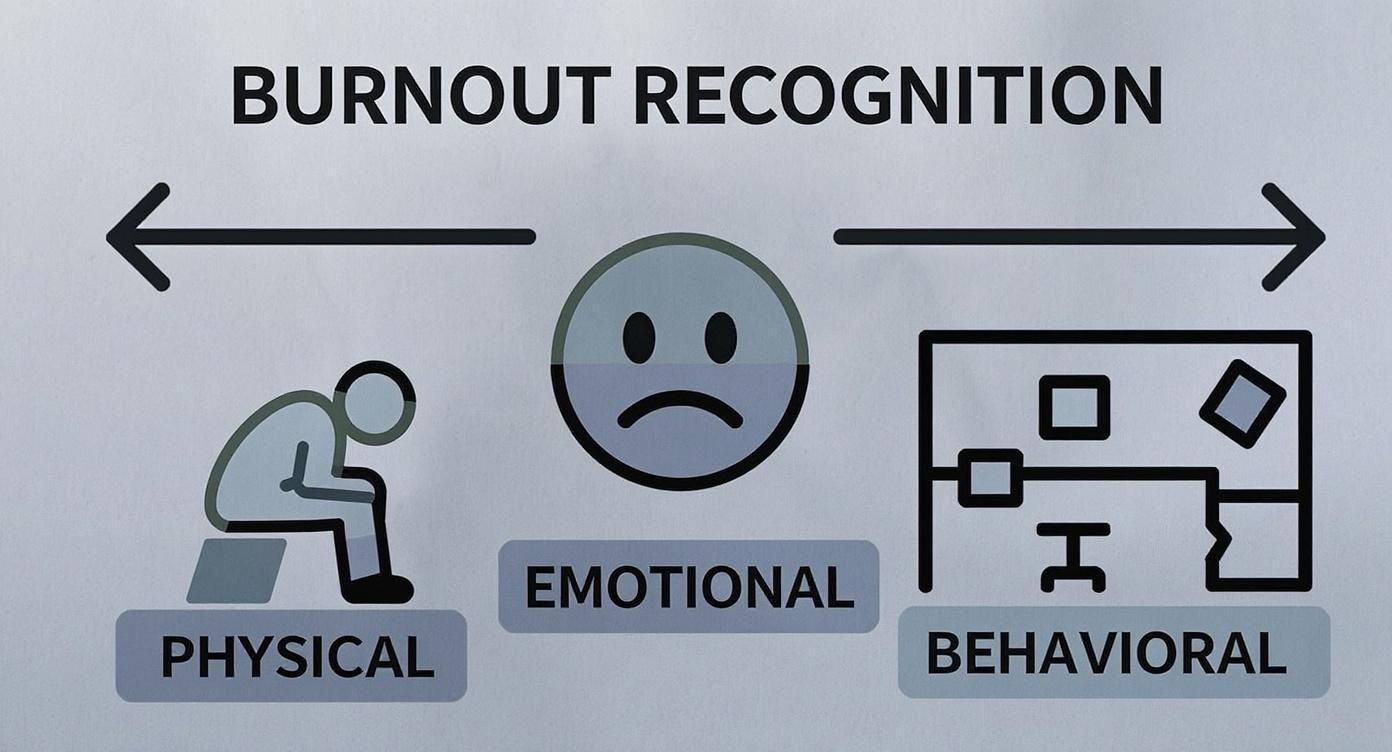
Spotting these signs in yourself is a critical first step, long before you sit down with your manager.
Using a Simple Conversation Script
Walking into that meeting with a few opening lines already in your head can make a world of difference. You don't need a perfectly memorised speech, but a basic structure will stop you from fumbling for words when you're feeling vulnerable.
Key Takeaway: Your goal is to be direct, professional, and centred on your health. You are not obligated to share every detail of your medical condition—only that you are unwell and need to take time off based on a doctor's advice.
Here’s a straightforward script you can adapt to your own style:
"Thanks for meeting me. I wanted to have a private chat about my health. I've been finding things difficult recently, and it's starting to affect my ability to do my job to my usual standard. I’ve spoken to my GP, and their advice is for me to take some time off to recover. I have the fit note here and wanted to discuss the next steps for starting my stress leave from work."
This approach gets straight to the point. It's professional, gives just enough context, and frames the leave as what it is: a medical necessity.
To make sure you've got all your bases covered, here’s a quick checklist summarising the key actions to take.
| Your Checklist for Requesting Stress Leave | ||
|---|---|---|
| Step | Action Required | Key Consideration |
| 1. Self-Assessment | Recognise and acknowledge the signs of burnout or excessive stress in yourself. | This is about your well-being, not just your workload. Be honest with yourself. |
| 2. See Your GP | Get a professional medical opinion and, if appropriate, a fit note for sick leave. | The fit note provides the official basis for your request and protects you. |
| 3. Schedule a Meeting | Ask your manager for a private, confidential conversation at a suitable time. | Choose a setting where you won't be interrupted or overheard. |
| 4. Prepare Your Points | Outline what you want to say, focusing on your need for leave based on medical advice. | Stick to the facts. You don't need to over-explain or justify your feelings. |
| 5. Have the Conversation | Use your script to open the discussion calmly and professionally. Present your fit note. | Your aim is to inform, not to ask for permission. This is a health matter. |
| 6. Follow Up in Writing | Send a brief email summarising your conversation and confirming the start date of your leave. | This creates a paper trail and ensures there are no misunderstandings. |
Following these steps provides a clear, structured path through what can be a very difficult process, ensuring both you and your employer are on the same page.
Following Up with an Email
After you’ve had the talk, it’s always smart to send a quick follow-up email. This simple step creates a written record of your discussion and confirms the details, making sure there's no confusion down the line.
A good follow-up email should do four things:
- Reference the conversation: Kick off by mentioning the chat you just had.
- State the request clearly: Formally state that, as per your doctor's advice, you are beginning a period of sick leave.
- Attach the fit note: If you didn't hand over a physical copy, attach a scan or photo of your doctor's note.
- Confirm the start date: Clearly state the first day of your absence.
This bit of admin helps keep everything professional and gives HR exactly what they need for their records, making the process smoother for everyone involved.
Understanding Your Employer’s Legal Duties
When you need time off for stress, your employer isn't just a passive observer. They have very specific legal and ethical responsibilities towards you, and knowing what these are is the first step in making sure you’re treated fairly. Think of it less as a confrontation and more as a set of established rules designed to protect your wellbeing.
At the core of these responsibilities is the ‘duty of care’. Under UK health and safety law, every single employer has a fundamental duty to protect the health, safety, and welfare of their people at work. This isn’t just about putting up 'wet floor' signs; it absolutely extends to managing psychological harm, including excessive workplace stress.
The Equality Act and Reasonable Adjustments
This duty of care gets even more specific if your stress-related illness is severe enough to have a long-term impact on your daily life. If that’s the case, it could be legally considered a disability under the Equality Act 2010, which gives you significant protection against discrimination.
Once a condition meets this threshold, your employer is legally required to make ‘reasonable adjustments’ to your job. This is a crucial concept. It’s all about removing barriers you face because of your health. These adjustments aren't optional perks or special favours; they are a legal requirement.
So, what counts as ‘reasonable’? It could be things like:
- A phased return to work: Instead of throwing you in at the deep end, you gradually build up your hours and duties.
- Modifying your duties: Temporarily or permanently shifting tasks that are the main source of your stress.
- Changing your working hours: Allowing for more flexible start and finish times to help you manage your energy and appointments.
- Providing different equipment: Sometimes simple tools or software can make a huge difference in reducing cognitive load and pressure.
The whole point is to help you come back to work successfully and stay there, not just to tick a box on a form.
The Gap Between Policy and Practice
Even with these legal frameworks in place, there’s often a huge gap between what companies are supposed to do and what actually happens on the ground. Many businesses really struggle to turn their duty of care into practical, meaningful support for employees needing stress leave from work.
While nearly two-thirds of UK organisations are taking steps to identify and reduce workplace stress, only half believe their efforts are truly effective. A staggering 64% cite heavy workloads as the top cause of stress-related absence, yet less than half of employers offer a specific stress leave policy.
This disconnect often means employees have no choice but to use their standard sick leave, which doesn't always come with the structured support needed for a proper recovery from burnout. This is exactly why having a clear and well-communicated sickness absence policy is so important for businesses—it creates a fair and consistent process for everyone.
By understanding your employer's legal duties around stress, you can become your own best advocate. You’ll be able to tell the difference between a genuinely supportive company and one that’s falling short, ensuring you get the protection and adjustments you need to recover properly.
Creating a Plan for a Successful Return to Work
Coming back to work after a period of stress leave isn't as simple as flicking a switch. To do it right, you need a thoughtful, deliberate plan. Otherwise, you risk walking straight back into the very situation that caused the burnout in the first place.
Think of it like recovering from a physical injury. You wouldn't go from a broken leg straight back to running a marathon. You’d start with gentle physiotherapy, gradually rebuilding your strength and confidence. A successful return from stress leave from work follows the exact same principle.
The first step? Open, honest communication with your manager and HR. It’s crucial to have a conversation before your official return date to map out what a supportive and sustainable comeback actually looks like for you.
Designing a Phased Return
One of the most powerful tools in your toolkit is the phased return. This is a formal, temporary arrangement that lets you ease back into your role, gradually increasing your workload over a set period—usually a few weeks. It’s not about doing less work forever; it’s about rebuilding your capacity without feeling overwhelmed.
This approach is a cornerstone of an employer’s duty of care and is often considered a reasonable adjustment. A well-designed plan could include:
- Temporarily reduced hours: Perhaps starting with half-days or working three days a week before building back up to your full schedule.
- Modified responsibilities: Focusing on core, less demanding tasks at first, while high-pressure projects are temporarily delegated.
- Regular check-ins: Scheduling brief, supportive catch-ups with your manager to see how things are going and adjust the plan if needed.
These steps create a much-needed safety net, giving you the space to find your footing again in a controlled way. For managers, knowing how to structure these conversations is key, and our return to work interview guide offers proven strategies to make them productive and positive.
Focusing on Long-Term Success
Ultimately, the most successful returns are the ones that address the root causes of the stress. This needs honesty from both you and your employer about what needs to change. Was it an impossible workload? A lack of support? Unclear expectations?
A sustainable return means acknowledging the factors that led to burnout and creating a plan to mitigate them. This might involve setting clearer boundaries, improving communication channels, or re-evaluating team workloads.
Tackling these underlying issues head-on is the only way to ensure lasting success. A solid guide for overcoming burnout at work can provide brilliant, actionable strategies for this journey.
Examples of Reasonable Adjustments for Returning Employees
To help ease an employee's transition back into the workplace, employers can implement various supportive measures. These adjustments are designed to manage workload and reduce stress, ensuring a smoother and more sustainable return.
| Adjustment Type | Example | Purpose |
|---|---|---|
| Workload Management | Prioritise essential tasks and temporarily reassign non-critical projects. | Prevents overwhelm by focusing the employee on core duties as they rebuild capacity. |
| Flexible Hours | Allow adjusted start/finish times to avoid peak travel stress. | Supports work-life balance and reduces the daily pressures associated with a rigid schedule. |
| Mentorship/Buddy System | Assign a supportive colleague to help with re-acclimatisation. | Provides an informal support channel for questions and helps the employee feel reconnected. |
| Quiet Workspace | Provide a desk in a lower-traffic area of the office. | Minimises distractions and sensory overload, creating a calmer working environment. |
| Regular Breaks | Encourage and schedule short, regular breaks throughout the day. | Helps manage energy levels and prevents mental fatigue from building up. |
By working together to create a collaborative roadmap, you and your employer can turn a period of absence into a catalyst for a healthier, more positive working relationship for the long run.
How LeaveWizard Helps Businesses Manage Absences
For any employer, juggling different types of leave is a massive headache. This gets even trickier when you're dealing with sensitive situations like stress leave from work. Trying to keep track of everything manually with spreadsheets and emails is a recipe for errors, inconsistent support for your staff, and major compliance worries. This is where a proper absence management system really comes into its own, bringing clarity and control.
Instead of wrestling with disconnected documents, a dedicated platform pulls all your absence-related information into one place. It becomes the single, reliable record for every employee's leave history, ensuring everything is accurate, secure, and easy to find when you need it. For managing complex cases fairly and consistently, that organised approach is absolutely vital.
Centralised Tracking and Reporting
A system like LeaveWizard gives you a crystal-clear overview of all employee absences, from annual holidays to long-term sick leave.
This kind of dashboard view lets managers see who's in and who's off at a glance. That makes it so much easier to plan resources and, crucially, spot potential workload issues before they snowball into burnout.
By taking the administrative burden off your managers' plates, technology frees them up to focus on what really matters—supporting their team’s well-being. This means having a secure place to store fit notes, being able to monitor absence trends with clear reports, and planning effective return-to-work strategies without the paperwork chaos.
With automated tracking, businesses can make sure every employee gets consistent and fair treatment. This isn't just a 'nice to have'; it's essential for building a supportive workplace culture and meeting your duty of care obligations.
It's a big shift from being reactive and buried in admin to being proactive and genuinely supportive. This helps companies not only manage absences effectively but also foster an environment where employees feel valued and looked after.
Common Questions About Stress Leave
Trying to get your head around the practical side of stress leave can feel overwhelming, especially when you're already feeling the strain. It’s completely normal to have questions about your rights, your pay, and what this all means for your job.
Let’s clear up some of the most common worries people have when they're thinking about taking stress leave from work. Getting straightforward answers can make all the difference in helping you decide what's best for you.
Will I Get Paid During Stress Leave?
This is often the first thing people worry about, and it really comes down to your company's policy and the law. If you’re off for more than four days in a row, you’re usually entitled to Statutory Sick Pay (SSP), which is the legal minimum.
However, a lot of employers offer their own, more generous contractual sick pay. The best place to find out what you’re entitled to is your employment contract or the company handbook. That should always be your first port of call.
Can My Employer Fire Me for Taking Stress Leave?
In short, no. It is against the law for your employer to dismiss you just because you’re unwell. If your stress-related illness is severe and has a lasting impact on your daily life, it may even be classed as a disability under the Equality Act 2010. This gives you significant protection against discrimination.
Your employer has a legal duty to explore ‘reasonable adjustments’ to help you. They can't just let you go; they have to follow a proper, formal process. Any dismissal that doesn't follow these rules could be considered unfair and end up at a tribunal.
How Long Can I Be on Stress Leave in the UK?
There’s no set limit on how long stress leave can last. It all depends on your doctor's professional medical opinion, which they will outline on your fit note.
Some people might only need a few weeks to get back on their feet. For others dealing with more chronic issues, it could be a matter of months. The key is to follow your GP’s advice and keep an open line of communication with your employer about how you’re doing and when you might be ready to return.


