
Before you even think about downloading a request for flexible working template, you need to get your head around your legal position. It’s absolutely crucial. Thanks to some recent shake-ups in UK law, every employee now has the right to request flexible working arrangements from the moment they start their job. This is a big deal, empowering you to shape your career around your life, not the other way around.
Understanding Your Rights to Flexible Working in the UK

Knowing your rights isn't just about ticking a box; it's the foundation for building a confident and solid proposal. When you understand the legal framework, you can frame your request with real authority, anticipate what’s required of your employer, and go into the conversation feeling much more assured.
The New Day-One Right
The biggest change came from the Employment Relations (Flexible Working) Act 2023, which kicked in officially in April 2024. This law scrapped the old 26-week qualifying period, making the right to request flexible work a day-one entitlement for every employee in the UK. This is a genuine game-changer, especially for new starters who used to have a six-month wait before they could even begin this dialogue.
This legal shift has some very real-world implications for both you and your boss. Under the new rules:
- You can now make two statutory requests within any 12-month period, which is up from just one before.
- Your employer is now required to consult with you about your request before they make a final decision. They can't just say no without a conversation.
- They have to give you a decision within two months, which is a month quicker than the old three-month deadline.
The key takeaway here is that employers can't just dismiss your request out of hand. They have a legal duty to consider it in a 'reasonable manner' and are only allowed to refuse it based on a handful of specific, legitimate business reasons.
The Reality on the Ground
While the law gives you a powerful right, how it plays out in practice can really vary from one company to another. Recent data shows there's still a bit of a gap between legal rights and what happens day-to-day. For instance, a 2025 survey from the CIPD found that 65% of organisations that allow hybrid work now insist on a minimum number of days in the office, with three days being the most common setup. The same study also found that about two-fifths of employers said only some of their staff can actually work flexibly.
What this tells us is that while your right to ask is protected, the final answer still often hinges on your company’s culture and operational demands. For business owners and HR managers, getting these arrangements right is a top priority. In fact, there are many effective strategies for managing flexible work arrangements that can help ensure everything runs smoothly.
Understanding this bigger picture helps you prepare properly. It highlights just how important it is to build a strong business case for your request—which we'll get into next—to show exactly how your proposal can work brilliantly within your company's specific setup.
Building a Business Case Your Manager Can't Ignore
To get a yes on your flexible working request, you need to stop thinking like an employee asking for a favour and start acting like a consultant presenting a solid business proposal. Your manager is wired to think about team performance, productivity, and hitting targets. So, you need to frame your request around those exact priorities.
Show them how this change isn't just a win for you, but a smart move for the business. Don't just lead with what you want; lead with why it helps them. How will this new arrangement benefit the team and, ultimately, the company's bottom line? Will working from home two days a week give you the uninterrupted time you need for deep, focused work, resulting in higher-quality output on that critical project? That’s the angle.
Pinpoint the Company Wins
Get specific about the benefits your new schedule will bring to your role and the team. Vague promises won't cut it. You need to draw a direct line from your request to real, operational improvements.
Here are a few business-centric benefits you could highlight:
- Increased Productivity: Explain how fewer office distractions will boost your efficiency on certain tasks. You could mention completing monthly reports 20% faster or dedicating your quiet time at home to complex problem-solving that's impossible in an open-plan office.
- Improved Client Coverage: Proposing adjusted hours? Show how this could extend the team's availability for clients in different time zones, making you more responsive and competitive.
- Enhanced Focus: Frame your remote days as dedicated "deep work" sessions. This isn’t about slacking off; it's about tackling the high-value, strategic tasks that get pushed aside by constant interruptions.
- Better Wellbeing and Reduced Burnout: This isn't just a fluffy point. A well-rested, less-stressed employee is more engaged, more creative, and more likely to stick around. Mentioning this shows you're thinking about your long-term sustainability and performance in the role.
The goal is to completely shift the conversation from "this is what I need" to "here is how we can achieve better results together." You're presenting a solution, not just a personal preference.
Proactively Address Managerial Concerns
The second you mention flexible work, a manager's mind will jump straight to the potential pitfalls. How will we communicate? What about team collaboration? Will you still be available when I need you? Getting ahead of these questions shows professionalism and proves you’ve thought this through.
Anticipate their worries and come to the table with concrete solutions. For instance, you could propose maintaining core hours for all team meetings, using Slack for quick check-ins, or scheduling specific in-office days purely for collaborative brainstorming sessions. For managers who are new to this, learning how to manage remote teams effectively is a big step, and your proactive plan shows you're a partner in making it work smoothly.
Back It Up with Evidence
A proposal without evidence is just wishful thinking. To make your case compelling, you need to back up your claims with actual data. This is what turns a hopeful ask into a data-driven business case that's hard to refuse.
Consider bringing these to the discussion:
- Your Performance Metrics: Your own track record is your best asset. Point to periods where you might have worked from home before and still exceeded targets or met tight deadlines.
- A Clear Communication Plan: Don't just say you'll "stay in touch." Outline exactly how. Specify the tools (Slack, Teams), your standard response times for emails, and your guaranteed availability for calls.
- A Productivity Plan: To really seal the deal, show them you're serious about accountability. You can use something like a Notion time tracking template to demonstrate how you'll manage your hours and tasks transparently.
- Offer a Trial Period: This is often the secret weapon. Proposing a three-month trial massively lowers the perceived risk for your manager. It shows you’re confident the arrangement will be a success and gives them an easy way to agree without feeling locked in.
Download Your Free Flexible Working Request Templates
Alright, let's get to the practical part. To save you from staring at a blank page, we’ve put together three distinct, professionally crafted templates. You can download and tweak them to fit your exact situation.
Choosing the right format is your first move, and it usually comes down to your company's culture. A formal letter might be the way to go in a traditional organisation, while a quick email often works perfectly for a fast-paced startup.
Each request for flexible working template is designed to give you a solid, professional starting point. We’ve even included notes on when to use each one and annotated examples to show you which bits to customise for the biggest impact. It’s all about framing the conversation effectively from the get-go.
Choosing the Right Template for Your Workplace
How you present your request really does matter. A formal, structured approach signals seriousness in a more traditional setting, whereas a direct email can reflect the agile nature of a modern company. It’s all about matching your tone to your environment.
To help you decide which is the best fit, here's a quick comparison of the templates we've created for you.
Choosing the Right Flexible Working Request Template
| Template Type | Best For… | Key Features |
|---|---|---|
| Formal Letter | Companies with established HR processes, larger corporations, or when you want a more traditional approach. | Comprehensive, structured, and shows you've carefully considered every angle. |
| Streamlined Email | Modern workplaces, smaller teams, or if you have a more informal relationship with your manager. | Direct, concise, and gets straight to the point while remaining professional. |
| Structured HR Form | If your company uses specific forms, or you want to provide an exceptionally detailed business case. | Pre-empts common HR questions on logistics, communication, and performance tracking. |
Think of these templates as your starting block. The real power comes from how you personalise them with the business case you’ve built, connecting your personal request to tangible wins for the team and the company.
This flowchart maps out the key steps to building that compelling business case, which you'll then slot into your chosen template.
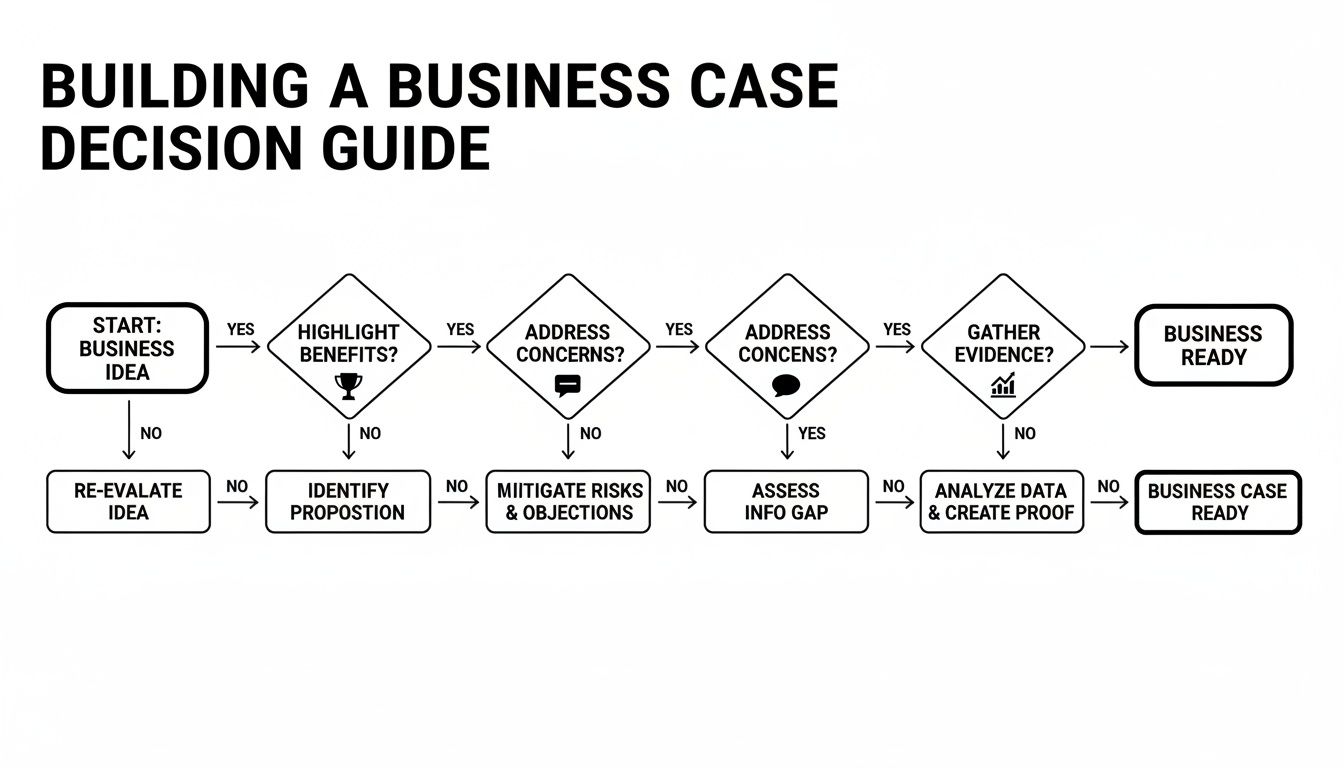
As the decision tree shows, a strong proposal really hinges on highlighting the benefits, tackling potential concerns head-on, and backing it all up with solid evidence.
What to Include in Every Request
No matter which template you go with, some elements are non-negotiable. Your request has to be clear, well-reasoned, and considerate of the business's needs. A vague proposal is easy for a manager to dismiss, but a detailed, thoughtful plan is much harder to ignore.
Every strong request should cover these four bases:
- A Clear Statement of Change: Be precise about what you’re asking for. For example, "I'd like to work a compressed 9-day fortnight, working my 37.5 hours over nine days and taking every other Friday off."
- The Proposed Start Date: Give a realistic timeline. Suggesting a start date a few weeks or a month away shows you understand that your team might need time to make adjustments.
- The Business Benefits: As we’ve covered, this part is critical. Explain how this change will improve your focus, help extend client coverage hours, or boost your overall productivity.
- How You'll Mitigate Disruption: Address potential concerns before they’re even raised. Detail your communication plan for your days away, how you’ll handle handovers, and confirm your commitment to attending key meetings. This forward-thinking approach is a core part of building an effective UK employee leave policy in any organisation.
By structuring your request around these points, you present yourself not just as an employee asking for a favour, but as a proactive problem-solver focused on mutual success.
Phrases and Wording for Common Flexible Work Scenarios
Getting the phrasing right in your flexible working request can be the difference between a quick "yes" and a drawn-out, difficult conversation. It’s not just about what you ask for, but how you ask.
Here, we'll break down some proven wording for the most common flexible working scenarios. Think of these as a starting point to help you frame your proposal with confidence. Each example is designed to be crystal clear, connecting the change you want to a real business benefit while tackling potential concerns head-on. The aim is to make it easy for your manager to approve by presenting a well-reasoned, win-win solution.
Requesting a Hybrid Work Model
Moving from being in the office full-time to a hybrid schedule is easily one of the most popular requests right now. When you're framing this, the key is to highlight how your remote days will boost your focus and output, while your days in the office are earmarked for teamwork and collaboration.
Here’s some sample wording:
"I would like to propose a hybrid working arrangement, where I work from home on Tuesdays and Thursdays and am in the office on Mondays, Wednesdays, and Fridays. This structure would allow me to dedicate my remote days to deep-focus tasks like report writing and data analysis, which I believe will increase my efficiency and the quality of my output. My in-office days will be prioritised for team meetings, collaborative projects, and brainstorming sessions."
Shifting Your Start and Finish Times
Whether it’s to manage the school run, dodge a nightmare commute, or just work when you’re most productive, adjusting your daily schedule is a common need. The trick here is to reassure your manager that your availability won't change and that you'll still be fully connected with the team.
- For early risers: "I'd like to adjust my working hours to 7:30 AM to 4:00 PM. Starting earlier allows me to address urgent overnight emails and prepare for the day ahead before peak hours, ensuring a more productive start for the team."
- For later starts: "I am requesting to shift my schedule to 10:00 AM to 6:30 PM. This would enable me to provide client support later in the day, extending our team’s coverage and improving responsiveness for our partners in different time zones."
Proposing a Compressed Four-Day Week
A compressed week—working your full hours over fewer days—is a pretty big change, so your business case needs to be rock-solid. You need to frame this as a way to supercharge your focus and energy, leading to better productivity on your working days. You also must have a clear plan for handovers before your day off.
Try this as a starting point:
"I am writing to request a move to a compressed working week, where I would work my contracted 37.5 hours over four longer days (Monday-Thursday) and take Friday off. I am confident that this focused schedule will enhance my productivity and reduce burnout, allowing me to bring more energy to my role. I will ensure all critical tasks are handed over on Thursday evenings and will remain reachable for genuine emergencies."
This isn't just a niche preference anymore; it's a major factor in the UK job market. Research has shown that around 40% of workers would look for a new job if their flexibility was taken away. What's more, CIPD analysis estimated that roughly 1.1 million workers changed jobs in the last year specifically because they couldn't get the flexible options they needed. You can explore more data on how flexibility impacts the workforce to see just how important this has become.
Requesting to Go Fully Remote
Asking to work fully remotely is the biggest request of all, and it requires the most detailed proposal. You have to get out ahead of every possible concern, from communication and team spirit to equipment and data security.
Your wording needs to show you've thought everything through.
"I would like to formally request a transition to a fully remote working arrangement. I have a dedicated and secure home office setup that ensures I can perform all my duties effectively. To maintain seamless communication, I propose daily check-ins via Slack, guaranteed availability during core hours of 10 AM to 4 PM for meetings, and will travel to the office for quarterly planning sessions to ensure strong team alignment."
How to Navigate the Conversation with Your Manager

Once your email or letter is in their inbox, the real work begins. The chat with your manager is where you’ll truly make your case, turning that written proposal into a real, collaborative dialogue.
Walk into that meeting prepared not just to talk, but to listen and solve problems together. Your mindset is everything here.
Think of it as a strategic partnership. The goal isn't just to get what you want, but to find a solution that works brilliantly for both you and the business. This isn't a confrontation; it's a negotiation aimed at mutual success. Have a quiet run-through of your key points beforehand so you can deliver them with calm confidence.
This is especially important right now. In early 2025, around 41% of UK workers did some form of remote work, but it's clear that not everyone gets the same opportunity. Those earning over £50,000 were far more likely to have hybrid options than those on under £20,000, which shows these arrangements are often tied to specific roles and industries. You can discover more insights into UK work statistics to get a feel for the bigger picture.
Prepare for Questions and Objections
Your manager is bound to have questions. They'll be thinking about logistics, communication, and how the team will function. Your job is to get ahead of these concerns and have thoughtful, practical answers ready to go.
The key is to avoid getting defensive. Instead, treat their worries as valid points that simply need a good solution.
You should be ready for questions like:
- "How will we make sure the team stays connected if you're not here?"
- "What's the plan if something urgent comes up on your day out of the office?"
- "How are we going to measure your performance in this new setup?"
The best strategy is active listening. Hear their concerns out completely, acknowledge them, and then calmly present the solutions you’ve already thought through. This positions you as a proactive problem-solver, not just an employee making a demand.
Propose a Trial Period
One of the most effective tools in your negotiation toolkit is suggesting a trial period. It’s a simple offer, but it can instantly lower the perceived risk for your manager and makes it so much easier for them to say yes.
Proposing a three-month trial is a great way to show you’re confident this can work. It gives both of you a chance to see the new schedule in action, with a clear review date pencilled in to assess how it’s going and tweak anything that isn't perfect. If you feel the discussion might be a bit tense, knowing how to handle difficult conversations is an invaluable skill to have in your back pocket.
Your Flexible Working Questions Answered
When you’re thinking about putting in a flexible working request, it’s natural for a few questions to pop into your head. Let's walk through some of the most common ones to clear things up.
Can My Employer Just Say No?
In short, yes, they can refuse your request, but they can't do it on a whim. UK law is quite clear on this: if your employer turns down your proposal, they have to back it up with a solid business reason.
They can’t just say "it doesn’t work for us." They need to explain why. The official reasons include things like:
- The change would add significant costs to the business.
- It would negatively affect quality or performance.
- The team can’t reorganise the work amongst the existing staff.
- It would be too difficult to meet customer demand.
So, a vague refusal simply isn't good enough. They must connect their decision to one of these legitimate business issues.
How Many Times Can I Make a Request?
Good news on this front—the rules have recently shifted in your favour. As it stands under UK law, you can now make two statutory requests in any 12-month period.
This is a step up from the old limit of just one request per year. While you should always aim to make your first application as strong as possible, this change gives you a bit of a safety net if your circumstances change or your first idea needs a rethink.
What Happens If My Request Gets the Green Light?
If your manager says yes, that new working arrangement becomes a permanent change to your employment contract. The only exception is if you both explicitly agreed to a trial period first.
It's absolutely vital that your employer gives you a written statement confirming the new deal. This document should spell out your new working pattern, the start date, and any review periods you’ve agreed on. Getting this in writing prevents any confusion down the line.
Will Going Flexible Affect My Pay or Benefits?
This all comes down to what you’ve asked for. A change in your working pattern doesn't automatically mean a pay cut.
If your request involves reducing your total contracted hours—like switching from full-time to part-time—then yes, your salary and benefits like holiday allowance will likely be adjusted on a pro-rata basis. But if you’re just changing when or where you work those hours (like moving to compressed days or a hybrid model), your core salary and benefits should stay the same. It's always a good idea to clarify this with your manager during your discussion.


