
Sending a request for annual leave email is much more than just firing off a quick note. It's a professional interaction, and how you frame it says a lot about your consideration for the team. A well-written email makes life easier for your manager, ensures a smooth handover, and keeps the workplace atmosphere collaborative and respectful.
Why Your Leave Request Email Matters
Before we jump into templates, it's worth taking a moment to think about what's happening behind the scenes. A thoughtfully composed email isn’t just about getting your time off approved; it shows you're a professional who understands team dynamics.
It signals that you’ve thought about how your absence will affect workflows and, crucially, that you have a plan to minimise any disruption. This simple act of communication helps your manager enormously with scheduling and resource allocation. By providing clear dates and a brief mention of your handover preparations, you make the whole process a breeze for everyone. It's these small things that build trust and reinforce your reputation as a reliable team member. You can find out more about streamlining the whole system by reading up on the simple steps for an efficient leave approval process.
The UK Culture Around Taking Leave
In the UK, the law says most full-time employees are entitled to a minimum of 5.6 weeks of paid annual leave per year, which works out to 28 days. You'd think we'd all be using every last day, but recent data tells a different story.
A study of over 3,000 UK companies found that the average employee took just 33.9 days off last year. That’s a big drop from 38 days back in 2020—a decrease of nearly 12% in just four years. Sectors like construction and financial services have seen some of the steepest declines. Experts point to heavy workloads and financial pressures as the main culprits, which is useful context to have when you're thinking about your own request.
Taking the leave you're entitled to isn't a luxury; it's essential for preventing burnout, staying productive, and looking after your long-term well-being. A professional email reinforces the idea that taking time off is a normal and necessary part of working life.
This infographic breaks down how a professional approach, from the initial email to planning your handover, makes for a seamless leave process.
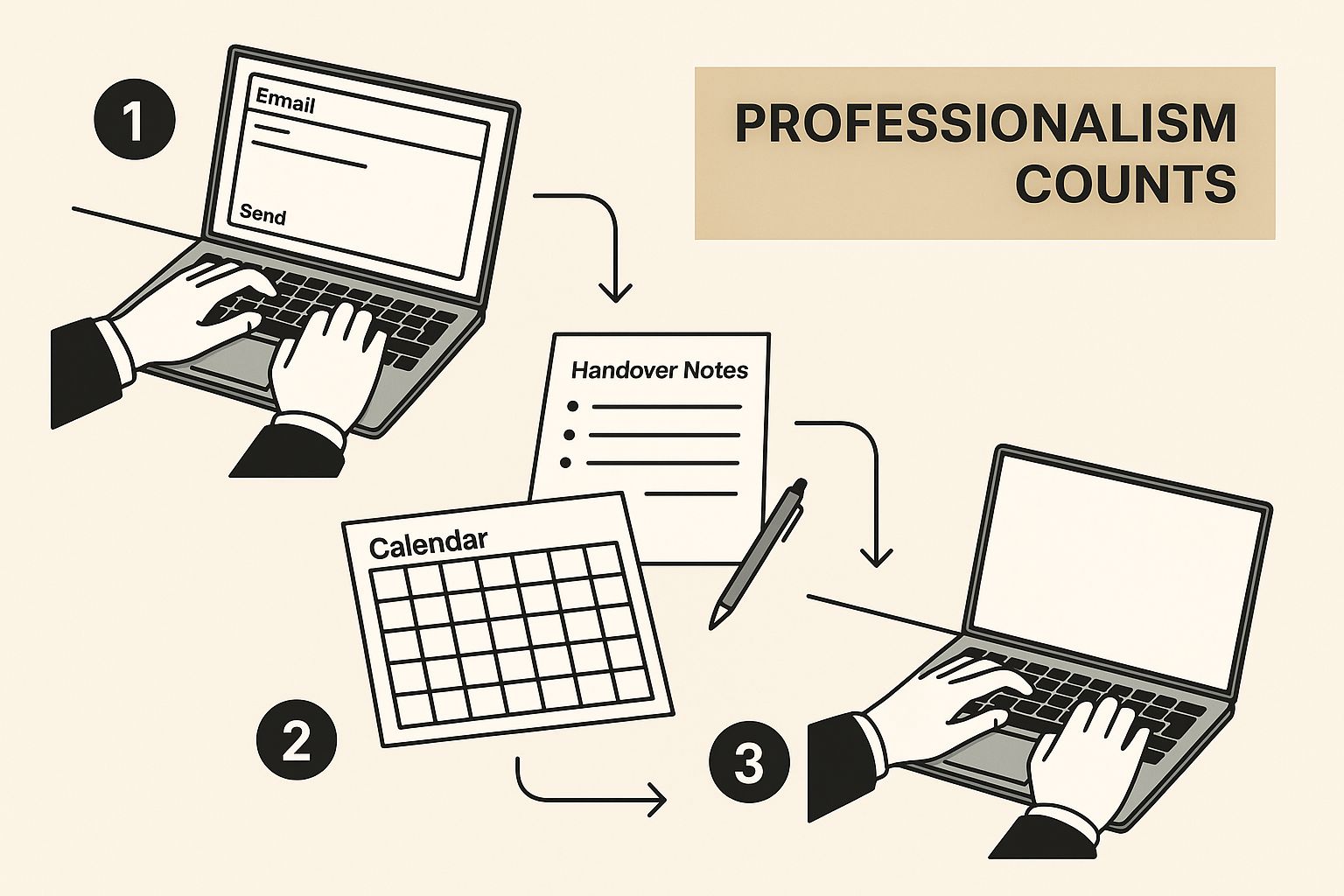
As the image shows, your email is just the first step. It kicks off a professional process involving planning and clear communication, which ultimately benefits the entire team.
Core Components of a Professional Leave Request
To make sure your annual leave request gets a quick "yes," it needs to be clear, professional, and give your manager all the info they need in one go. Think of it this way: your goal is to make their decision as easy as possible.
A well-put-together email shows you’re organised and that you respect your team's schedule. Getting this right comes down to nailing a few essential parts that make your request look professional and well-thought-out.
Let's break down exactly what goes into a leave request that works. This simple structure ensures nothing gets missed and keeps the whole process smooth and professional.
Anatomy of an Effective Leave Request Email
| Component | Purpose | What to Include |
|---|---|---|
| Clear Subject Line | To provide all key details at a glance and ensure the email gets noticed. | "Annual Leave Request," your name, and the specific start and end dates. |
| Polite Opening | To start the conversation on a professional and courteous note. | A simple, friendly greeting like "Hi [Manager's Name]," or "Dear [Manager's Name],". |
| The Specific Dates | To eliminate any confusion about when you will be away from work. | The exact start date and end date of your leave, plus your planned return date. |
| The Handover Plan | To show you are proactive and care about work continuity. | A brief sentence stating you'll complete urgent tasks and arrange a handover. |
| A Courteous Closing | To end the email politely and prompt a response. | A professional sign-off like "Best regards," or "Kind regards," followed by your name. |
By following this blueprint, you provide everything your manager needs to approve your request without any frustrating back-and-forth.
The All-Important Subject Line
Your subject line is the first impression. It needs to tell your manager exactly what the email is about before they even open it. Vague phrases like "Time off" or "Holiday" are easily overlooked in a crowded inbox. The aim here is to be specific and instantly informative.
For the best results, always include three key things:
- The reason for the email (e.g., "Annual Leave Request").
- Your full name.
- The exact dates you want off.
A perfect subject line looks something like this: Annual Leave Request – [Your Name] – [Start Date] to [End Date]. This format gives your manager everything they need at a glance, helping them prioritise your email correctly.
Clearly Stating Your Proposed Dates
When you get to the body of the email, the most important part is, of course, the dates. Be crystal clear. Any ambiguity just creates extra work and potential mix-ups for everyone involved.
State the first and last day of your leave directly. It’s also a great idea to mention the total number of working days this adds up to. For example: "I would like to request annual leave from Monday, 2nd September to Friday, 6th September, returning to work on Monday, 9th September. This will be a total of five working days."
Being this precise removes all guesswork for your manager. Adding your return date is another thoughtful touch that helps with planning and shows you’re already thinking about a smooth transition back. It’s a small detail that makes a big difference.
Mentioning Your Handover Plan
You don't need a super-detailed, minute-by-minute handover document in your initial request. That would be overkill. However, briefly mentioning that you will prepare for your absence is a game-changer. It shows you're responsible and considerate of your teammates.
Just one simple sentence will do the trick:
- "I will ensure all my urgent tasks are completed and a full handover is prepared before I leave."
- "Before my leave, I will coordinate with the team to ensure a smooth handover of my responsibilities."
This reassures your manager that you're not just thinking about your holiday, but also about the business carrying on smoothly without you. It tells them you’re proactive and organised, which makes it much, much easier for them to approve your request.
Nailing the Tone and Timing of Your Request
Getting your annual leave approved isn't just about what you write in your email. It's often more about the how and the when. Getting the tone and timing right can be the difference between a swift "approved" and a follow-up meeting you'd rather not have.
The perfect tone is a careful balance: professional, yet approachable. Remember, you're requesting something you're entitled to, so there's no need to sound overly apologetic. A confident, courteous, and straight-to-the-point approach always works best. It shows respect for your manager's time while making your intentions perfectly clear.
Finding the Perfect Moment
Timing is everything. Sending your email at just the right moment can dramatically increase the chances of it getting approved without a second glance. Before you even think about typing that subject line, take a moment to consider these points:
- Check the Company Handbook First: This should always be your first stop. Your company's policy will tell you the exact notice period required. Many businesses have a simple rule of thumb: give twice as much notice as the leave you plan to take (e.g., two weeks' notice for a one-week holiday).
- Scan the Team Calendar: Have a quick look at the shared calendar. Is anyone else on the team already booked off during your preferred dates? Trying to book time off when a colleague is already away, especially during a busy spell, is one of the quickest routes to a rejected request.
- Avoid Peak Workloads: It sounds obvious, but try not to send your request right before a huge project deadline or during the company's busiest quarter. Submitting it when things are a bit calmer shows you’re thinking ahead and have the team's goals in mind.
A quick, informal chat with your manager before you send the official email can be a game-changer, particularly if you're planning a longer trip. It positions you as a considerate team player and lets you smooth out any potential issues upfront, turning the email into a simple formality.
The Bigger Picture: UK Holiday Culture
Understanding the context of annual leave in the UK can also help you frame your request more strategically. While the statutory minimum leave is 28 days, many employers offer more generous packages. Despite this, workplace culture often means people don't use their full allowance; last year, the average UK employee left five days of holiday on the table.
Interestingly, just over 50% of UK employees took a solid week off at once. Requests also tend to pile up around bank holidays and festive periods, with December 27th being a particularly popular day to book off. This just goes to show how important it is to get in there early for those popular dates. You can dig into more fascinating trends in the state of UK annual leave statistics. Knowing these patterns helps you be that little bit smarter when timing your own annual leave email.
Proven Email Templates for Common Scenarios
Knowing the theory is one thing, but seeing a request for annual leave email in practice makes all the difference. While every office has its own vibe, these templates are a solid starting point for the most common situations you'll run into.
Think of them as a foundation. They're designed to be clear and professional, but you should absolutely tweak the language to match your own voice and your relationship with your manager. The goal is to give you a framework you can confidently make your own.
The Standard Week-Long Holiday
This is your bread-and-butter request. It's for a simple, straightforward week away. The key here is to be as clear and brief as possible—your manager is busy, so get straight to the point and give them everything they need upfront.
Example Email
Subject: Annual Leave Request – [Your Name] – [Start Date] to [End Date]
Hi [Manager's Name],
I would like to request annual leave from [Start Date] to [End Date], returning to work on [Return Date].
I'll make sure all my urgent tasks are wrapped up and that a full handover is prepared before my last day.
Please let me know if these dates work for the team's schedule.
Best regards,
[Your Name]
Why this works: The subject line is perfectly clear. No one has to guess what the email is about. The body is direct, provides the crucial dates, and proactively mentions a handover, which shows you're thinking ahead and reassures your manager instantly.
Requesting an Extended Leave
Going away for two weeks or more? Your request will need a bit more substance. A longer absence has a bigger impact on the team, so showing some extra foresight by detailing your preparation plan is a smart move.
This demonstrates your commitment to making sure things run smoothly while you're away. It’s also a good idea to have a quick, informal chat with your manager about a longer trip before you send the official email.
Example Email
Subject: Annual Leave Request (Extended) – [Your Name] – [Start Date] to [End Date]
Hi [Manager's Name],
I'm writing to formally request three weeks of annual leave, starting from [Start Date] and ending on [End Date]. I plan to be back in the office on [Return Date].
Over the coming weeks, I’ll be putting together a detailed handover document and will work closely with [Colleague's Name] to ensure my key responsibilities are fully covered. My goal is to get all major projects to a stable point before I go.
I'm happy to chat through my cover plan in more detail whenever you have a moment.
Kind regards,
[Your Name]
Navigating a Peak Season Request
Asking for time off during popular periods like the summer holidays or over Christmas requires a bit more tact. More importantly, it requires planning well in advance. Competition for these slots can be fierce, so getting your request in early is non-negotiable.
For more formalised systems, you can also check out different holiday request form templates to see how some companies structure this process.
A few tips for success:
- Be Early: Get your request in months ahead of time if you can. First come, first served is often the rule.
- Be Flexible: If possible, offer alternative dates or mention you can shift by a day or two.
- Acknowledge the Timing: A simple sentence showing you realise it's a busy period is a thoughtful touch that goes a long way.
Example Email
Subject: Annual Leave Request – [Your Name] – [Christmas/Summer Period]
Dear [Manager's Name],
I would like to request annual leave for the festive period, from [Start Date] to [End Date].
I know this is a really popular time for holidays, which is why I wanted to get my request in as early as possible. I can also be flexible by a day or two on either side if that helps with scheduling for the wider team. I'll, of course, make sure a comprehensive handover is in place.
Please let me know if this is feasible.
Many thanks,
[Your Name]
Handling Tricky Leave Request Situations
Let's be honest, not every leave request is a straightforward affair like booking a week off in a quiet month. Sometimes you have to navigate choppier waters, like asking for time off right after starting a new job or slap bang in the middle of a critical project. Getting a "yes" in these moments boils down to diplomatic communication and framing your request collaboratively.
When your annual leave email lands during a major project, your timing and tone are absolutely everything. Acknowledge the busy period right at the start of your email. This shows you're aware of the team's pressures.
Frame your request as a conversation starter, not a demand. You could say something like, "I'm aware this falls during the final stages of the [Project Name] launch, and I want to make sure my absence causes zero disruption."
From there, you need to show you’ve already thought about the impact and have a plan.
- Offer to work ahead: Detail exactly how you plan to complete key tasks before you go.
- Create a detailed handover: Mention that you'll prepare a thorough guide for whoever is covering for you.
- Be available for emergencies: If it's appropriate for your role, you could offer to be reachable for truly urgent issues.
Requesting Leave as a New Employee
Asking for time off when you’re the new kid on the block can feel pretty awkward. It’s often necessary, though, especially if you had plans booked long before you even got the job offer. The key here is transparency.
If you were upfront about this during your interviews, you can gently remind your manager in your email. If it didn't come up, it’s always best to have a quick, informal chat before sending the formal request. Briefly explain the situation, and then follow up with a professional email that reiterates your commitment. Showing you're dedicated to making a great start while still needing the time off usually goes down very well.
A common worry is that you'll look uncommitted, but a well-handled request can actually reinforce your professionalism. It shows you're organised, respectful of the company’s time, and capable of planning for your responsibilities—even when you’re not in the office.
Part-Time and Irregular Hours Contracts
The UK's legal framework also brings its own nuances for different work patterns. Part-time workers are entitled to the same 5.6 weeks’ holiday as full-timers, but it’s calculated on a pro-rata basis, meaning it's proportional to the hours they work.
For those on irregular hours or zero-hour contracts, employers use an accrual system. You earn holiday pay based on 12.07% of the hours you've worked. For example, working 30 hours in a week would accrue about four hours of leave. This often means your request email needs to be a bit more detailed, perhaps referencing your calculated entitlement so everything is clear.
In any tricky scenario, from unexpected personal needs to complex contracts, a collaborative and solution-focused approach is your best friend. Sometimes, you might also have to make a leave request at short notice, which requires its own specific approach. Ultimately, showing you've considered the impact on the team and have a solid plan to manage it makes even the most difficult requests much easier to approve.
Got Questions About Annual Leave Requests?
Even with the best email templates in hand, you might still have a few questions buzzing around. It's totally normal. Trying to line up your personal plans with company policy and general office etiquette can feel like a bit of a tightrope walk.
Let's clear up some of the most common queries. We'll get straight to the point with practical answers so you can send that request off with complete confidence.
How Much Notice Should I Give for an Annual Leave Request?
A great rule of thumb is to give your manager at least twice as much notice as the amount of time you want off. Planning a week-long getaway? Aim to ask at least two weeks beforehand. For a bigger two-week holiday, giving a month's notice is a professional courtesy that managers really appreciate.
But before you do anything, your first stop should always be the employee handbook. Your company will have an official policy spelling out the exact notice period required, and sticking to that is non-negotiable.
Planning to take time off during popular periods, like the school summer holidays or over Christmas? Get your request in months in advance. These slots often get snapped up on a first-come, first-served basis, so being early is the only way to guarantee you get the dates you want.
What if My Annual Leave Request Is Denied?
Getting a "no" is never fun, but it's important to stay calm and professional. Don't jump to conclusions. The best first step is to simply ask your manager for a bit of context behind the decision. More often than not, it's down to a practical issue like not having enough cover, clashing holidays with other team members, or a massive project deadline looming.
Once you know the "why," you can start looking for a "how."
- Suggest different dates: Could you shift your plans? Ask if another week would work better for the team.
- Offer to clear your plate: Is there a critical task you could get finished before you go that would make your absence less of an issue?
- Look for a compromise: Perhaps you could take a shorter break, or split your leave into two smaller chunks?
If you've had a good chat and still feel the rejection is unreasonable, your next port of call is usually HR. But always, always start by trying to find a solution with your direct manager first.
A rejected leave request is rarely personal—it's usually a logistical puzzle. If you treat it like a problem-solving exercise, you show real maturity and a commitment to the team. That attitude can be what turns a "no" into a "yes" for a different set of dates.
Should I Explain Why I Need the Time Off?
Honestly? No. You're not required to give any reason for taking your statutory annual leave. Your holiday time is a legal right, not a favour from your boss. A simple, professional "request for annual leave" is all you need.
You might feel like adding that you're going to a family wedding gives helpful context, and that's fine if you want to share, but it's completely optional. For a standard holiday, there’s absolutely no need to overshare personal details. Keep it straightforward.
Is an Out-of-Office Email Message Necessary?
Yes, 100%. Setting a clear out-of-office message isn’t just a nice-to-have; it's a vital part of a professional handover. It manages expectations for colleagues and clients and stops important work from grinding to a halt while you're away.
Your message needs to state the exact dates you're away and when you'll be back. Most importantly, it must name a colleague (and provide their contact details) who can handle urgent queries in your absence. This little step is what allows you to properly switch off and enjoy that well-earned break.


