
Paid time off accrual is simply the way employees earn their holiday allowance over time, instead of getting it all in one big chunk at the start of the year. The easiest way to think about it is like a savings account for your well-being. With every hour, day, or month you work, you "deposit" a small amount of leave time, which gradually builds up to your full yearly entitlement.
Understanding Paid Time Off Accrual and Why It Matters

At its heart, paid time off accrual is a system that lets holiday entitlement accumulate as an employee works. Rather than handing over a full block of holiday days on 1st January, this method ties leave directly to time served. It creates a steady, predictable stream of earned time off, which turns out to be a massive plus for both your staff and the business itself.
For employees, it's a transparent and fair way to watch their leave balance grow. It also means new starters begin earning their holiday from their very first day on the job—a key part of UK employment rights.
To give you a clearer picture, here’s a quick breakdown of what PTO accrual means for everyone involved.
PTO Accrual at a Glance
| Aspect | For Employees | For Employers |
|---|---|---|
| Earning Leave | Holiday time is earned progressively with each pay period worked. | Leave liability is spread out, preventing a huge financial hit at year-end. |
| Fairness | New hires and part-time staff earn a fair, pro-rated amount from day one. | Provides a consistent and fair system for all employment types. |
| Planning | Balances are clear and easy to track, making it simple to plan holidays. | Easier to forecast staffing levels and avoid operational disruption from holiday clashes. |
| Compliance | Ensures entitlement aligns with UK statutory requirements for accruing leave. | Helps maintain compliance with employment law regarding leave for all workers. |
This table shows how an accrual system creates a more balanced and predictable environment, which is a win-win for morale and operational stability.
The Business Case for PTO Accrual
From an employer's perspective, the accrual model is a powerful tool for managing your resources. It helps you dodge that all-too-common year-end rush, where half the team tries to use up their remaining holidays at once, causing chaos for operations. By spreading leave entitlement throughout the year, you can forecast staffing levels far more effectively and keep things running smoothly.
This system is particularly brilliant for managing different kinds of employment contracts:
- Part-time workers get a fair, prorated amount of leave based on the hours they actually work.
- Salaried employees have a clear, consistent accrual rate with every payslip.
- New hires start building up their leave immediately, which simplifies the onboarding process.
A well-structured paid time off accrual system does more than just track days off. It builds a culture of fairness and predictability, which is absolutely fundamental for employee morale and keeping the business stable.
Legal Foundations in the UK
Here in the UK, the concept of accrual is baked right into employment law. By law, full-time employees are entitled to 5.6 weeks of paid annual leave, which works out to 28 days for someone on a standard five-day week. This statutory minimum can include bank holidays, and the key thing is that leave accrues from the very first day of employment, usually at a rate of about 2.33 days per month.
Of course, many employers offer more generous packages to stay competitive, sometimes allowing staff to carry over unused days or even buy and sell holiday. You can explore more details about UK annual leave entitlements and see how they work in practice.
Getting your head around this legal framework is the first step to building a policy that’s both compliant and effective. It ensures your approach to paid time off not only ticks all the legal boxes but also genuinely supports your team’s well-being.
How to Calculate Paid Time Off Accrual
Figuring out paid time off accrual can sound like a job for a payroll wizard, but it's often more straightforward than you might think. The real key is picking a method that makes sense for your business and, just as importantly, for how your employees actually work.
Most UK businesses rely on one of three core methods to calculate holiday entitlement as it's earned. Each approach has its own perks, whether you're managing full-time salaried staff, part-time team members, or workers with unpredictable hours. Getting to grips with these options is the first step towards building a system that’s both fair and easy to understand.
This infographic breaks down the core concepts behind the most common accrual methods.
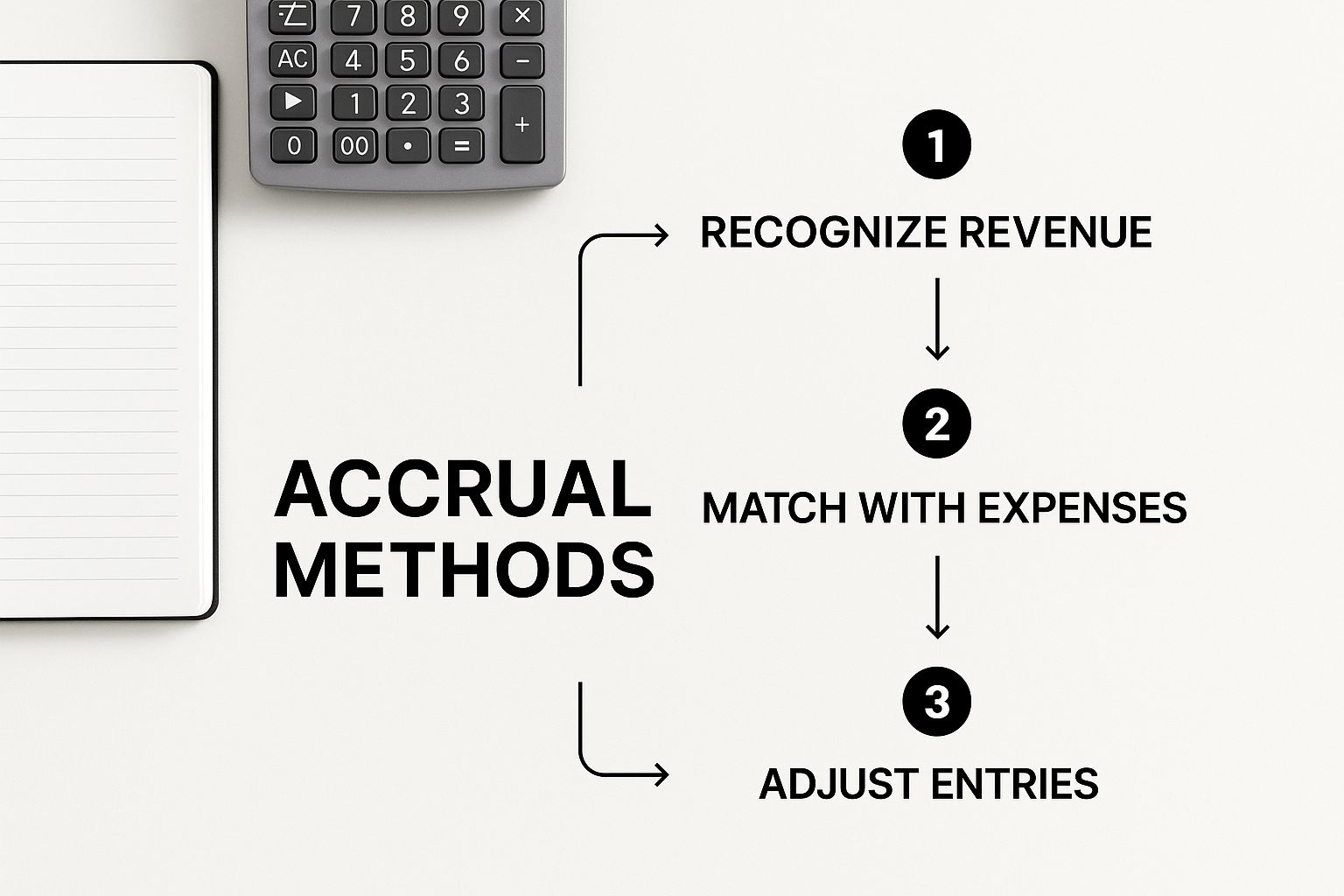
The image drives home a simple point: no matter which method you choose, the goal is always a clear and repeatable process for calculating leave.
Method 1: Per Pay Period
This is probably the most common route for salaried employees who get a consistent pay cheque each month. You simply take their total annual leave entitlement and divide it by the number of pay periods in a year. The result? A predictable amount of leave added with every payslip.
- How it works: An employee entitled to 28 days of annual leave who is paid monthly would accrue 2.33 days per month (28 days ÷ 12 months).
- Pros: It’s incredibly easy to calculate and simple for your team to follow. This method is a perfect fit for standard full-time contracts.
- Cons: It’s not a great fit for employees with irregular hours. Their work time doesn't directly map to the leave they earn, which can cause complications.
Method 2: Per Hour Worked
If you have hourly or part-time workers, calculating their holiday based on the hours they actually work is often the fairest and most transparent approach. It directly links the holiday time earned to the time they've spent on the job, which is essential for ensuring fairness and compliance for those with variable schedules.
To get this right, you need to work out an accrual rate. In the UK, the statutory minimum holiday entitlement is 5.6 weeks. This translates into a standard accrual rate of 12.07% of hours worked (5.6 weeks of holiday ÷ 46.4 working weeks in a year).
Let's look at a quick example:
An employee works 20 hours in a week. To figure out their holiday time, you'd calculate:
20 hours × 0.1207 = 2.414 hours of paid leave.
This approach makes sure that part-time and zero-hours contract workers receive their proper, pro-rated entitlement. If you want to get into the nitty-gritty, you can find a complete breakdown of the UK annual leave calculation formula in this guide.
Method 3: Annual Lump Sum
Sometimes, the simplest method is the best. Granting the entire holiday allowance in one go at the start of the leave year—usually on 1st January—is a popular choice. While it's not technically an "accrual" method in the traditional sense, it's a very common practice.
Even when you grant leave as a lump sum, you still have to track accrual behind the scenes for new starters or anyone who leaves mid-year. UK law is clear: employees must be paid for any leave they’ve accrued up to their last day, even if they haven't "used" it yet.
This means you’ll need a background accrual calculation ready to go. It’s the only way to stay compliant if an employee's status changes partway through the year.
Designing a Compliant PTO Accrual Policy

A great policy is the foundation of any successful leave management system. Think of it as the official rulebook for your company’s approach to rest and well-being. Crafting a solid and legally sound paid time off accrual policy is your chance to set clear expectations from day one, build trust, and make sure everyone is treated fairly.
This isn't just about ticking boxes for compliance; it's about creating a transparent framework that every employee can understand and rely on. Without one, you're opening the door to confusion, disputes, and potential legal headaches down the road. A well-thought-out policy stops these issues before they can even start.
Core Components of Your Policy
To actually work in practice, your PTO accrual policy needs to address several non-negotiable elements. These components are the operational heart of your leave system, leaving no room for guesswork or "I didn't know" moments.
Your policy must spell out:
- The Accrual Rate: How much leave is earned per pay period or hour worked? Be specific. For instance, "Employees accrue 2.33 days of paid leave per calendar month."
- Eligibility: Who is actually entitled to accrue this leave? Define this clearly for your full-time, part-time, and temporary staff.
- Carryover Rules: Can staff roll unused leave over to the next year? If so, specify the maximum number of days or hours they can carry over.
- Request Process: How should employees book their time off? Outline the required notice period and the approval workflow so there are no surprises.
Getting these key details down in writing is the first major step towards a system that practically runs itself.
Your policy is more than just a document—it's a promise to your team. It should clearly communicate their entitlements and the procedures for using them, ensuring total compliance with UK employment laws like the Working Time Regulations.
Handling Leave Upon Termination
One of the most critical parts of your policy is explaining what happens when an employee leaves the company. UK law is very clear on this: employers must pay out any accrued but unused statutory holiday entitlement when someone's employment ends. Your policy has to reflect this legal duty.
You need to clearly state how this final holiday pay will be calculated and when it will be paid, which is usually with their final payslip. This kind of transparency protects your business and guarantees a smooth, professional offboarding for the departing employee. This is also a crucial point for staff on atypical contracts; you can learn more by checking out our guide on zero-hour contract holiday calculation.
When putting your PTO policy together, using solutions with seamless accounting software integration can be a massive help in streamlining data accuracy and reporting. It ensures that final pay calculations, including that all-important accrued leave, are precise and compliant. This cuts down on administrative work and the risk of costly errors, helping you build a policy that is not only fair but also robust and legally sound.
Exploring Modern PTO Policy Trends
The world of work is always changing, and so are people's expectations around time off. While a standard paid time off accrual system gives you a solid foundation, many UK businesses are now trying out more flexible and modern approaches to attract and keep the best people. These aren't just quirky perks; they show a big shift in how companies think about work-life balance, trust, and employee well-being.
By moving beyond the legal minimum, these forward-thinking policies give employees much more say over their own time. It's a clear sign that the old one-size-fits-all approach to leave just doesn’t cut it for today's diverse workforce.
The Rise of Flexible Leave Options
Three major trends are shaking up paid time off policies in the UK, and each one offers a different flavour of flexibility.
- Unlimited PTO: This policy does away with the traditional accrual model completely. Instead of earning a set number of days, employees are trusted to take the time they need, whenever they need it, as long as their work is getting done. It’s all built on a culture of trust and personal responsibility.
- Buying and Selling Holiday: This option lets employees tweak their leave allowance to fit their life. Staff who want more time off can purchase extra days, while those who’d rather have the cash can sell back some of their unused entitlement.
- Dedicated Wellness Days: With mental health finally getting the attention it deserves, some companies now offer specific "wellness" or "mental health" days. These are separate from sick leave and holidays, encouraging people to look after their well-being without feeling guilty about it.
These policies all point towards a more grown-up way of working, empowering people to manage their own rest and recovery.
At the heart of these modern trends is empowerment. By giving employees more control over their leave, companies are building a culture of trust and showing they genuinely care about their team’s overall well-being.
The Real-World Impact on Leave Utilisation
Here's an interesting twist: offering more flexibility doesn’t always mean employees take more time off. Sometimes, the opposite happens. When you remove a defined number of days, like with unlimited PTO, it can create a bit of uncertainty. People might end up taking less leave because they’re worried about how it will look.
Recent UK data actually shows a surprising drop in the number of annual leave days being taken. In 2023, the average employee took 33.9 days off, a noticeable dip from 36.7 days in 2022 and almost 12% less than in 2020. This trend was particularly sharp in sectors like construction (-10.98%) and financial services (-9.11%). It could be down to things like the cost of living crisis, or maybe the subtle pressures that come with "unlimited" holiday policies. You can dig into the numbers in the full UK annual leave report from PeopleHR.
At the end of the day, the success of any modern PTO policy comes down to company culture. For these flexible approaches to actually work, leaders need to actively encourage time off and lead by example.
Navigating UK Legal Compliance and Common Pitfalls
Getting to grips with the legal side of paid time off isn't just good practice for UK employers—it's non-negotiable. One wrong move could land you in a costly tribunal and do real damage to your reputation. The entire rulebook for paid time off accrual is built on the foundation of the Working Time Regulations, which clearly lay out your duties and your employees' basic rights.
At its heart, the law guarantees nearly every worker a minimum of 5.6 weeks of paid holiday each year. For someone working full-time, that comes out to 28 days. It's vital to remember this entitlement applies from their very first day on the job, and their leave starts building up immediately.
Key Legal Considerations
Managing PTO accrual properly means paying close attention to a few key areas. The common mistakes here are surprisingly frequent, but they're also entirely avoidable if you know what to look out for.
Your core legal duties include:
- Prorated Leave for Part-Time Staff: You absolutely must calculate holiday for part-time and zero-hours workers on a pro-rata basis. A standard and accepted method is to use 12.07% of the hours they've worked to make sure their entitlement is fair and accurate.
- Accrual During Leave: An employee’s holiday entitlement keeps ticking up even when they're on other types of leave, like maternity, paternity, or long-term sick leave. You can't just press pause on accrual during these times.
- Bank Holidays: You're allowed to include bank holidays as part of the statutory 5.6 weeks, but only if this is spelled out clearly in the employment contract. There’s no automatic legal right for an employee to have bank holidays off.
A frequent pitfall we see is making unlawful deductions from an employee’s final pay. When someone leaves your company, you must pay them for any statutory holiday they've accrued but haven't used. Failing to do so is a direct breach of the Working Time Regulations.
Understanding Broader Economic Influences
The legal landscape doesn't exist in a bubble; it's constantly shaped by wider economic forces. For instance, May 2025 data shows the UK labour market is undergoing some interesting shifts that can indirectly affect how people take leave. Sectors like accommodation and food services have seen employment numbers dip while wage growth has jumped by 8.5%. This kind of dynamic might change how employees view their accrued leave, perhaps encouraging them to prioritise work over time off because of the higher pay. You can dive deeper into these trends in the ONS labour market overview.
Ultimately, staying compliant is about more than just ticking boxes. It's about fairness and building trust. By understanding how PTO works within this legal framework, you not only protect your business but also create a positive workplace where people feel their rights are taken seriously.
Common Questions About PTO Accrual
Even with a crystal-clear policy in place, the finer details of paid time off accrual can still throw up a few questions. These queries often pop up at the most critical times—like when an employee switches to part-time, goes on long-term leave, or decides it's time to move on. Getting these answers right isn't just about being fair; it's about staying on the right side of UK law.
Navigating these common situations with confidence means your leave management stays consistent and transparent for everyone on the team. It’s all about turning potential points of confusion into moments of clarity. So, let’s tackle some of the most frequently asked questions head-on.
How Do You Calculate Holiday for Part-Time Employees?
This is easily one of the most common questions, and the key is all about fairness through pro-rata calculations. Part-timers are legally entitled to the same 5.6 weeks of paid holiday as their full-time colleagues, but this is scaled down to reflect the hours they actually work.
The most reliable way to get this right is by using a percentage. UK guidance often points to a standard accrual rate of 12.07%. Where does that number come from? It's the statutory holiday entitlement (5.6 weeks) divided by the number of working weeks in a year (52 weeks – 5.6 weeks = 46.4 weeks).
Let’s see how that works in practice:
- An employee works 15 hours in a given week.
- Their holiday accrual for that week is: 15 hours × 0.1207 = 1.81 hours of paid leave.
This simple calculation ensures their holiday time is directly proportional to their work. It's a fair, legally sound system that works for everyone, no matter their schedule.
Does Annual Leave Still Accrue During Sick or Maternity Leave?
Yes, absolutely. This is a non-negotiable point of UK employment law that every employer needs to get right. An employee’s statutory holiday entitlement continues to build up as normal while they are on any form of statutory leave, including:
- Sick Leave: Even during long-term sickness, their holiday pot keeps growing.
- Maternity, Paternity, or Adoption Leave: The full leave period counts towards their continuous employment, so their holiday accrual is completely unaffected.
You cannot legally pause or reduce the rate of paid time off accrual during these protected periods. When the employee returns to work, they should be able to take this accrued holiday. If they leave the company, it must be paid out.
It is unlawful to treat an employee unfavourably because they are on sick or family-related leave. This protection extends to their holiday rights, ensuring their entitlement continues to grow just as it would if they were actively working.
What Happens to Unused Holiday When an Employee Leaves?
When an employee’s contract comes to an end, they are entitled to be paid for any statutory holiday they’ve accrued but haven't taken during that leave year. This isn't just good practice; it's a legal requirement under the Working Time Regulations.
The calculation for their final holiday pay is based on the leave they've earned up to their very last day. For example, if someone leaves exactly halfway through the leave year, they’re entitled to half of their annual holiday allowance. If they’ve used less than that, you must pay them for the difference.
What if they've taken more leave than they've accrued? You might be able to deduct the excess from their final pay packet. However, this is only possible if you have a clear, unambiguous clause in their employment contract that allows for it. Without that explicit agreement, you can't reclaim the pay for the extra days taken.


