
Dealing with staff absence effectively is about so much more than just keeping track of who's off and when. It’s about having a proactive strategy that truly gets to grips with the financial and cultural knock-on effects of absenteeism.
From my experience, the best approach is a mix of a crystal-clear policy, fair and consistent procedures, and a genuine focus on employee wellbeing. This helps you tackle the root causes, not just the symptoms.
The True Cost of Staff Absence

Before you can even begin to improve how you manage staff absence, you have to understand its real impact. So many businesses I see make the mistake of thinking the cost is just the statutory sick pay they have to cover. The reality is much, much bigger.
Unplanned absences send ripples through every part of your business, from the bottom line to the general vibe in the office.
Direct Financial Burdens
Let's start with the obvious costs—the ones that are easy to spot on a balance sheet. These are the immediate, out-of-pocket expenses you face every time an employee is unexpectedly off work.
Some of these direct costs include:
- Statutory and Contractual Sick Pay: This is the baseline, the non-negotiable cost of paying someone while they’re unable to work.
- Overtime Payments: It's a common scenario. Colleagues have to step up and work extra hours to cover the gaps, which naturally drives up your wage bill.
- Temporary Staff Costs: Sometimes you have no choice but to hire agency workers to fill a critical role. That means paying recruitment fees and premium hourly rates.
These are simple enough to calculate, but trust me, they're just the tip of the iceberg when it comes to the financial damage.
The Hidden Costs of Absenteeism
This is where the real trouble lies. The indirect costs are often far more damaging because they’re harder to pin down, yet they have a lasting impact on your business's health and productivity. Think of them as the silent drains on your resources and team spirit.
The hidden costs of employee sickness are huge. For example, back in 2023, the total hidden cost of employee sickness in the UK shot up to a staggering £103 billion. That’s a massive £30 billion increase since 2018, which really highlights the scale of the challenge for businesses. You can learn more about the real cost of absenteeism for UK employers in this deep dive.
One of the biggest unseen costs I’ve witnessed firsthand is the hit to team morale. When your most reliable people are constantly picking up the slack for absent colleagues, it’s a fast track to burnout, resentment, and a feeling that they’re being taken for granted.
This drop in morale almost always goes hand-in-hand with a major loss in overall productivity. The absent person's work piles up, and the colleagues covering for them are rarely as efficient because they're juggling unfamiliar tasks on top of their own. This disruption can easily lead to missed deadlines, a drop in work quality, and can even start to affect customer satisfaction.
Getting your head around these wider costs is the crucial first step. Once you do, building a solid business case for investing in a proper absence management strategy becomes a no-brainer.
Building Your Absence Management Policy
A clear, fair, and legally sound absence policy is the absolute foundation for managing your team effectively. Flying blind without one is a recipe for inconsistency, confusion, and some serious legal headaches down the road. A good policy isn't just a stuffy rulebook; it's a practical guide that sets crystal-clear expectations for everyone involved.
Think of it as the single source of truth for your entire organisation. It cuts through the fog about what to do when someone is unwell, making sure managers and employees are always on the same page. This document is your first line of defence against misunderstandings and ensures every situation is handled fairly and consistently.
Defining Different Types of Absence
First things first, you need to break down the different kinds of absence. Not all time off is created equal, and your policy has to reflect that reality. Make sure you clearly explain the procedure for each one.
Common categories you'll want to cover include:
- Sickness Absence: This is your typical unplanned absence when someone is ill or injured.
- Authorised Absence: This covers any pre-approved leave, like holidays, planned medical appointments, or training days.
- Unauthorised Absence: This happens when an employee is off without a valid reason or, crucially, fails to follow your reporting rules. The classic no-call, no-show falls squarely into this category.
- Compassionate Leave: This is for time off to handle emergencies involving a dependant, such as a sick child or a family bereavement.
Defining these categories clearly helps managers follow the right steps and ensures employees know exactly what’s expected of them in each scenario. It's all about creating a framework that is both supportive and robust.
Setting Clear Reporting and Communication Procedures
How should an employee tell you they're not coming in? Who do they need to contact, and by when? Your policy has to answer these questions with absolute clarity. Vague instructions like "let your manager know" just won't cut it and leave too much room for error.
Be specific. For example, "You must telephone your direct line manager no later than one hour before your scheduled start time." This removes any grey areas and establishes a professional standard for communication. To really nail this down, you can explore other proven tactics for staff absence management that can help refine your approach.
This is where visualising data can be a game-changer for managers, helping to spot trends that might otherwise go unnoticed.
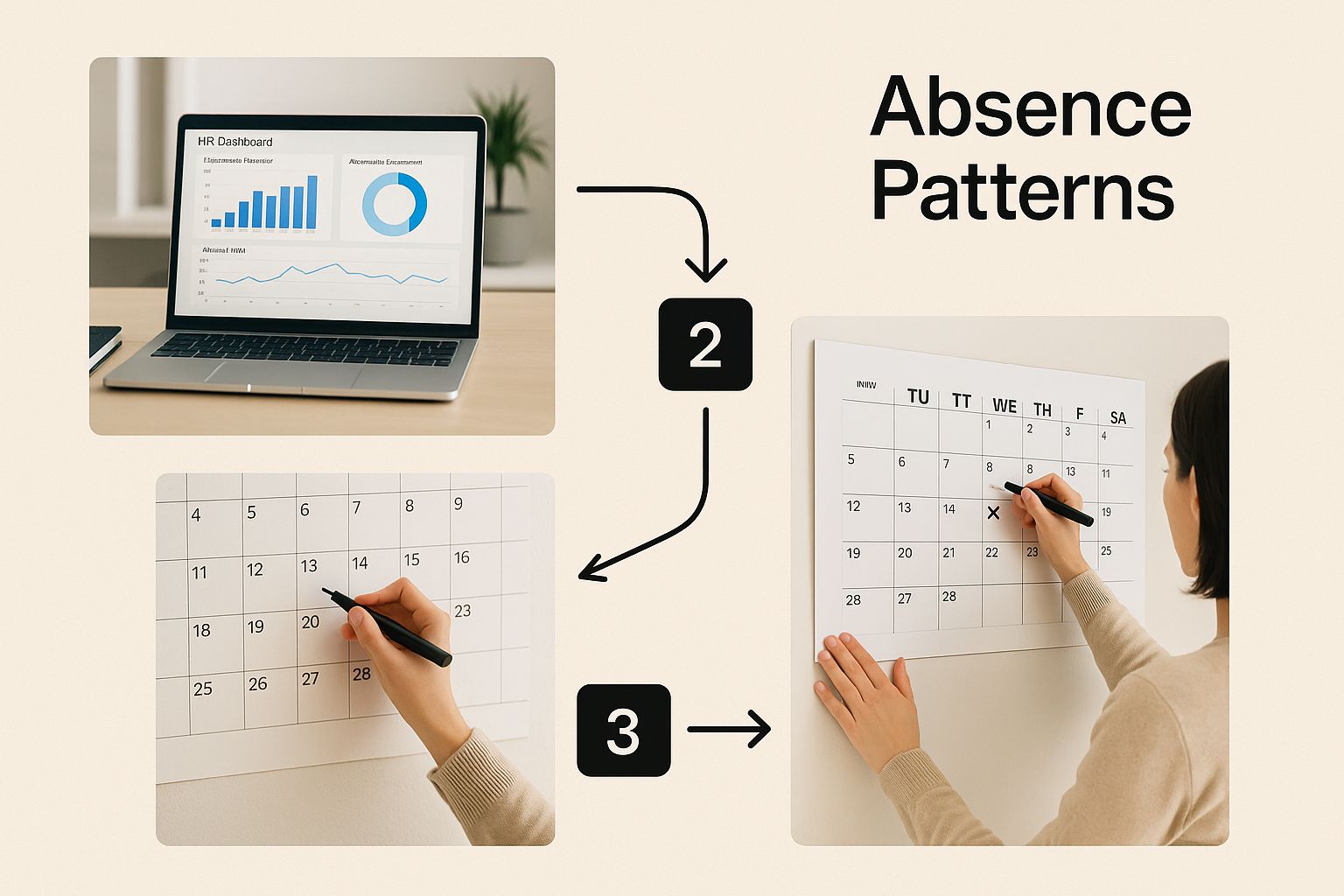
When you can see key data points laid out like this, you can quickly identify patterns, like frequent Monday or Friday absences. This allows you to have supportive, informed conversations rather than making assumptions.
Detailing the role of medical evidence is also vital. Your policy should state when a self-certification form is acceptable (typically for absences up to seven calendar days) and at what point a doctor's fit note becomes a requirement.
Before we move on, let's put it all together in a simple checklist. A really effective absence policy needs to cover a few key areas to be both fair and legally compliant.
Key Components of an Effective Absence Policy
| Policy Component | Why It Is Important | Example Clause Snippet |
|---|---|---|
| Reporting Procedures | Ensures timely and consistent communication, preventing confusion. | "Employees must phone their line manager directly at least 60 minutes before their shift begins." |
| Absence Types | Clarifies the different reasons for absence and the rules for each. | "Unauthorised absence is any absence not reported according to procedure or taken without prior approval." |
| Medical Evidence | Defines when a doctor's fit note is needed versus self-certification. | "For absences exceeding 7 calendar days, a medical fit note from a GP is required." |
| Return-to-Work Interviews | Provides a supportive way to discuss the absence and any needed adjustments. | "A return-to-work interview will be conducted with your line manager upon your return." |
| Support Systems | Shows commitment to employee wellbeing by outlining available help. | "Employees can access confidential support through our Employee Assistance Programme (EAP)." |
This table isn't exhaustive, but it's a solid starting point for building a policy that works for your business and your people. A well-crafted policy is a living document, one that grows and adapts with your organisation.
A great policy isn't just about protecting the business. It’s a powerful tool for demonstrating a genuine commitment to employee wellbeing by clearly outlining the support available, such as occupational health referrals or access to employee assistance programmes.
By building a comprehensive policy, you're creating a fair and transparent system. This consistency is fundamental to fostering trust and ensuring that the entire process of managing absence is a constructive one, focused on support and resolution, not conflict.
Applying Absence Procedures Fairly and Consistently

A fantastic absence policy on paper is only half the battle. The real test is how you apply it day-to-day. If your procedures aren't followed fairly and consistently for every single employee, even the best policy will quickly lose credibility and could even expose your business to legal risks.
Consistency really is the cornerstone of trust. When your team sees that everyone is treated equitably, regardless of their role or relationship with management, it reinforces the fairness of your entire approach. This is fundamental to building a culture where managing staff absence is seen as a supportive process, not a punitive one.
The Power of the Return-to-Work Interview
One of the most effective tools in your arsenal is the return-to-work interview. This shouldn’t be a formal interrogation; think of it as a crucial, confidential chat that should happen every time an employee comes back after being off sick.
The main goal is simply to show you care and to get a better handle on the situation. This conversation gives you a vital opportunity to:
- Welcome the employee back to the team.
- Confirm they feel well enough to return to their duties.
- Update them on anything important they missed while they were away.
- Spot any underlying issues or patterns that might need support or workplace adjustments.
By making these interviews a standard, non-negotiable part of your procedure, you create a consistent touchpoint that can help you catch potential problems early. It also sends a clear message that every absence is noted and will be discussed in a supportive way. For more ideas on proactive management, you might find our guide on how to reduce absenteeism at work with effective methods useful.
A well-handled return-to-work interview can be the difference between an employee feeling supported and an employee feeling scrutinised. Frame it as a welfare check-in, not a disciplinary step. Try asking open questions like, "How are you feeling now?" and "Is there anything we can do to help you settle back in?"
Using Absence Data Ethically
Tools that track absence data, like the Bradford Factor, can be incredibly useful for identifying patterns of frequent, short-term absences. However, they must be used with a great deal of care and sensitivity. The key is to use the data as a trigger for a supportive conversation, not as an automatic trigger for disciplinary action.
For example, if an employee’s score flags a potential issue, that’s a signal for their manager to have a private discussion to understand what’s going on. There could be an undiagnosed health condition, personal stress, or problems in the work environment. Without that conversation, you risk making the wrong assumptions and penalising someone who genuinely needs help.
The national picture on sickness absence rates in the UK shows just how much these trends can fluctuate. For instance, the sickness absence rate hit a peak of 2.6% in 2022, its highest point since 2004. While it dropped to 2% by early 2024, the public sector still had a higher rate of 2.9% compared to the private sector's 1.8%, showing how different environments face unique challenges.
When you apply your procedures with fairness and use data to inform compassionate conversations, you give your managers the confidence to handle these sensitive situations effectively and build a truly supportive workplace.
Proactive Strategies to Boost Attendance and Wellbeing
The best way to manage staff absence is to stop it from happening in the first place. When you shift your focus from reactive fixes to proactive strategies, you start building a healthy, engaged workforce where people genuinely want to be. It’s all about creating an environment that supports employee wellbeing from the ground up.
Investing in wellbeing isn't just a "nice-to-have"; it's a powerful business strategy. When employees feel supported, valued, and genuinely cared for, they are more resilient, more engaged, and far less likely to call in sick.
Fostering a Supportive and Flexible Culture
A positive workplace culture is your best defence against absenteeism. So, making your work environment supportive and engaging is one of the most powerful proactive moves you can make. If you're looking for practical ways to do this, there are some great resources that explain how to build high-performing teams by focusing on things like psychological safety and positive dynamics.
One of the most impactful ways to show you support your team is through genuine flexibility. If it’s feasible for your business, think about bringing in options like:
- Flexible start and finish times: This can be a complete game-changer for parents, carers, or anyone trying to juggle appointments.
- Hybrid or remote work options: Letting people work from home, even for just part of the week, can massively improve their work-life balance and cut down on stress-related absence.
- Compressed hours: A four-day week or a nine-day fortnight can give staff more meaningful time to rest and recharge.
These aren't just perks. They demonstrate trust and empower your team to manage their lives both inside and outside of work, which almost always leads to higher morale and better attendance.
My own experience has shown that simply asking the question, "What can we do to make your work life more manageable?" can unlock incredible loyalty. Often, small, low-cost adjustments make the biggest difference to an individual's wellbeing and their commitment to the organisation.
Championing Mental and Physical Health
Poor mental health is one of the biggest drivers of long-term absence. For any modern business, making mental health support visible, accessible, and completely free of stigma is simply non-negotiable.
Think about introducing tangible wellbeing initiatives. For example, a small tech firm I know introduced "Wellbeing Wednesdays," offering subsidised gym memberships and a weekly mindfulness session. It wasn't a huge investment, but within six months, they saw a 15% reduction in short-term sickness absence. The link was undeniable.
For a deeper dive into the nuts and bolts of handling sickness when it does occur, our detailed guide on managing sickness absence covers the entire process from start to finish.
Ultimately, the goal is to create a culture where looking after yourself isn't just accepted, it's actively encouraged. This kind of proactive investment doesn't just cut absence rates; it delivers a powerful return by fostering a healthier, happier, and more productive team.
Using Technology for Smarter Absence Management
Relying on clunky spreadsheets and scattered email chains to manage staff absence is a recipe for errors and missed insights. Let’s be honest, it’s a chaotic way to work. Modern tools, however, can completely change how you track, analyse, and handle time off, giving you back valuable time and providing some much-needed clarity.
Dedicated HR software automates the entire process. It moves you from a state of reactive fire-fighting to proactive, strategic control.
The days of hunting through inbox archives or trying to make sense of messy calendar entries are over. These platforms give you a central, real-time view of who is off, why they're off, and for how long. With everything in one place, your data is always accurate and up-to-date—a solid foundation you can actually trust.
Uncovering Trends with Data Analytics
One of the most powerful things about dedicated absence management software is its ability to analyse data and show you patterns you’d otherwise miss. This is where you turn raw information into genuine intelligence.
For example, you might notice that one particular department has a consistently higher rate of short-term sickness, especially on Mondays. A spreadsheet probably wouldn't make this obvious, but a good system will flag it almost instantly. This gives you a starting point to investigate the root cause—is it an unmanageable workload, tricky team dynamics, or a management issue?
By spotting these hotspots early, you can step in with targeted support before a small issue snowballs into a major problem that hits morale and productivity hard. It's about using data to start a supportive conversation, not to point fingers.
This data-driven approach gives your managers real power. Instead of just relying on gut feelings, they have concrete evidence to back up their decisions and guide their conversations with team members.
Key Benefits of an Absence Management System
- Automated Reporting: Forget spending hours manually calculating metrics. Systems can automatically generate Bradford Factor scores, sickness percentage reports, and other key figures.
- Centralised Records: Every absence request, fit note, and note from a return-to-work interview is stored securely in one employee record. This isn't just convenient; it's essential for compliance.
- Self-Service for Employees: Staff can request leave and check their remaining allowance through an app. This boosts transparency and cuts down on the constant "how many days do I have left?" questions for managers.
Streamlining Day-to-Day Processes
Beyond the high-level analytics, technology smooths out all that daily administrative friction. When an employee logs a sickness absence through a self-service portal, their manager gets an instant notification. The system can then be set up to automatically trigger a reminder for a return-to-work interview once they’re back.
Think about the holiday approval process. With the right software, a manager can see the entire team calendar at a glance. This prevents clashes and makes sure there’s enough cover, all without having to cross-reference multiple spreadsheets or wall planners. That simple function alone stops bottlenecks and ensures fairness.
Ultimately, using the right technology for managing staff absence isn't just about efficiency. It’s about building a more transparent, consistent, and supportive framework that helps everyone—from your employees right through to the HR team and line managers. It provides the tools to manage absence fairly and, most importantly, proactively.
Even with a solid policy and proactive strategies in place, certain situations will always pop up that leave managers and HR teams scratching their heads. Managing staff absence often means navigating a landscape of tricky, practical questions. Getting the answers right is key to handling these moments with confidence, fairness, and consistency.
Let's tackle some of the most frequent questions that come up, with clear, actionable answers to help you make the right call.
Distinguishing Authorised and Unauthorised Absence
One of the most common points of confusion is the difference between an authorised and an unauthorised absence. It’s actually quite straightforward.
Authorised absence is any leave that has been approved in advance or is covered by your policy. This includes things like pre-booked annual leave, planned appointments, or sickness that has been reported correctly according to your procedures.
On the other hand, unauthorised absence is when an employee fails to show up for work without permission or a valid reason. This also covers situations where they don't follow the proper reporting procedure—the classic no-call, no-show is a perfect example. Each type requires a totally different management approach, with unauthorised absence often leading down a more formal disciplinary route.
Handling Frequent Short-Term Absences
What do you do about an employee who is frequently off for a day or two at a time? These short but regular absences can be far more disruptive than a single long-term issue and often signal an underlying problem that needs addressing.
The first, and most important, step is to use the return-to-work interview to have a supportive, open conversation. You're looking for patterns here. Do the absences always seem to fall on a Monday or Friday? Is there a recurring health issue they haven't mentioned?
The goal is to understand the "why" behind the absences. A high Bradford Factor score should be a trigger for a conversation, not an automatic disciplinary measure. It’s a tool to help you start a dialogue, not a weapon to punish someone who may genuinely need support or a workplace adjustment.
Contacting an Employee Who Is Off Sick
Yes, you absolutely can contact an employee who is off sick, but there's a big caveat: this communication must be reasonable and for a legitimate purpose. Your own absence policy should clearly outline the expected frequency and method of contact so there are no surprises.
Good reasons for getting in touch include:
- Checking on their wellbeing and offering support.
- Getting an update on their expected return date.
- Discussing temporary cover for their duties.
The key is that the contact should always feel supportive, not intrusive. Try to avoid discussing work-related pressures or deadlines unless the employee brings it up first. Piling on that kind of stress can actually hinder their recovery.
Understanding the Key Legal Risks
Managing staff absence carries some significant legal risks if you get it wrong. The main areas you need to be concerned about are claims of unfair dismissal or discrimination. A particular risk crops up if an employee's absence is related to a disability, as defined by the Equality Act 2010.
To protect your business, it's crucial to have a fair policy that is applied consistently to everyone. You must make reasonable adjustments for employees with disabilities and ensure every single case is handled with sensitivity, empathy, and meticulous documentation.


