
If you’ve ever found yourself wondering, "how many days annual leave do I get in the UK?", you're not alone. The simple answer is that almost all full-time workers are legally entitled to 5.6 weeks of paid holiday each year.
For someone working a standard five-day week, this works out to a neat 28 days.
Your UK Annual Leave Entitlement Explained

It’s best to think of your annual leave as a fundamental part of your employment deal—a legally protected allowance for you to rest, recharge, and look after your wellbeing. This isn't just a company perk; it's a statutory right that guarantees you get paid time away from your desk.
This 5.6-week entitlement is the legal minimum, and for most people, it includes bank holidays. Whether your employer offers the 28 days in addition to bank holidays is down to your contract. Some are more generous, but they don't have to be.
Understanding The Basics
The 5.6-week figure is the universal starting point, but how this translates into actual days off depends entirely on your working pattern. If you don't work a typical five-day week, your entitlement is calculated on a pro-rata basis. This ensures fairness, no matter your schedule.
A common trip-up is how bank holidays fit into the picture. Your employer is perfectly within their rights to include the eight bank holidays (in England and Wales) as part of your statutory 28 days. On the flip side, they might offer 28 days plus bank holidays—a much better deal that should be clearly spelled out in your employment contract. Getting to grips with your specific annual leave entitlement is key.
The core principle is straightforward: every worker is entitled to paid time off. The law is there to make sure you get a minimum 'reset' period each year, regardless of your job or industry.
To help you visualise this, here’s a quick guide showing how the minimum entitlement breaks down for different full-time work patterns.
Quick Guide to Statutory Annual Leave Days
This table gives you a clear at-a-glance view of the minimum paid holiday you're entitled to based on how many days you work per week.
| Days Worked Per Week | Minimum Paid Holiday (Days) |
|---|---|
| 5 Days | 28 Days |
| 4 Days | 22.4 Days |
| 3 Days | 16.8 Days |
As you can see, the days are calculated pro-rata, which can result in fractions of a day. This framework is the foundation of UK holiday rights, providing a clear starting point for both you and your employer.
The Hard-Won History of Paid Holidays in Britain

When we ask "how many days annual leave in the UK?", we're usually just thinking about the number. But that figure is more than just a number—it’s a right that was fiercely debated and fought for over generations. It’s hard to imagine now, but before the 20th century, paid holidays were a luxury reserved for the privileged few. The vast majority of workers simply had no such entitlement.
The very idea of a guaranteed, paid break from work was radical. It took decades of campaigning by trade unions and social reformers to shift the collective mindset. They argued that paid leave wasn't a costly expense, but a vital part of a worker's wellbeing. The notion that every single employee deserved time to rest, recover, and simply live was a massive social milestone.
This long, hard-fought battle eventually led to a landmark piece of legislation that changed the nature of work in Britain forever.
A Turning Point for Workers' Rights
The big moment arrived with the 1938 Holidays with Pay Act. For the first time, the government officially recognised just how important paid leave was for the nation's workforce. The Act recommended one week's paid holiday for all full-time employees, beginning the slow transformation of what was once a privilege into an essential right.
Of course, the change wasn't instant. The rollout was gradual, and some industries, like the Lancashire cotton mills, pushed back hard, fearing the financial impact. It actually wasn't until the immense pressures of wartime production between 1940 and 1941 that the act's rules became compulsory, truly embedding paid leave into the fabric of British employment. You can read more about this holiday revolution and its impact on working life in the UK.
This act marked the beginning of a profound shift. It was the first step on a journey from zero guaranteed paid holidays to the 5.6-week statutory entitlement that protects almost every worker in the UK today.
The Legacy of the 1938 Act
The impact of this legislation was immense. It suddenly unlocked the possibility of leisure and travel for millions of working-class families who had never had the chance before. The classic British seaside holiday—deckchairs, sandcastles, and ice creams—became an accessible reality for a whole new generation.
This history is so important. It's a powerful reminder that your annual leave isn't just an admin detail in your contract; it's a hard-won social achievement. Understanding where it came from adds real weight to the importance of taking your full entitlement—using that time to rest and recharge, just as those early reformers intended.
Calculating Holiday For Part-Time and Atypical Workers
Not everyone works a standard nine-to-five, Monday to Friday. So, how do you get your head around annual leave entitlement in the UK if you're a part-time, shift, or irregular-hours worker? The answer is the pro-rata system, which makes sure your holiday is fair and directly proportional to the time you actually work.
Think of the total annual leave pot like a pizza. A full-time employee gets the whole pizza, but if you work part-time, you get a slice that's sized according to your hours. It’s a straightforward idea that ensures everyone gets their fair share of paid time off, preventing part-time staff from being short-changed.
This infographic helps to visualise exactly how pro-rata leave works for part-time employees.
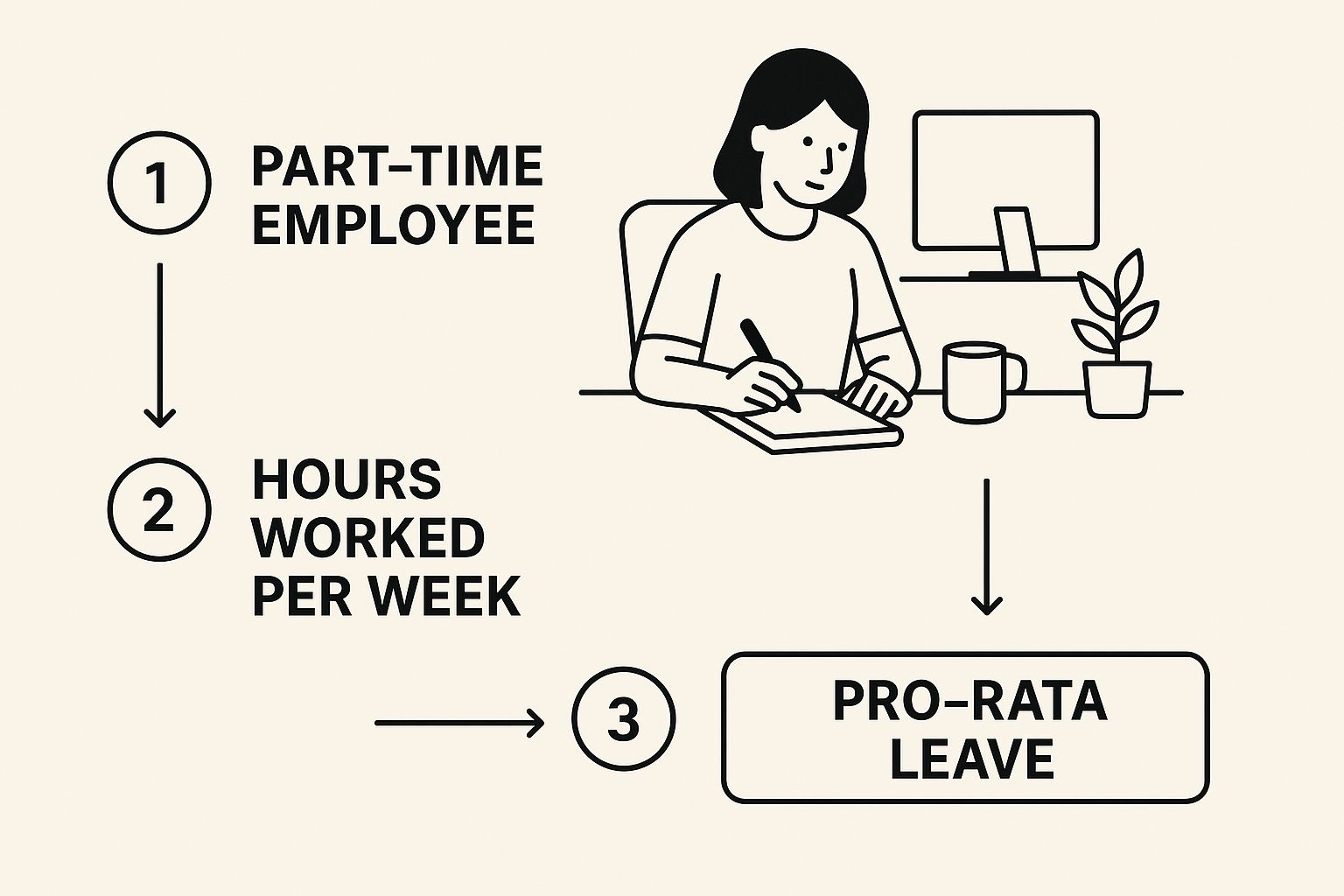
As you can see, the core concept is simply to scale the standard full-time entitlement down to match an individual's specific working pattern.
The Pro-Rata Formula Explained
For most part-time employees who work a set number of days each week, the standard calculation for statutory leave is nice and simple. The formula is:
(Number of days worked per week) x 5.6 = Total annual leave days
This simple multiplication gives you the total number of paid days off you are legally entitled to each year. No complex maths needed!
For many contractors, who are often considered 'atypical workers', sorting out holiday entitlement starts with their employment structure. Resources for understanding umbrella companies can shed light on how this setup impacts statutory rights, as contractors working this way are typically entitled to the same pro-rata holiday pay.
Worked Examples In Action
Let’s plug this formula into a few common scenarios to see how it plays out in the real world.
-
Example 1: The Three-Day Week Worker
Sarah works Tuesday, Wednesday, and Thursday. Her calculation is 3 days x 5.6 weeks, which comes to 16.8 days of paid holiday per year. Often, an employer will round this up to a neat 17 days for simplicity's sake. -
Example 2: The Employee Joining Mid-Year
David starts a new five-day-a-week job on 1st July, exactly halfway through the company's holiday year. His entitlement for the rest of that year is simply half of the full amount: 28 days / 2 = 14 days.
Things can get a bit more complex when calculating leave for workers with no fixed hours, like those on zero-hours contracts, because it's based on hours worked. We've put together a detailed breakdown in our guide on https://www.leavewizard.com/zero-hour-contract-holiday-calculation-your-essential-guide.
To make it even clearer, this table shows the calculation for different part-time working patterns.
How to Calculate Pro-Rata Annual Leave
| Working Pattern | Calculation Method | Total Annual Leave (Days) |
|---|---|---|
| Works 4 days per week | 4 days x 5.6 weeks | 22.4 days |
| Works 2 days per week | 2 days x 5.6 weeks | 11.2 days |
| Works 1 day per week | 1 day x 5.6 weeks | 5.6 days |
As you can see, this pro-rata approach ensures that every employee, no matter their working schedule, receives their rightful holiday entitlement. It’s all about maintaining fairness and staying compliant with UK employment law.
How Holiday Pay and Accrual Actually Work
Knowing your total holiday allowance is the first step, but the real key is understanding how you actually earn it and how you get paid for it. It's helpful to think of your annual leave like a savings account that you contribute to with every hour you work. You don't get the full pot on day one; instead, you build it up steadily over the year.
This process is called accrual. For most people, holiday entitlement accrues at a consistent rate. The standard method is pretty straightforward: you earn 1/12th of your total annual leave for each full month you work. This keeps things fair, ensuring the leave you have available is always proportional to how much of the year you’ve worked.
There is, however, a special rule that often applies during your first year with a new company. In this initial period, many employers will cap the amount of leave you can take in any given month to whatever you've accrued up to that point. This is a practical measure to prevent new starters from taking their entire year's allowance and then leaving the job shortly after. To get a deeper dive into how this works, you can explore the details of what is accumulated holiday pay.
What Is a Week’s Pay?
When you take a day off, you should be paid at your normal rate. Simple enough for salaried staff with fixed hours, right? But what about people whose pay packet looks different from one week to the next? This is where the legal definition of "a week's pay" becomes so important.
The law is clear that your holiday pay must reflect what you would have typically earned. That means it has to include more than just your basic hourly rate or salary.
Your holiday pay should not leave you financially worse off than if you had been at work. It must be based on your average earnings, including regular extra payments.
This is a critical point that a lot of people—and even some employers—get wrong. If certain payments are a regular part of your income, they absolutely have to be factored into your holiday pay calculation.
Calculating Pay for Variable Hours
To make sure everyone gets a fair deal, employers are required to calculate an average of your pay over a specific time frame. The legally required reference period for this calculation is the previous 52 paid weeks. When working out your holiday pay, they must look at everything you've earned.
This means they have to:
- Include regular overtime: If you consistently work extra hours, the pay from that overtime has to be included in your holiday pay.
- Factor in commission: Any commission you earn that's directly linked to the work you do is part of your normal pay and should be in the calculation.
- Account for performance bonuses: Bonuses tied to your performance are also considered part of your usual earnings.
By averaging your pay over the last 52 weeks you actually worked (ignoring any weeks where you didn't get paid at all), your holiday pay gives a true reflection of your normal earnings. This system is designed to protect you from a financial hit just for taking a well-deserved break.
How to Book Time Off and What Happens if You Don't Use It All
Knowing how many days of annual leave you're entitled to is only the first piece of the puzzle. The real-world application comes down to the rules around booking that time off and what happens to any days left in the bank at the end of the year. These processes aren't just red tape; they're there to ensure things are fair for everyone and to help businesses keep running smoothly.
Most companies have a straightforward procedure for requesting leave. A common rule of thumb is that you need to give notice that's at least double the length of the holiday you want to take. So, if you're dreaming of a two-week getaway, you should get your request in four weeks beforehand. Simple.
It's also worth remembering that your employer can say no to a holiday request. They can't just refuse leave for no reason, but they can turn down requests if there's a genuine business need. This could be anything from making sure there's enough cover during a madly busy period to avoiding a situation where half the team is off at the same time.
Can Your Employer Tell You When to Take Holiday?
In a word, yes. In certain situations, your employer can absolutely tell you when you need to take your annual leave. This is most common in industries that have a scheduled shutdown, like a manufacturing plant that closes over Christmas or schools that shut their doors for the summer holidays.
As long as this requirement is clearly stated in your contract and they give you plenty of notice (usually that same 'double the length of the leave' rule applies), it's perfectly legal. It's a practical way for a business to manage its operational calendar and make sure everyone gets their mandatory rest.
The key takeaway here is that while the leave is your right, the timing is often a negotiation between you and your employer, guided by company policy and what the business needs.
The Lowdown on Carrying Leave Over
So, what happens if you get to the end of your company's leave year with a few days of holiday left over? The rules on "carrying over" this leave can feel a bit complex, but they're built on a pretty clear legal foundation.
The whole point of statutory leave is to make sure you get enough rest. Because of this, the law is quite strict about the first four weeks of your holiday entitlement (that's 20 days for a full-time employee). This chunk of leave generally cannot be carried over. The law insists it must be taken within the leave year it was earned.
However, the extra 1.6 weeks (or 8 days for a full-timer) that make up the UK minimum can be carried over, but only if you have a written agreement with your employer allowing it. Anything beyond this, like a more generous company allowance, is completely up to your employer's discretion.
You'll find that company policies on this vary quite a bit:
- A "use it or lose it" policy: This is very common. Many businesses say that any unused holiday beyond the statutory minimum is lost if not taken by the end of the year.
- Limited carry-over: A popular approach is to let staff carry over a small number of days, often up to five, with the condition that they must be used within the first few months of the new leave year.
- Flexible arrangements: Some employers are more flexible, especially if heavy workloads or business demands made it difficult for you to take all your time off.
The best advice? Always check your employment contract or the company handbook to get the exact details on your carry-over rules. A little bit of forward planning is all it takes to make sure you use the holiday you've earned and avoid any nasty surprises.
It’s a strange paradox, isn't it? Despite having a legal right to a decent amount of paid time off, a surprising number of UK workers just don't use their full holiday allowance. And this isn’t just a hunch; it’s a clear trend showing up in the data.
Recent stats paint a worrying picture. The average number of holiday days taken by UK employees actually fell from 38 in 2020 to just 33.9 days in 2023. That means around 60% of UK workers are leaving valuable, hard-earned holiday days on the table each year. If you want to dive deeper into the numbers, you can read the full UK annual leave report by industry.
So, what's really going on here? Why are people so reluctant to switch off? It turns out several factors are creating a culture where taking a proper break can feel more like a luxury than a necessity.
The Pressure to Stay "On"
For many, the biggest hurdle is a simple one: an overwhelming workload. The fear of coming back to an avalanche of emails and a mountain of catch-up tasks can make the holiday itself feel more stressful than just staying put. This is the classic "presenteeism" culture, where being visible is mistaken for being productive, creating a subtle pressure to stay connected at all times.
This cycle of overwork is particularly damaging. When employees feel they cannot afford to take time off, it leads directly to burnout, reduced productivity, and lower morale across the entire team.
On top of that, some modern workplace perks can unintentionally muddy the waters. "Unlimited holiday" policies sound fantastic in theory, but in practice, they can sometimes lead to employees taking less time off. Without a clear number of days to aim for, staff can feel uncertain about how much leave is truly acceptable, and they often end up erring on the side of caution.
Of course, this issue isn't spread evenly across the board. Industries known for their high-pressure environments, like finance, tech, and construction, often report the highest levels of unused leave. This really highlights how a specific work culture can either encourage people to take restorative breaks or quietly discourage them from ever logging off.
Your Annual Leave Questions Answered
When it comes to holiday pay and time off, a few common questions always seem to pop up. Let's break down the answers to some of the queries we hear most often.
Can My Employer Tell Me When to Take Holiday?
In short, yes they can. Your employer has the right to dictate when you take your annual leave, which is a common practice for things like a company-wide Christmas shutdown.
However, they can't just spring it on you. The rule of thumb is that they must give you notice that is at least double the length of the holiday they're requiring you to take. All of this should be spelled out clearly in your employment contract.
What Happens to My Holiday When I Leave a Job?
When you move on from a role, you’re legally entitled to be paid for any statutory holiday you've built up but haven't used. It's your earned benefit, after all.
On the flip side, if you've been a bit keen and taken more holiday than you've actually accrued by your leaving date, your employer can deduct the difference from your final pay. This should only happen if it's a clause in your contract, so it's always worth checking.
Key Takeaway: Your employer can't pay you for your statutory holiday instead of you taking it. The only exception is when your employment is ending—that's when any untaken, accrued leave is paid out.
Do Bank Holidays Count Toward My Statutory Leave?
This is a big one, and the answer often surprises people. An employer is perfectly within their rights to include the UK's bank holidays as part of your minimum 5.6 weeks' statutory leave.
There's no automatic legal right to have bank holidays off in addition to your standard allowance. It all comes down to what's written in your contract. Some companies offer bank holidays on top of the 5.6 weeks as an extra perk, while others roll it all into one figure.
Understanding your full benefits package is crucial. Beyond your specific entitlement, it's essential to consider how annual leave factors into your overall compensation when learning how to evaluate job offers. A generous holiday policy can significantly enhance a job's appeal, making it a key point of comparison between different roles.


