
A holiday allowance calculator is one of those tools that can feel like a bit of a lifesaver. It’s designed to cut through the noise of UK leave rules and give you simple, reliable answers.
Whether you're dealing with full-time staff, part-timers, or people on zero-hour contracts, it helps you figure out exactly what they're owed—keeping things fair, transparent, and legally sound.
Why Getting Holiday Calculations Right is a Bigger Deal Than You Think
Let's be honest, navigating UK holiday allowance can feel like you're wading through a swamp of regulations. But getting it right isn’t just about ticking a box for compliance; it’s about looking after your team, keeping the business running smoothly, and protecting your finances.
A simple mistake can easily lead to underpaid staff, which opens the door to potential employment tribunals and, just as damagingly, erodes the trust you've built with your people.
On the flip side, when calculations are spot-on and transparent, it builds a genuinely positive culture. Employees who know what they're entitled to feel valued and respected, which nips confusion and disputes in the bud. That clarity is the bedrock of a fair system that keeps you compliant and your team happy.

The Legal and Financial Stakes are High
The rules around annual leave in the UK are strict for a reason. The legal minimum, or statutory entitlement, for a full-time employee working a five-day week is 28 days of paid annual leave. This works out to 5.6 weeks and has been the standard since the Working Time Regulations 1998 came into force.
Getting these sums wrong can have a real financial impact. Miscalculations don't just mess up an employee's pay packet; they throw a wrench into your financial forecasting and make resource planning a nightmare.
Think of it this way: your holiday calculations are a critical piece of a much larger puzzle. They feed directly into your payroll and overall compliance. Getting this one detail wrong can create a domino effect of costly admin headaches you just don't need.
Accuracy here is foundational to how to effectively manage small business payroll without constant firefighting.
A quick reference can make all the difference. Here’s a simple breakdown of the minimum statutory holiday entitlement in the UK based on a typical work week.
UK Statutory Holiday Entitlement At a Glance
| Days Worked Per Week | Statutory Annual Leave (Days) | Statutory Annual Leave (Weeks) |
|---|---|---|
| 5 | 28 | 5.6 |
| 4 | 22.4 | 5.6 |
| 3 | 16.8 | 5.6 |
| 2 | 11.2 | 5.6 |
| 1 | 5.6 | 5.6 |
Remember, this table shows the legal minimum. Many businesses offer more as part of their contractual benefits, but you can never offer less than the statutory amount.
It's Time to Ditch the Manual Spreadsheets
When you're just starting out with one or two employees, a spreadsheet might seem like it does the job. But as soon as your team starts to grow, that spreadsheet quickly becomes a liability.
Manual data entry is a recipe for human error, there's no clear audit trail, and it becomes a huge time-sink when you're juggling different contract types. This is where a dedicated holiday allowance calculator comes in. It automates all the tricky formulas for you, handling:
- Full-time and part-time staff: It nails the pro-rata entitlements without you needing to break out the calculator.
- Irregular and zero-hour workers: It applies the correct 12.07% accrual method, which can be a real headache to do manually.
- New starters and leavers: It accurately calculates how much leave someone is owed when they join or leave part-way through the year.
Think of this guide as your roadmap. We’ll start with the straightforward calculations for full-time staff before diving into the more complex scenarios. By the end, you’ll have the confidence to move from administrative guesswork to a streamlined, fair, and foolproof system.
Calculating Leave for Your Full-Time Employees
Let’s start with the most common scenario: your full-time staff. Getting this calculation right is the bedrock for everything else, so it’s essential to nail the basics before we tackle the trickier situations.
Think of each employee's annual leave as a 'leave pot'. At the start of the year, your job is to fill this pot with the correct amount of paid time off, making sure it meets legal standards and reflects your company policy. Once you know the rules, it's actually pretty straightforward.

Unpacking the Statutory 5.6 Weeks
In the UK, the law is refreshingly clear on this. Every full-time employee is entitled to a minimum of 5.6 weeks of paid holiday each year. This is the absolute legal floor – you can’t offer less.
For someone working a standard five-day week, this translates into a simple sum:
5.6 weeks × 5 days per week = 28 days of paid annual leave
This magic number of 28 days is the total statutory entitlement. It's the minimum you have to provide, but how you handle it—especially when it comes to bank holidays—can vary from one business to the next. Any good holiday allowance calculator will use this as the starting point for full-time staff.
The Role of Bank Holidays
A common tripwire for employers is figuring out how bank holidays fit into this 28-day total. You have two main options, and both are perfectly legal as long as the employee gets at least 28 days off.
- The Inclusive Approach: You give 28 days of annual leave in total, which includes bank holidays. If there are 8 bank holidays in a year, your employee gets 20 days of 'flexible' leave to book themselves, plus the 8 bank holidays off.
- The Exclusive Approach: You offer the 28 statutory days plus bank holidays as an extra perk. In this case, an employee on a five-day week would get 36 days off (28 days + 8 bank holidays).
Whichever route you take, it’s vital to spell it out clearly in your employment contracts. Any grey areas here can easily lead to misunderstandings and disputes. Consistency is your best friend.
Going Beyond the Minimum: Contractual Allowance
While 28 days is the legal minimum, many companies choose to offer more. This extra time off is known as contractual allowance and it’s a powerful tool for attracting and keeping great people. For instance, a business might offer 30 days of leave plus bank holidays to make their benefits package more competitive.
If you offer more, this enhanced allowance must be detailed in the employment contract. The contract should specify the total number of days and clarify your policy on bank holidays, ensuring everyone is on the same page from day one.
It’s also important to understand how this leave builds up over the year, particularly for new starters. To get a better handle on this, check out our detailed guide on how to calculate annual leave accrual and keep things fair for everyone on the team.
Mastering Pro-Rata For Part-Time Staff
Calculating holiday allowance for part-time employees is often where businesses stumble. The key is applying the pro-rata principle, which just means that part-timers get the same amount of holiday as their full-time colleagues, but in proportion to the hours or days they work. This makes sure everyone is treated fairly, no matter their working pattern.
Think of it like sharing a cake. A full-time employee gets a full slice representing 5.6 weeks of leave. A part-time employee gets a smaller slice, but it's cut from the same cake and is perfectly proportional. It's all about equity.
Getting this right prevents potential disputes and keeps you compliant with UK employment law, which is crystal clear that part-time workers must not be treated less favourably than their full-time counterparts.
The Go-To Formula For Part-Time Days
For staff who work a set number of days each week, the calculation is refreshingly simple. You can figure out their annual leave with a straightforward formula that any good holiday allowance calculator would use.
Here’s the formula:
Number of days worked per week × 5.6 = Total annual leave entitlement (in days)
Let's see this in action. Say you have an employee who works a consistent three-day week.
- Calculation: 3 days × 5.6 weeks = 16.8 days of paid leave per year.
It’s really important that you don't round this figure down. Legally, you must give them the full 16.8 days (which is easy if you track leave in hours) or round up to the nearest half or full day, like 17 days.
When Hours Matter More Than Days
But what about employees with more complex schedules? Maybe someone works full days on Monday and Tuesday but only a half-day on Wednesday. In these situations, calculating their holiday entitlement in hours is much more accurate and fair.
To do this, you first need to know the total weekly working hours for a full-time employee at your company. Let's assume a standard full-time week is 37.5 hours (e.g., 7.5 hours a day, 5 days a week).
- Calculate the total full-time holiday hours: 5.6 weeks × 37.5 hours/week = 210 hours of annual leave.
- Determine the part-timer's hours: Let's say your employee works 20 hours per week.
- Find the pro-rata percentage: (20 hours ÷ 37.5 hours) × 100 = 53.33%.
- Calculate their holiday hours: 210 hours × 53.33% = 112 hours of annual leave.
This method gives you the precision you need when every hour counts. Gaining a solid grasp of these rules is vital, and you can dig deeper into understanding PTO for part-time employees to cover all the bases.
This is the homepage of LeaveWizard, an employee management solution designed to simplify these exact calculations for small businesses.
The platform automates complex pro-rata calculations, eliminating the manual effort and risk of error highlighted in these examples.
Building Confidence With Practical Application
Getting comfortable with pro-rata calculations just comes down to practice. This approach ensures you're not just guessing but applying a fair and legally sound method to every part-time worker. For those looking to dive even deeper, our guide on how to calculate prorated leave provides more examples and context.
The core principle is simple: a part-time worker's holiday entitlement must be directly proportional to that of a full-time worker. Sticking to this prevents unfairness and keeps your leave management system transparent and defensible.
By mastering both the day-based and hour-based methods, you’ll be ready to handle any part-time arrangement with confidence. This removes ambiguity, cuts down on admin headaches, and helps build a workplace where every employee feels their time is valued fairly.
Handling Irregular Hours and Zero-Hour Contracts
Calculating holiday allowance for staff on zero-hour contracts or with irregular working patterns can feel like trying to hit a moving target. Their hours are unpredictable by nature, which means a simple pro-rata calculation just won't cut it. It’s a common headache in sectors like retail and hospitality where flexible rotas are the norm, often leading to confusion for employers and staff alike.
Thankfully, you don’t have to guess. There are specific, government-approved methods designed for these exact situations. Knowing which one to use, and when, is the key to making sure your calculations are fair, accurate, and completely above board. This is where a reliable holiday allowance calculator really proves its worth, taking the complex rules and automating them to prevent any costly slip-ups.
This little decision tree gives you a visual on how entitlements start to branch out based on working patterns, setting us up for the more detailed calculations.
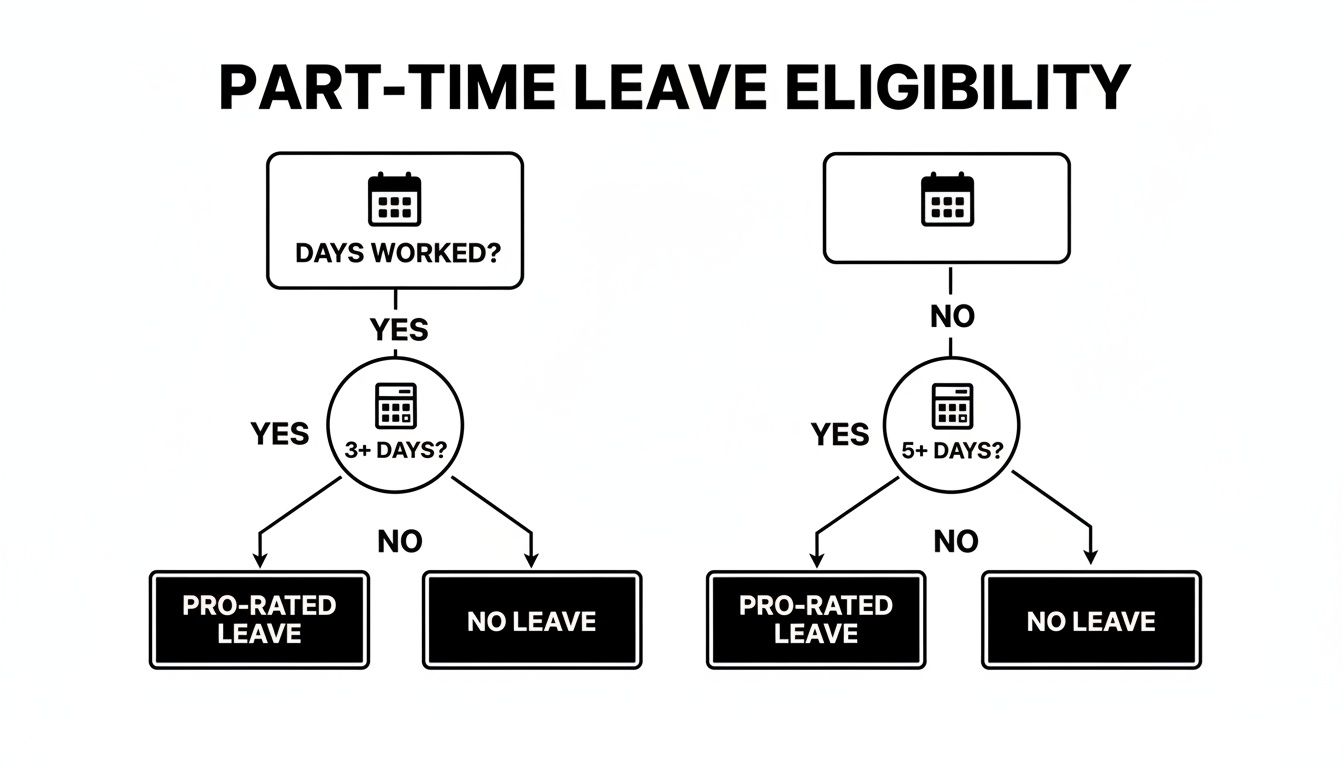
As the flowchart shows, the more variable the work, the more detailed the calculation needs to be. We quickly move away from straightforward day-based sums.
The 12.07% Accrual Method Explained
For a long time, the go-to approach for handling holiday for casual and zero-hour workers has been the 12.07% accrual method. That number isn't just pulled out of thin air; it’s directly linked to the statutory holiday entitlement.
Here’s how the maths breaks down:
- A standard working year is 52 weeks long.
- The statutory holiday entitlement is 5.6 weeks.
- This leaves 46.4 weeks in the year for working (52 – 5.6).
- If you work out what 5.6 is as a percentage of 46.4, you land on 12.07%.
What this means in practice is that for every hour an employee works, they build up holiday entitlement at a rate of 12.07%. It’s a beautifully simple system that ensures their leave allowance grows in direct proportion to the hours they actually work, keeping things fair no matter how much their schedule chops and changes.
Example in Action
Let's say a student works on a zero-hour contract at a local pub and clocks 80 hours in a month. To figure out their accrued holiday:
80 hours × 12.07% = 9.66 hours of paid leave.
It’s a straightforward way to manage leave for your most flexible people. To get a complete picture of how to apply it, our guide on holiday entitlement on zero-hours contracts digs even deeper.
The 52-Week Holiday Pay Reference Period
While the 12.07% method works out the time off an employee has earned, the 52-week reference period is all about figuring out their holiday pay. This is absolutely vital for staff whose pay packet varies from one week to the next.
To get this right, you have to look back over the last 52 weeks that they actually earned money and work out their average weekly pay. This ensures their holiday pay is a fair reflection of their typical earnings.
Crucially, you must ignore any weeks where the employee didn't work and, therefore, earned nothing. If you need to, you can go back as far as 104 weeks to find 52 weeks' worth of pay data.
- Step 1: Pull the pay data for the last 52 weeks the employee was paid.
- Step 2: Tally up the total pay across those 52 weeks.
- Step 3: Divide that total by 52 to get their average weekly pay.
This average figure is what they get paid for one week of holiday. It's the legal standard and stops workers from being unfairly penalised with low holiday pay just because they happened to take leave after a quiet spell.
Managing Leave for New Starters and Leavers
People joining and leaving your company is just a normal part of business. But when it comes to their holidays, you need to be absolutely on the ball with the calculations. For anyone joining or leaving mid-way through your holiday year, the key is to work out what they're owed on a pro-rata basis. This whole process boils down to one core idea: holiday accrual.
Think of it like a pay-as-you-go mobile plan, but for holidays. Instead of getting their full year's allowance dumped in their lap on day one, an employee earns it bit by bit as they work through the year. This gradual build-up ensures their leave entitlement is always perfectly in sync with the time they've actually spent with the company.
Getting this right isn't just about ticking boxes; it's about being a fair and professional employer. A leaver who gets the correct final pay leaves with a positive impression. A new starter who sees you've handled their allowance correctly from the get-go knows they've joined a company that does things properly.
Calculating Holiday Accrual for Starters and Leavers
The most straightforward way to work out accrued holiday is to figure out what an employee earns each month. You simply take their total annual leave and divide it by 12.
The go-to formula looks like this:
(Total annual holiday allowance ÷ 12) × Number of months worked in the leave year
Let's see how that works for someone who starts part-way through the year.
- Scenario: A new team member starts on 1st July.
- Your Leave Year: Runs from 1st January to 31st December.
- Full Annual Allowance: 28 days.
- Months Worked: They'll work 6 full months that year (July through to December).
- Calculation: (28 days ÷ 12) × 6 months = 14 days.
Simple as that. Your new starter is entitled to 14 days of holiday for the rest of that leave year.
Handling Final Pay for Employees Who Leave
When an employee hands in their notice, the same accrual logic clicks into gear. You need to calculate what they've earned up to their leaving date and then square that against what they've actually taken.
If an employee has earned more holiday than they've used, you're legally required to pay them for those untaken days. This is often called 'payment in lieu of holiday' and it must be included in their final paycheque.
Here’s a quick example for someone leaving your business:
- Scenario: An employee's last day is 30th September.
- Your Leave Year: 1st January to 31st December.
- Full Annual Allowance: 28 days.
- Months Worked: They've completed 9 full months (January to September).
- Calculation: (28 days ÷ 12) × 9 months = 21 days accrued.
Next, you dive into their leave record. Let's say they've only taken 18 days off. You owe them payment for 3 days (21 accrued – 18 taken).
What If an Employee Has Taken Too Much Leave?
Now for the flip side. What happens if an employee has been a bit too keen on holidays and taken more than they've earned by the time they leave? If the employee in our example had taken 23 days off, they'd have used 2 days more than their entitlement.
Here's the crucial bit: you can only reclaim the money for this excess leave if you have it explicitly written into their employment contract. The clause needs to clearly state that you have the right to deduct the value of any holiday taken beyond their accrued entitlement from their final salary. Without that written agreement, you can't legally touch their final pay.
It’s an interesting side note that UK employees are getting much better at taking their allocated time off. Recent data shows that unused annual leave has dropped by a massive 71% since 2019, from 18.5 days per employee down to just 5.3 days in 2024. You can discover more insights into annual leave statistics. This trend makes accurate tracking even more important, as with fewer leftover days floating around, the final calculation for leavers has to be spot-on.
Common Holiday Calculation Mistakes and How to Avoid Them
Even with the best formulas in hand, it's surprisingly easy for small miscalculations in holiday allowance to snowball into big problems. These aren't just numbers on a spreadsheet; errors can lead to unhappy employees, legal headaches, and a huge administrative mess. Think of this section as your guide to dodging the most common pitfalls I've seen businesses fall into.
Getting the maths right is the first step, but applying it fairly and consistently is where things can get tricky. A simple rounding error or a misunderstanding of the rules for bank holidays can cause real issues. By getting familiar with these common mistakes now, you can build a holiday system that’s robust, fair, and headache-free for everyone involved.
Incorrectly Rounding Days
One of the most frequent slip-ups is rounding holiday entitlements down. Let's say your calculation for a part-time employee works out to 16.8 days of leave. It is illegal to round this down to 16. That employee is entitled to the full amount you calculated.
So, how do you handle it? You have two straightforward, compliant options:
- Track in hours: This is by far the most precise method. Calculating and tracking leave in hours completely sidesteps the problem of partial days.
- Round up: The simpler alternative is to always round the final figure up to the nearest half or full day. In our example, you’d give the employee 17 days.
Whichever route you take, the key is consistency. Apply the same rule across the business and spell it out clearly in your annual leave policy so there’s no room for confusion.
Mishandling Bank Holidays for Part-Timers
It’s a common myth that part-time staff are only entitled to bank holidays if they happen to fall on their normal working days. This is wrong, and it can easily lead to unfair treatment and disgruntled employees. The reality is that all part-time employees are entitled to a pro-rata share of bank holidays, no matter what their work schedule looks like.
The fairest way to manage this is to calculate their total annual leave entitlement including bank holidays. Then, if a bank holiday falls on a day they would normally work, they simply book it off from this total allowance. This method ensures every part-timer receives their full, proportional entitlement.
Key Takeaway: A clear, written annual leave policy is your single most important tool for preventing disputes. It should explicitly cover how you handle rounding, bank holidays for all staff types, and rules on carrying over leave. Ambiguity is the enemy of fairness.
Having an Unclear Carry-Over Policy
When the end of the year approaches, assumptions around carrying over unused leave can cause a lot of confusion and last-minute chaos. UK law allows employees to carry over up to 1.6 weeks (that's 8 days for a full-time employee) of their statutory leave, but only if there's a formal agreement in place.
Without a clear policy, you'll be fielding endless questions. Your policy needs to specify:
- The maximum number of days anyone can carry over.
- The deadline by which any carried-over leave must be used in the new year.
- The exact process for requesting to carry leave over.
Putting this in writing prevents that year-end rush of holiday requests and makes sure the process is managed fairly for the whole team. A good holiday allowance calculator or a dedicated system like LeaveWizard can automate these rules for you, creating a clear audit trail. This central record is what protects your business from risk by making sure your calculations are consistent, documented, and compliant.
Your Holiday Allowance Questions Answered
Even with the best formulas and systems in place, specific questions about holiday allowance always seem to pop up. This section tackles some of the most frequent queries we hear from business owners and HR managers, giving you clear, straightforward answers. Think of it as your quick-reference guide for those tricky edge cases.
Getting these details right is about more than just compliance; it’s about making sure your policies are fair and transparent for every single member of your team. Let's dive into the common questions that can catch even seasoned employers out.
How Do I Handle Bank Holidays for Part-Time Employees?
This is a classic point of confusion. The bottom line is that part-time staff are legally entitled to a pro-rata share of bank holidays, just like the rest of their annual leave. You can't just give them the day off if a bank holiday happens to fall on their normal working day, as that would be unfair to others on your team.
The fairest and most compliant way to manage this is to:
- Calculate their total annual leave entitlement in days or hours (for example, someone working 3 days a week gets 16.8 days in total: 3 days × 5.6 weeks).
- Lump all bank holidays into this total allowance.
- When a bank holiday comes around that they would normally work, they simply book it off using their total leave pot.
This approach guarantees every part-timer gets their full, proportional entitlement, no matter which days of the week they work. Simple.
What Is the Maximum Holiday an Employee Can Carry Over?
UK law is quite specific about carrying over the statutory 5.6 weeks of leave. Employees can carry over up to 1.6 weeks (which works out to 8 days for a full-timer) into the next leave year, but only if you have a formal agreement for this, like a clause in their employment contract.
It's crucial to remember that the first 4 weeks of statutory leave (the bit that originally came from the EU directive) generally cannot be carried over. The main exceptions are if an employee was physically unable to take it due to things like long-term sickness or statutory family leave. Of course, for any extra contractual leave you offer on top, your own company policy will dictate the rules.
Do We Pay Employees for Untaken Holiday When They Leave?
Yes, absolutely. When an employee's time with you comes to an end, for whatever reason, you are legally required to pay them for any statutory holiday entitlement they've accrued but not yet taken. This is a non-negotiable requirement under the Working Time Regulations 1998.
The final calculation should be based on how much leave they've earned right up to their last day. This payment, often called 'payment in lieu of holiday', must be included in their final paycheque. It’s a key step for a clean and compliant offboarding process.


