
Ever heard of the Bradford Factor? If you're in HR or manage a team, you've probably come across it. It’s a straightforward formula used to get a handle on the real impact of employee absences.
The core idea is simple but powerful: frequent, short-term sick days are way more disruptive to a business than one single, long-term absence, even if the total days off are identical.
Understanding the Bradford Scale and How It Works
Let's paint a picture. You run a small shop. One of your team, Alex, is off sick for two straight weeks (10 working days). That's one single absence. Another team member, Ben, is also off for 10 days over the year, but he takes ten separate Mondays off.
Which scenario gives you the bigger headache?
Most managers would agree: it's Ben. His pattern of absence is a recurring nightmare, forcing you to scramble for cover and messing up the team's rhythm week after week. Alex's absence, though longer, is a one-off event you can actually plan around.
This is exactly what the Bradford Scale is designed to measure. It shines a spotlight on the frequency of absences, penalising repeated spells much more heavily than the total time off.
The Formula Explained
The scale uses a simple bit of maths to cook up a score that shows this disruptive effect. This number is often called the 'Bradford Factor'.
The Bradford Scale Formula: S² x D = B
Let's break that down:
- S (Spells): This is just the number of separate times someone was off sick. One continuous week off is one spell. Five separate Mondays off? That's five spells.
- D (Days): This is the grand total of days the employee was absent over a set period, which is usually a rolling 52 weeks.
- B (Bradford Score): This is the final number the formula spits out.
The real magic is in the "S²" (Spells squared). By squaring the number of absence instances, the formula makes the score jump up exponentially for every separate spell.
This clever calculation gives managers a number that goes beyond just counting sick days. It helps spot potentially tricky attendance patterns that might otherwise fly under the radar. It provides a consistent, data-driven starting point for conversations about employee attendance and wellbeing, shifting the focus from just how long someone is off to how often.
Calculating Bradford Scale Scores with Real Examples
Reading the theory is one thing, but seeing the Bradford Scale for sickness in action is where it really clicks. The formula itself is incredibly simple, yet the results can be eye-opening. It has a knack for highlighting just how different absence patterns impact a business, even when the total number of days off is identical.
The core formula is S² x D, where 'S' is the number of separate absence spells and 'D' is the total number of days absent. Let's walk through a couple of classic scenarios to see how it works and why it places so much weight on frequent, short-term absences.
Scenario 1: A Single Long-Term Absence
First up, let’s imagine an employee named Sarah. She comes down with a nasty bout of flu and is off work for 10 days straight.
- Spells (S): Because it was one continuous period of sickness, her spell count is just 1.
- Total Days (D): She was away for a total of 10 days.
- Calculation: 1² x 10 (which is simply 1 x 10).
- Sarah’s Bradford Score: A very low 10.
A score this low reflects an absence pattern that, while not ideal, isn't the kind of recurring disruption that sets alarm bells ringing for managers.
Scenario 2: Frequent Short-Term Absences
Now, let's look at her colleague, David. Over the same 52-week period, he was also off for a total of 10 days. The crucial difference? His time off was spread across five separate two-day instances.
- Spells (S): David had 5 separate instances of absence.
- Total Days (D): His total days off also add up to 10.
- Calculation: 5² x 10 (which is 25 x 10).
- David’s Bradford Score: 250.
Hang on a minute. Both employees were away for the exact same number of days, but David's score is a whopping 25 times higher than Sarah's. This is the Bradford Factor doing its job—immediately flagging an absence pattern that is far more disruptive to team planning, workflow, and productivity.
For a deeper dive into applying these calculations in a real-world setting, you might want to explore our complete playbook for HR leaders.
This diagram breaks down exactly how the spells and days come together to create that final score.
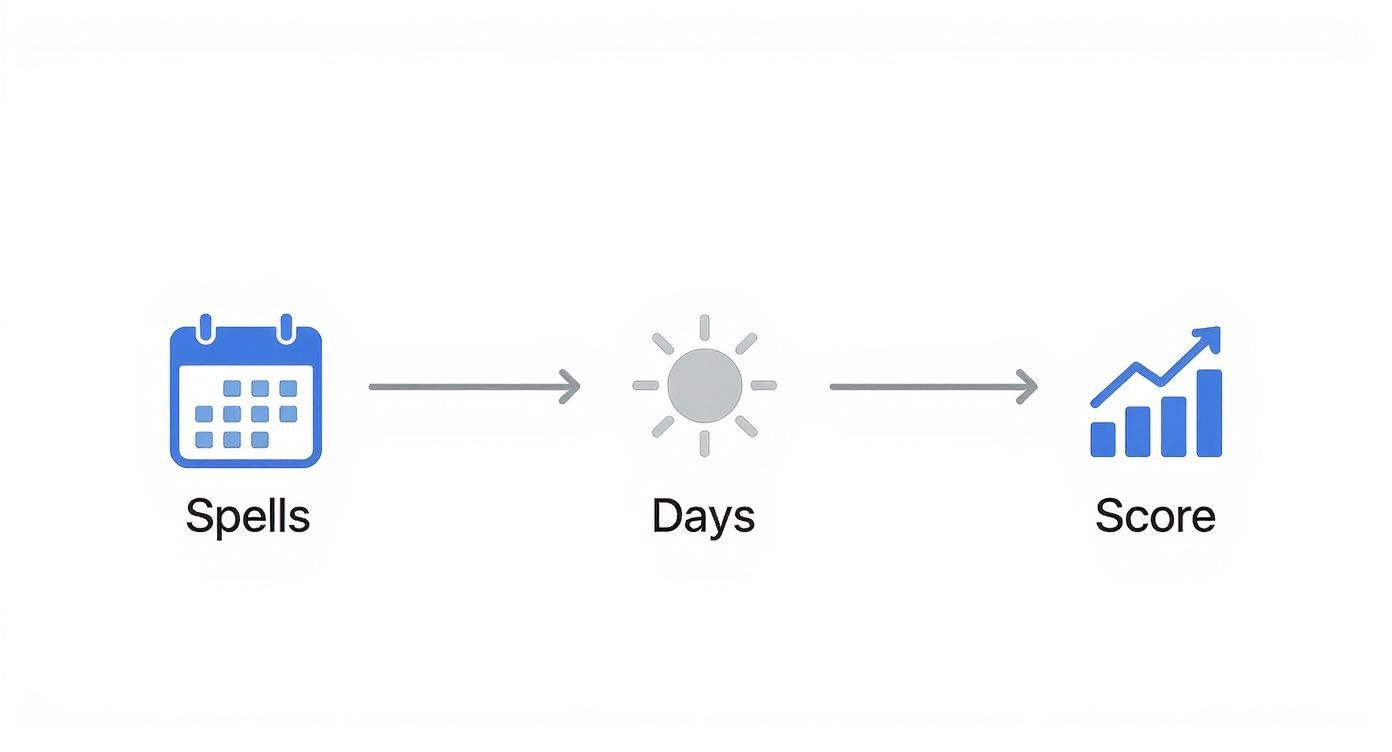
The key takeaway here is how squaring the 'Spells' factor causes the score to shoot up exponentially with each separate absence.
Comparing Different Absence Patterns
To really drive the point home, this table lays out a few different scenarios side-by-side. You can clearly see how the score changes dramatically based on the pattern of absence, even when the total days off are the same.
Bradford Scale Score Examples
| Absence Pattern | Spells (S) | Total Days (D) | Calculation (S² x D) | Bradford Score |
|---|---|---|---|---|
| One 10-day absence | 1 | 10 | 1 x 1 x 10 | 10 |
| Two 5-day absences | 2 | 10 | 2 x 2 x 10 | 40 |
| Five 2-day absences | 5 | 10 | 5 x 5 x 10 | 250 |
| Ten 1-day absences | 10 | 10 | 10 x 10 x 10 | 1,000 |
As you can see, the score escalates quickly as the number of spells increases. This kind of objective data gives managers a solid, factual starting point for conversations about potentially problematic attendance trends, taking the guesswork out of the equation.
How to Interpret Scores and Set Fair Thresholds
A Bradford Scale score is just a number until you give it meaning. Translating that figure into a practical, fair response is where the real work of managing absence begins. The idea is to set up clear ‘trigger points’—specific scores that prompt a consistent management action, starting with a gentle intervention and moving toward more formal procedures if needed.
It's really important to get this right: there is no single, universally accepted set of thresholds. What works for a massive manufacturing plant will almost certainly not suit a small creative agency. Your company’s trigger points need to reflect your own operational needs, team size, and organisational culture.

The key is to use these triggers as a prompt for a supportive conversation, not just as a fast track to disciplinary action. A high score isn't an automatic guilty verdict; it's a signal to dig a bit deeper and find out what's going on, with compassion and genuine curiosity.
Setting Your Trigger Points
When you're putting your policy together, creating a tiered system is a massive help. It gives you a clear and transparent framework that both managers and employees can understand, so everyone knows exactly what to expect.
A high score on the Bradford scale for sickness should be a catalyst for a supportive conversation. It's an opportunity to understand what's really going on, not a reason to jump to conclusions. The score is the start of the process, not the end.
This approach ensures you’re being fair and consistent every time. It’s also worth thinking beyond just setting thresholds and considering how a Bradford Score might feed into the bigger picture of how to evaluate employee performance. After all, it’s just one piece of the puzzle.
Here is a practical template showing how different score ranges can line up with specific management actions. Many UK businesses use a similar model, adapting it to fit their specific needs.
Example Bradford Scale Trigger Points and Actions
| Bradford Score Range | Interpretation | Recommended Management Action |
|---|---|---|
| 0 – 49 | No immediate concern | Routine monitoring as part of standard practice. |
| 50 – 199 | Informal concern | An informal chat to discuss attendance and offer support. This is often part of a return-to-work interview. |
| 200 – 499 | Formal concern | Issue a first verbal or written warning. This stage involves a formal meeting to discuss the impact of the absences and agree on improvements. |
| 500+ | Serious concern | This could lead to a final written warning or, in persistent cases and after a thorough process, potential dismissal. |
Remember, these are just guidelines. The most important thing is that your policy clearly states your chosen thresholds and is communicated to all staff. Being transparent is absolutely vital for building trust and making sure the Bradford scale for sickness is seen for what it should be: a fair and objective tool.
Weighing the Pros and Cons of the Bradford Scale
The Bradford Scale is a popular HR tool, but it’s certainly not without its critics. Like any formula that tries to capture complex human behaviour in a single number, it has both powerful advantages and some pretty significant drawbacks. Getting to grips with this balance is the only way to decide if, and how, it fits into your organisation.
On one hand, the scale offers a clear, objective starting point. It’s designed to replace gut feelings with hard data, giving you a consistent way to spot potentially disruptive absence patterns that might otherwise fly under the radar. This mathematical approach means every employee is measured by the same yardstick, which can help reduce the risk of unconscious bias creeping into absence management.
For managers, this kind of clarity can be a huge help. It provides a factual basis for starting supportive conversations, helping them distinguish between isolated instances of illness and recurring patterns that might need a closer look.
The Advantages of an Objective Metric
The main draw of using the Bradford Scale for sickness is its straightforward, numbers-based nature. It gives HR and line managers a simple method to flag potential issues before they spiral into bigger problems.
Here are the key benefits:
- Objective Analysis: The formula is purely mathematical. This removes subjectivity from the initial stages of absence monitoring and helps ensure fairness.
- Identifies Disruptive Patterns: It excels at its core purpose—highlighting the frequent, short-term absences that often cause the most operational chaos.
- Deters Non-Genuine Absences: When employees know how the system works, the heavy penalty on frequency can discourage those casual, unplanned days off.
- Provides a Framework for Action: Clear trigger points give managers a consistent and transparent process to follow, from an informal chat right through to formal warnings.
The Disadvantages and Ethical Concerns
But here’s the catch: the scale’s biggest strength—its cold, mathematical logic—is also its greatest weakness. The formula is completely blind to context. It can't understand the human stories behind the numbers, and this creates some serious risks that you have to manage carefully.
The most significant criticism is its potential to unfairly penalise certain groups of employees.
The Bradford Scale can inadvertently discriminate against individuals with chronic health conditions, disabilities, or mental health challenges. These employees may experience frequent, short-term absences that are entirely legitimate and unavoidable, yet the formula would flag them as problematic.
This lack of nuance can lead to serious ethical and even legal problems, particularly around the Equality Act 2010, which requires employers to make reasonable adjustments for disabled staff.
What’s more, a rigid application of the scale can create a culture of presenteeism. This is where people feel pressured to drag themselves into work while genuinely ill, just to avoid triggering a high score. A sick employee at their desk isn’t just less productive; they also risk spreading illness to the rest of the team, potentially causing even more disruption in the long run. An over-reliance on the numbers can easily overshadow a genuine commitment to employee wellbeing, breeding distrust instead of support.
Legal Guidelines and Best Practices for UK Employers
Using the Bradford Scale in the UK is about more than just crunching numbers; you have to tread carefully to meet legal and ethical standards and ensure you’re being fair. A high score should never be the only reason for disciplinary action. Think of it as a flag—a signal to start a supportive and thorough conversation about an employee's absence patterns.
A rigid, numbers-only approach can land you in hot water, especially when it comes to the Equality Act 2010. The law is crystal clear on this: employers have a legal duty to make reasonable adjustments for employees with disabilities. This isn't just good practice; it's a non-negotiable part of using the Bradford Scale legally in the UK.
Making Reasonable Adjustments
So, what does a "reasonable adjustment" actually look like? It simply means looking at the context behind the absences.
For an employee with a known disability or a chronic health condition, this usually means discounting certain absences from their Bradford Score calculation. For instance, you might need to disregard absences related to:
- Regular hospital appointments for an ongoing condition.
- Recovery time from a procedure linked to their disability.
- Sickness that is a direct result of their condition.
Failing to make these adjustments isn't just poor management. An employment tribunal could see it as disability discrimination, which can carry serious legal and financial penalties.
Building a Transparent Absence Policy
A fair system is built on a foundation of transparency. Your company’s absence management policy needs to spell out exactly how you use the Bradford Scale, leaving no room for guesswork.
A Bradford Scale score should be the beginning of a conversation, not the end of one. Its purpose is to flag potential issues for supportive intervention, ensuring employees get the help they need while maintaining operational stability.
Your policy should detail the specific trigger points you use and what happens when each threshold is met. For example, it should clearly state that a certain score will lead to an informal chat, while a higher score will prompt a more formal meeting. This level of clarity builds trust and helps everyone understand the process. In fact, effective strategies for managing sickness absence always put clear communication and a supportive framework first.
When a score does trigger an alert, the first step should always be a conversation, typically as part of a structured return-to-work interview. This is your chance to understand the real reasons for the absences, offer support, and discuss any adjustments that might help. Remember, the goal is to support your team and maintain a healthy, productive workplace—not to catch people out. The only sustainable and lawful way forward is to use the scale as a tool for support, not just punishment.
Using Software to Automate Absence Management
Let’s be honest, manually tracking absences on spreadsheets is a recipe for an administrative migraine. It’s clunky, prone to human error, and calculating the Bradford scale for sickness for every single employee quickly becomes a mammoth task. Trying to apply absence policies consistently when you're buried in spreadsheets? It's nearly impossible.
This is where modern HR software completely changes the game.
Dedicated systems take the entire process off your plate. They log absence spells and durations with perfect accuracy and calculate Bradford Scores in real-time. Better yet, they can automatically ping managers when an employee’s score crosses a trigger point you’ve set.

From Burden to Strategic Tool
This kind of automation delivers huge wins. It ensures everyone is treated consistently, frees up countless hours for your managers, and gives you insightful data to spot wider absence trends across the business. The right employee absence management software transforms the Bradford Factor from a painful calculation into a genuinely strategic tool.
This isn’t just theory. The UK Prison Service famously adopted this approach and saw sickness rates drop by around 25% after rolling out the formula alongside better employee support. It's a powerful example of how the scale, when used as part of a wider, supportive strategy, can be incredibly effective. You can dive deeper into the findings on UNISON's website.
By taking the admin away, automation allows managers to get back to what truly matters: having supportive, constructive conversations with their teams.
Bradford Scale: Your Questions Answered
When it comes to the Bradford Scale, things can get a bit confusing. Let's clear the air and tackle some of the most common questions we hear from both managers and their teams.
Is the Bradford Scale Legal in the UK?
Absolutely. Using the Bradford Scale is perfectly legal in the UK. But there’s a big "however" attached to that. You have to apply it fairly and consistently to everyone in the company. If you don't, you could be walking straight into a discrimination claim.
The crucial part is making reasonable adjustments for employees with disabilities, as laid out in the Equality Act 2010. This means you might need to disregard absences that are a direct result of a known disability or chronic condition. Think of the score as a prompt for a supportive chat, not as the sole reason for disciplinary action.
What Is Considered a Bad Bradford Scale Score?
There’s no magic number here; every organisation sets its own trigger points. A common setup might see scores over 500 kicking off a more formal process, while a score floating between 200-499 could lead to a formal warning.
It’s vital that a company clearly outlines these thresholds in its absence management policy and makes sure every single staff member knows what they are. Transparency is what makes the system feel fair and objective, not like a tool for punishment.
Can I Be Fired Based on My Bradford Scale Score?
Getting dismissed only because of a high Bradford Scale score would almost certainly be seen as an unfair dismissal by a UK employment tribunal. It just doesn't work like that.
A high score should be the starting pistol for a formal process, not the finish line. This process must include meetings to talk about the absences, offering support (like an occupational health referral), and giving clear warnings about what might happen next. Dismissal should only ever be the final resort after a thorough, fair, and supportive procedure has been followed.


