
When it comes to holiday rights in the UK, the foundation is refreshingly simple: almost every worker is legally entitled to a minimum of 5.6 weeks of paid annual leave each year. This isn't just a perk; it's a statutory right that acts as a legal floor, making sure everyone gets a proper chance to rest and recharge.
Understanding Your Core UK Holiday Rights
Trying to get your head around your annual leave entitlement in UK law can feel a bit daunting at first, but the core idea is straightforward. Think of it as a personal 'recharge account' that your employer is legally required to top up for you every single year. The whole point is to protect employee wellbeing and encourage a healthy work-life balance, no matter what your job title or industry is.
This fundamental right covers a surprisingly wide range of people, not just your typical full-time, Monday-to-Friday employee. It includes:
- Full-time employees working a standard five-day week.
- Part-time workers, whose entitlement is simply calculated on a pro-rata basis.
- Workers on zero-hour contracts, who build up their leave based on the hours they actually work.
- Agency workers, once they've been in the job for a qualifying period.
The Statutory Minimum Explained
So, what does 5.6 weeks actually look like in the real world? For someone working a typical five-day week, it translates neatly to 28 days of paid time off.
It’s important to know that this figure is capped at 28 days. So, even if you work six days a week, your statutory minimum won't go any higher than that. Your employer might include bank holidays as part of this entitlement, but that depends entirely on what's in your contract. For a deeper dive into UK leave specifics, you can find more insights on vacationtracker.io.
This infographic is a great way to visualise the key parts of your holiday rights.
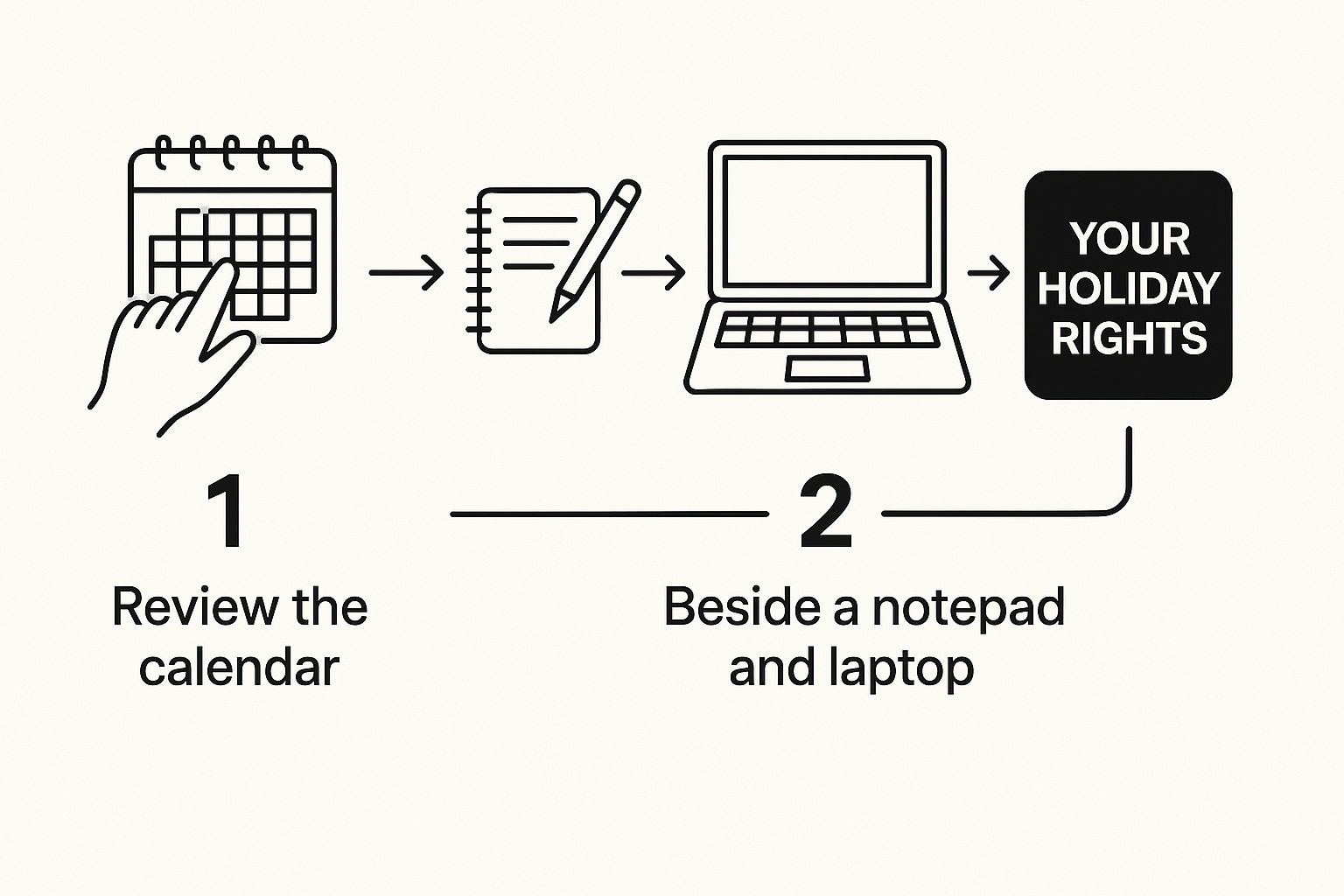
As you can see, getting this baseline clear is the first step to making sure you're getting the right amount of paid time away from work.
A crucial point to remember: this 5.6-week figure is the absolute legal minimum. Many companies offer more generous holiday allowances as a benefit to attract and retain staff, but they can never offer less than the statutory amount.
A Quick Snapshot of Your Entitlement
To make things even clearer, here’s a simple breakdown of the minimum paid holiday days you get based on the number of days you work per week. Think of this table as a handy reference before we get into the nitty-gritty of calculating leave for different working patterns.
UK Statutory Annual Leave at a Glance
| Days Worked per Week | Minimum Paid Holiday Days (5.6 weeks) |
|---|---|
| 5 days | 28 days |
| 4 days | 22.4 days |
| 3 days | 16.8 days |
| 2 days | 11.2 days |
| 1 day | 5.6 days |
This gives you a quick idea of where you stand. In the next section, we'll explore exactly how to calculate this for part-time, irregular hours, and other less straightforward working arrangements.
Calculating Leave for Different Work Patterns

Working out annual leave isn't a simple one-size-fits-all job. While the 5.6 weeks of statutory entitlement is the universal starting point, how this actually translates into days or hours off can change dramatically depending on an employee's work pattern.
Getting this right is absolutely critical for fairness, legal compliance, and keeping your team happy. Think of the 5.6 weeks as the main ingredient in a recipe. For a full-timer, the recipe is straightforward. But for part-time staff or those on irregular hours, you need to adjust the measurements carefully to get the right result.
Let's break down the formulas for each scenario, making sure everyone gets their fair slice of paid time off.
Full-Time Employees Working a Standard Week
For staff who work a fixed number of days each week, the calculation is refreshingly simple. It’s just a quick bit of multiplication.
The formula is:
Number of days worked per week x 5.6 = Total statutory holiday days
So, your typical full-time employee working five days a week gets 28 days of annual leave (5 x 5.6). Simple as that. If someone works a compressed week of four longer days, they would be entitled to 22.4 days (4 x 5.6).
Part-Time Employees and Pro-Rata Leave
When an employee works part-time, their leave is calculated on a pro-rata basis. This is a fancy way of saying they get a holiday entitlement that’s proportional to what their full-time colleagues receive.
To figure this out, you first need to know what a full-time equivalent (FTE) looks like in your company. Let’s imagine a full-time employee works 37.5 hours and gets 28 days of leave.
Now, say you have a part-timer who works 22.5 hours a week:
- Find their FTE: 22.5 hours / 37.5 hours = 0.6 FTE
- Apply this to the full leave allowance: 0.6 x 28 days = 16.8 days
This approach keeps everything fair and consistent across your entire workforce. If you want to dive deeper, our guide on how to calculate prorated leave has more detailed examples.
Irregular Hours and Zero-Hour Contracts
Figuring out leave for workers with no set hours, like those on zero-hour contracts, demands a totally different method. For a long time, the go-to approach has been based on a percentage of hours worked.
For these workers, holiday entitlement builds up based on the hours they actually put in. This directly links their paid leave to their contribution, which is the fairest way to handle it.
The classic method uses an accrual rate of 12.07%. This number isn't pulled out of thin air; it comes from the statutory 5.6 holiday weeks as a percentage of the remaining working weeks in a year (52 weeks – 5.6 weeks = 46.4 weeks).
The maths looks like this: (5.6 / 46.4) x 100 = 12.07%
So, for every hour someone works, they earn 12.07% of that hour as paid holiday. If an employee works 30 hours one week, they will have accrued 3.62 hours of leave (30 x 0.1207).
One crucial thing to keep in mind, though, is a recent legal update. For leave years starting on or after 1 April 2024, the government has officially brought back this percentage method for irregular-hour and part-year workers. This simplifies things massively and makes it the standard for calculating leave entitlement in these specific cases. Always double-check you’re using the correct, up-to-date method for your team.
How Bank Holidays Affect Your Annual Leave
Bank holidays are always a welcome sight on the calendar, but they can stir up a bit of confusion around annual leave entitlement in UK rules. It's a common myth that everyone has an automatic legal right to take these days off with pay. That’s actually not the case.
The truth is, it all comes down to your employer. Whether you get bank holidays off—and whether you get paid for them—is entirely decided by the terms in your employment contract.
Are Bank Holidays Included in Your Statutory Leave?
Your statutory minimum holiday entitlement is 5.6 weeks a year. Your employer can handle the bank holidays that fall within that time in one of two main ways, and your contract will spell out which method they use.
- Included in the 5.6 weeks: Many employers will state that your 28 days (if you're full-time) of annual leave are inclusive of bank holidays. This just means that when a bank holiday comes around, a day is automatically taken from your total leave allowance.
- Offered on top of the 5.6 weeks: A more generous approach is for a company to give you the statutory 5.6 weeks of leave plus paid time off for all bank holidays. This is a great contractual perk, but it's not a legal requirement.
The big takeaway here? Always check your contract. It’s the definitive guide on how your company treats public holidays and the key to understanding your complete holiday package.
What Happens if You Work on a Bank Holiday?
If your contract says you have to work on a bank holiday, your employer isn't legally required to pay you extra, like time-and-a-half. What they must do, however, is make sure you still get your full statutory holiday entitlement.
This usually means you'll get a day off in lieu. For example, if you work on Good Friday, your boss will simply add a day back to your leave balance for you to use another time. This makes sure your total of 5.6 weeks of paid time off stays intact over the course of the year.
It's crucial to understand that your contract determines your rights. If it states you must work bank holidays at your normal rate of pay, this is legally permissible as long as you still receive your minimum paid holiday allowance.
Protecting Part-Time Workers
The law is crystal clear on this: part-time workers must not be treated less favourably than their full-time colleagues. This principle is especially important when it comes to bank holidays.
Since most bank holidays fall on a Monday, a part-timer who doesn't normally work Mondays would be at an unfair disadvantage. To fix this, employers have to calculate a pro-rata entitlement to bank holidays for their part-time staff.
For instance, if a full-time employee gets eight bank holidays a year, a part-timer working three days a week (a 0.6 FTE) is entitled to 4.8 of those days (8 days x 0.6). They can then use this allowance for paid time off when a bank holiday falls on one of their normal working days. If they don't work on that bank holiday anyway, a day is simply deducted from their pro-rata bank holiday pot. It's a simple system that ensures fairness for everyone, no matter their work pattern.
If you're curious to learn more, you can read our article about some interesting facts about UK bank holidays.
The Rules on Carrying Over Unused Leave
What happens to all those holiday days you don't quite get around to taking? It’s a question that trips up both employees and managers, especially when the end of the leave year is fast approaching. The rules around carrying over your annual leave entitlement in the UK are there to strike a balance between fairness for staff and the practical needs of a business.
As a general rule, the approach is often 'use it or lose it'. The core four weeks of leave, which comes from the EU’s Working Time Directive, typically can't be rolled over into the next year. This isn't about being strict for the sake of it; it's designed to make sure everyone takes regular breaks, which is absolutely vital for health and wellbeing.
However, the extra 1.6 weeks of statutory leave granted under UK law is a bit more flexible. This portion can be carried over, but only if there's a clear agreement between you and your employer. This gives companies the wiggle room to create policies that work for their specific operational rhythm.
When Carrying Over Leave Is a Legal Right
There are a few important situations where you are legally entitled to carry over unused holidays, no matter what your company’s standard policy says. The most common one is when you’ve been on long-term sick leave.
If an employee is off sick, they don't stop accruing their holiday time. Should they be too unwell to use their statutory leave during the year, they have the right to carry over up to 20 days (the four-week EU portion) into the next holiday year. This ensures that a period of illness doesn't also mean losing out on the right to paid rest.
Another key protected scenario is statutory family-related leave, including:
- Maternity leave
- Paternity leave
- Adoption leave
- Shared parental leave
Employees on these types of leave continue to build up their full holiday entitlement just like everyone else. Since it’s impossible for them to take this holiday while they are away, they must be allowed to carry it over and use it when they return to work.
Company Policies and Generous Arrangements
While the law sets out the bare minimum, many employers choose to offer more flexible carry-over policies as a perk for their staff. It's quite common for businesses to let people carry over a certain number of days—often somewhere between five and ten—into the new leave year.
Your employment contract is the ultimate guide here. It will spell out exactly how many days you can carry over and any deadlines for using them, which is often by the end of the first quarter (e.g., 31st March).
These enhanced policies are a fantastic way for companies to acknowledge the pressures of modern work and give their employees a valuable safety net. If you're an employer, clearly outlining these rules is crucial. For more guidance, our article on whether you can carry over leave for an employee can help you create a system that's transparent and fair for everyone.
To make things clearer, let's compare what the law requires versus what a more generous company policy might look like.
Annual Leave Carry-Over Rules Compared
| Scenario | Statutory Minimum Rule | Common Enhanced Company Policy |
|---|---|---|
| Standard Year-End | The 1.6 weeks of UK-specific leave can be carried over only by agreement. The main 4 weeks cannot. | Allows employees to carry over a set number of days (e.g., 5 days) from their total entitlement. |
| Sickness Absence | Up to 20 days of leave must be carried over if an employee was too sick to take it. | Follows the statutory rule, but may offer more flexibility on when the carried-over leave must be used. |
| Family Leave (Maternity etc.) | All accrued and unused holiday must be carried over for the employee to take on their return. | Follows the statutory rule and often includes clear communication to help plan the carried-over leave. |
| Deadline for Use | Carried-over sick leave must be used within 18 months of the end of the leave year in which it was accrued. | Often sets a deadline, such as 31st March of the new leave year, for using any carried-over days. |
As you can see, while the law provides a solid foundation, company policies often build on it to offer greater flexibility and support for employees.
The Growing Problem of Unused Leave
Despite all these rules and policies, there's a worrying trend in the UK: people just aren't taking all their holiday allowance. This isn't a small quirk; it points to deeper issues in our workplace culture, from overwhelming workloads to the pressure to be constantly available.
This isn't just a feeling—the numbers back it up. Data from 2024 shows that while the typical statutory allowance is 22 to 23 days plus bank holidays, UK employees leave an average of five days of their annual leave on the table. That's a whole working week of rest and recovery just vanishing. You can find more insights on the state of annual leave in the UK from timetastic.co.uk.
The fallout from this is serious, contributing to rising stress, burnout, and an inevitable dip in productivity. Even well-intentioned 'unlimited' holiday policies can backfire, making staff hesitant to book time off because there's never a "good" time to go. This stockpile of unused leave is a flashing red light, warning us that employees aren't getting the rest they are legally entitled to and so desperately need.
What Happens to Your Holiday When Life Gets in the Way?
Life doesn’t stop for work. Whether you're starting a family, dealing with an illness, or even just moving to a new job, you might wonder what happens to your hard-earned holiday time. The good news is, UK law has your back. Your right to paid annual leave is protected through all of it.
Think of it like this: your holiday entitlement keeps building up, or 'accruing', even when you're not physically at your desk. It's a fundamental part of your employment rights, making sure you aren't penalised for taking legally protected time off for your health or your family.
This protection is a cornerstone of fairness in UK employment law, ensuring everyone gets the rest they're entitled to, no matter what's going on in their personal lives.
Family Leave: Maternity, Paternity, and More
When an employee is on statutory family-related leave, their holiday entitlement continues to build up just as if they were still at work. This isn't a company perk; it's a non-negotiable legal right.
This rule applies across the board for new parents and caregivers, ensuring everyone is treated consistently.
- Maternity Leave: An employee on maternity leave accrues her full contractual holiday entitlement for the entire period she's off.
- Paternity Leave: The same rule applies during the one or two weeks of statutory paternity leave.
- Adoption Leave: Holiday rights are fully protected during statutory adoption leave.
- Shared Parental Leave: Both parents will continue to build up holiday during any periods of shared parental leave they take.
Obviously, you can't take holiday while you're already on another form of leave. So, the law says employees must be allowed to carry over all of that untaken, accrued leave into the next holiday year. A common approach is to agree for the employee to take this holiday either just before their family leave starts or tack it onto the end, which can create a smoother, longer transition back to work.
Sickness Absence and Holiday Accrual
Just like with family leave, employees continue to accrue their statutory holiday time while off sick, no matter how long the absence lasts. This is a crucial protection that stops a period of illness from eating into essential rest and recovery time.
If someone is too unwell to use their holiday during the leave year, they have a legal right to carry it over. This applies specifically to the four weeks of leave that originate from EU law. This carried-over leave must then be used within 18 months from the end of the leave year it was accrued in.
It's a common myth that you can't take holiday while signed off sick. An employee can absolutely choose to take paid holiday while off sick—for example, if their Statutory Sick Pay is running out. What an employer can never do is force an employee to take holiday when they are sick.
This safeguard prevents a tough situation from getting worse. It means that getting better doesn't have to come at the expense of well-earned time off.
Starting or Leaving a Job Mid-Year
What happens when someone joins or leaves the company part-way through the year? Their holiday entitlement for that year is simply calculated on a pro-rata basis.
The calculation is pretty straightforward. You work out what they're owed based on the fraction of the year they've actually worked. For each month on the job, they accrue one-twelfth of their full annual entitlement.
Here’s a quick example:
Let's say a full-time employee gets 28 days of holiday a year and leaves the company after exactly six months.
- Work out the monthly accrual: 28 days / 12 months = 2.33 days per month.
- Calculate the total accrued: 2.33 days x 6 months = 14 days.
If, on their last day, they've taken fewer than those 14 days, the company has to pay them for the outstanding days in their final payslip. This is calculated at their normal rate of pay.
On the flip side, if they've taken more than the 14 days they've earned, the employer can legally deduct the value of those extra days from their final pay. However, this is only allowed if there's a specific clause in their employment contract that permits it. If that clause isn't there, the employer can't reclaim the money.
Why Brits Are Taking Less Time Off

The rules around annual leave entitlement in UK law are pretty clear-cut, but a worrying trend has started to creep in. Even with a legal right to paid time off, UK workers are leaving more and more of their holidays unused.
There's a growing gap between the leave people are entitled to and what they actually take.
This isn't just a few people forgetting to book a long weekend; it's a real shift in our workplace culture. The days of meticulously planning to use every last hour of leave seem to be fading. Instead, we're seeing a rise in 'presenteeism' and a pile-up of pressures that make taking a break feel like a guilty luxury, not a fundamental right.
Something is clearly off-balance in the modern British workplace. To fix it, we first need to get to grips with what's driving this behaviour.
The Forces Driving the Decline in Leave
So, what's keeping people chained to their desks? It’s not one single thing but a perfect storm of economic worries, overwhelming workloads, and even the unintended side effects of company policies.
A massive factor is the sheer pressure of modern jobs. Teams are often run lean, and we're always connected, making many employees feel they simply can't afford to step away. They're either worried about the mountain of work that will greet them on their return or feel guilty for leaving their colleagues to pick up the slack.
On top of that, the rising cost of living is a huge player. For a lot of families, a proper holiday is now an expense that's hard to justify. A 'staycation' often ends up being a week of catching up on life admin, which doesn't exactly make booking time off feel like an exciting prospect.
This isn't just a feeling in the air; the numbers back it up. Recent data shows a significant drop in the amount of leave taken by UK workers. It points to a cultural shift where work is consistently winning out over essential rest.
These pressures are pushing personal wellbeing further and further down the priority list.
Which Industries Are Most Affected?
This isn't a problem that's spread evenly across the board. Some sectors are feeling the strain much more than others, and the data paints a pretty clear picture of where the issue is most severe.
Recent industry analysis has flagged a significant drop in the amount of annual leave employees are actually taking. Looking at data from over 3,000 companies, UK workers took an average of 33.9 days off in 2023. That's a steep fall from 38 days in 2020—a drop of nearly 12% in just three years. You can dig deeper into these industry trends in the full People HR annual leave report.
The sectors hit hardest by this trend include:
- Construction and Trades: Known for its tight deadlines and project-based nature, finding a good time to schedule a break can be a real headache.
- Finance and Insurance: These are often high-pressure environments where a competitive culture can make taking leave feel like a sign of weak commitment.
- Technology: This industry is famously fast-paced and demanding, with an 'always-on' culture that blurs the lines between work and personal life.
This data really shines a light on how specific industry pressures directly affect whether employees feel they can actually use their full annual leave entitlement in UK workplaces. It’s a massive wake-up call for businesses to build a culture where taking time off isn't just permitted but actively encouraged for everyone's long-term health and productivity.
Common Questions About Annual Leave
Diving into the nitty-gritty of UK annual leave can throw up a few tricky questions in everyday situations. Getting quick, clear answers helps everyone—whether you're an employee or employer—handle holiday requests with confidence and stay on the right side of the law. Let's tackle some of the most common queries to round out your understanding.
One question that pops up all the time is whether your boss can tell you when to take your holiday. The short answer is yes, they can. A classic example is a company-wide shutdown over Christmas, where the business requires all staff to use their annual leave for that period. The only catch is they have to give you proper notice, which is at least twice as long as the leave they're making you take.
Rules on Holiday Requests and Pay
How holiday requests and pay are handled is another area that often causes a bit of confusion. There are clear legal rules in place to make sure everything is fair, though your own company's policies might adjust these through your employment contract.
A key point is the notice required to book a holiday. The standard legal rule is that you must give notice that is twice the length of the holiday you want to take. So, if you're planning a one-week getaway, you need to give your employer two weeks' notice. Always double-check your contract, as it might set out a different notice period.
You might also hear about 'rolled-up' holiday pay. This is where an employer tries to include an amount for holiday pay within a worker's normal hourly rate. It's crucial to know this practice is unlawful because it discourages people from actually taking their time off. Holiday pay has to be paid when you take the leave.
Managing Leave Effectively
For any business trying to get a better handle on annual leave and other HR tasks, looking into software solutions can be a real game-changer. These tools can automate all the tracking and help ensure you’re always compliant.
If that sounds useful, you can find a great comparison of the best HR software for startups to see what's out there. The right system makes managing holiday requests, tracking what everyone is owed, and staying compliant a much simpler, stress-free process for the whole team.


