
Why Your Current Absence Policy Isn't Working

Let's face it: many UK absence policies are outdated. They often gather dust in employee handbooks while absence rates climb. This isn't about assigning blame. Instead, it's about acknowledging the gap between traditional policies and the modern workplace. This means businesses need to rethink their absence management policy.
One major issue is that current policies often don't reflect modern working practices. Flexible working, remote work, and the rise in mental health challenges all demand a more nuanced approach. Outdated policies frequently emphasize punitive measures instead of employee wellbeing. This can foster a culture of presenteeism, where employees come to work sick, impacting productivity and team morale.
Inadequate Management Training
Another problem is inadequate management training. Many managers lack the skills to discuss absence effectively. They may avoid addressing the root causes of frequent absences, unintentionally reinforcing negative behaviours. This is particularly tricky with sensitive topics like mental health or long-term illness. Providing managers with proper training and resources can empower them to support their teams. This requires shifting from simply monitoring absence to actively managing it.
The Rise of Long-Term Sickness Absence
Further complicating matters is the increase in long-term sickness absence. This is a significant challenge for UK employers. Approximately 2.78 million people were economically inactive due to long-term sickness in the first quarter of 2025. This increase is linked to a rise in chronic health conditions, impacting the labor market and straining healthcare systems. You can find more detailed statistics from Statista. Managing this situation effectively requires a proactive absence management policy.
A truly successful absence management policy goes beyond tracking days off. It focuses on a supportive environment that prioritizes employee wellbeing while meeting business needs. This includes clear communication, fair procedures, and a culture of trust and understanding. In the following sections, we'll explore building an effective absence management policy that benefits everyone.
The Hidden Costs That Are Crushing Your Bottom Line

Unplanned absences can create a ripple effect throughout your organization, impacting everything from productivity to team morale. Beyond simply covering shifts, these hidden costs, often overlooked, can significantly affect your bottom line. Understanding these costs is the first step towards developing a robust absence management policy.
The Obvious vs. The Hidden
Most businesses account for the obvious costs of absence, such as paying overtime or the expense of hiring temporary staff. However, the less obvious, indirect expenses are often far more damaging. These can include lost productivity, a decrease in the overall quality of work, and the administrative burden of managing absences.
Think, for example, about the time spent finding cover for an absent employee. This might involve training temporary staff or rescheduling projects. These tasks divert your existing team from their core responsibilities, further impacting productivity.
Additionally, unplanned absences can negatively impact team morale. Existing employees often have to shoulder the extra workload, leading to burnout and decreased job satisfaction. This can trigger a domino effect, leading to further absences and potentially increased staff turnover. A seemingly small absence can snowball into significant long-term consequences.
The Financial Impact of Absenteeism
The financial repercussions of poorly managed absence are substantial. The cost of employee absenteeism for UK employers has risen dramatically, reaching £103 billion in 2023. This represents a significant increase of £30 billion since 2018. Average employee absence has also risen to 7.8 days annually, a jump from the pre-pandemic average of 5.8 days.
Company size also plays a role. Smaller businesses with fewer than 50 employees reported an average of 5.0 days absent, while larger firms with 5,000 or more employees saw a much higher average of 13.3 days per employee. More detailed statistics can be found here. This data underscores the urgent need for effective absence management strategies.
Calculating Your True Absence Costs
To fully grasp the financial impact of absence, it’s important to look beyond just calculating sick pay. A comprehensive calculation includes both direct and indirect costs.
- Direct Costs: These include the easily quantifiable expenses like sick pay, overtime payments, and the costs associated with temporary staff.
- Indirect Costs: These encompass the less tangible, but often more significant expenses, including lost productivity, reduced quality of work, the administrative burden of managing absences, the impact on team morale, and the potential for increased staff turnover.
Having a complete picture of these costs helps justify investments in proactive absence management solutions and allows you to demonstrate the return on investment (ROI) of a robust absence management policy. This isn’t just about minimizing costs; it's about cultivating a healthier, more productive, and more engaged workforce.
Building Policies That Actually Prevent Problems
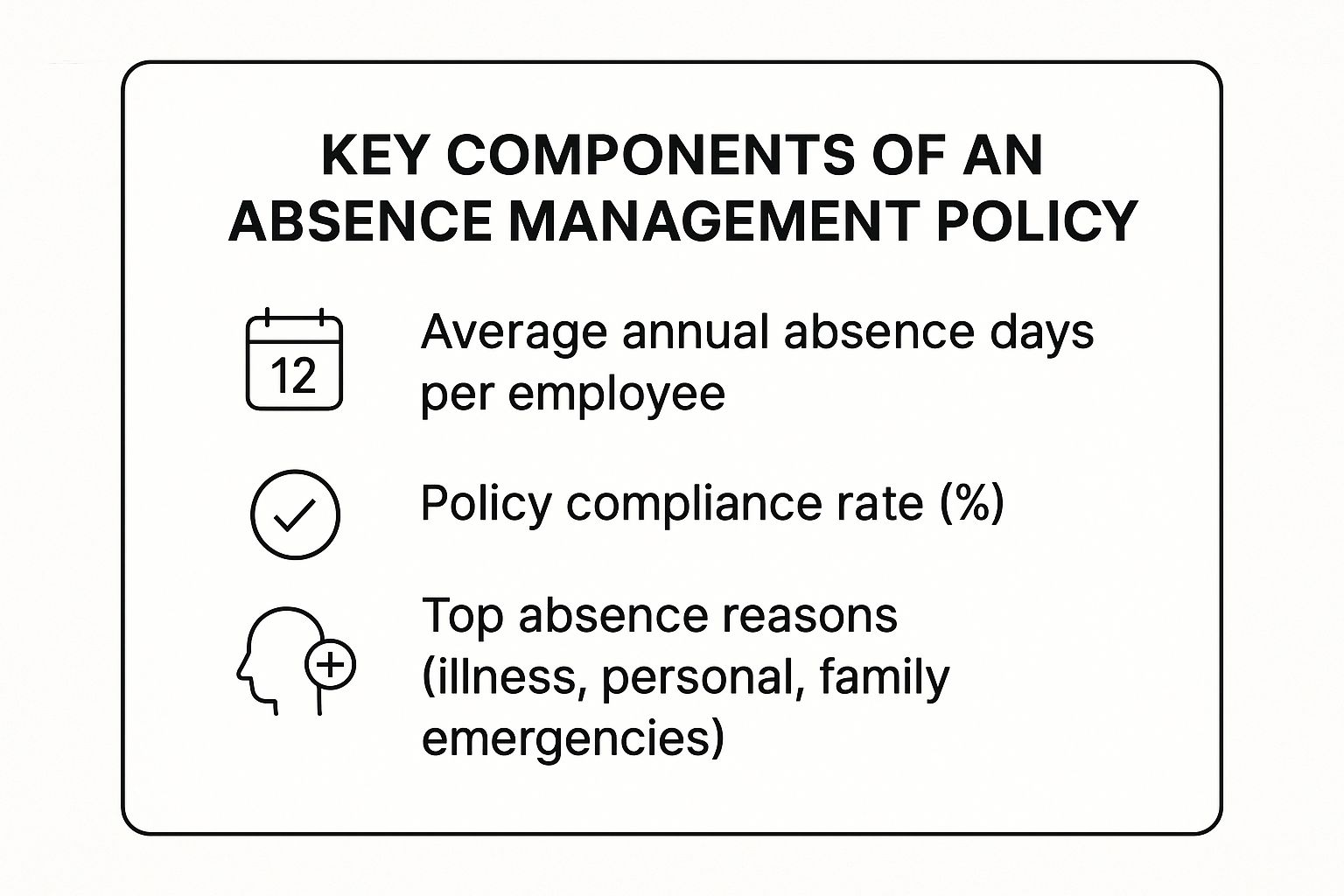
The infographic above illustrates key absence data, including average annual absence days, policy compliance rates, and primary absence reasons. Understanding these metrics, like the high percentage of illness-related absences, is crucial for developing effective absence management strategies and underscores the need for robust wellbeing programs.
Effective absence management starts with a proactive absence management policy designed to prevent issues before they arise. This proactive approach goes beyond simply reacting to absences and focuses on creating a framework that supports both employee wellbeing and operational success. Smart UK employers recognize that a well-structured policy is an investment in their employees and their business.
Clear Reporting Procedures
A clear and straightforward reporting process is fundamental to any successful absence management policy. Employees need to understand exactly how to report an absence, whom to contact, and what information to provide. This clarity simplifies administration and promotes open communication.
Tools like an online portal or a dedicated phone line can streamline reporting and ensure consistent record-keeping. A clear escalation path for complex cases should also be in place.
Fair Triggers and Early Intervention
Early intervention plays a vital role in effectively managing absence. Implementing fair triggers that prompt proactive intervention can address issues before they become long-term problems.
These triggers might include a certain number of absences within a specific timeframe or a pattern of absences on particular days. When a trigger is activated, it should initiate a supportive discussion between the employee and their manager to understand the reasons behind the absence and explore possible solutions.
Return-to-Work Processes That Support Recovery
A comprehensive absence management policy also needs a well-defined return-to-work process. This often involves a phased return, allowing employees to gradually transition back into their roles after a period of absence. This approach supports their recovery and minimizes the risk of relapse or re-injury.
A structured return-to-work interview can also offer valuable insights into the causes of absence and inform preventative measures. This demonstrates care for employee well-being and can contribute to improved morale and reduced long-term absence. Learn more about creating effective strategies: How to master absence management strategies.
Balancing Flexibility and Consistency
Developing an effective absence management policy requires a balance between flexibility and consistency. While clear rules and procedures are important, it's also essential to consider individual circumstances and offer flexibility as needed.
This might include flexible working arrangements or adjusted return-to-work schedules to accommodate specific employee needs. A flexible approach fosters a more supportive environment, encouraging open communication and reducing pressure on employees to work while unwell. This ultimately benefits both the employee and the organization.
To help illustrate best practices across different organizational structures, the following table compares key policy components.
Policy Components That Drive Results
Essential absence management policy elements compared across different organisational contexts and their proven effectiveness
| Policy Component | Small Business Approach | Large Organisation Approach | Public Sector Considerations |
|---|---|---|---|
| Reporting Procedures | Often informal, direct communication with manager | Formalized process, possibly using online systems | Formalized, often multi-layered reporting systems, potentially with union involvement |
| Triggers & Intervention | Manager discretion based on observation and informal conversations | Defined triggers based on absence frequency and duration, automated alerts | Clearly defined triggers, often linked to collective bargaining agreements, emphasis on employee support programs |
| Return-to-Work | Flexible, adapted to individual needs, focus on open communication | Structured process, phased return options, return-to-work interviews | Formalized process, adherence to regulations, potential for occupational health involvement |
| Flexibility & Consistency | High degree of flexibility, individualized approach | Balance between standardized procedures and individual needs | Focus on consistent application of policy within regulatory and union frameworks |
The table highlights the need for tailored approaches to absence management, considering the specific context of each organization. While large organizations and public sector bodies benefit from formalized procedures, small businesses often thrive with a more flexible, individualized approach. However, the core principle of supporting employee wellbeing and maintaining operational effectiveness remains consistent across all contexts.
Staying Legal While Getting Results

Creating a robust absence management policy requires a delicate balance. You must meet your business objectives while staying compliant with UK employment law. This means understanding the legal framework and avoiding potential issues that can lead to expensive claims. This section explores how to develop a compliant absence management policy that protects both your company and your employees.
Understanding Equality Duties
The Equality Act 2010 is a cornerstone of UK employment law. This legislation prohibits discrimination based on protected characteristics, such as disability, pregnancy, and maternity. For example, if your absence management policy disproportionately affects employees with disabilities, it could be considered discriminatory. It's crucial to apply policies fairly and consistently across all employee groups.
Employers also have a duty to make reasonable adjustments for employees with disabilities. This could include modified work schedules, providing assistive technology, or offering phased return-to-work programs. Failing to make these adjustments can open your organization up to legal challenges.
Navigating Disability Discrimination
The intersection of absence management and disability discrimination law is a common area of concern for UK employers. This area demands careful attention, especially when managing long-term absences related to a disability. Automatically dismissing an employee after a certain period of absence, without considering the underlying reasons and possible adjustments, could be discriminatory.
This is where understanding reasonable adjustments is paramount. Employers should engage with employees to understand their individual needs and explore how to best support their return to work. This proactive approach minimizes legal risks and fosters a more inclusive environment. In 2022, a record 185.6 million working days were lost to sickness absence, according to the Office for National Statistics. This highlights the need for clear and effective absence management policies, as emphasized by employment law experts. Learn more about the impact of sickness absence.
Best Practice Approaches
To ensure legal compliance and minimize absence-related risks, consider these best practices:
Clear Policy Documentation: A well-written and accessible absence management policy is essential. This document should clearly outline reporting procedures, what triggers intervention, and the return-to-work process.
Consistent Application: Apply your policy consistently across all employee groups, irrespective of their protected characteristics. Documenting all absence-related decisions and communications demonstrates fairness and transparency.
Regular Training: Regularly train your managers on absence management, equality duties, and reasonable adjustments. This equips them to handle absence-related discussions confidently and appropriately.
Open Communication: Foster open communication between managers and employees about absences. This helps identify any underlying issues and find solutions collaboratively.
Regular Reviews: Review your absence management policy periodically. This ensures it aligns with current legal requirements and best practices. Staying informed on evolving regulations is crucial. Check out How to Master HR Compliance for 2025 for more insights. This proactive approach keeps your policy relevant and effective.
By implementing these strategies, organizations can effectively manage absence, mitigate legal risks, and build a supportive work environment. This benefits both the company and its employees.
Making It Work In The Real World
Successfully implementing an absence management policy requires bridging the gap between the written document and everyday practice. This is often where well-intentioned strategies fall short. This section explores proven methods from UK organizations that have successfully transformed their absence cultures. We'll tackle those common sticking points that can undermine even the best policies.
Training Managers For Difficult Conversations
Equipping your managers with the skills to navigate sensitive absence discussions is critical. Many managers avoid these conversations, fearing they'll make things worse. However, ignoring the problem often exacerbates it.
Effective training should provide managers with practical tools and techniques for handling various absence-related scenarios. This includes:
Asking the right questions: Encouraging open dialogue without being intrusive.
Setting clear expectations: Communicating policy requirements while maintaining a supportive tone.
Addressing underlying issues: Identifying and addressing the root causes of frequent absences.
Documenting conversations: Maintaining a clear record of all interactions.
For example, imagine a manager who notices an employee has been frequently absent on Mondays. Instead of ignoring the pattern, the trained manager initiates a conversation, enquiring about the employee's well-being and offering support. This approach can reveal underlying issues, potentially preventing more serious problems in the future. You might be interested in: How to reduce absenteeism at work.
Establishing Effective Communication Channels
Communication is vital for successful absence management. Clear communication ensures that everyone understands the policy, reporting procedures, and their individual responsibilities.
Multiple channels can improve communication, such as:
Regular team meetings: Briefly reviewing key policy points and addressing any questions.
Email updates: Providing reminders about reporting procedures and policy changes.
An online portal: Allowing employees to easily access the policy, report absences, and track their leave balances.
One-on-one meetings: Offering a safe space for confidential discussions between managers and employees.
This multi-faceted approach ensures everyone stays informed and feels comfortable raising any concerns. This transparency helps build trust and encourages appropriate absence reporting.
Creating A Supportive Workplace Culture
A supportive workplace culture is fundamental to minimizing unnecessary absences. When employees feel valued and supported, they’re more likely to be engaged and committed to their work. This, in turn, can lead to lower absence rates.
This culture of support can be fostered through initiatives like:
Wellbeing programs: Promoting physical and mental health through workshops, resources, or subsidized gym memberships.
Flexible working arrangements: Allowing for greater work-life balance, reducing stress and potential burnout.
Recognition and rewards: Acknowledging employee contributions and celebrating successes.
Adapting To Changing Needs and Gathering Feedback
The workplace is constantly evolving. As workforce needs change, so too should your absence management policy. Regular policy reviews are essential to ensure it remains relevant and effective.
Gathering feedback from employees and managers provides valuable insights into the policy's effectiveness and identifies areas for improvement. This feedback loop allows for continuous improvement, adapting the policy to meet the needs of both the business and its employees.
Furthermore, consistent policy application across the organization is crucial. Inconsistency can undermine the policy's effectiveness and create feelings of unfairness. This necessitates training for all managers, equipping them to apply the policy consistently and fairly in every situation. This ensures equal treatment for all employees, promoting a sense of fairness and trust within the workplace.
By focusing on practical implementation, fostering open communication, and promoting a supportive culture, organizations can transform their absence management from a source of frustration to a valuable tool for supporting their employees and achieving business objectives.
Smart Technology That Actually Helps
Effective absence management requires more than a solid policy. It demands efficient tools to track, analyze, and manage absences effectively. This is where technology becomes crucial. Choosing the right technology for your UK business means understanding your specific needs and avoiding costly, unnecessary features. This section explores how smart technology can truly bolster your absence management policy.
Streamlining Processes With Digital Tools
Technology can automate many tedious absence management tasks. Think about manual processes like tracking absences in spreadsheets or handling paper forms. These are time-consuming and error-prone.
Software solutions automate these processes, freeing up HR and management time for more strategic work. Automated notifications can alert managers when an employee reports an absence, ensuring prompt follow-up. Real-time dashboards provide a clear overview of absence trends across the organization.
Improving Data Visibility and Insights
A key advantage of technology is improved data visibility. Instead of sorting through paperwork, you can access concise reports on absence trends. This helps identify patterns, like increased absences on certain days or within specific teams.
This data-driven approach enables informed decisions about your absence management strategy. For example, noticing a high number of stress-related absences might lead you to implement a wellbeing program.
Enhancing Employee Experience With a Human Touch
Technology is crucial, but maintaining the human element is equally important. Absence management should prioritize employee wellbeing. Technology can support this by streamlining communication and providing easy access to information.
Self-service portals empower employees to manage their absences, view leave balances, and report absences easily. Mobile apps offer even greater flexibility and convenience. These tools simplify processes for employees and provide HR with a more efficient way to manage absences.
Choosing the Right Software
Selecting appropriate absence management software requires careful thought. Here are some key factors to consider:
Features: Does the software offer necessary features like automated notifications, reporting tools, and integration with your current systems?
Ease of Use: Is the software user-friendly for both employees and administrators?
Cost: Does the pricing fit your budget and offer good value?
Support: Does the vendor offer sufficient training and ongoing support?
Scalability: Can the software grow with your business needs?
To help you evaluate options, let's look at a comparison of different technology solutions.
Technology Solutions That Deliver ROI
Comprehensive comparison of absence management technology options, features, and implementation requirements for different organization types
| Technology Type | Key Features | Implementation Complexity | Cost Range | Best Suited For |
|---|---|---|---|---|
| Basic Spreadsheet | Simple absence tracking, manual calculations | Low | Free – Low (Spreadsheet software cost) | Very small businesses with limited budgets and basic needs |
| Dedicated Absence Management Software | Automated tracking, reporting, notifications, integrations | Moderate | Moderate – High (Subscription based) | Small to medium-sized businesses seeking comprehensive features |
| Integrated HR Suites | Absence management module within a larger HR system | High | High (Often part of a larger HR system cost) | Larger organizations requiring seamless integration with other HR functions |
| Bespoke Solutions | Customized features and integrations | High | Very High | Large enterprises with highly specific requirements |
This table provides a starting point. The best choice for your UK business depends on your specific circumstances and absence management needs. Solutions like LeaveWizard offer tailored approaches for small businesses, automating essential tasks and improving oversight without needing complex enterprise-level systems.
Planning Your Implementation
Successfully implementing new software requires a clear plan. Consider these steps:
Define Objectives: What do you want to achieve with the software?
Choose a Vendor: Evaluate different vendors based on your needs and budget.
Integrate With Existing Systems: Ensure seamless integration with payroll and HR systems.
Train Your Staff: Provide comprehensive training.
Monitor and Evaluate: Regularly assess the software's performance and make adjustments.
Predictive Analytics: A Look Ahead
Some advanced systems use predictive analytics. This analyzes absence data to identify potential future trends, allowing proactive steps to address potential issues.
For instance, if the system predicts a rise in illness-related absences, you could implement preventative measures.
Assessing Costs and Benefits
While technology offers significant benefits, consider the costs. This includes the initial price, ongoing fees, implementation costs, and time invested in training and maintenance. A thorough cost-benefit analysis will help you decide if the investment is worthwhile. The goal is to find a solution with a positive return on investment – financially and in terms of improved employee wellbeing and organizational efficiency.
Key Takeaways
A successful absence management policy is more than just a document; it’s a vital component of a healthy and productive workplace. This section highlights key takeaways from real-world implementations, offering practical guidance for enhancing your approach to absence management. These actionable points concentrate on measurable improvements you can put into practice right away.
Prioritize Prevention Over Reaction
A truly effective absence management policy emphasizes preventing absences rather than simply reacting to them. This involves addressing the root causes of absence, such as stress, burnout, or insufficient support for employees dealing with health issues. For example, offering resources for stress management or implementing flexible work arrangements can preemptively decrease the need for absences. This proactive approach cultivates a more supportive work environment and minimizes disruptions to productivity.
Understand Your True Absence Costs
Calculating the true cost of absence extends beyond just sick pay. It includes evaluating the effect on productivity, team morale, and administrative overhead. These often-overlooked costs can significantly impact your bottom line. A clear understanding of the full financial implications allows you to justify investing in a comprehensive absence management program and demonstrate its return on investment.
Implement Clear and Consistent Policies
Your absence management policy should be clear, concise, and readily available to all employees. This clarity minimizes confusion and ensures that everyone understands the procedures for reporting an absence, requesting leave, and returning to work. Consistency in applying the policy is equally crucial, as it promotes fairness and transparency throughout your organization.
Equip Your Managers for Success
Managers play a critical role in absence management. They require the skills to conduct sensitive conversations with employees, address underlying problems, and provide support to their teams. Investing in training on absence management best practices, legal considerations, and communication techniques empowers managers to handle absences effectively and compassionately. This focus on training yields significant returns by reducing absence and improving employee well-being.
Leverage Technology Wisely
Technology can be a valuable asset in streamlining absence management. Selecting the right tools for your UK business can automate tasks, enhance data visibility, and simplify reporting procedures for both employees and managers. However, technology should supplement, not replace, personal interaction. Ensure any technology you choose enhances the employee experience and contributes to a supportive atmosphere.
Measure What Matters
To effectively monitor the efficacy of your absence management policy, measuring key metrics is essential. Traditional metrics like absence rates are important, but consider also including metrics that reflect employee well-being, such as return-to-work success and employee satisfaction. Tracking these broader indicators offers a more holistic perspective on your policy’s impact and facilitates continuous improvement.
Continuous Improvement Through Feedback
Your absence management policy should not be static. Regularly review your policy and solicit feedback from both employees and managers. This feedback loop provides valuable insights into what is working well and what requires adjustment. This ongoing refinement process ensures your policy remains relevant and effective in addressing the evolving needs of your business and your workforce.
For UK small businesses seeking to optimize their absence management, LeaveWizard provides a straightforward and efficient solution. Learn more about LeaveWizard and how it can help reshape your approach to absence management.


