In 2025, sickness absence removed an estimated 148.8 million working days from the UK economy, with an average of 4.4 days lost per worker. The sickness absence rate was 2.0%, still above the 1.9% recorded in 2019, according to the Office for National Statistics sickness absence analysis.
For a small business, those figures aren't remote economic background. One unexpected absence can leave a customer without support, delay a project, put pressure on colleagues and create an urgent payroll question. That's why absence management matters. It gives owners and managers a reliable way to protect service continuity, apply policies fairly and meet UK compliance obligations without relying on scattered emails or an out-of-date spreadsheet.
Table of Contents
- What Absence Management Actually Means for Small Businesses
- The Operational Cost of Poor Absence Tracking
- Financial Stakes and Compliance Risks You Cannot Ignore
- Absence KPIs and Reporting That Drive Better Decisions
- Best Practices for Managing Staff Absence Effectively
- How LeaveWizard Solves Common Absence Management Pain Points
- Building a Supportive and Productive Workplace
What Absence Management Actually Means for Small Businesses
Absence management is the practical system a business uses to record, approve, monitor and respond to employee time away from work. It covers sickness absence, annual leave, compassionate leave, parental leave and other authorised or unauthorised absences. The process should show who is unavailable, why the absence has been recorded at the appropriate level, what cover is needed and what action is due next.
The important distinction is between recording absence and managing it. A calendar that shows an employee is off doesn't tell a manager whether a return-to-work conversation is needed, whether the absence affects Statutory Sick Pay or whether a repeated pattern requires a fair, supportive discussion. A useful process connects those details while protecting confidential health information.
A small team still needs structure
Businesses with 10 to 50 employees often manage absence informally because everyone knows one another. That works until the owner is away, a line manager misses a message or two people are absent at the same time. At that point, the business has no dependable record of cover arrangements, previous absence discussions or pending approvals.
The UK figures explain why this isn't just an HR administration problem. The ONS reports that the public sector sickness absence rate was 2.9%, compared with 1.7% in the private sector. Absence varies by workplace type, so each employer needs accurate data from its own organisation rather than relying on a broad benchmark.
A workable process should answer four questions quickly:
- What happened? Record the start date, expected duration and appropriate absence category.
- Who needs to know? Notify the relevant manager, payroll contact and colleagues responsible for cover.
- What happens next? Set a review date, return-to-work action or escalation point.
- What does the pattern show? Review team-level information to identify workload, scheduling or support issues.
Practical rule: Treat absence data as an operational input, not a private HR archive. Managers need enough visibility to plan work, while access to sensitive information remains controlled.
Good absence management supports employees as well as the business. It gives people a consistent reporting route, makes entitlements clearer and reduces the risk that two employees receive different treatment because their managers use different informal methods. The purpose isn't to discourage legitimate time off. It's to make absence visible, manageable and fair.
The Operational Cost of Poor Absence Tracking
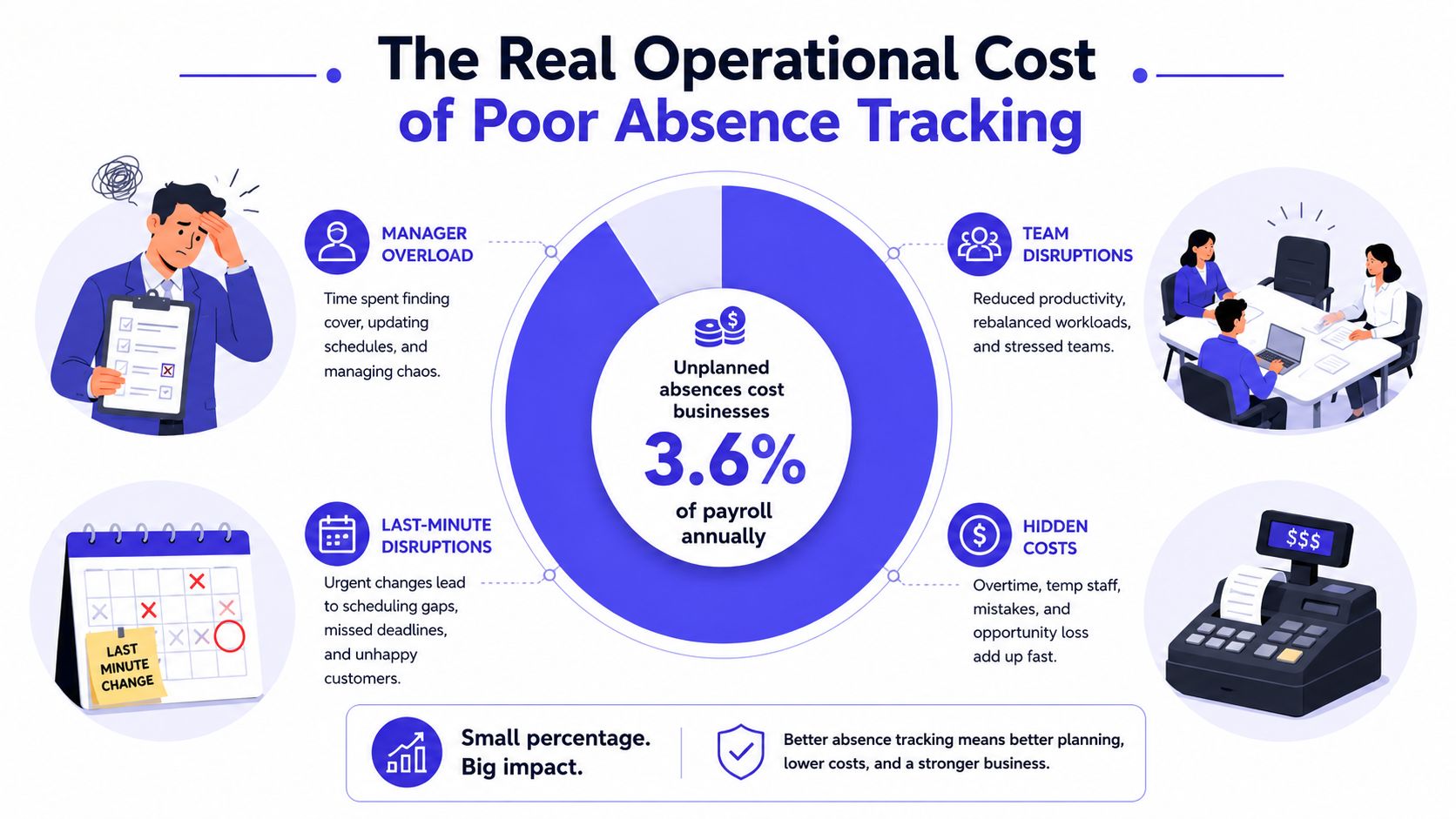
Poor tracking creates work before it creates a report. An employee messages a manager, the message is forwarded to finance, someone updates a spreadsheet, and nobody records the expected return date. A customer-facing task still needs an owner, while colleagues guess who can cover it.
The result is often operational friction rather than one dramatic failure. Managers reallocate work without warning, projects slow down, and employees who remain at work absorb extra tasks. That pressure can affect morale and make future cover harder to arrange.
Everyday absence causes repeated disruption
The common absence is not always a rare, lengthy event. The ONS found that minor illnesses accounted for 30.4% of sickness absence occurrences. For a small employer, frequent short-term disruption is difficult because the team may have little spare capacity and no dedicated substitute.
A consistent process helps managers distinguish between different operational problems:
| Absence pattern | Immediate management question |
|---|---|
| Short, unexpected absence | Who covers the essential work today? |
| Repeated absence | Is a return-to-work discussion or support conversation due? |
| Extended absence | What review, communication and continuity plan is appropriate? |
| Overlapping leave | Can customer, project or shift commitments still be met? |
The answer should be evidence, context and a fair basis for action, rather than automatic suspicion. A spreadsheet can record dates, but it often fails to connect them with approvals, notifications, cover planning and follow-up.
Manual records hide the cost
The hidden cost appears in payroll corrections, manager time and rushed scheduling rather than one invoice. Incorrect dates can affect pay, leave balances and staffing decisions. Delayed approval can leave an employee unsure whether a request has been accepted, while a missed absence notification can create a gap on the day.
Businesses reviewing the wider financial impact should also understand the principles of managing payroll cash flow. Absence records influence when payroll teams need information, how managers plan capacity and whether there is time to arrange cover.
If your process depends on paper forms, email trails and several versions of Excel, calculate the time spent correcting records and chasing approvals. The cost of a paper-based or Excel and email leave management solution includes more than software fees. It also includes operational decisions made with incomplete information, avoidable payroll corrections and time lost checking which version is accurate.
Financial Stakes and Compliance Risks You Cannot Ignore
Sickness absence is an operational risk, not only a wellbeing concern. The Royal Society for Public Health reported an estimated £141 billion cost to the UK economy associated with sickness absence in 2025, alongside 148 million working days lost. Its RSPH assessment places absence firmly within business planning. For an SME, the practical question is how much disruption reaches customers, projects, staffing and payroll.
The exposure has direct and indirect parts. Direct costs include sick pay administration and paid time away where applicable. Indirect costs include temporary cover, lost output, management time, delayed work and the risk that overloaded colleagues cannot maintain performance. Poor records increase both types of cost because managers cannot reliably confirm what happened or what the business owes.
SSP now requires cleaner records
From 6 April 2026, eligible workers receive Statutory Sick Pay from the first full day of sickness absence rather than the fourth day, and the lower earnings limit was removed. Employers must pay the lower of £123.25 per week or 80% of average weekly earnings, according to the UK government guidance on Statutory Sick Pay changes.
The first absence record therefore affects payroll sooner. A business needs the correct start date, eligibility information, average earnings calculation and linked absence history. Acas states that SSP can be payable for up to 28 weeks, average weekly earnings use the eight weeks before sickness begins, and a later absence can link to an earlier period when the worker returns and is off sick again within eight weeks. The Acas SSP guidance shows why casual record-keeping can lead to incorrect payments or missed obligations.
| Change | Previous rule | New rule from April 2026 | Impact on employers |
|---|---|---|---|
| SSP waiting period | SSP began from the fourth day | SSP starts from the first full day for eligible workers | Record the first full day accurately and process payroll promptly |
| Lower earnings limit | Eligibility included the lower earnings limit | The lower earnings limit was removed | Review payroll checks and eligibility workflows |
| SSP amount | Previous arrangements applied | Pay the lower of £123.25 per week or 80% of average weekly earnings | Calculate pay using current records and the employee's earnings information |
| Absence links | Linked periods applied when an employee returned and went off sick again within 8 weeks | Linked periods still need to be identified under the relevant rules | Retain accessible, consistent absence history |
Compliance reaches beyond payroll
The Employment Rights Act backdrop has increased attention on legal exposure for SMEs. Absence records can affect probation handling, sickness procedures, return-to-work decisions and pay administration. A business that cannot show what was reported, approved, discussed and paid may struggle to demonstrate consistent treatment.
Use a 2025 HR compliance checklist to review the wider process, including policy ownership, manager actions and record controls. A checklist supports review, but it cannot replace accurate day-to-day records. Compliance depends on what managers record and how consistently they follow the process.
Absence KPIs and Reporting That Drive Better Decisions
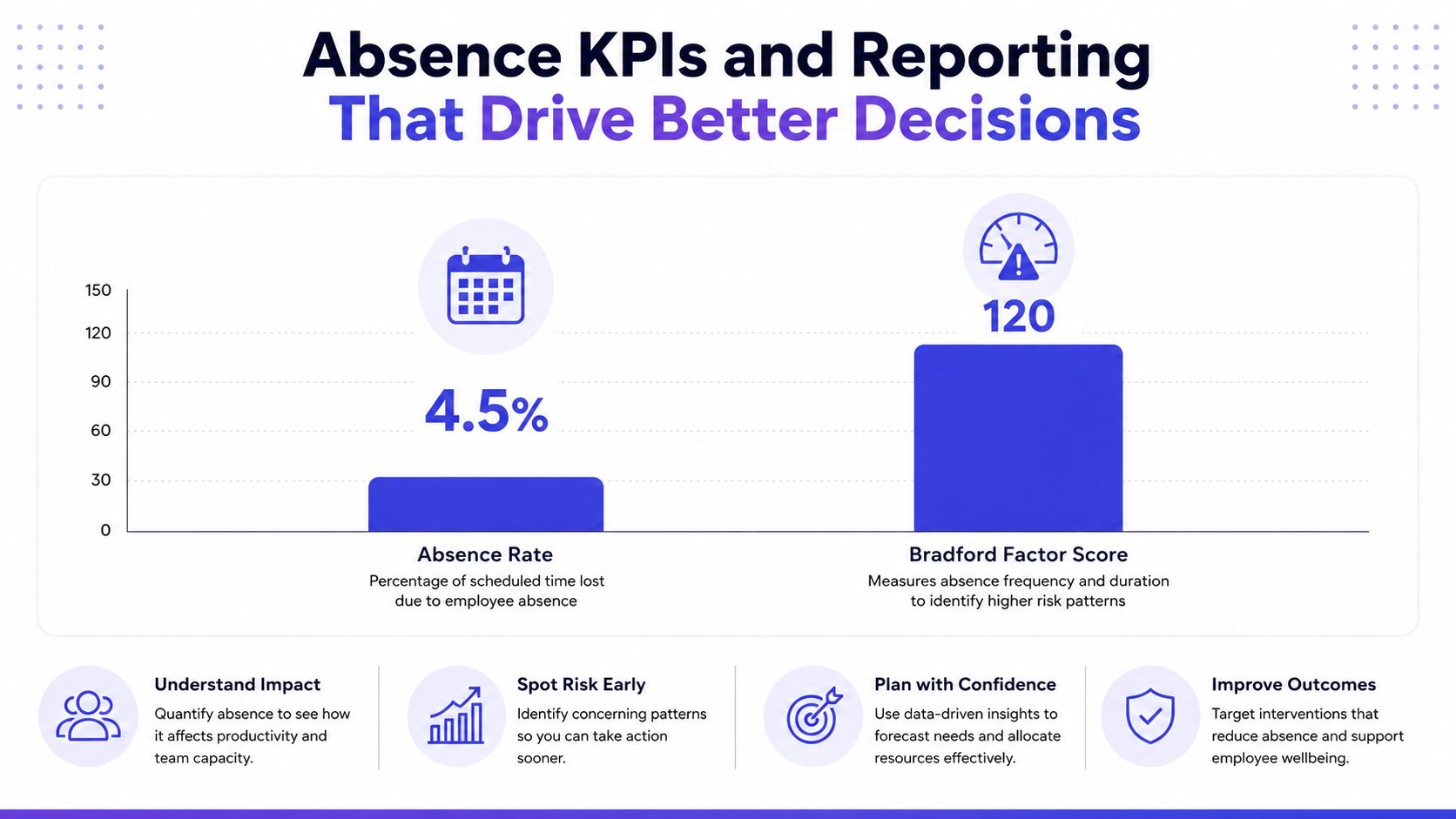
A small business doesn't need a dashboard crowded with metrics. It needs a short set of measures that answer operational questions and prompt appropriate action. Start with absence rate by department, average days lost per worker, the frequency and duration of absence cases, Bradford Factor scores for identifying patterns of repeated short-term absence and return-to-work completion rates.
The metric isn't the decision. It's the signal that tells a manager where to look.
Build a useful reporting routine
Use one consistent reporting period and define each measure clearly. Compare departments carefully, because a customer support team, warehouse and office function may have different work patterns and staffing requirements.
- Absence rate by department: Shows where working time is being lost and where cover planning needs attention.
- Average days lost per worker: Helps distinguish isolated disruption from a sustained capacity issue.
- Bradford Factor score: Highlights frequent, short absences, but it should trigger a conversation, not an automatic disciplinary response.
- Return-to-work completion rate: Shows whether managers are consistently checking support needs and recording follow-up actions.
- Absence calendar: Gives operations a practical view of who is unavailable and where commitments may be exposed.
Interpret patterns without labelling people
The RSPH summary of ONS data reports that workers with a long-term health condition lost 8.3 days per worker, compared with 2.3 days for workers without one. It also records the highest absence rate among people aged 65 and over at 3.3%, while the rate for 16- to 24-year-olds was 1.3%.
Those differences don't justify assumptions about individuals. They show why managers should examine role, workload, working arrangements and support needs rather than applying a single explanation to every absence. Reporting should focus on patterns at an appropriate level and avoid collecting unnecessary diagnostic detail.
A good review asks what action the data supports. A department with longer absences may need better continuity planning and occupational support. A team with repeated short absences may need a workload or scheduling review. A low return-to-work completion rate may indicate that managers need a clearer template and training.
Best Practices for Managing Staff Absence Effectively
The most effective absence processes are simple enough for a busy manager to follow on a difficult day. They don't depend on a policy nobody can find or a spreadsheet only one person understands.
Start with a written policy that states how employees report sickness, who receives the notification, what information is required, how planned leave is approved and when the employee should make contact again. Keep the policy concise, accessible and consistent with the organisation's actual working patterns.
Use a fair process from first notification to return
A practical implementation checklist looks like this:
- Set one reporting route. Employees should know whether to call a manager, use a portal or follow another documented process. Avoid relying on informal group messages as the official record.
- Record the absence promptly. Capture the date, category, expected review point and cover implications. Don't ask managers to record detailed medical information that the business doesn't need.
- Arrange cover deliberately. Identify essential tasks, customer commitments and handovers. Don't distribute every task evenly if that creates further overload.
- Hold a return-to-work conversation. Confirm the employee is fit to return, discuss any workplace adjustments and check whether further support is needed.
- Escalate patterns consistently. Use agreed triggers to prompt a review, not to presume misconduct. The manager should consider frequency, duration, context and any relevant support obligation.
- Keep communication respectful. A short, agreed contact routine prevents an absent employee from feeling ignored while avoiding pressure to work during sickness.
A supportive process is not a soft process. It gives employees clarity and gives managers a defensible, consistent way to respond.
Work-related stress, depression and anxiety need particular care. The Health and Safety Executive reports that these conditions affected 964,000 workers in Great Britain in 2024/25, resulting in 22.1 million working days lost and an average of 22.9 days lost per case. That duration makes workload visibility, trigger-based reviews and a structured return plan operational necessities as well as wellbeing measures.
The process can be supported by guidance on managing employee absences, especially when line managers need a practical reference. Train managers to listen, record agreed actions and seek appropriate advice rather than trying to diagnose an employee's condition.
A video can reinforce the manager's role in applying the process consistently:
How LeaveWizard Solves Common Absence Management Pain Points
Manual tracking can be adequate when records are simple and one person manages them reliably. It becomes fragile when approvals sit in email, employees work across locations, managers need real-time availability and payroll requires an accurate absence history.
A dedicated platform addresses those failure points by creating one central record. Employees and managers can submit or review requests through self-service tools, while administrators can apply organisational policies, check leave calculations and maintain a clearer audit trail. The practical benefit is not that software eliminates absence. It reduces the administrative gaps that make absence harder to manage.
Manual tracking compared with a dedicated system
| Manual approach | Dedicated absence management approach |
|---|---|
| Information sits across spreadsheets, inboxes and calendars | Absence and leave information is held in a central system |
| Managers chase approval status | Workflows can route requests to the appropriate approver |
| Cover decisions rely on memory or separate calendars | Availability is visible through calendars and notifications |
| Reporting requires manual consolidation | Reports can support pattern review and workforce planning |
| Policy changes require repeated spreadsheet updates | Configured rules can be maintained in one place |
LeaveWizard is designed for small businesses that need employee leave and absence records in a central hub. Its stated capabilities include automated leave calculations, approval workflows, real-time visibility into employee availability, self-service access through smartphone apps and web portals, and reports and calendars for planning. Those functions directly address the problems created by fragmented records.
Choose automation for control, not decoration
The right test is whether a tool improves a real decision. Can a manager see who is unavailable before committing work? Can payroll access the dates needed to process sickness absence? Can an administrator run a report without reconciling several files? Can employees check their own requests instead of sending repeated messages?
Software won't replace judgement. Managers still need to discuss support, assess work arrangements and handle sensitive cases fairly. It can, however, make the underlying record more timely and consistent, which gives those conversations a stronger operational foundation.
Building a Supportive and Productive Workplace
Absence management works when it joins two responsibilities that are often treated as opposites: supporting people and protecting operational capacity. Employees need a fair route to report illness and request leave. Managers need accurate information to organise cover, protect workloads and meet payroll obligations.
The need is becoming harder to ignore. CIPD data reported by Personnel Today shows average absence rose to 9.4 days per employee in 2025, the highest level in more than 15 years. The same reporting notes that long-term health conditions accounted for substantially more lost time per worker than short-term illness.
Take three practical actions
- Audit the current record: Follow one recent absence from first notification through payroll and return to work. Note every hand-off, delay and duplicate entry.
- Identify the highest-risk gap: Decide whether your immediate problem is coverage, SSP accuracy, manager consistency, employee communication or reporting.
- Put one structured process in place: Document the policy, assign ownership and use a central system that managers and employees can access.
The answer to “why is absence management important” isn't just that absence costs money. It matters because reliable records help a small business make fairer people decisions, respond earlier to support needs and keep essential work moving when plans change.