In the UK, a product marketing manager salary was reported at £65,000 in job vacancies posted over the 6 months leading to 19 August 2026. For an SMB, that's a useful anchor, but it shouldn't be the whole budget, because role scope, location and total compensation change what you really need to offer.
Most small-business leaders get into trouble when they treat one market number as the answer. A better approach is to build pay around the job you need, the city you're hiring in, and the mix of cash and benefits that makes the offer realistic for both sides.
Table of Contents
- What Product Marketing Manager Salaries Look Like in 2026
- How Total Compensation Shapes the Salary Offer
- The Factors That Move Pay Up or Down
- How to Read Conflicting Salary Benchmarks
- How growthroles Can Help
- Setting a Competitive SMB Pay Band
- Building and Negotiating a Strong Offer
- Practical Pay Band Scenarios for Growing Businesses
- A Practical Salary Planning Checklist
What Product Marketing Manager Salaries Look Like in 2026
The cleanest starting point is the vacancy market. UK job ads showed a median product marketing manager salary of £65,000 over the 6 months leading to 19 August 2026, with the latest published vacancy snapshots moving from £65,000 to £70,000 and then £67,500. That pattern matters because it shows advertised pay moving inside a fairly tight band around the mid-£60k range, not exploding upward in a way that would justify panic budgeting. See the vacancy-based benchmark in the UK product marketing manager salary dataset.
Why a single figure can mislead
A vacancy median tells you what employers are advertising right now, not what every incumbent earns. It also tends to lean towards employers that are actively recruiting, which often includes larger firms and commercial hubs, so it can sit above what many SMBs pay. That's why a single national average can make a perfectly sensible offer feel “low” when, in reality, it just reflects a different hiring context.
Employee-reported salary pages tell a different story. Indeed's UK page shows an average of £55,872 based on 283 reported salaries updated on 16 August 2026, while PayScale's UK data shows £46,429 overall, with £40,968 for early-career PMMs and £49,633 for mid-career PMMs. Those aren't contradictions, they're different data lenses. The right response is to compare them, not choose the one that flatters your budget.
Practical rule: If you're setting an SMB band, don't ask, “What's the salary?” Ask, “What salary is appropriate for this scope, in this location, for this source type?”
A structured market view beats headline chasing
You'll make better hiring decisions if you treat the market as a range of possibilities, not a single number. Vacancy data is useful for current employer intent, employee-reported data is useful for experience-based reality, and location data tells you where compensation resets upward. That's the logic behind the rest of this guide, because SMB salary-setting works best when it starts with scope and ends with an offer structure, not the other way around.
| Source | Benchmark Type | Median / Mid | Typical Range |
|---|---|---|---|
| UK vacancy dataset | Vacancy-based median | £65,000 | Tight band around the mid-£60k range |
| Indeed UK salaries | Employee-reported average | £55,872 | Not stated in the brief |
| PayScale UK | Employee-reported average | £46,429 | £40,968 to £49,633 by experience |
A useful reference point for fixed pay is basic salary, because that's only one part of the offer an SMB should be planning.
How Total Compensation Shapes the Salary Offer
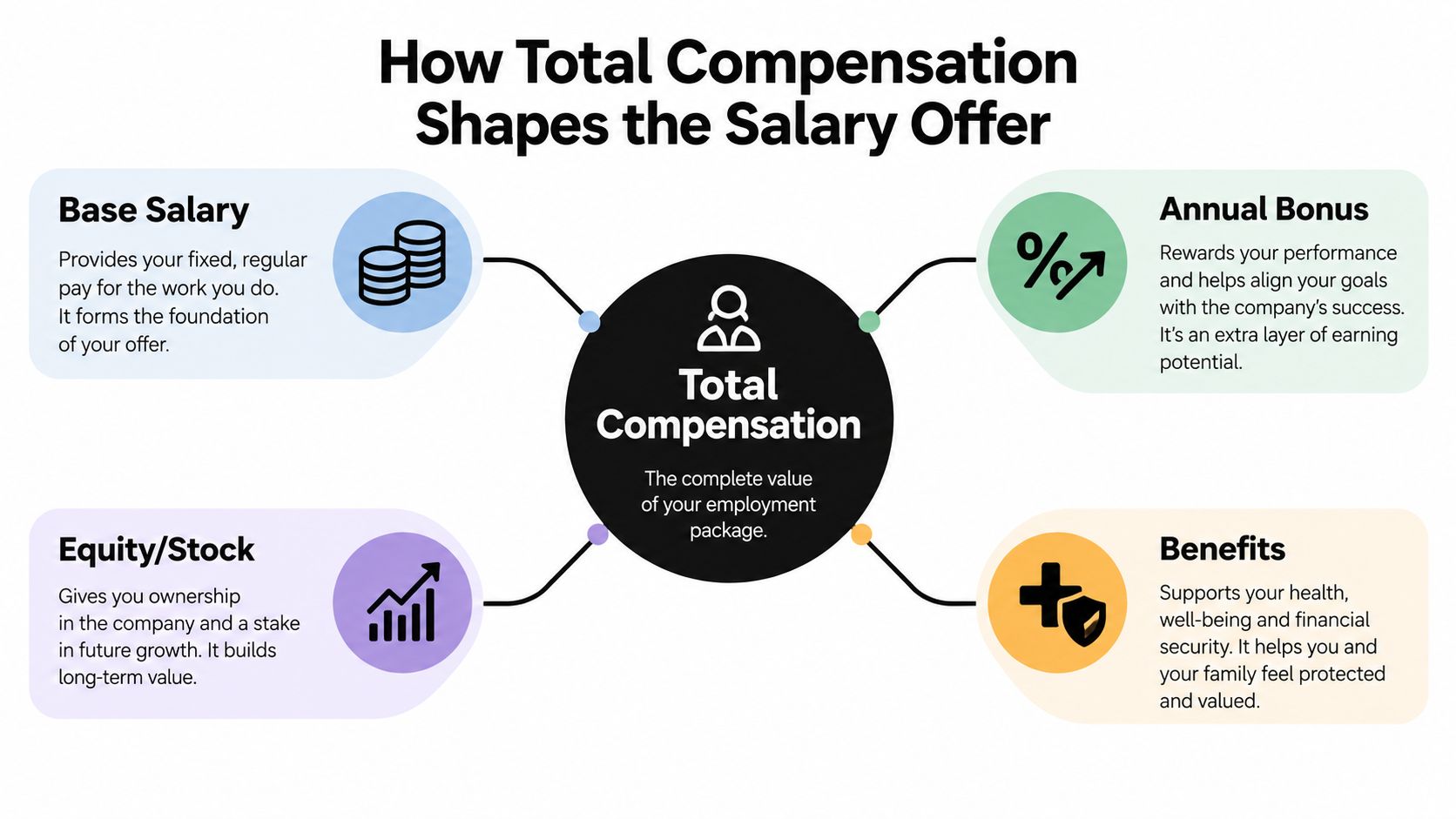
A headline salary is only the centre of the package. In practice, the offer is a mix of base pay, bonus, equity and benefits, and each piece changes how attractive the role feels to a candidate. If you ignore that mix, two offers with the same base can land very differently in the market.
The four parts that matter
Base salary is the fixed cash you pay every year. It gives the candidate certainty and it anchors the rest of the package.
Annual bonus is variable cash tied to performance, company results or both. In smaller firms, it can be modest, but if you use it, you need a clear trigger so it doesn't feel like vague promise-making.
Equity gives the person a long-term ownership stake. It can make a lower-cash offer more acceptable in a startup, but only if the candidate understands what they're trading off.
Benefits are the non-cash pieces that reduce friction in day-to-day life, such as pension, healthcare, leave and flexible working policies. For a small business, benefits often carry more weight than leaders expect because they can improve perceived value without matching large-company cash burn.
Practical rule: If you don't have meaningful equity, you need to be more deliberate about cash, bonus clarity and benefits quality. The package has to work as a whole.
Why SMBs should think in total reward
Many offers go wrong because a founder or HR lead sees a number below a competitor's base and assumes the candidate won't listen, when the real issue is that the rest of the package hasn't been framed properly. A clear total-reward statement helps the candidate compare realities, not just headline figures.
For leave and benefit design, the practical framing is straightforward. A sensible package can include stronger leave policy, flexible scheduling, private healthcare or other low-cost benefits that make the role easier to accept. For a compact guide to the kinds of benefits that can support retention, the types of employment benefits overview is a useful companion.
The Factors That Move Pay Up or Down
Experience is the first divider, but it's not the only one. In product marketing, a junior person who mainly executes launches and writes enablement material should not be priced like a senior PMM who shapes positioning, competitive narrative and go-to-market strategy. The title can be the same on paper while the value delivered is very different in practice.
Scope, seniority and company size
A smaller company often asks one PMM to cover more ground, but that doesn't automatically justify enterprise pay. SMBs usually compensate with broader visibility, more autonomy and faster decision-making, which many candidates value. That trade-off works best when the role brief is honest about what's strategic and what's executional.
Larger employers typically pay more because they can support deeper specialisation and more formal compensation bands. A senior or head-of-level role will normally command more than a generalist PMM role because the person is influencing team direction, not just campaign output. The title matters less than the work attached to it.
Industry and working location
Some industries pay more because the commercial stakes are higher and the talent pool is more competitive. Tech, SaaS and fintech usually sit above consumer goods, nonprofits and public-sector roles. Remote roles can undercut city pricing if the employer bases pay on a lower-cost region, which means geography and industry interact rather than operating as separate levers.
The fastest way to miss the market is to compare your job to a title without checking the company stage, reporting line and product complexity.
| Factor | Effect on Pay | Typical Direction | SMB Consideration |
|---|---|---|---|
| Experience level | Less experience usually means lower pay | Up with expertise | Pay for outcomes, not just years |
| Seniority | Senior and head-of roles cost more | Up sharply | Confirm whether the job is strategic or executional |
| Company size | Larger firms usually pay more | Up with scale | SMBs can offset with autonomy and breadth |
| Industry | Higher-demand sectors pay more | Up in tech-led sectors | Match compensation to commercial competition |
| Working location | Urban hubs and premium cities pay more | Up in major cities | Align budget to the location strategy |
| Remote model | Can reduce local pay pressure | Down from hub rates in some cases | Define whether the band is hub-based or national |
The key point is simple. Pay bands should reflect both the market and the role design, because a small business hiring in a competitive sector can't use a generic national figure and expect the right candidates to appear.
How to Read Conflicting Salary Benchmarks
Salary pages disagree because they're measuring different things. Employee-reported surveys reflect what people say they earn, while vacancy-based datasets reflect what employers are currently advertising. If you don't notice that difference, you'll compare numbers as if they were identical when they're not.
What each dataset tends to show
Employee-reported sources often skew higher in mature tech markets because they capture more experienced professionals and larger employers. Vacancy-based sources can look stronger in hot hiring markets because they show current offers, including roles that are actively being priced to fill. Neither view is “right” on its own.
That's why medians, ranges and averages all tell different stories. A median can hide a very wide spread. A range can look generous without telling you where most hires land. An average can be dragged up or down by the mix of respondents or vacancies included.
A simple triangulation method
Use two or three relevant sources, then ask how close they are to your hiring context.
- Match the source type to the decision: vacancy data is better for offer setting, while employee-reported data is better for checking experience-based pay.
- Weight location properly: a London hire shouldn't be priced like a regional hire if the market evidence says otherwise.
- Check the level of the role: a strategic PMM should not be benchmarked against an execution-only title.
- Document your assumption: keep a short note explaining why your band sits where it does, so future pay-equity questions are easier to answer.
The practical answer isn't to chase one perfect benchmark. It's to create a defensible band from several imperfect ones and make sure the reasoning is visible to finance, leadership and the candidate.
How growthroles Can Help
For salary-setting, the hardest part is often not finding a number. It's finding live roles that show how the market is pricing similar responsibilities right now. That's where a marketing-specific job index can be more useful than a broad job board, especially when you're trying to decide whether your PMM role is closer to a strategy hire or an execution-heavy position.
A platform like product marketing manager salary from growthroles is helpful because it focuses on marketing roles only, then surfaces live postings with function, level, location and pay details where available. It's updated nightly, which makes it more practical than stale salary pages when you're comparing offer timing, remote options and current demand.
What it solves for SMB hiring teams
The first problem it solves is fragmented discovery. Instead of checking multiple generalist boards and employer sites, you get a centralised marketing-only index. That saves time when you're trying to confirm whether your band is realistic.
The second problem is unclear compensation. When a posting shows employer-provided pay, you can see the shape of the market without guessing. When compensation is missing, estimated ranges still give you a comparison point, which is better than pretending the vacancy has no value signal.
The third problem is role confusion. A structured taxonomy helps you separate product marketing from general marketing, growth, brand or communications, which matters because a mislabelled role usually leads to a mispriced offer.
When it's the right choice
Growthroles is strongest when you need current hiring intelligence, not just a salary article. It's a good fit if you're scoping a role, checking location-based competition or comparing how PMM sits against adjacent marketing jobs. It's also useful when you need a faster shortlist view across multiple markets and want to see employer sites directly rather than go through an intermediary application flow.
For SMB leaders, the main value is clarity. The platform helps you answer the practical question, “What kind of PMM are we buying?” before you set the budget and post the role.
Setting a Competitive SMB Pay Band
Start with the role brief, not the pay number. If the PMM is expected to own positioning, product launches and sales enablement, the band should be higher than if the person is mainly producing launch assets and supporting campaigns. That distinction keeps you from overpaying for a light role or underpaying for a strategic one.
Build the band in three steps
First, benchmark against two or three relevant sources that match your location and company stage. Use a vacancy-based source, an employee-reported source and, if needed, a city-specific source so you can see the spread before you decide.
Second, convert that market view into an internal minimum, midpoint and maximum. The minimum should be the lowest number you'll pay for someone who can already do the job. The midpoint should be the clean target for a strong fit. The maximum should be reserved for someone who brings extra value in the exact areas your business needs.
Third, define progression criteria that are tied to outputs, not just tenure. If the PMM improves launch quality, sharpens positioning or supports sales with material that gets used, that's a stronger basis for movement than “one more year in role”.
Budget like finance will read it
A base salary band is only the visible part. Finance also needs to model bonus, equity where applicable and on-costs, because the fully loaded number is what affects cash planning. For SMBs, that usually means setting a band that works in the current quarter and leaving room for a market-adjustment pot if the market shifts mid-year.
Budgeting rule: If the fully loaded number doesn't fit, the answer isn't to guess. It's to reduce scope, change the location strategy or adjust the package mix.
That approach also creates more room to negotiate. If cash is constrained, the band can still hold as long as the trade-offs are explicit, documented and consistent with the job scope.
Building and Negotiating a Strong Offer
A strong offer starts before the salary conversation. Candidates usually decide whether a role is worth pursuing based on the mission, the scope and the growth path, then they check the numbers against that picture. If you lead with pay alone, you force the conversation into a pure price contest.
The most effective SMB offers are transparent total-reward packages. That means base salary first, then bonus or profit share if you use it, then any equity or long-term upside, then low-cost benefits that make the job easier to accept. The candidate should be able to compare your offer without decoding hidden value.
A practical negotiation approach
Use trade-offs the candidate cares about. Remote flexibility often matters more than small cash differences. A learning budget can carry real weight for someone moving into a broader PMM remit. An accelerated review cycle can help if you can't match the top of market immediately. A sign-on bonus can work if recruitment costs are already sunk and you need to bridge a gap.
If a candidate counters, respond with clarity rather than defensiveness. A useful line is, “We can't move that far on base, but we can revisit the package mix and tighten the review point if the scope and expectations fit what you're looking for.” That keeps the conversation honest without sounding rigid.
When benefits are part of the negotiation, salary sacrifice can be relevant in some cases, but only if the candidate values the trade-off and the overall package makes sense. A simple explainer on whether salary sacrifice is worth it can help you frame that discussion properly.
Negotiation rule: Don't promise flexibility, reviews or rewards casually. If you offer them, document them, so the next hire on the same band isn't treated differently.
The objective is consistency. A good offer may vary by candidate, but the reason for the variation should be visible, fair and tied to the same pay architecture every time.
Practical Pay Band Scenarios for Growing Businesses
A product marketing manager in one SMB can sit in a very different package from the same title in another, and that's not automatically a problem. The problem only starts when the company can't explain why. A documented role scope lets you price the job on value, not title inflation.
Three common SMB hiring situations
A 40-person SaaS startup hiring its first PMM usually needs someone who can shape positioning, support launches and work directly with founders and product. The offer may lean more on growth potential, visibility and equity-like upside because the company is still proving the role's full impact.
A 120-person professional services firm adding a senior PMM is often buying coordination, commercial alignment and credibility across multiple stakeholders. That role usually sits higher because the person is expected to influence more of the funnel and manage complexity across teams.
A 25-person e-commerce business needing a hands-on generalist may want someone who can move fast across messaging, launches and sales support. The scope can be narrower than a strategic SaaS PMM, but the role may still need enough cash to attract someone who can work without heavy structure.
The right band depends on revenue, reporting line, candidate availability and how much of the job is strategic versus tactical. The same title can therefore justify different offers, as long as the internal rationale is consistent and recorded.
| Scenario | Company Profile | Role Scope | Base Salary Range | Variable/Equity | Band Rationale |
|---|---|---|---|---|---|
| First PMM in SaaS | 40-person startup | Strategic and cross-functional | Mid-band, with room for growth | Stronger upside mix | Building the function from scratch |
| Senior PMM in services | 120-person firm | Broader commercial influence | Upper-mid band | Bonus-led package | More stakeholders and complexity |
| Generalist PMM in e-commerce | 25-person business | Hands-on execution and launches | Lower-mid to mid band | Limited variable, practical benefits | Smaller scope, fast-moving delivery |
For HR, finance and hiring leaders, the sequence is simple. Define the scope, set the location strategy, agree the band, then choose the mix of cash and benefits that the business can sustain.
A Practical Salary Planning Checklist
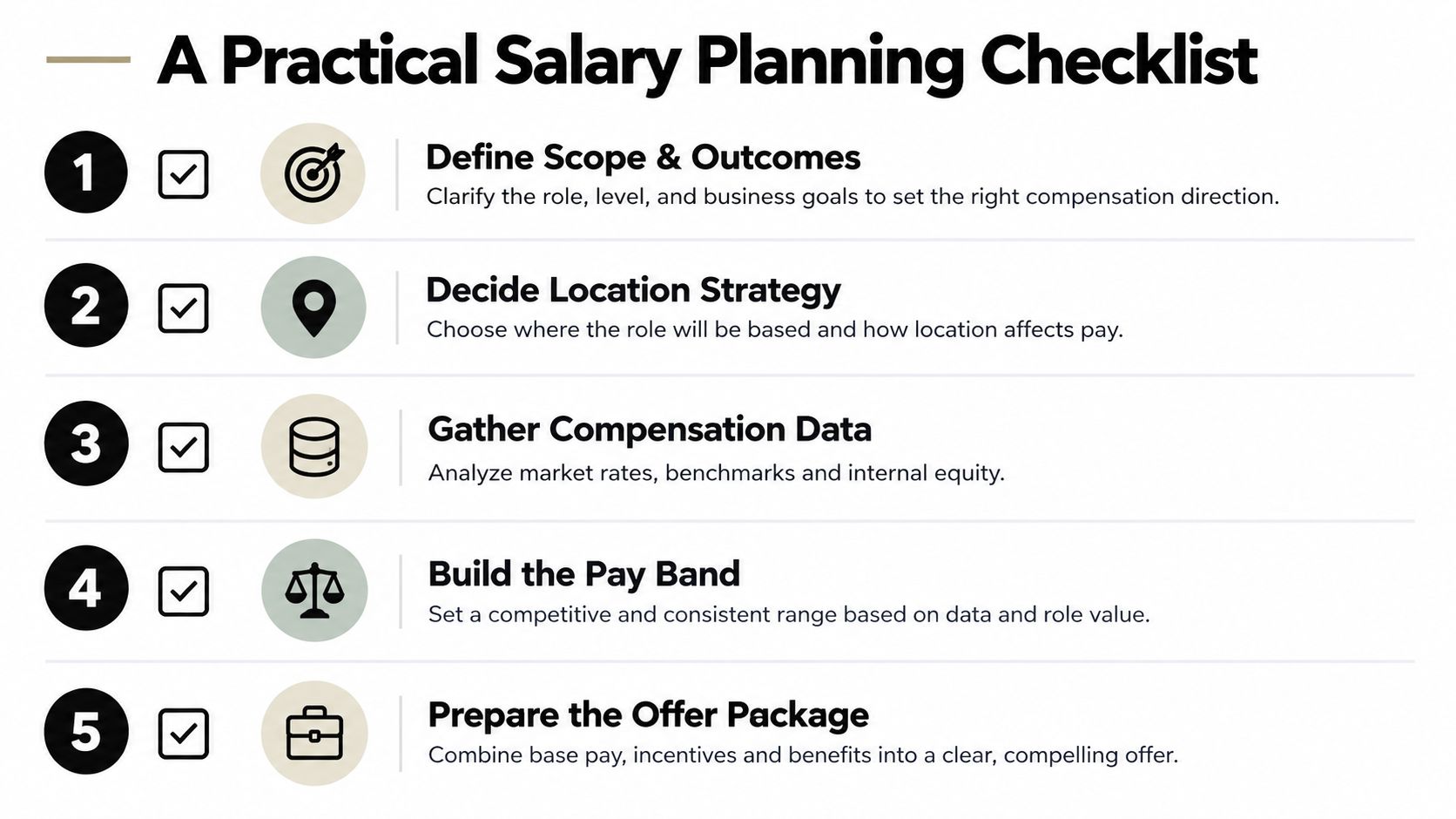
Use the job scope as the first filter. Decide whether the PMM is strategic, executional or a mix of both, because that changes the level and the price.
Choose the location strategy next. A London hire, a regional hire and a remote hire won't price the same way, so the band has to reflect that choice up front.
Pull at least two salary sources and write down why they're relevant. If you're using vacancy data, employee-reported data or city-specific data, document how each one influences the band.
Build the offer package inside the budget, not after it. Add base, bonus, equity where available and benefits, then check the fully loaded cost before posting the role.
Prepare the narrative before you speak to candidates. Explain scope, growth path, pay mix and review timing clearly, so the offer feels structured rather than improvised.
If your SMB is about to hire a product marketing manager, turn the scope into a pay band before you post the job, then pressure-test the mix of cash, benefits and flexibility against the market evidence. For teams using LeaveWizard to keep HR planning and leave coordination under control, this is also a good moment to align hiring budgets with the wider people plan, so the new role fits the business rather than stretching it.