
You've got a redundancy leaver with six weeks of notice left, and the manager wants them to finish today. Payroll needs a final figure, the employee wants to know what they'll receive, and the spreadsheet has a single cell labelled redundancy payment. Before you approve it, you need to separate the entitlements and check whether ending employment now changes the service used in the calculation.
PILON and redundancy pay are separate entitlements, but they need a linked calculation. The notice decision affects dates, dates can affect reckonable service, and the contract determines whether basic salary is enough. Getting the arithmetic right won't rescue a payment built on the wrong leaving date or an unfinished redundancy process.
Table of Contents
- What PILON Covers in a UK Redundancy
- When PILON Is the Wrong Choice
- How PILON Changes Service and Notice Dates
- Contractual Extras That PILON Must Include
- How to Calculate Each Redundancy Payment Line
- Tax and National Insurance on Each Payment
- Worked Example for a Small Business Redundancy
- Sign Off the Payment Breakdown
What PILON Covers in a UK Redundancy
For your leaver, the immediate choice is whether they work their remaining notice or leave now with payment in lieu of notice, usually shortened to PILON. With PILON, employment ends immediately and the employer pays for the notice period the employee won't work.
That payment replaces notice pay. Statutory redundancy pay compensates for losing the job, so paying PILON doesn't remove the need to calculate redundancy entitlement separately.
Keep the employment documents and payroll calculation together while reviewing the exit.

Separate the entitlements before adding them
A leaver might receive notice pay, compensation for redundancy and payment for untaken holiday in the same payroll run. They aren't interchangeable, even if the employer describes the total as an exit package. GOV.UK's employer guidance on redundancy pay distinguishes redundancy entitlement from notice pay and explains the importance of full pay and contractual extras when PILON is agreed.
Payment types a leaver can receive in a redundancy
| Payment | What it pays for | What it depends on |
|---|---|---|
| PILON | Basic pay for notice weeks not worked | PILON clause in the contract, or the employee's agreement |
| Worked notice | Pay for working the notice period | Contractual or statutory notice length |
| Statutory redundancy pay | Compensation for losing the job | Age, completed years of service and capped weekly pay |
| Accrued holiday pay | Untaken leave owed at termination | Holiday entitlement and the leaving date |
| Enhanced redundancy pay | Any amount above the statutory minimum | The contract, policy or settlement terms |
The authority to use PILON matters as much as its value. You need a contractual PILON clause or, where there's no clause, the employee's agreement. Don't treat a manager's request for an immediate departure as authority to terminate on that basis.
A partially worked notice period also needs a clean split. Keep salary for notice already worked separate from payment replacing the unworked balance, so you don't pay the same period twice.
For today's leaver, mark which payment lines apply and attach the supporting clause, policy or record to each. If you can't identify what a line pays for, it isn't ready for payroll.
When PILON Is the Wrong Choice
PILON can be the weaker choice in a redundancy, even when it looks administratively convenient. NHS England's exit-payment guidance says PILON should be exceptional and notes that it shortens the period available to search for suitable alternative employment. That's public-sector guidance, not a universal rule for private employers, but the practical concern applies much more widely.
Make the employment decision before asking payroll to price it.

Before offering PILON, answer these questions:
- Consultation complete? Has the employer considered representations and alternatives?
- Alternative roles addressed? Have suitable vacancies been considered and offered where appropriate?
- Immediate termination justified? Is there a documented operational reason, rather than a preference to close the file?
An immediate exit can remove useful handover time and an opportunity for redeployment. Where the concern is workplace access rather than continued employment, consider whether garden leave is a better contractual option.
Consultation comes before convenience
In Great Britain, GOV.UK's collective consultation guidance applies where an employer proposes 20 or more redundancies at one establishment within any 90-day period. Employers must notify the Redundancy Payments Service before consultation begins and consult representatives, with minimum periods before the first dismissal of 30 days for 20 to 99 proposed redundancies, or 45 days for 100 or more.
PILON doesn't shorten those requirements. Check overlapping proposals across the establishment, not just the list your department has sent to payroll.
Use the accompanying video alongside your review of the proposed exit arrangements.
Decision rule: Approve PILON only after the process is complete, the contractual authority or necessary agreement is established, and the reason for immediate termination is on file.
Explain the arrangement to the leaver and seek written acknowledgement. Where there's no contractual clause, their agreement isn't merely an administrative preference, it's necessary.
How PILON Changes Service and Notice Dates
PILON ends the obligation to work, but it doesn't necessarily stop the service calculation for statutory redundancy. ACAS's guidance on notice-period pay explains the statutory notice adjustment and gives an example where eight weeks of PILON adds eight weeks of reckonable service.
Keep the actual termination date, statutory-notice-adjusted relevant date, completed service years and applicable age bands as separate, linked inputs. Don't overwrite the actual leaving date with the adjusted date: they serve different purposes.
Check the statutory notice floor
Use the following notice check alongside your contract review. LeaveWizard's guide to calculating UK notice periods can help organise the dates and distinguish contractual notice from the statutory floor.
Statutory minimum notice by length of service
| Continuous service | Statutory minimum notice | Statutory redundancy eligibility |
|---|---|---|
| Under 1 month | None | Not eligible |
| 1 month to under 2 years | 1 week | Not eligible |
| 2 years | 2 weeks | Eligible |
| 5 years | 5 weeks | Eligible |
| 12 years or more | 12 weeks (capped) | Eligible |
Eligibility here assumes the other statutory conditions are met. A longer contractual notice period can increase PILON, but don't automatically add that entire contractual period when establishing the statutory redundancy relevant date.
Test anniversary cases rather than rounding service
Take a hypothetical employee with five years and 50 weeks of service, all within the middle age band, and eligible weekly pay of £600. Before the notice adjustment, five completed years would produce £3,000; adding the applicable five-week statutory notice period takes the employee past the next service anniversary, giving six completed years and £3,600.
An age-band boundary can also matter, but don't apply the employee's age at departure retrospectively to every service year. Allocate each completed year to the appropriate band.
The redundancy relevant date is a calculation input, not permission to show an employee as still employed after their actual termination.
Nor should you automatically accrue holiday through the notional notice extension. Check holiday against the actual employment arrangements and leaving date. Before approving the redundancy figure, ask: which end date and which completed-year count did payroll use?
Contractual Extras That PILON Must Include
The contract decides which extras belong in PILON. A salary-only calculation is reliable only after you've checked that salary is the correct contractual basis.
GOV.UK's redundancy notice guidance explains that an employer can use a contractual PILON clause, or offer PILON without one if the employee agrees. The payment must cover basic pay for the notice period and may also need to include contractual extras such as pension contributions or private medical insurance.
Read the PILON wording itself, not just the general salary and benefits pages. A clause may specify how payment is calculated, which benefits it includes and whether any provision continues separately.
Apply a benefit-by-benefit test
A monthly contractual car allowance will usually need to be considered in the notice calculation. Confirm whether it forms part of contractual remuneration and whether the PILON wording includes or excludes it.
Commission and bonuses need closer reading. A contractual entitlement may remain payable, but the scheme's earning conditions, payment dates and termination provisions determine the calculation. Don't assume that everything described as variable pay disappears on termination.
A discretionary one-off bonus ordinarily has a weaker claim to inclusion. However, a label isn't conclusive if the contract, commitments or established practice point towards an entitlement.
Use a short benefits schedule:
- Contractual entitlement: Record the clause and how the benefit is valued or continued.
- Regular practice: Identify the evidence and obtain advice if its contractual status is unclear.
- Discretionary provision: Record why no entitlement arises, rather than deleting it without explanation.
Keep valuation separate from assumptions
Pension contributions and insured benefits aren't always best handled by adding an estimated cash equivalent. Check the contract and relevant scheme arrangements before deciding whether a benefit continues, ends or requires compensation.
A spreadsheet that multiplies basic salary by notice weeks can therefore underpay the employee. Applying the statutory redundancy weekly-pay cap to that salary calculation creates another error: the redundancy cap isn't a general cap on notice pay.
Keep a reason beside every inclusion and exclusion. A clear record won't prevent every challenge, but it lets you explain the figure from the contract rather than trying to reconstruct the decision after the employee queries it.
How to Calculate Each Redundancy Payment Line
Calculate in an order that lets you validate each input before using it elsewhere. Keep the notice-pay basis distinct from the statutory redundancy weekly-pay basis, even where both produce the same weekly amount.
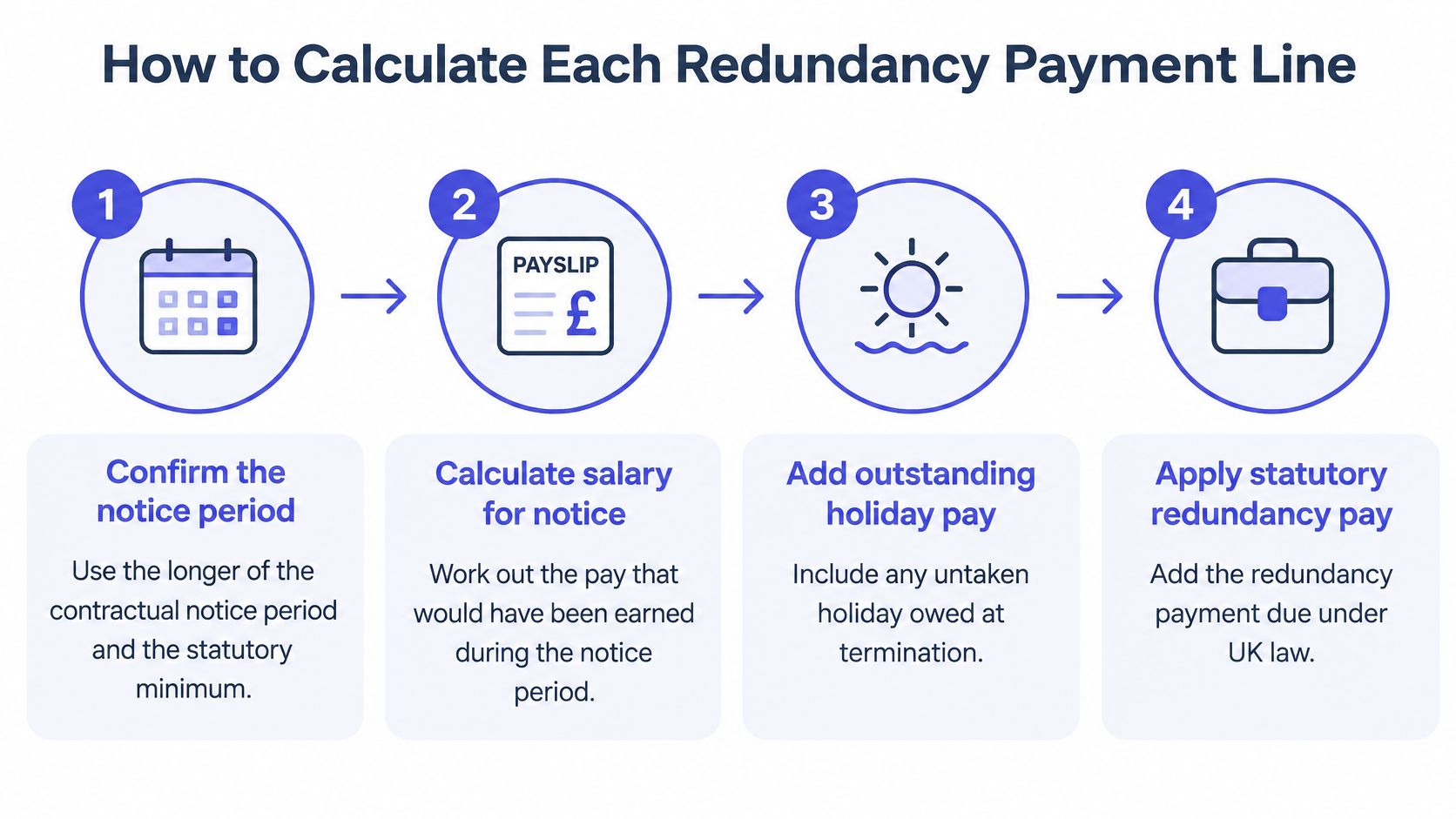
The process below separates notice, redundancy and holiday rather than treating the exit as a single compensation figure.
Build the calculation in order
Confirm the notice entitlement. Compare contractual notice with the statutory minimum and use the longer entitlement for notice pay. Identify any notice already worked before setting the unworked balance.
Establish the pay inputs. Preserve the pay history rather than substituting the employee's latest rostered week. GOV.UK's explanation of redundancy payments uses average gross weekly pay over the 12 weeks before redundancy notice, so retain that history and separately confirm the contractual pay required for PILON.
Calculate PILON. Multiply the applicable basic weekly notice pay by the notice weeks not worked, then account for contractual extras on their proper basis. Where salary is fixed monthly, use the contractual conversion method consistently rather than assuming every month contains the same number of weeks.
Calculate statutory redundancy pay. GOV.UK's statutory redundancy guidance requires at least two years' continuous service, applies the age-band multipliers below and caps reckonable service at 20 years. For redundancies taking effect on or after 6 April 2026, it sets capped weekly pay at £751 and the maximum statutory award at £22,530; the preceding weekly cap is £719, so select the cap by the relevant date rather than reusing a saved spreadsheet value.
Statutory redundancy weeks by age band and service
| Age on each full year | Weeks per full year | Weeks for 5 years | Weeks for 20 years (cap) |
|---|---|---|---|
| Under 22 | 0.5 | 2.5 | 10 |
| 22 to 40 | 1 | 5 | 20 |
| 41 and over | 1.5 | 7.5 | 30 |
The table shows arithmetic assuming every year falls within the stated band. The under-22 long-service illustrations aren't realistic employment histories, so don't use them as actual entitlement examples.
Add accrued untaken holiday. Reconcile entitlement, leave taken and approved adjustments at the actual leaving date. Use a holiday calculator for an employee leaving a job to support the entitlement check, then apply the correct holiday-pay basis.
Total only after checking each line. Add any enhanced redundancy entitlement separately and retain the policy or agreement supporting it. Keep gross entitlement distinct from payroll deductions.
Catch the spreadsheet shortcuts
For variable-hours staff, a quiet or busy current week isn't a substitute for the required pay history. Likewise, using the older cap for a later redundancy can understate entitlement; using the newer cap before its effective date applies the wrong statutory limit.
The payslip test is simple: every payment line should have an explanation the leaver can follow, without needing to inspect your spreadsheet formula.
Tax and National Insurance on Each Payment
For an employee leaving through redundancy, tax treatment depends on what each payment represents, not the label on the payslip. Contractual PILON is taxable as earnings, including when paid as a lump sum. HMRC's Employment Income Manual guidance on PILON explains its treatment under section 62 of the Income Tax (Earnings and Pensions) Act 2003 and the notice-pay rules applying from 6 April 2018.
Removing a PILON clause from a contract does not automatically make notice compensation tax-free. Identify the notice element under the current termination-pay rules. If the payment is instead a damages payment or arises under an older arrangement, get case-specific advice.
Code the payment's substance
Salary, holiday pay and notice compensation remain earnings even when paid alongside redundancy pay. Qualifying redundancy and severance compensation share a combined £30,000 income-tax exemption. It is not a separate allowance for each payment, and it does not exempt notice earnings.
Income tax and NICs by payment line
| Payment line | Income tax | National Insurance |
|---|---|---|
| PILON paid as a lump sum | Taxed as earnings | Subject to NICs as earnings |
| Worked notice pay | Taxed as earnings | Subject to NICs |
| Accrued holiday pay | Taxed as earnings | Subject to NICs |
| Statutory redundancy pay | Tax-free within the combined £30,000 threshold | Not subject to NICs |
| Redundancy pay above £30,000 combined | Taxed on the amount above the threshold | No employee NICs on genuine qualifying compensation; employer NICs can apply |
Employee and employer NICs are separate questions. Genuine qualifying redundancy compensation is outside employee NICs, but an employer may still have an employer NIC liability on taxable termination awards. Ask a qualified adviser to check an enhanced package if its classification is uncertain.
Make deductions understandable
Use separate payroll codes for earnings and qualifying termination compensation. Keep the termination date, contractual clause, calculation and compensation agreement with the payroll record so a reviewer can trace each treatment. A documented payroll checklist can help control the entries; build a reliable small business payroll process, and leave UK termination-tax judgements to a qualified adviser.
Payroll control: Apply the tax treatment for each payment line separately, not the largest component to the whole package.
Show the employee each gross line and identify which payments attract deductions. Give a net figure only after payroll has calculated it using the employee's relevant tax and National Insurance information.
Worked Example for a Small Business Redundancy
Say an employee starts their notice arrangements aged 35, with exactly six years' continuous service, £600 gross weekly pay and six weeks' contractual notice. They also have five days of accrued untaken holiday at £120 a day. These are hypothetical inputs, with no enhanced redundancy entitlement or additional contractual benefits.
Consultation and the alternative-employment review are complete. The employer has authority to use PILON and confirms immediate termination, rather than requiring the employee to work notice.
Calculate the gross lines
PILON is six weeks × £600 = £3,600. The statutory notice floor for this service matches the contractual entitlement, so there's no notice shortfall. Payroll treats the PILON as earnings for income tax and NICs.
Statutory redundancy pay is six completed years × one week × £600 = £3,600. All the reckonable years fall within the middle age band, and the weekly amount is below the statutory cap. Assuming no other qualifying termination compensation uses the exemption, this redundancy payment is tax-free and outside NICs.
Accrued holiday pay is five days × £120 = £600. This is a separate earnings line, subject to income tax and NICs. Do not absorb it into the PILON because both replace pay the employee would otherwise receive.
| Payment line | Calculation | Gross amount |
|---|---|---|
| PILON | 6 weeks × £600 | £3,600 |
| Statutory redundancy pay | 6 years × 1 week × £600 | £3,600 |
| Accrued holiday pay | 5 days × £120 | £600 |
| Total | Separate lines added together | £7,800 |
The £7,800 is gross, not the amount to promise as take-home pay. Payroll must calculate the deductions on the earnings components.
Check whether the notice adjustment changes anything
Adding six weeks of reckonable service still leaves this employee with six completed years. The adjustment is necessary, but it doesn't change the redundancy multiplier in this scenario.
Change the age history and the result changes. If the employee had been 41 or over throughout all six completed years, statutory redundancy pay would be six × 1.5 weeks = nine weeks, producing £5,400 at the same weekly pay.
Keeping PILON and holiday unchanged, the alternative gross total becomes £9,600. That's why the payroll record needs the employee's age across the reckonable service years, not just a current age field.
Sign Off the Payment Breakdown
Before releasing payment, give each line a basis, source document and employee explanation. Use a record that another payroll or HR colleague can check without asking you to reconstruct the calculation.
| Payment line | Basis | Source document | Explanation given to the leaver |
|---|---|---|---|
| PILON | Unworked notice and included benefits | Contract clause or written agreement | Period replaced and pay included |
| Worked notice, if any | Notice actually worked | Notice letter and payroll record | Salary period covered |
| Statutory redundancy | Relevant date, service, age bands and capped pay | Service record and pay history | Completed years and calculation |
| Enhanced redundancy, if any | Additional agreed entitlement | Policy, contract or settlement | Amount above statutory entitlement |
| Accrued holiday | Outstanding entitlement at termination | Holiday record and agreed leaving date | Leave balance and pay basis |
Complete an independent reconciliation
Retain the 12-week pay history, benefit classifications and reasons for exclusions. Confirm the actual and notice-adjusted dates, apply the correct date-specific statutory caps, and check each line's tax and NIC coding rather than coding the total as one block.
Holiday records deserve particular attention where teams follow different policies. LeaveWizard supports accruals, carryovers, and varying leave entitlements across teams or regions, helping you maintain the entitlement record used for the final reconciliation.
If finance needs extra capacity to reconcile payroll outputs and accounting entries, HireAccountants' Hire Bookkeepers resource can support that staffing decision. Keep employment-law judgements and termination-tax classifications with appropriately qualified advisers.
Issue the breakdown to the leaver and walk through it line by line before asking them to acknowledge the figures. Resolve discrepancies, obtain the signed acknowledgement and retain it with the supporting documents; acknowledgement isn't a substitute for any required settlement agreement.
LeaveWizard helps you manage leave accruals, carryovers and different entitlements, so the holiday balance feeding a redundancy calculation is easier to verify. Visit LeaveWizard to organise your leave records and give HR and payroll a clearer basis for final holiday-pay checks.


