
Losing someone close is one of the hardest things any of us will ever go through. When it happens, the last thing you should be worrying about is work. That’s where bereavement leave comes in – it’s dedicated time away from your job to navigate the aftermath of a loved one's death.
Think of it as a crucial breathing space. It allows you to grieve, handle practicalities like funeral arrangements, and just be with your family, all without the added pressure of your work responsibilities.
What Bereavement Leave Means for You

Seeing the term "bereavement leave" in a company handbook can feel a bit cold and corporate, especially when you're dealing with something so personal. In reality, it’s a safety net provided by your employer, acknowledging that you need to step away from your professional duties to cope with a major loss.
The core idea is to give you the time and mental space for grieving, a process that looks different for everyone. But it's not just about the emotional side of things; there are often urgent, practical tasks that suddenly demand your attention.
Practical and Emotional Support
At its heart, this leave is about support. It’s a formal recognition that we're all human and that life throws incredibly difficult challenges our way. It gives you permission to focus on what truly matters without worrying about your job performance.
This time is typically used for things like:
- Arranging or travelling to a funeral or memorial service.
- Sorting out legal and financial matters for the estate.
- Spending time with family to support each other.
- Simply taking a moment to process everything that has happened.
It's important not to mix this up with other types of time off. For instance, what dependants' leave is usually covers unexpected emergencies for people who rely on you, whereas bereavement leave is specifically for the period following a death. To get a clear picture of what your entitlement covers, it’s always a good idea to understand any potential bereavement policy limitations.
Bereavement leave is more than just a few days off; it's a compassionate acknowledgement that work is only one part of life. A good policy shows that a company truly values its employees' wellbeing during their most difficult moments.
Your Legal Rights to Bereavement Time Off
Trying to figure out your legal rights when you're grieving is the last thing you need on your plate, so let's break it down simply. In the UK, the law acts as a fundamental safety net, giving you a minimum amount of time off you’re entitled to after a loss. It's really important to know these rights, as they apply no matter what your company’s specific policy says.
The most basic protection is a ‘Day One’ right, which means from your very first day of employment, you can take a reasonable amount of unpaid time off to handle an emergency involving a dependant. This often covers the immediate aftermath of a death, like making funeral arrangements. What counts as ‘reasonable’ is flexible, but it’s there for those urgent first steps.
Specific Legal Entitlements
While there isn't yet a universal right to paid bereavement leave for every situation, the law does step in to protect employees in specific, heartbreaking circumstances. The most significant of these is the Parental Bereavement (Leave and Pay) Act, which you might know as Jack’s Law.
This law gives eligible working parents who lose a child under 18 (or have a stillbirth after 24 weeks of pregnancy) the right to two weeks of leave. For those who meet the criteria, this leave is also paid at a statutory rate. This is the legal minimum, and you can see how it stacks up against more generous company policies in our guide on how long compassionate leave is.
Another big step forward has been the recent recognition of pregnancy loss in law. Previously, UK law didn't offer much in the way of statutory support, but the Employment Rights Bill now extends help to families who experience loss before 24 weeks, including miscarriages. This change is vital, especially when you consider that an estimated 250,000 miscarriages happen in the UK each year. You can read the full government report on this employment rights bill to get all the details.
These statutory rights are your absolute minimum. Think of them as the floor, not the ceiling. Your employer’s policy will provide the full picture of the support available to you.
Navigating Your Company's Bereavement Policy
While UK law offers a basic safety net for time off, your company’s own policy is where the real, practical details are. Think of the law as the minimum requirement, but the company policy is what tells you exactly what support you can expect day-to-day.
The first thing to do is find that policy. It’s usually tucked away in the employee handbook, on the company intranet, or maybe within your HR software. If you’re struggling to locate it, a quiet word with your manager or HR is the best next step. They can give you a copy and answer any immediate questions.
Key Details to Look For
Once you have the policy, you'll want to scan for a few specific things. These details will give you a clear picture of what’s available and how to ask for it.
- Eligibility and Scope: The policy should spell out who counts as a “close relative.” Often, this goes beyond just immediate family, but it’s crucial to check the exact wording.
- Duration of Leave: Look for how many days are offered. Most UK companies provide between three to five days, but this can change depending on your relationship with the person who has passed away.
- Paid vs Unpaid Leave: This is a big one. The policy must state whether the time off is paid. While most compassionate policies do offer paid leave, it’s not always a legal requirement.
The infographic below shows how different UK legal rights are layered, from general employee protections to very specific entitlements.
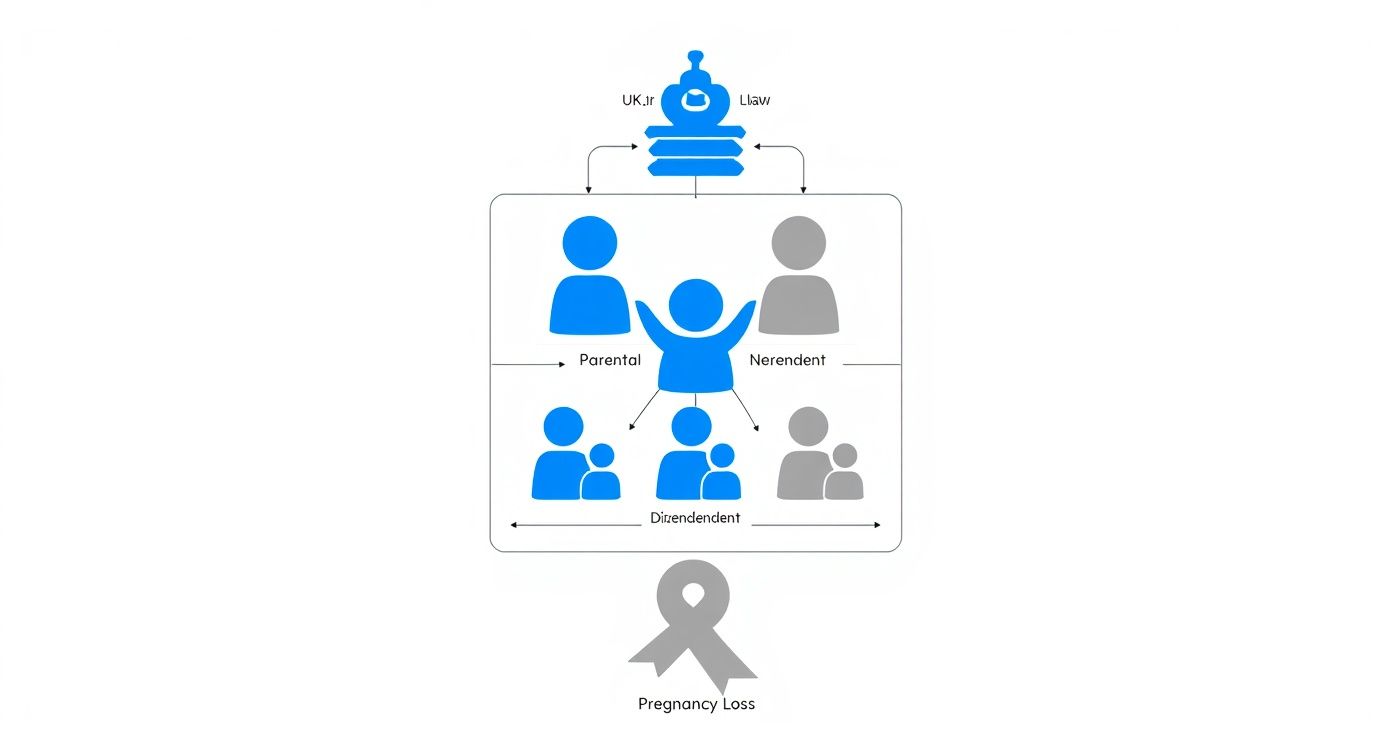
As you can see, the law steps in for specific, tragic situations like parental loss, but it's your company's policy that will likely cover a much broader range of circumstances. For a closer look at what makes a supportive framework, our guide on crafting a bereavement leave policy has some great insights for both staff and employers.
Comparing Statutory Rights vs Common Company Policies
It’s helpful to see the difference between the legal baseline and what a more compassionate company policy typically offers.
| Aspect of Leave | UK Statutory Minimum | Typical Compassionate Company Policy |
|---|---|---|
| Who It Covers | Only parents who lose a child under 18 or suffer a stillbirth after 24 weeks. | Broader definition including immediate family, partners, and often close relatives like grandparents. |
| Duration | 2 weeks for parental bereavement leave. | Usually 3 to 5 days, sometimes more depending on the relationship or travel needs. |
| Pay | Statutory Parental Bereavement Pay is available if eligibility criteria are met. | Time off is often fully paid, though not legally required for all situations. |
| Flexibility | The leave must be taken within 56 weeks of the child’s death. | More flexible, allowing immediate time off for a wider range of circumstances. |
This table really highlights why checking your specific company policy is so important—it’s where you’ll find the support that goes beyond the bare minimum required by law.
What if your workplace doesn’t have a formal policy? Don’t panic and assume there's no support. Talk to your manager. Many smaller businesses handle these things on a case-by-case basis with a human touch. Just explain your situation and what you need; a good employer will listen and work with you to find a way forward.
How Much Bereavement Leave You Can Expect
When you’re dealing with a loss, one of the first practical questions that comes to mind is, "How much time can I actually take off work?" It’s a simple question, but the answer isn't always straightforward. The amount of bereavement leave you can get usually hinges on your company's own policy and your relationship to the person who has passed away.
As a general rule of thumb, most UK companies that have a formal policy in place will offer somewhere between three to five days of paid leave. This is widely seen as a standard amount of time to handle the immediate arrangements and attend a funeral. But it’s important to remember this is just a benchmark, not a hard-and-fast rule.
Understanding the Averages
Looking at recent data on UK leave patterns, it’s clear that while compassionate leave is becoming more common, the time people actually take can be surprisingly short. In fact, one analysis showed the average duration of bereavement leave taken is just 1.6 days. This low number might suggest that many people only take time off for the funeral itself, or perhaps that some company policies are quite restrictive.
Despite the limited statutory rights for bereavement leave (outside of parental bereavement), advisory bodies are strongly encouraging employers to put more supportive policies in place. This push has led to a 40% increase in the uptake of compassionate leave in just one year, with over 10% of employees now taking it annually. You can dig into more of this data by exploring UK compassionate leave trends on employmenthero.com.
Grieving is not a linear process that fits neatly into a few days. The time offered is for the immediate aftermath; healing takes much longer.
It really helps to think of the offered leave as just a starting point. If you find you need more time to cope with your loss or to sort out complex family matters, don't be afraid to talk to your manager about what you're going through.
Many supportive employers are quite open to finding a flexible arrangement. This could mean letting you use some of your annual leave or taking a bit of unpaid time off to give yourself the space you need. The key is to have an open, honest conversation about what you need during such a difficult time.
Why Compassionate Leave Is Becoming Essential
There's been a real shift in how modern businesses look at employee wellbeing, and compassionate leave is right at the heart of it. What used to be seen as a 'nice-to-have' perk is now being recognised for what it is: a fundamental part of a healthy, supportive workplace.
It’s about finally acknowledging that employees are people first, with lives and challenges that extend far beyond their job titles.
This isn’t just about being good-hearted; it’s a genuinely smart business strategy. When a company supports its team during their toughest moments, it builds a deep, unshakable sense of loyalty and trust. This has a direct knock-on effect on morale, productivity, and, perhaps most importantly, employee retention.
The growing focus on compassionate leave mirrors a wider societal move towards valuing emotional intelligence and fostering empathy and compassion in every part of our lives.
The Data Behind Compassionate Policies
Public opinion is firmly behind these more human-centric policies. A recent survey revealed that a staggering 87% of UK adults believe employers should offer paid leave following the death of a close family member.
Digging deeper, 60% agree this support should also cover losses before 24 weeks of pregnancy—an area where employment rights are rightly evolving. This highlights a clear gap between public expectation and what’s common practice, with only about 24% of private sector workers currently getting employer-provided bereavement leave.
Offering robust compassionate leave is no longer just a policy decision; it's a reflection of a company's core values. Companies that lead with empathy see a tangible return in the form of a more resilient, engaged, and committed workforce.
Organisations that put these supportive policies in place often gain a significant competitive edge. In fact, data shows companies with strong bereavement support can achieve 20-30% better talent retention over a two-year period.
In a competitive job market, a compassionate approach isn't just kind—it's a powerful tool for attracting and keeping the very best people.
Common Questions About Bereavement Leave
When you're dealing with a loss, the last thing you need is more stress. You just need clear, simple answers. Let’s walk through some of the most common questions people have about bereavement leave.
Do I Have to Provide a Death Certificate?
Generally, no. Most employers operate on a basis of trust, especially for the standard three to five days of leave. A compassionate company will handle this sensitively and won’t ask for immediate proof when you're grieving.
That said, if you need to take an extended period of leave, they might ask for some form of documentation later on. This is usually something like an obituary notice or a verification of service from the funeral director, not necessarily a death certificate. It’s always best to check your employee handbook or have a quiet word with HR if you’re unsure.
What if the Person Was Not a Close Relative?
This really comes down to your company’s specific policy. While the law often has a very narrow definition of who counts as family, many modern workplace policies are much more flexible and understanding.
Many now extend compassionate leave to include close friends, partners, or other significant relationships not defined by blood or marriage. If your company’s policy seems a bit vague, just have an open conversation with your manager. Explaining why this person was important to you is often all it takes for a supportive employer to grant you the time you need.
The real purpose of bereavement leave is to support an employee through a significant loss. A good policy recognises that the impact of grief isn't always defined by a family tree.
Is Bereavement Leave Paid in the UK?
This is a really important question. The only type of leave that is legally required to be paid is Statutory Parental Bereavement Leave. This is paid at a set government rate, assuming you meet the eligibility criteria.
For any other situation, there's no automatic legal right to be paid. However, the good news is that most companies with a formal bereavement policy do choose to offer a certain number of paid days. You’ll need to check your employment contract or company handbook to see what your entitlement is.
Can My Employer Refuse My Request?
Your employer can't legally refuse your statutory rights, like time off for a dependant or Parental Bereavement Leave, as long as you're eligible. It's the law.
When it comes to discretionary leave offered in a company policy, a refusal is highly unlikely but not impossible, especially if the situation falls far outside the policy's terms. Any reasonable employer will always aim to support you. If you ever feel your request was unfairly denied, you can get free, impartial advice from an organisation like ACAS.


