A leave payout usually looks simple until the leaver's file lands on your desk at the same time payroll is closing. Someone has a holiday balance, someone else has changed hours twice this year, and finance wants one clean figure for the final pay run. That's where even organised teams get caught out.
The problem usually isn't arithmetic. It's choosing the wrong method before the arithmetic starts. A sound leave payout calculation in the UK depends on worker category first, then entitlement, then pay basis, then tax treatment.
Table of Contents
- Why Leave Payouts Trip Up Even Experienced HR Teams
- The Building Blocks of a Leave Payout Calculation
- Pro Rata Calculations for Part Time and Mid Year Staff
- Irregular Hours and Part Year Workers Under the 2024 Reforms
- Walking Through a Real Final Pay Settlement
- Edge Cases and Common Mistakes That Cost Money
- Spreadsheet Templates and How Automation Helps
Why Leave Payouts Trip Up Even Experienced HR Teams
A resignation comes in two days before payroll close. The holiday tracker shows 6.5 days left. Payroll has a day rate ready. Then someone notices the employee moved from fixed days to variable shifts in April, and the contract includes extra leave above the statutory minimum. That is the point where experienced teams start making expensive assumptions.
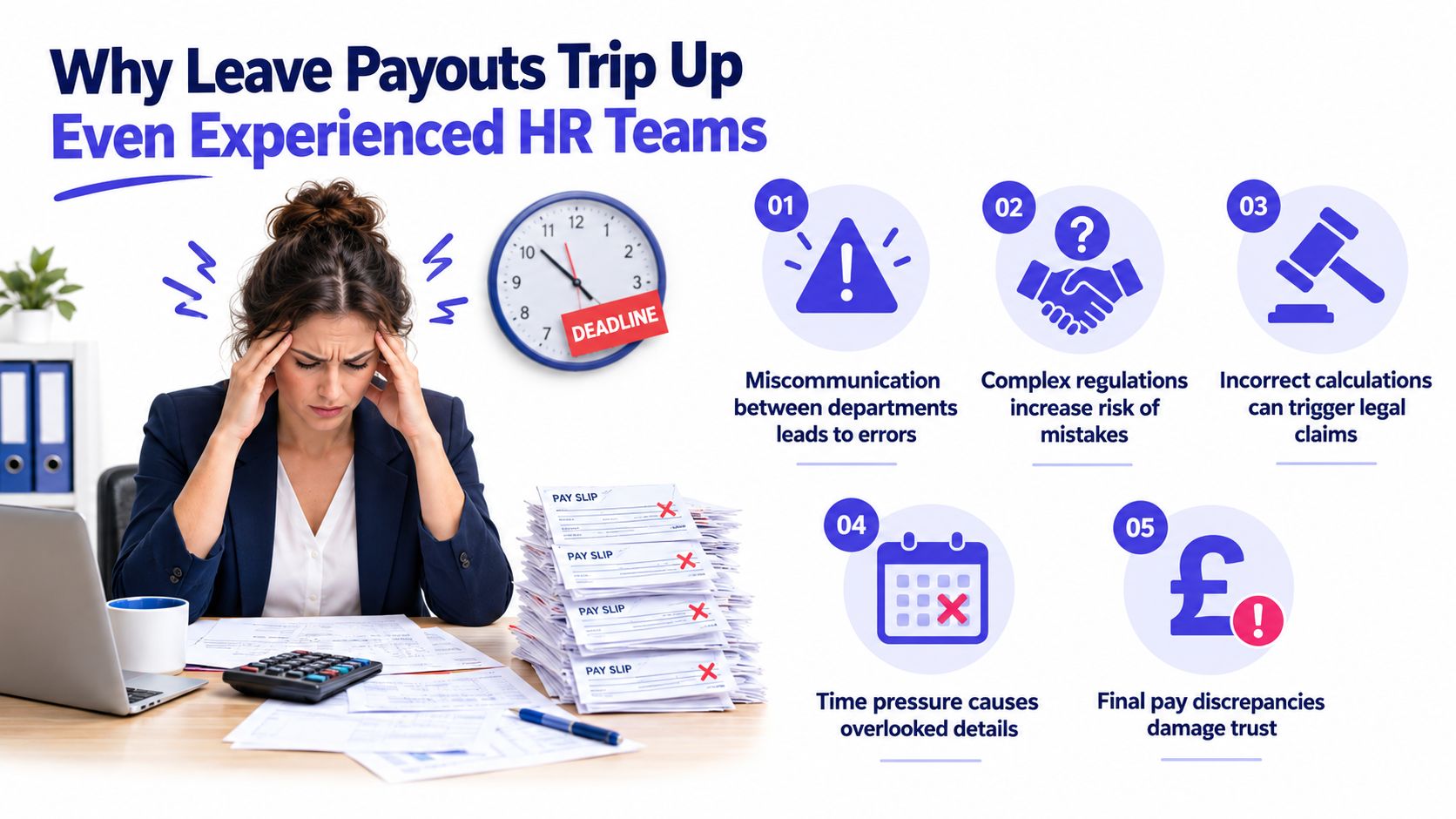
I have seen final-pay disputes caused less by bad arithmetic than by using the wrong calculation route. A leave balance on its own is not enough. The first question is which worker category applies under the current UK rules, because that choice determines whether the payout starts from fixed-hours pro rating, 12.07% accrual, or an averaged-pay method.
Where good teams still slip
The weak point is usually the handoff between HR records and payroll logic. HR may hold the leave year, contract terms, and working pattern history. Payroll may hold the earnings data needed to value leave correctly. If nobody joins those pieces before the final run, the file gets pushed through a generic formula that was built for easier cases.
The repeat errors are predictable:
- Worker category is set incorrectly: fixed-hours staff, irregular-hours workers, and part-year workers cannot all be processed from the same template.
- Statutory and contractual leave are blended too early: extra contractual holiday may follow the contract wording, but the statutory portion still needs the right legal method behind it.
- Normal remuneration is understated: teams leave out regular overtime, commission, or other payments that should feed into holiday pay calculations.
- The leave year is taken from policy, not the individual record: many disputes start with the wrong accrual window, not the wrong rate.
- Legacy spreadsheets keep old assumptions alive: a workbook built before the 2024 reforms can keep producing tidy figures that are still wrong.
The practical rule is simple. Identify the worker category first, then choose the formula.
That single decision prevents a lot of avoidable rework. A fixed-pattern employee with stable hours usually belongs on a pro-rated entitlement method. An irregular-hours or part-year worker may need the accrual approach introduced under the updated UK framework, and the payment value may still depend on averaging earnings over the correct reference period. The government's main overview of holiday rights sits at GOV.UK holiday entitlement rights, but in day-to-day HR operations the challenge is matching the record to the right route before anyone touches the final number.
What works better in practice
Use a formula map, not one master formula. In small businesses, that usually means adding a mandatory check at the start of the leaver process: fixed hours, irregular hours, or part year; statutory only or statutory plus contractual uplift; stable pay or variable pay elements. It takes a few extra minutes and saves far more time than correcting an underpayment after the employee has left.
Process design matters here as much as the maths. Where HR, payroll, and finance split ownership, the control point should sit before payroll sign-off, not after. Resources such as HR outsourcing tips from HireAccountants are useful for that reason. They focus on the handoff problems that often cause leave payout errors in the first place.
The Building Blocks of a Leave Payout Calculation
A leave payout goes wrong when HR skips the classification step and starts with a pay rate. In practice, the order is: confirm the worker category, confirm the entitlement basis, confirm what has already been taken, then value the remaining balance using the right pay method.
For a fixed-hours, full-time employee, the underlying entitlement is usually straightforward. The statutory baseline is 5.6 weeks a year, which for a five-day pattern comes out as 28 days, as noted earlier. That gives you the entitlement side of the calculation. It does not settle the pay side on its own.
Build the calculation in the right order
I use four checks before I let anything through to payroll:
- Set the entitlement basis. Statutory only, or statutory plus any contractual top-up.
- Pro-rate for time worked in the leave year. Use the share of the leave year completed for fixed-pattern staff.
- Deduct leave already taken. Use approved records, not diary estimates.
- Value the untaken balance. Apply the correct daily, hourly, or averaged pay method for that worker type.
That sequence prevents a common final-pay error. Payroll teams often jump to a day rate because it is quick to model in a spreadsheet, but a clean-looking figure is still wrong if the entitlement basis or worker category was wrong at step one.
| Step | What you are checking | Worked Example |
|---|---|---|
| Full-year entitlement | Contractual leave or statutory baseline for the working pattern | 28 days for a five-day fixed pattern |
| Pro-rated entitlement | Annual entitlement multiplied by the share of the leave year worked | 28 × (36 ÷ 52) |
| Untaken leave | Accrued leave less approved leave already taken | 8 days remain |
| Gross payout | Untaken days multiplied by the correct pay value | 8 × £120 = £960 |
A clean fixed-hours example
Take an employee who works five fixed days a week and leaves after 36 weeks of the leave year. If their full-year entitlement is 28 days, and the records show 8 days still untaken, the balance is easy to state. If their holiday pay for payout purposes is properly expressed as £120 a day, the gross leave payout is £960.
This is the version finance teams like because the formula is transparent and the audit trail is short.
It is also the version that gives smaller employers false confidence. The same sheet often gets reused for someone on variable hours or mixed pay, and that is where claims start. A day-rate method only holds up when the work pattern and the pay pattern are both stable enough to support it.
Teams reviewing systems often want one place to hold entitlement rules and payroll output together. If you are comparing tools, Cloudvara payroll software recommendations is a useful starting point for assessing whether a platform can support payroll-ready holiday calculations rather than just track days off.
Where fixed-hours spreadsheets start to break
The fixed-hours route is safe for fixed-pattern workers. It is not a universal formula. Once the worker is irregular-hours, part-year, or paid in a way that changes the value of leave, you need to switch methods before you do any arithmetic.
That is the practical line to hold. Use pro-rating for fixed-pattern entitlement cases. Use the accrual method where the 2024 rules permit it. Use an averaged pay approach where holiday pay cannot be valued fairly from a flat day rate.
Pro Rata Calculations for Part Time and Mid Year Staff
A final pay dispute often starts with a simple question. How much leave had the worker built up by the leaving date?
For fixed-hours staff on a fixed weekly pattern, the answer is usually straightforward once you choose the right entitlement base. Use the statutory 5.6 weeks against the person's normal working week, then pro-rate for the part of the leave year they were employed. That gives a cleaner result than starting from a full-time allowance and cutting it down by instinct.
A three-day worker gets 16.8 days a year. A four-day worker gets 22.4 days. Those figures are fine for fixed-pattern staff. They are not a shortcut for part-year or irregular-hours categories, which need a different route.
Comparing patterns side by side
| Working Pattern | Days per Week | Annual Entitlement | Accrued After 6 Months |
|---|---|---|---|
| Part-time contractor | 3 | 16.8 days | 8.4 days |
| Part-time employee | 4 | 22.4 days | 11.2 days |
| Full-time reference | 5 | 28 days | 14 days |
| Term-time-only staff member on a fixed pattern | Fixed pattern but not full-year working | Pro-rate against actual working year | Depends on the contract and leave year worked |
Term-time cases need more care than teams expect. Some are still fixed-hours workers, so standard pro-rating works. Others fall into the part-year category used in the current reforms, and using the fixed-pattern method there can produce the wrong entitlement before payroll has even priced the leave.
Mid-year starters and leavers
For a fixed-hours employee who joins with six months left in the leave year, the usual formula is:
annual entitlement × months remaining ÷ 12
If the contract gives 25 days a year, six months of service gives 12.5 days for that leave year. On termination, calculate what was accrued to the leaving date, subtract what has already been taken, then apply the correct pay rate to the balance.
I prefer working from service in the leave year rather than asking what was "left." It reduces argument later, especially where someone has taken holiday early in the year and then leaves sooner than expected. If you want a worked comparison of the arithmetic, this guide to how to calculate prorated leave is a useful reference.
The common failure point is category choice, not arithmetic. HR teams get into trouble when they use a fixed-pattern pro-rata formula for anyone who works part-time, without checking whether the person is fixed-hours, irregular-hours, or part-year under the current rules.
Use the weekly pattern first. Then pro-rate the year worked. Only use this method where both the work pattern and the pay basis are stable enough to support it.
Irregular Hours and Part Year Workers Under the 2024 Reforms
A common tribunal-risk scenario looks like this. Payroll has the leaver date, HR has a holiday balance in hours, and nobody has stopped to ask whether the worker belongs in the fixed-hours method or the irregular-hours or part-year method. Once the category is wrong, the rest of the calculation can be perfectly tidy and still produce the wrong final pay figure.
For irregular-hours and part-year workers, current UK rules can point you to an accrual method where holiday builds at 12.07% of hours worked in the pay period, based on the statutory reforms that took effect from 1 January 2024 (GOV.UK reforms from 1 January 2024).
The practical decision comes first. Choose the worker category, then the entitlement formula, then the pay rate.
Picking the right route
| Worker type | Accrual method | Pay reference | Use case |
|---|---|---|---|
| Fixed-hours employee | Pro-rated annual entitlement | Contractual daily or weekly rate where appropriate | Stable weekly pattern |
| Irregular-hours worker | 12.07% of hours worked | Average pay over previous 52 paid weeks | Variable hours and variable earnings |
| Part-year worker | 12.07% accrual where the category applies | Average pay rules where pay varies | Works only part of the year |
| Worker with varying weekly pay | Depends on worker category | Exclude zero-pay weeks and look back further if needed | Seasonal or uneven earning pattern |
That distinction matters because entitlement and payment are separate steps. A worker may accrue leave through the 12.07% method, but the cash value of that leave can still require a 52 paid week averaging exercise if pay varies. Teams often get the accrual right and the valuation wrong.
The 52-week pay reference is where underpayments happen
For workers without fixed hours or fixed pay, holiday pay is generally based on the previous 52 paid weeks, leaving out weeks with no pay and looking further back where needed, up to a 104-week cap under current guidance (Acas guidance on irregular-hours and part-year workers). If the worker has not been employed long enough, use the paid weeks you have.
In practice, spreadsheet shortcuts start to fail. A sheet that stores only current hourly rate and leave balance will not produce a compliant figure for someone whose overtime, shift premiums, or weekly hours move around. Someone has to pull the paid weeks, remove the zero-pay weeks, and check whether the average reflects normal earnings.
A simple accrual example
Acas uses a straightforward illustration. If an irregular-hours worker does 35 hours at £10.42 per hour, applying the 12.07% factor gives 4.2245 hours of leave accrued in that period. If rolled-up holiday pay is being used lawfully for that category and holiday year, that equates to £44.06 for the period. The point of the example is not the arithmetic. It shows why forcing this group into a day-based model causes errors.
The old habit is to start with days. Under the current rules, that is often the wrong starting point for this category.
If a worker's hours change week to week, start by testing the category. The contract and working pattern usually tell you which formula applies before payroll works out the cash value.
Current guidance also allows rolled-up holiday pay again, but only for irregular-hours or part-year workers from holiday years starting on or after 1 April 2024 (calculate your holiday entitlement on GOV.UK). That creates a real operational split inside small employers. One group may still need a standard fixed-hours leave calculation, while another can lawfully sit on accrued hours and rolled-up pay. If the categories are mixed up, final pay errors follow quickly.
Walking Through a Real Final Pay Settlement
A real final-pay case rarely arrives as a neat formula. It arrives as a leaver form, a line manager email, and a payroll deadline.
Take Hannah. She leaves on 30 June. She works full-time at 37.5 hours per week and is paid £14.50 per hour. She joined on 1 September in the prior year. The job is to produce a holiday payout figure that payroll can process correctly the first time.
The settlement sequence
Start with the leave record, not the payslip. Pull Hannah's leave year record from 1 September to 30 June and confirm the policy year being used. Then calculate what she has earned in that period, subtract any leave already taken, and convert the remaining balance into a cash figure using the right pay basis.
For a standard five-day full-time pattern, many teams express entitlement in days. Others hold it in hours. At 37.5 hours per week, the annual statutory equivalent can be expressed operationally as 210 hours, because statutory leave is 5.6 weeks and the weekly hours are known. That hours view is often easier when final balances include part-days.
Turning the balance into payroll
If Hannah's pay is stable, you can usually derive the payout from her normal hourly or daily rate. If her earnings vary in a way that affects holiday pay, the pay basis may need closer review. On termination, untaken statutory holiday must still be paid, and the payment is made through final wages as a payment in lieu of untaken leave (government guidance on calculating holiday pay for workers without fixed hours or pay).
Holiday pay on termination also needs to be treated properly in payroll. Accrued holiday pay is treated as earnings and taxed through PAYE rather than falling within the £30,000 termination payment exemption rules described in the government holiday pay guidance (GOV.UK holiday pay guidance).
If you want a practical reference for the earned-but-untaken side of the process, this guide to accrued holiday pay is a useful operational companion to the legal rules.
What changes if Hannah were irregular-hours
The workflow would stay broadly the same, but the calculation route would change. Instead of relying on a fixed annual pattern, you'd check whether the worker belongs in the irregular-hours or part-year category, calculate accrued leave using the appropriate accrual method for that category, and then pay it using the correct average-pay basis where variable earnings apply.
That's why experienced teams standardise the sequence, not the formula. The steps can stay consistent. The method inside those steps can't.
Edge Cases and Common Mistakes That Cost Money
Most expensive leave errors aren't dramatic. They're small decisions made quickly, then repeated.
The mistakes that keep recurring
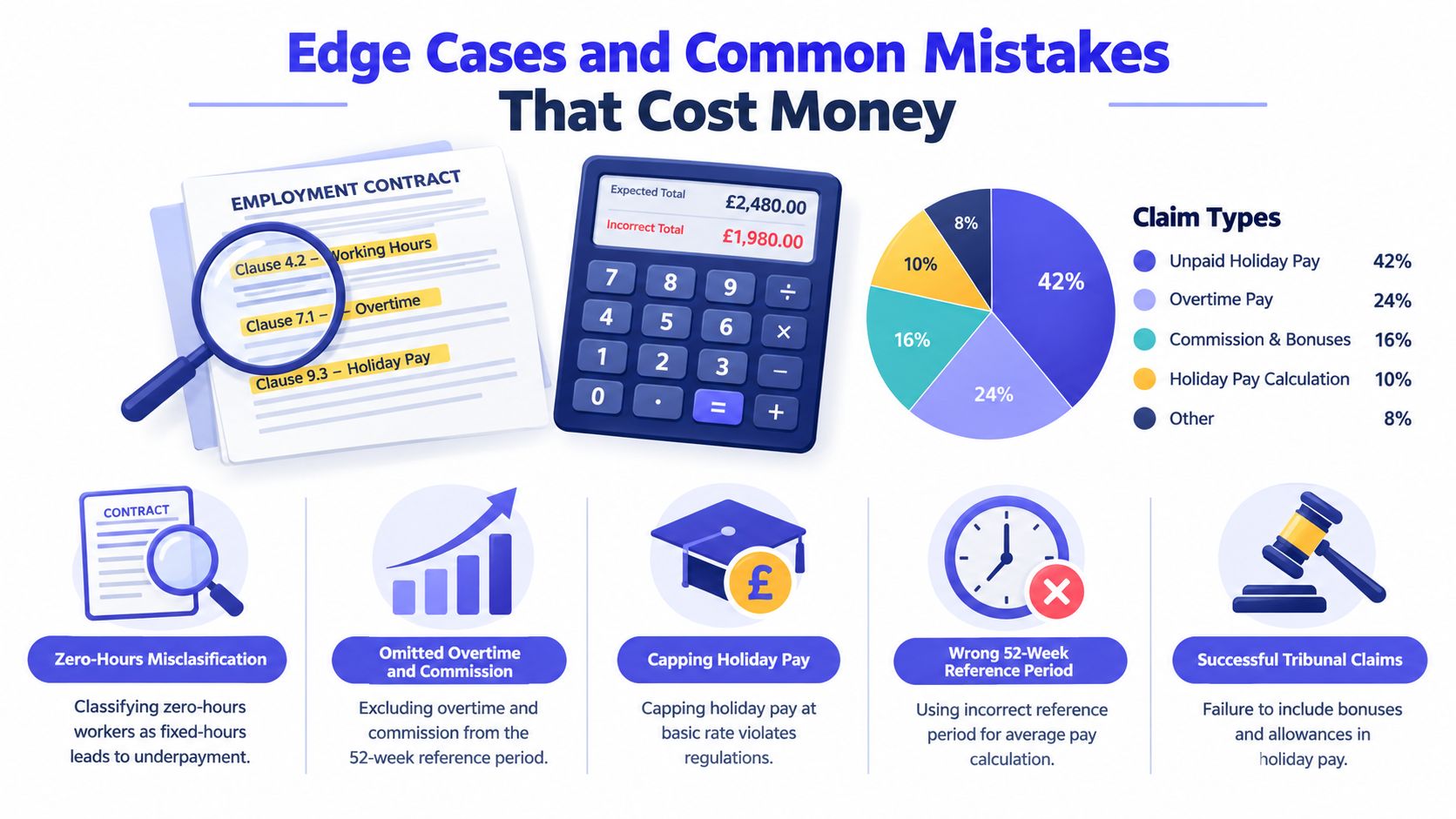
- Zero-hours worker treated as fixed-hours: Check the actual contract pattern first. If hours are irregular, don't use a fixed annual day allowance.
- Overtime and commission left out of pay calculations: Include them where they form part of normal remuneration, otherwise the holiday pay figure is understated.
- Holiday pay capped at basic rate: Use the correct pay basis for statutory leave rather than defaulting to base salary only.
- Contractual holiday ignored: Check whether the contract provides extra leave above the statutory minimum and how that excess is meant to be handled on exit.
- Accrual methods mixed in the same leave year: Apply one coherent method to the relevant worker category and document why.
- Reference period cut short: Where average pay rules apply, remember zero-pay weeks are excluded and earlier paid weeks may need to be pulled in.
The one correction that helps most
Build one approval checkpoint into the process: worker type, leave year, pay basis. If those three fields are right, the rest of the leave payout calculation usually follows.
Underpaid final leave often starts as a classification error, not a maths error.
The Farrer summary of Acas holiday pay guidance is a useful reminder of where small employers stumble, especially when contracts, variable earnings, and incomplete reference weeks all collide in one payroll run (Acas guide summary from Farrer).
Spreadsheet Templates and How Automation Helps
A final-pay dispute often starts in a familiar place. Payroll has the leaving date. HR has a holiday balance. Neither side is fully sure which formula produced it.
A spreadsheet can still handle leave payout calculation for a small employer, but only if it separates category choice from the arithmetic. I would not start with "days left x day rate" as the first field. I would start with worker type, leave year, and pay basis, because those choices determine whether the sheet should use fixed-hours pro rata logic, 12.07% accrual for eligible irregular-hours or part-year workers, or an average-pay approach. If the classification is wrong, the workbook can produce a neat number that is still wrong.
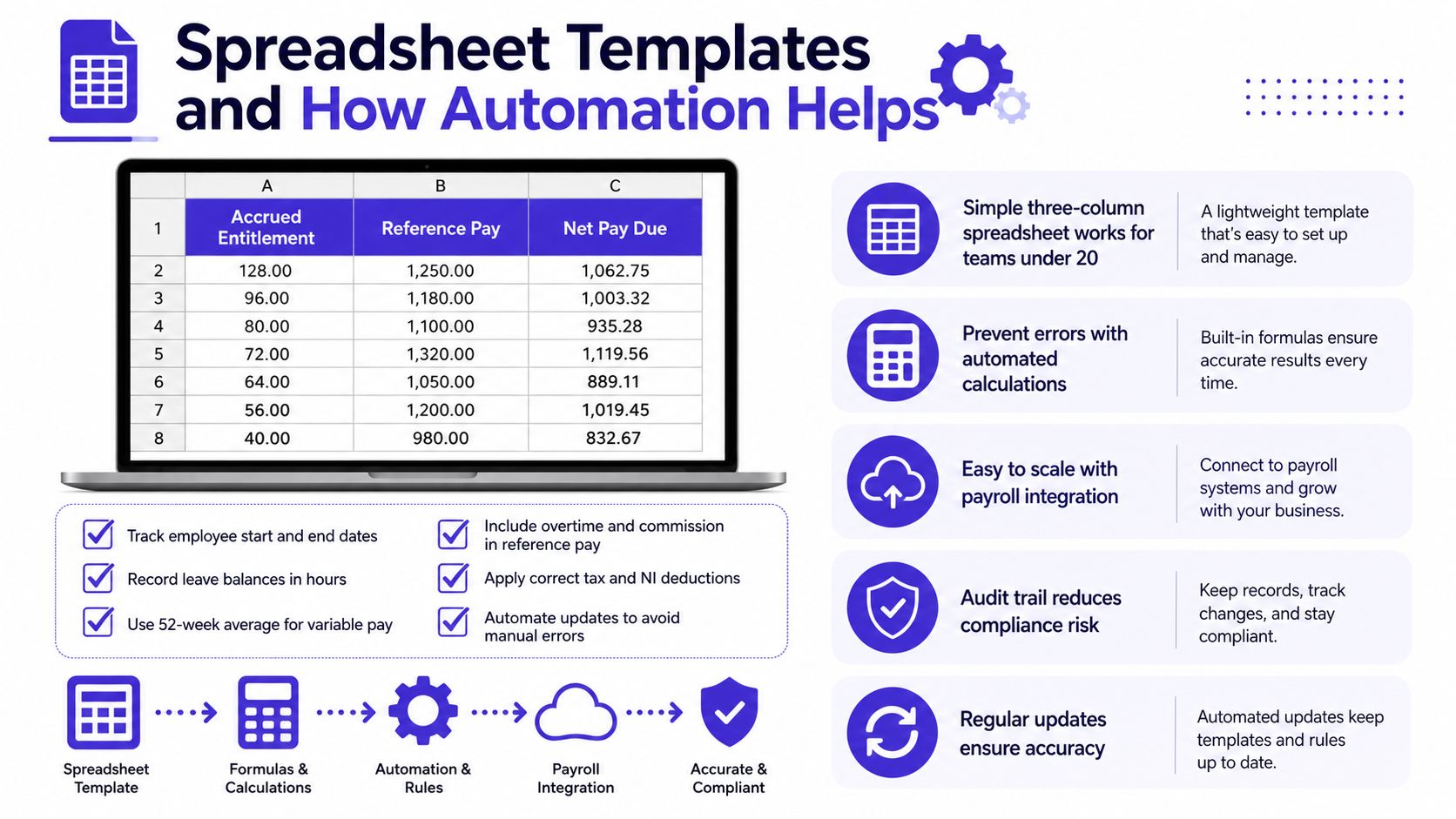
For a basic spreadsheet, one row per leaver is fine. The minimum useful columns are: worker category, contract pattern, leave year start and end, entitlement method, accrued leave, leave taken, payable balance, pay basis, and final gross amount. Where average pay rules apply, keep a separate tab showing the paid weeks pulled into the reference period. That audit trail matters if the employee queries the figure later.
Spreadsheets usually break at the handoff points, not in the formula cell itself. The weak spots are predictable:
- One template used for every worker type: fixed-hours staff, irregular-hours workers, and part-year workers do not belong on identical logic.
- Manual rate overrides: they hide whether the payout is based on salary, average earnings, or a blended figure that nobody can justify later.
- Work pattern changes mid-year: a worker moves role or hours, but the original accrual formula stays in place.
- Reference-week history stored outside the file: payroll gets a number, but not the weeks used to support it.
- Too many people editing the workbook: version control fails before the maths does.
That is where automation earns its keep. A leave system can store the worker category, apply the right accrual method consistently, preserve balance history, and pass payroll a figure with less manual repair work. LeaveWizard is one example of that kind of setup. If your team still relies on Excel, this annual leave tracker spreadsheet guide shows the level of structure a workbook needs before it is safe to depend on.
Keep this checklist beside the payroll sign-off:
- Confirm the worker category first
- Check the leave year attached to the balance
- Match the formula to the category
- Reconcile leave accrued against leave taken
- Use the correct pay basis for the payout
- Store the workings used for the final amount
Good automation does not replace judgment. It removes the repeatable errors, so the judgment is spent on the cases that need it.
LeaveWizard gives small businesses one place to track leave entitlement, balances, and absence records so final-pay calculations do not start from a messy spreadsheet.