
Crafting HR policies isn't just a paper-pushing exercise. It's a deep dive into your company's real needs, a careful check of UK legal requirements, and then drafting clear, consistent guidelines before sharing them with your whole team. The real goal is to build a framework that’s not only legally sound but also a true reflection of your company's culture.
Why Effective HR Policies Are a Strategic Asset
Too many business owners see writing HR policies as a boring, box-ticking task—a necessary evil to dodge legal headaches. And while compliance is absolutely vital, looking at your policies as just a rulebook is a huge missed opportunity.
Think of it this way: your policies are the DNA of your company culture. They're more than just rules; they are a powerful strategic asset that builds the foundation for a fair, productive, and resilient organisation. Without clear traffic rules, the roads would be a mess. The workplace is no different. Your policies guide behaviour, prevent collisions between team members, and keep everyone moving towards the same business goals.
Beyond Compliance to Culture
Great HR policies do more than just scrape by the legal minimums; they actively shape your company culture. A clear, consistently applied flexible working policy, for instance, sends a powerful message: you trust your employees and value their work-life balance. In a tight hiring market, that kind of trust builds loyalty and gives you a serious edge.
On the flip side, vague or non-existent policies create a vacuum of uncertainty. Managers might make inconsistent calls, sparking feelings of favouritism and crushing team morale. When people know what to expect and trust that the system is fair, they feel more secure, engaged, and ready to do their best work.
"Policies are the binding blocks of an organisation. They connect your strategy, vision, culture, engagement, and people. Therefore, HR must create policies that resonate with and align with the culture it has set out to build."
A Shield Against Disputes and Costs
Let’s look at a real-world scenario. Two employees have a disagreement that starts to escalate. With no formal grievance procedure, the problem just sits there, poisoning team productivity and morale. A manager might step in and handle it poorly, opening the business up to a potential constructive dismissal claim.
Now, imagine there's a well-written grievance policy. It gives everyone a clear, step-by-step process for resolving conflicts fairly and professionally. It empowers both employees and managers by spelling out their roles, turning a potentially volatile situation into a structured, manageable process.
This proactive approach pays off in so many ways:
- Reduced Legal Risk: Clear policies are your first line of defence against employment tribunals. They prove you have fair procedures in place and use them every time.
- Managerial Confidence: Policies give managers the backbone they need to lead with conviction. They can tackle issues like absenteeism or poor performance confidently, knowing they're following a fair, established protocol.
- Improved Consistency: Applying rules the same way for everyone is the cornerstone of fairness. Policies make sure every employee gets the same treatment in similar situations, slashing the risk of discrimination claims.
- Enhanced Clarity: When your team knows the rules—from how to use social media to how to request leave—it cuts out the guesswork and lets everyone get on with their jobs.
Laying the Groundwork Before You Write

Great policies aren't just downloaded from a template; they're built with purpose. Before you type a single word of a new policy, you need to lay some solid groundwork. This prep phase is what turns a generic document into a strategic tool that genuinely reflects and supports your UK business.
Jumping straight into writing without this groundwork is a bit like building a house without a blueprint. You might end up with a shaky structure that doesn’t meet your needs and won't stand up to scrutiny. Taking the time to plan ensures every policy has a clear purpose and a direct link to your company's day-to-day reality.
Distinguish Between Legal Must-Haves and Smart Additions
First things first, you have to get clear on the difference between policies mandated by UK law and those that are simply good business practice. Not every policy is a legal requirement, but some are absolutely non-negotiable.
Legally required policies in the UK typically include:
- A written Health and Safety Policy (this is a must if you have five or more employees).
- A formal Grievance Procedure for managing employee complaints.
- A clear Disciplinary and Dismissal Procedure.
Beyond these legal cornerstones are the policies that, while not mandatory, are vital for running a modern, fair, and efficient workplace. This is where you might bring in policies on flexible working, data protection (to align with UK GDPR), or equal opportunities. The trick is to figure out which of these "smart additions" will best serve your specific industry and your people.
Conduct a Real-World Needs Analysis
Your own team is your most valuable resource here. Honestly, the best way to figure out what policies you actually need is to uncover the real pain points and daily challenges happening right now in your organisation. Don't guess what the problems are—go and find them.
This means you need to talk to people. Have informal chats with your managers to hear about the recurring issues they face. Are they struggling with how to handle leave requests consistently? Is there a grey area around social media use that's causing confusion? These conversations are gold; they reveal the gaps that well-crafted policies can fill.
A policy created in a vacuum solves a hypothetical problem. A policy built from employee feedback solves a real one. It moves from a document people are forced to follow to a resource they find genuinely helpful.
As you begin this process, it can be really useful to see how the experts do it. Looking at an expert access control policy template, for example, can give you great insight into how to structure a clear and effective document, no matter the specific topic.
Align Every Policy with Your Company Culture
This is the final, and I'd argue most crucial, step in your prep work. You must connect every policy back to your company's core values. Your HR policies are a powerful signal to your team about what your organisation stands for, so they need to be an authentic reflection of the culture you're trying to build.
For instance, if one of your core values is "trust and autonomy," a rigid, micro-managing remote work policy would be completely out of step. It would actively undermine the culture you claim to have. A better approach would be a policy that provides clear guidelines on outcomes and security but empowers employees with genuine flexibility.
Before moving forward, ask yourself these simple questions for every policy idea:
- Does this policy reflect our company values?
- Does it help build the kind of workplace we want to be?
- Will our team see this as fair and supportive?
By asking these questions, you move beyond just writing rules. You start the process of how to write HR policies that are not just compliant, but are also authentic, strategic, and a living part of your company's success. This groundwork ensures your final documents are practical, respected, and truly alive within your organisation.
Navigating UK Employment Law with Confidence

Writing HR policies in the UK can feel like trying to hit a moving target. Employment law isn't a dusty old rulebook; it's a living, breathing framework that shifts with societal changes and new government priorities. Getting this right isn’t just about dodging fines—it’s about building a workplace that’s fundamentally fair and secure for everyone.
For many small business owners, the idea of a deep dive into legislation is pretty daunting. But here's the thing: understanding the core legal pillars is an essential part of creating HR policies that actually work. This knowledge gives you the confidence to draft documents that not only protect your business but also treat your employees with the equity they deserve.
Core Legal Requirements for UK Businesses
Some policies are simply not optional. They are legal necessities, and at a minimum, your policy framework must address key legislation that forms the very bedrock of UK employment rights. Falling short in these areas can expose your business to some serious legal and financial risks.
Here are the non-negotiables your policies must cover:
- The Equality Act 2010: This is a cornerstone of UK law. Your policies must actively prevent any form of discrimination based on the nine "protected characteristics," which include age, disability, race, religion, sex, and sexual orientation.
- Working Time Regulations 1998: These rules govern everything from maximum weekly working hours to rest breaks and annual leave. Your policies on holiday entitlement and working hours need to align perfectly with these regulations.
- UK GDPR: Data protection is a huge deal. You need a solid policy explaining exactly how you collect, store, and use employee data, respecting their right to privacy under the UK General Data Protection Regulation.
There's no grey area here. Failing to have clear, compliant policies on these topics isn't an option. For a more detailed look at your legal duties, our guide to complying with UK employment laws is a great place to get more context.
Staying Ahead of Legislative Changes
One of the biggest challenges for any HR professional or business owner is that the legal landscape is constantly shifting. What was standard practice last year could be outdated today. We're seeing this play out right now with the evolution of UK employment law.
For instance, the upcoming Employment Bill, expected in 2025, has been described as the most significant update to employment legislation in a decade. This bill is set to introduce some major changes, like removing the qualifying period for claiming unfair dismissal and requiring more pay transparency reporting.
For businesses, this means your existing disciplinary and compensation policies will need a thorough review to stay compliant.
Keeping your policies current isn't a once-a-year task. It's an ongoing process. You have to monitor legal updates and think about how they impact your specific business. Subscribing to HR newsletters or setting up government announcement alerts can make this much more manageable.
What Recent Reforms Mean for Your Policies
Let's get practical. How do these big legislative changes actually translate into policy updates? It’s rarely just about adding a new sentence; it’s often about rethinking the entire procedure behind the policy.
Take the recent changes around flexible working requests. The law now makes this a "day one" right, which means an employee no longer needs a minimum service period to apply.
So, how does this one change impact your policy?
- Scope and Eligibility: First off, your flexible working policy must be updated. Any mention of a 26-week qualifying period needs to go.
- Procedure: You might need to streamline your request-handling process. With new starters able to apply, you could see a higher volume of applications.
- Manager Training: Your line managers need to be retrained on the new rules. They must learn how to evaluate requests fairly based on business grounds, without letting the employee's length of service influence their decision.
This single legislative tweak creates a ripple effect, forcing changes to the written document, your internal processes, and even your team's training. It's a perfect example of why staying legally current is so crucial when writing HR policies. When you're proactive, you minimise risk and show your team you’re committed to protecting their rights.
How to Write Policies That People Actually Read
You’ve done the groundwork and understand the legal maze. Now for the most important part: turning all that prep into documents your team will actually read and use. Let's be honest, a policy is useless if it’s so dense with legal jargon that nobody can make sense of it.
The real art is writing for clarity. Your goal isn't to impress a solicitor with complex clauses; it's to give clear, direct guidance that everyone—from a new starter to a senior manager—can easily follow. Think of it less as a legal document and more as a user-friendly guide to your workplace.
The Essential Structure of Any Policy
Every policy you write, whether for grievances or flexible working, should follow a consistent and logical structure. This predictability makes your entire policy library much easier for people to navigate. When an employee knows exactly where to find the information they need, they're far more likely to actually engage with it.
For a clearer breakdown, here are the standard components you should aim to include in every policy document.
Essential Components of an HR Policy Document
A breakdown of the standard sections to include in every HR policy for clarity and completeness.
| Component | Purpose | Example Content Snippet |
|---|---|---|
| Policy Purpose | Explains why the policy exists in simple terms. | "This policy outlines our commitment to providing a safe and respectful work environment, free from harassment." |
| Scope | Defines who the policy applies to. | "This policy applies to all full-time and part-time employees, contractors, and volunteers of the company." |
| Policy Statement | The core rules and principles, written clearly. | "The company prohibits all forms of unlawful discrimination and harassment." |
| Procedure | A step-by-step guide on how to follow the policy. | "To report an incident, you can speak with your line manager or a representative from the HR department." |
| Responsibilities | Clarifies who is responsible for what. | "Employees are responsible for reporting incidents. Managers are responsible for escalating them to HR." |
This simple framework provides a solid backbone for almost any HR policy, ensuring you don’t miss anything critical. If you want to dive deeper, you can explore more detailed guidance on how to write company policies to build on this structure.
From Jargon to Plain English
The single biggest mistake I see businesses make is writing policies in overly formal, legalistic language. If your team needs a dictionary to understand their rights, you’ve already failed. The key is to be precise without being complicated.
Your HR policies should be written for the people who need to use them every day, not just for a potential employment tribunal. Clarity builds trust; complexity creates confusion and suspicion.
So, instead of writing, "The organisation is committed to facilitating equitable resolutions to interpersonal workplace conflicts," just say this: "We are committed to resolving workplace disagreements fairly." It means the same thing but is instantly understandable.
Crafting Policies for Retention and Growth
In today's job market, your policies can't just be about rules and restrictions. They need to be strategic tools that help you keep and develop your best people. We're in a strange position right now: redundancies are on the rise, yet many companies are struggling to fill key roles.
For instance, a report from the Chartered Institute of Personnel and Development noted that 25% of UK businesses planned redundancies in early 2025. At the same time, 33% of UK employers reported hard-to-fill vacancies, and 47% of those businesses were focusing on upskilling existing staff to fill the gaps.
This tells us that policies must do more than just manage exits; they need to actively encourage growth. This is where a well-written upskilling or professional development policy becomes a powerful retention tool. It shows your team you’re invested in their future, not just managing their present.
The image below shows the three core steps for bringing any new policy to life in your organisation.
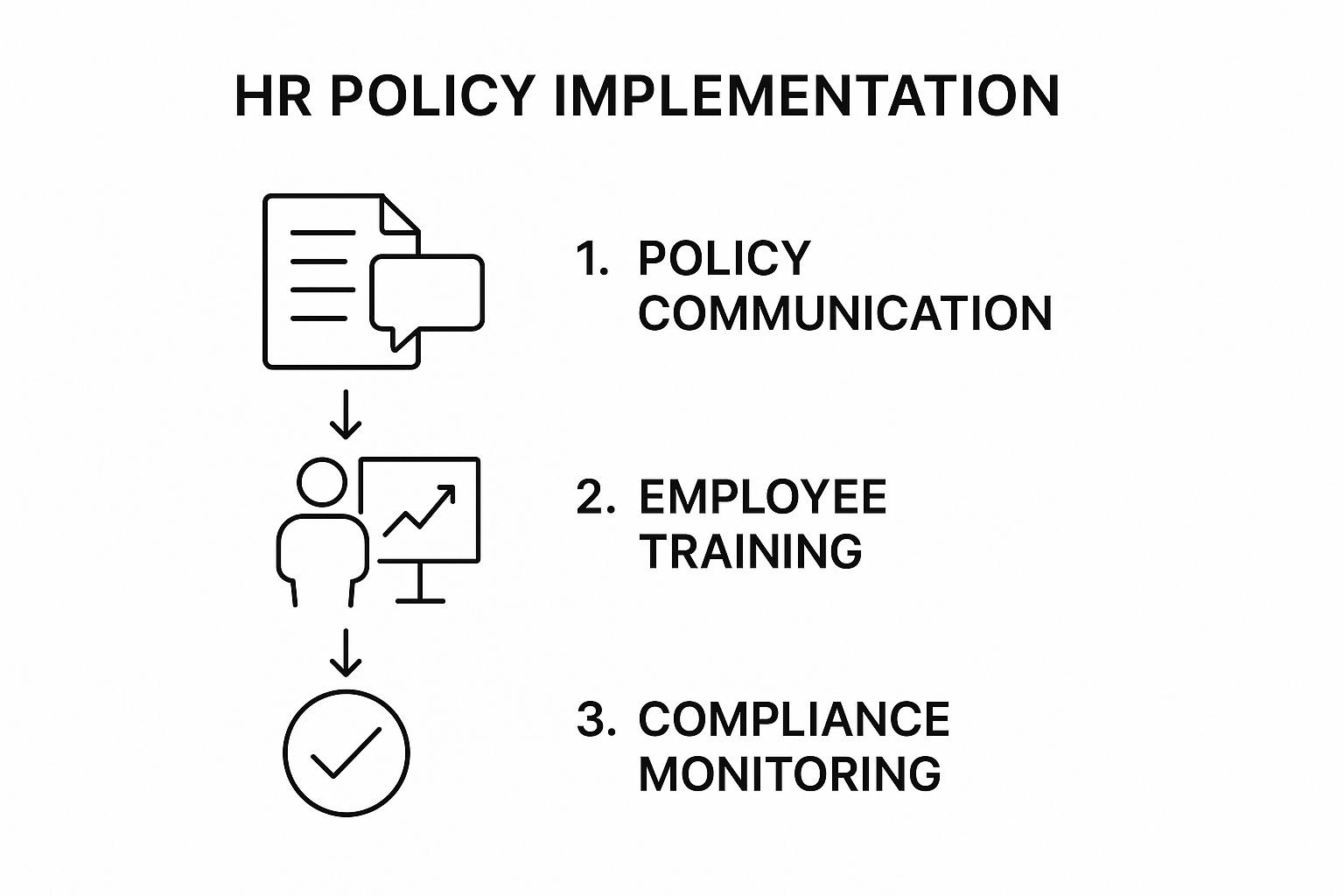
This simple flow reminds us that a policy is only truly "live" once it’s been communicated, understood through training, and its effectiveness is being checked.
Practical Examples of Key Policies
Let's look at how to apply these principles to three common and critical UK policies.
1. Grievance Policy
- Bad Example (Vague): "Employees should report any grievances to their manager." This just leaves people with more questions. What if the grievance is about their manager? What’s the next step?
- Good Example (Clear & Actionable): "If you have a workplace concern, you can raise it informally with your line manager first. If you're not comfortable with that, or if the issue isn't resolved, you can start a formal grievance process by submitting a written complaint to the HR department."
2. Flexible Working Policy
- Bad Example (Restrictive): "Flexible working requests will be considered where operationally viable." This sounds discouraging and non-committal. It doesn't invite a conversation.
- Good Example (Supportive & Clear): "We support flexible working, and all employees have the right to request it from day one. To apply, please submit the Flexible Working Application Form to your manager, outlining your proposed arrangement and how you believe any impact on the business can be managed. We will schedule a meeting to discuss your request within two weeks."
3. Disciplinary Procedure
- Bad Example (Threatening): "Policy violations will result in disciplinary action up to and including termination." While this might be true, it’s purely negative and comes across as a threat.
- Good Example (Fair & Procedural): "Our goal is to resolve performance or conduct issues constructively. Our disciplinary procedure follows the ACAS Code of Practice, ensuring a fair investigation and the chance for you to state your case. The process typically involves a formal warning system, and dismissal is a last resort for serious misconduct or repeated issues."
By focusing on clarity, structure, and a supportive tone, you can turn your HR documents from dreaded rulebooks into genuinely useful guides that strengthen your whole organisation.
Bringing Your HR Policies to Life
Drafting your HR policies is a huge step, but the document itself is only half the journey. Think about it: a brilliant policy hidden away on a shared drive is little more than a digital paperweight. The final, and arguably most important, phase is implementation—the process of weaving these guidelines into the very fabric of your company's daily life.
This is where your words on a page become actions in the workplace. It's about much more than just firing off a company-wide email. You need a proper plan for review, communication, and training to make sure your policies are understood, respected, and applied fairly by everyone.
The Final Review and Feedback Loop
Before you unveil any new or updated policy, it needs one last, thorough check. I’m not just talking about a quick proofread for typos; this is a multi-layered review to make sure the policy is solid, fair, and legally sound.
Your review process should pull in a few key people:
- Senior Leadership: They need to sign off on the policy to ensure it lines up with the company's wider goals and operational realities. Without their buy-in, the policy simply won't have the authority it needs to stick.
- A Sample of Managers: These are the people on the front lines who will be enforcing the policy day-to-day. Give them a chance to poke holes in it. Can they realistically follow the procedures? Is the language clear enough to avoid confusion during a tricky conversation?
- Legal Counsel: This step is non-negotiable. It’s absolutely essential for legally sensitive policies like disciplinary procedures, grievance handling, or anything touching on the Equality Act. An employment law solicitor can spot potential compliance gaps that could expose your business to serious risk.
A policy isn't really finished until it's been stress-tested by the people who will actually use it. Asking for feedback isn't a sign of weakness; it’s a smart move to create a document that's practical and respected from day one.
Rolling Out Your Policies with Clarity
Once your policy is finalised, you need a clear communication plan. The goal is simple: every single employee must not only receive the new policy but also understand what's changed and, crucially, why it matters to them. A scattergun approach just won't cut it.
Try using a few different channels to get the message across effectively:
- Company-Wide Announcement: Start with an all-hands email or a post on your internal comms platform like Slack. Briefly introduce the policy, explain its purpose, and state exactly when it comes into effect.
- Dedicated Intranet Page: Don't just upload a PDF and call it a day. Host the full policy document in an easy-to-find place, like a dedicated section of your company intranet or HR portal. It's a good idea to create a page that includes a short summary and maybe an FAQ section to answer common questions.
- Team Meetings: Ask managers to discuss the new policy in their team meetings. This gives employees a chance to ask questions in a smaller, more comfortable setting where they feel safe to speak up.
This layered approach makes sure the message is not only received but also reinforced.
Empowering Managers to Be Consistent Champions
Your managers are the most critical link in bringing policies to life. If they don't understand a policy or apply it incorrectly, it can quickly lead to inconsistency, accusations of favouritism, and even legal headaches. They need to be equipped to be fair and consistent champions of your guidelines.
This is why manager-specific training is so important. And it shouldn't just be a boring recap of the policy text. Focus on practical, real-world application. Use scenario-based training to walk them through how to handle situations they'll actually face.
For a new flexible working policy, you could discuss things like:
- How to fairly assess competing requests from different team members.
- What counts as a legitimate business reason for turning down a request.
- The best way to document their decisions clearly and respectfully.
When you invest in this kind of training, you empower your managers to apply the rules with confidence and fairness. This is how you transform your HR policies from static documents into living guides that actively shape a positive, predictable, and supportive workplace culture for everyone.
Common Questions About Writing HR Policies

When you're deep in the weeds of drafting company documents, you start to notice the same questions cropping up. It's only natural. Navigating how to write HR policies means you'll almost certainly hit a few tricky spots or points of confusion. Let's walk through some of the most common queries I hear and give you the clear, direct answers you need to move forward with confidence.
Getting these fundamentals right is what separates a policy binder that gathers dust from one that genuinely serves your team.
Which HR Policies Are Legally Required in The UK?
This is usually the very first question business owners ask, and for good reason. While you could create a policy for just about anything, a few are completely non-negotiable under UK law. Your top priority should be getting these in place.
Every single UK employer, no matter how small, must have:
- A formal Grievance Procedure that clearly outlines how your team can raise and resolve complaints.
- A clear Disciplinary and Dismissal Procedure that follows a fair and consistent process.
- A written Health and Safety Policy if you employ five or more people.
You also have a day-one legal duty to give all employees a "Written Statement of Employment Particulars," which covers the core terms and conditions of their job.
How Often Should We Review Our HR Policies?
Think of your HR policies as living documents, not a one-and-done project you can tick off a list. To stay relevant and compliant, they need regular check-ups. As a solid rule of thumb, you should aim to review all your policies at least once a year.
That said, some events should trigger an immediate review, outside of your annual schedule. These include:
- Major legislative changes, like a new Employment Act or big updates to working time regulations.
- A significant business event, such as a merger, a major restructure, or a big shift to a remote-first work model.
- Feedback from your own team telling you a policy is confusing, outdated, or just not working in the real world.
Staying on top of reviews stops your policies from becoming obsolete and ensures they're still protecting both the business and your people effectively.
A policy review isn't just a legal box-ticking exercise. It's about asking, "Does this still serve our business and our people? Is it creating a fair process, or is it just an unnecessary roadblock?" Answering that honestly is key.
What Is the Difference Between a Policy and a Procedure?
This is a classic point of confusion, but the distinction is actually quite simple—and incredibly important for structuring your documents properly. Once you get this, your writing will become much clearer.
A policy is the ‘why’. It’s the high-level statement of principles, the rule itself. It sets the company's official stance on an issue.
- Example: "We are committed to maintaining a safe and healthy working environment for all employees."
A procedure is the ‘how’. It's the practical, step-by-step guide for actually carrying out the policy. It tells employees and managers exactly what to do.
- Example: "To report a safety hazard, an employee must: 1. Inform their line manager immediately. 2. Complete the 'Hazard Report Form' on the intranet. 3. Submit the form to the Health and Safety Officer."
Keeping the 'why' and the 'how' separate makes everything much easier for people to read and understand.
Can We Just Use a Template for Our Policies?
Templates can be a fantastic starting point, I won't deny it. They're especially useful for small businesses that don't have a dedicated HR team, as they provide a solid structure and stop you from missing anything essential. But please, never use a template straight out of the box.
Every single policy must be customised to reflect your specific:
- Company Culture: A policy for a relaxed creative startup will sound very different from one for a formal financial firm.
- Industry Nuances: Your sector might have unique risks or standard practices that have to be addressed.
- Operational Realities: Your procedures have to match how your business actually functions day-to-day. For instance, our guide on how to manage employee absences digs into the sort of practical steps that generic templates often miss.
My best advice? Always adapt templates. And for your most critical policies, it's well worth the investment to have them checked by an employment law professional to make sure they're fully compliant and fit for purpose.


