A team leader has just hired someone who works three fixed days a week. The contract is ready, the start date is agreed, and then one practical question stops everything: how many days of holiday should go into the HR record?
That calculation looks simple until you account for working patterns, mid-year starts, irregular hours, bank holidays and final pay. The safe approach is to identify the worker type first, then use the matching formula and keep a clear record of the result.
Table of Contents
- Why Pro Rata Holiday Calculations Trip Up Small Businesses
- Calculating Pro Rata Holiday for Regular-Hours Workers
- The Accrual Method for Irregular-Hours and Part-Year Workers
- Handling Mid-Year Starters and Leavers
- Working Out Holiday Pay for Different Worker Types
- Policy Templates and Common Mistakes to Avoid
Why Pro Rata Holiday Calculations Trip Up Small Businesses
A manager who guesses the allowance may accidentally give a part-time employee too much or too little leave. Rounding a result down, overlooking a bank holiday, or applying a fixed-days formula to someone whose hours change every pay period can create disputes that are difficult to resolve later.
The legal starting point is the UK statutory minimum of 5.6 weeks' annual leave. For a full-time employee working a five-day week, that equals 28 days, and the entitlement for a regular part-time worker is adjusted in proportion to the days worked, as explained in government guidance on holiday entitlement.
Pro rata holiday exists to ensure that a person who works fewer days or part of the leave year receives a fair proportion of the same holiday rate. It isn't a separate benefit for part-time staff. It's the same underlying entitlement, expressed in the unit that matches their contract.
Practical rule: Don't begin with the employee's job title. Begin with the pattern of work.
Three situations commonly get grouped together even though they need different calculations:
- Regular-hours workers: They work a predictable number of days each week, so the days-per-week formula usually fits.
- Irregular-hours workers: Their hours vary, so entitlement is built from actual hours worked in each pay period.
- Part-year workers: They're contracted to work only during part of the year, making the accrual method particularly important.
- Starters and leavers: Their annual allowance must be adjusted for the part of the leave year they work.
- Changing patterns: Their entitlement may need to be split between the old and new arrangements.
A spreadsheet can handle the arithmetic, but it won't decide which method applies. That classification decision is where small businesses most often need a disciplined process.
Calculating Pro Rata Holiday for Regular-Hours Workers
For a worker with a fixed weekly schedule, the core calculation is:
Days worked each week × 5.6 = annual statutory leave in days.
The 5.6-week multiplier is the legal minimum for UK workers. A three-day worker therefore has an entitlement of 16.8 days, while a four-day worker has 22.4 days, based on the practical examples set out in UK holiday entitlement guidance.
Use the employee's working days
Start by confirming how many days the employee normally works in a week. If the employee works three days, calculate 3 × 5.6. If they work four days, calculate 4 × 5.6. Keep the result in the unit used by the contract, either days or hours.
| Days Worked Per Week | Calculation | Annual Leave Days |
|---|---|---|
| 3 | 3 × 5.6 | 16.8 |
| 4 | 4 × 5.6 | 22.4 |
| 5 | 5 × 5.6 | 28 |
A decimal result isn't an error. It reflects the fact that annual leave is measured in weeks and then translated into working days. Don't casually remove the decimal or round it down. Check your payroll and HR process against the applicable contract and legal guidance, and record the entitlement in a way that preserves the employee's full statutory minimum.
A useful way to explain the calculation to an employee is: “Your working week is three days, so your statutory entitlement is three multiplied by 5.6 weeks, giving 16.8 days for the leave year.” If your business records leave in hours, convert the entitlement using the employee's normal daily hours rather than treating every working day as identical.
Treat bank holidays as part of the allowance when the contract does
Bank holidays don't automatically sit outside annual leave. Your contract should state whether they form part of the overall holiday entitlement. If a bank holiday falls on a part-time employee's normal working day, it may use part of their leave allowance. If it falls on a non-working day, don't let the employee lose the equivalent benefit because of their pattern.
Term-time and other fixed-pattern contracts still need a clear annual entitlement. The calculation may be expressed in days or hours, but the record should show how the figure was reached and how leave is requested.
For a spreadsheet-based process, this annual leave calculation guide can help managers organise the inputs and check that the working pattern has been applied consistently.
The Accrual Method for Irregular-Hours and Part-Year Workers
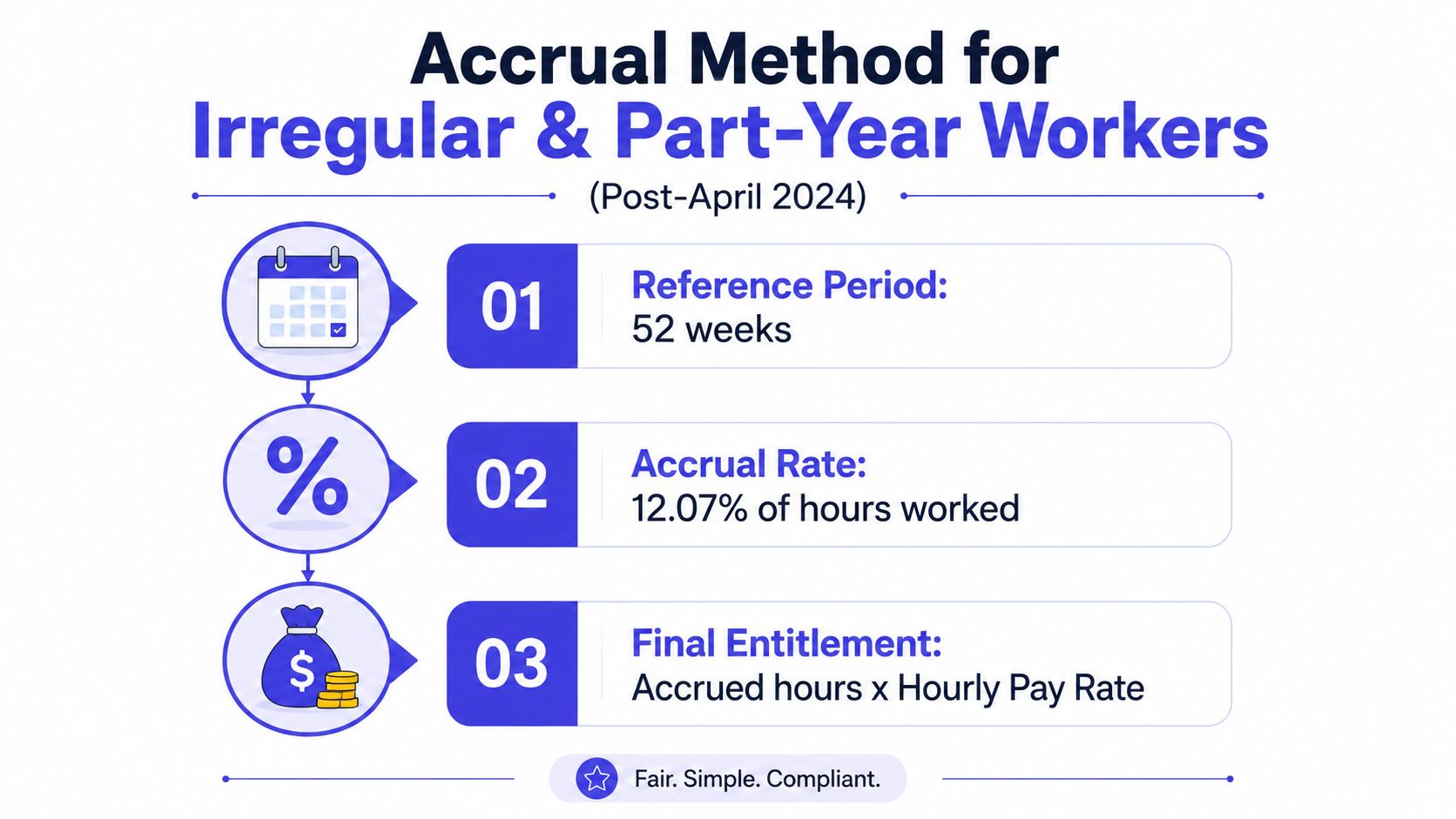
A casual worker may work different hours in every pay period, while a term-time employee may work only during part of the year. A fixed weekly-days formula does not reflect either pattern. For qualifying irregular-hours and part-year workers, calculate statutory holiday at 12.07% of actual hours worked in each pay period, with entitlement accruing on the last day of that period, as set out in ACAS guidance for irregular-hours and part-year workers.
Calculate each pay period separately
Use the timesheet for each pay period and keep a running balance:
- Total the actual hours worked during the pay period.
- Multiply those hours by 12.07%.
- Add the result to the employee's accrued holiday balance.
- Record the accrual on the last day of the pay period.
- Apply the rounding rule if the result includes part of an hour.
For example, a casual worker with changing hours should have each pay period calculated from its own approved timesheet. An assumed average can produce the wrong entitlement, particularly where work rises or falls across the year.
ACAS states that a fraction of an hour is rounded down when it is under 30 minutes and up when it is 30 minutes or more. A statutory-minimum worker also can't accrue more than 28 days in a leave year, as confirmed in the guidance above. Monitor that cap when the system stores holiday in hours, because the equivalent daily limit depends on the worker's normal working day.
Identify the contract before applying the percentage
An irregular-hours worker has no consistent number of hours in each pay period. A part-year worker has periods when they are not required to work under the contract, such as a term-time arrangement. Someone with predictable weekly hours during a defined working season may still qualify for part-year treatment.
Set up a record showing the hours worked, calculation date, holiday accrued and leave taken. The holiday accrual guide can help structure that record, but check the contract before applying the method. Your payroll process should also use the same treatment each pay period.
The accrual method links holiday to work performed, so it responds to changing hours more accurately than a fixed annual figure. It also makes reliable timesheets and timely approvals a management responsibility.
The following video provides a visual explanation of the calculation process:
Handling Mid-Year Starters and Leavers
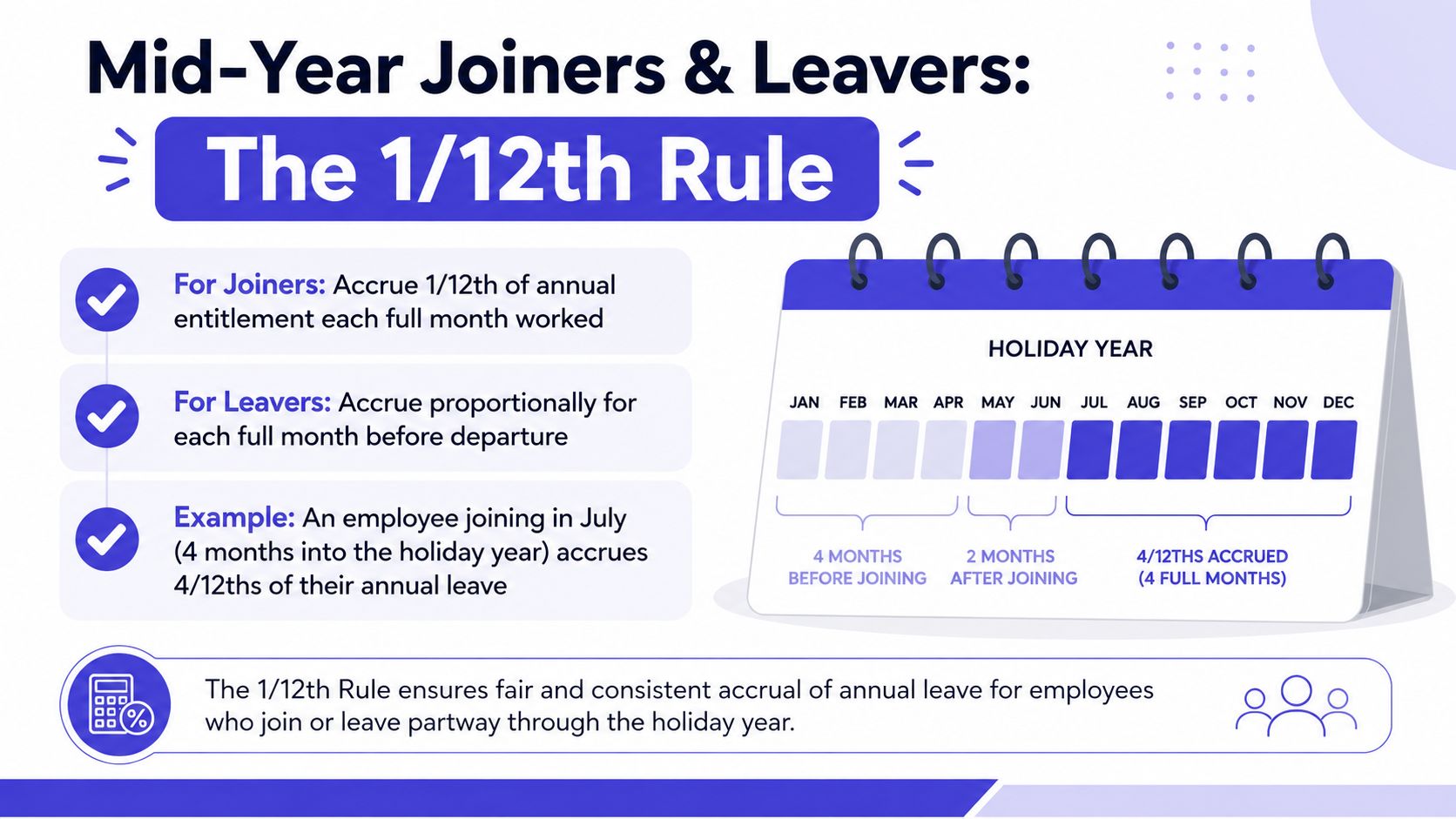
A new employee who joins after the leave year has begun shouldn't receive the full annual allowance immediately. A common method is to allocate one-twelfth of the annual entitlement for each month worked in the leave year, particularly where the employee starts on the first day of a month, as described in this holiday calculator guidance for starters.
Starters
Take the employee's full annual entitlement and divide it by 12. Multiply that monthly amount by the number of applicable months in the leave year.
A starter who begins on the first day of a month can be allocated the monthly amount for that month, then for each later month worked. For someone starting part-way through a month, check the wording of your policy and use a consistent approach. Don't switch between calendar months, complete months and days worked, because employees will receive different outcomes for comparable start dates.
Give the employee a written statement showing:
- Annual basis: The full entitlement for the working pattern.
- Start-date treatment: How the business handles a partial first month.
- Accrual record: How much has become available and when.
- Booking process: How the employee requests and receives approval for leave.
Leavers
For a departing employee, calculate the portion earned up to the leaving date, then compare it with leave already taken. If the employee has unused accrued leave, it may need to be paid in final pay. If they've taken more leave than accrued, a deduction may be possible only where the contract or another clear written agreement allows it.
Notice creates a practical issue. An employee remains employed during notice, so leave may be taken during that period if the employer approves it or directs the employee to take it with the required notice. Don't promise that all unused leave will automatically be taken during the final week. Check the dates, the remaining balance and the contract before confirming the outcome.
Working Out Holiday Pay for Different Worker Types
Entitlement tells you how much leave the employee has. Holiday pay tells you what the employee should receive while taking it, and the two calculations shouldn't be treated as interchangeable.
A salaried employee with fixed hours will usually receive their normal salary during ordinary annual leave, subject to the contractual and statutory rules that apply. A worker on variable shifts, casual hours or changing pay needs a calculation that reflects their normal earnings rather than an arbitrary daily figure.
For irregular-hours and part-year workers, holiday pay is based on average pay over the previous 52 weeks, regardless of when the leave year starts, according to ACAS guidance on calculating holiday pay. The guidance also recognises calculations based on days or hours worked per week, casual or irregular hours, and shifts.
Build a reliable pay record
Payroll should retain the pay history used for the average, identify weeks with no work, and record the reasoning behind exclusions or adjustments. Keep regular overtime, shift-related payments and other relevant normal pay under review instead of assuming that basic hourly pay always tells the whole story.
For businesses reviewing wider employment arrangements alongside leave, this guide to part time benefits offers useful context on how part-time terms can be documented and communicated.
A manual spreadsheet can work when the workforce is small and patterns are stable. It becomes harder to audit when managers edit balances, payroll holds the pay data, and employees request leave through separate channels. A dedicated UK holiday pay calculation guide can help structure the process, but the figures still need to match the employee's actual contract and pay history.
Policy Templates and Common Mistakes to Avoid
A good policy doesn't need legalistic wording. It needs to tell employees which calculation applies, how the business treats fractions, and what happens when their working pattern changes.
Plain-language templates
For a regular part-time employee
“Your annual leave is calculated from your normal working days each week. We multiply those days by the statutory 5.6-week entitlement, then record the resulting allowance in days or hours. Bank holidays are included where your contract says they form part of your annual leave.”
For an irregular-hours employee
“Your holiday entitlement builds from the actual hours you work in each pay period. We calculate the applicable accrual, add it to your running balance at the end of the pay period, and record leave taken against that balance.”
For a starter or leaver
“Your holiday allowance is adjusted to reflect the part of the leave year covered by your employment. We'll compare accrued leave with leave taken and include any required payment or authorised deduction in final pay.”
Check the errors that cause the most trouble
- Assuming every part-time worker receives the full-time allowance: Apply the worker's pattern, not the full-time figure.
- Using the wrong accrual method: Don't apply a fixed-days calculation to irregular hours.
- Ignoring bank holidays: State clearly whether they sit inside the overall allowance.
- Failing to update records: Recalculate when an employee's working pattern changes.
- Relying on memory: Keep the formula, dates, timesheets and approvals together.
If changing shifts are causing coverage problems as well as leave errors, a practical Productivity Radar scheduling guide may help you organise rotas alongside absence records.
Audit each employee's contract, working pattern, leave-year dates, accrued balance and leave taken. That simple review will expose most spreadsheet errors before they reach payroll.