
You've booked the flights in your head, your colleague has promised cover verbally, and payroll closes next week. Then your manager asks for the request in writing, HR asks what balance you have left, and nobody can find the spreadsheet that was supposedly definitive. That's where most holiday requests stall. Learning how to request holiday pay properly means running two separate workflows, the permission to be away and the calculation that pays you for it, and getting both recorded before anyone books anything.
Table of Contents
- What Counts as Holiday Pay in the UK
- Submitting a Request That Gets Approved First Time
- Written Request Template You Can Copy and Send
- How Managers Should Handle the Approval Decision
- Payroll-Side Calculations Without Costly Errors
- Records, Carry-Over and Final Compliance Checklist
What Counts as Holiday Pay in the UK
A worker says, "Can I have next Friday off?" and the manager hears a rota problem. Payroll should hear something different, a claim on paid statutory leave. If you conflate the two, you'll approve dates without checking entitlement or pay people without an authorised absence. Both errors create disputes later.
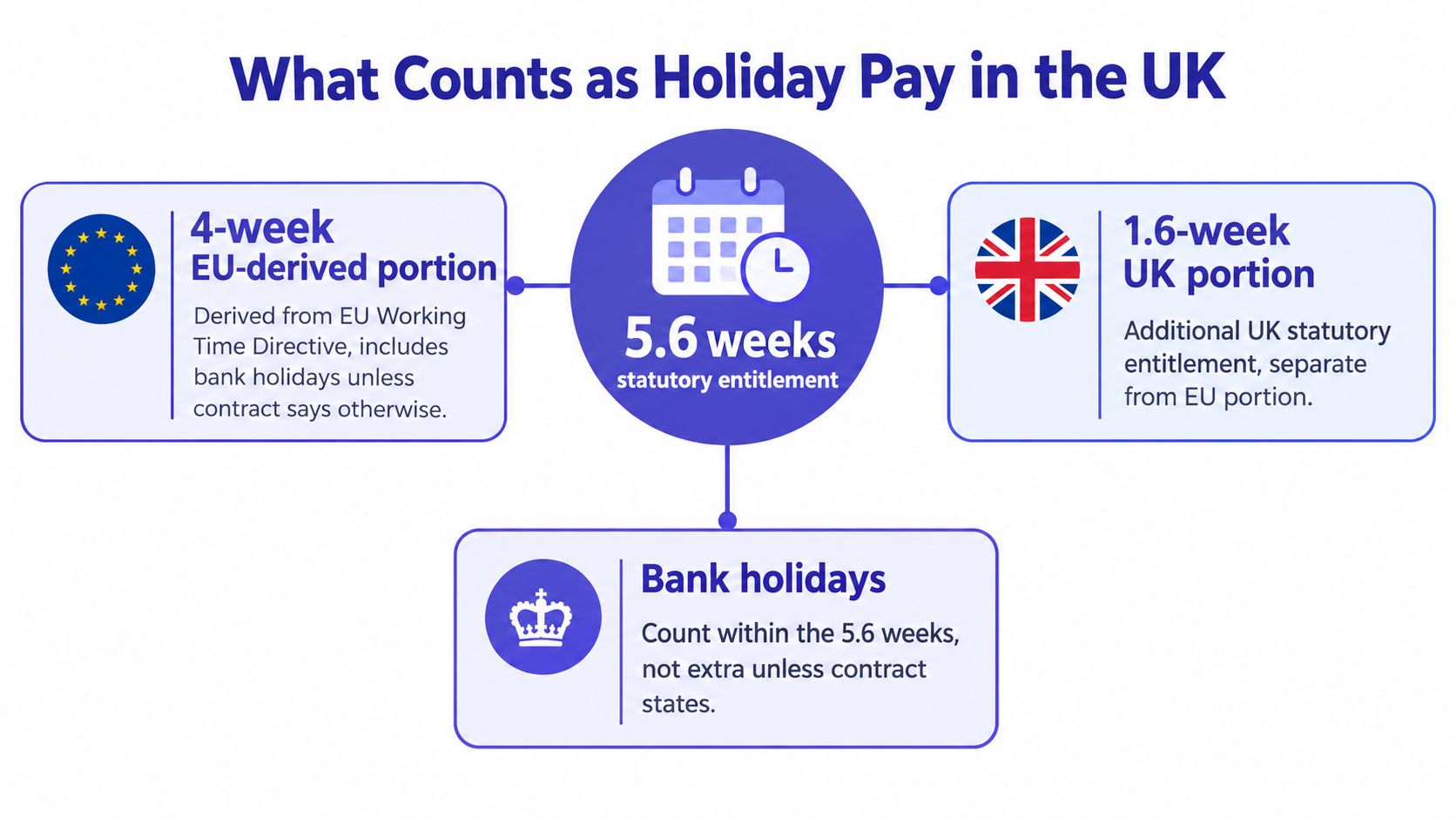
In the UK, almost all workers are legally entitled to 5.6 weeks of paid annual leave each leave year, including agency workers, irregular-hours workers and zero-hours workers, according to GOV.UK guidance on calculating holiday pay for workers without fixed hours or pay. For someone working five days a week, that normally equals 28 days, and bank holidays can sit inside that total rather than on top of it, as explained in the same guidance.
The Two Parts of the Statutory Floor
The entitlement has two components under the Working Time Regulations 1998. There's a four-week portion derived from the EU Working Time Directive and an additional UK-created portion that makes up the rest of the statutory total. That split matters for payroll because the portions can be paid at different rates, which is covered later in this article.
Contracts can offer more than the statutory minimum, and many do. They cannot normally offer less. Before you submit anything, read your contract and staff handbook together, identify your leave year, and separate statutory leave from any contractual extra.
Practical rule: Check the contract for extra leave, but never let a contract talk you below the statutory floor.
If your paperwork lives in scanned PDFs and email attachments, pull the key fields out first. Using structured HR document extraction from Matil can help you turn contract clauses on leave year, notice and entitlement into searchable data instead of hunting through files each time. For the wider legal picture, work through the UK holiday pay rules explained for employers and workers before you rely on a manager's memory.
Who Is Inside the Rules
- Employees: Covered from the first day of employment, with no qualifying period to serve first.
- Agency, irregular-hours and zero-hours workers: Covered as workers, even though their calculation method differs.
- Self-employed contractors: Outside the statutory scheme, so their time off is a commercial negotiation, not a holiday pay claim.
That last distinction causes real damage in small businesses. If you label someone self-employed but control their hours like staff, you're building a backdated liability. Get status right before you argue about dates.
Submitting a Request That Gets Approved First Time
Start with the visual summary below, then do the checks in order before you send anything.
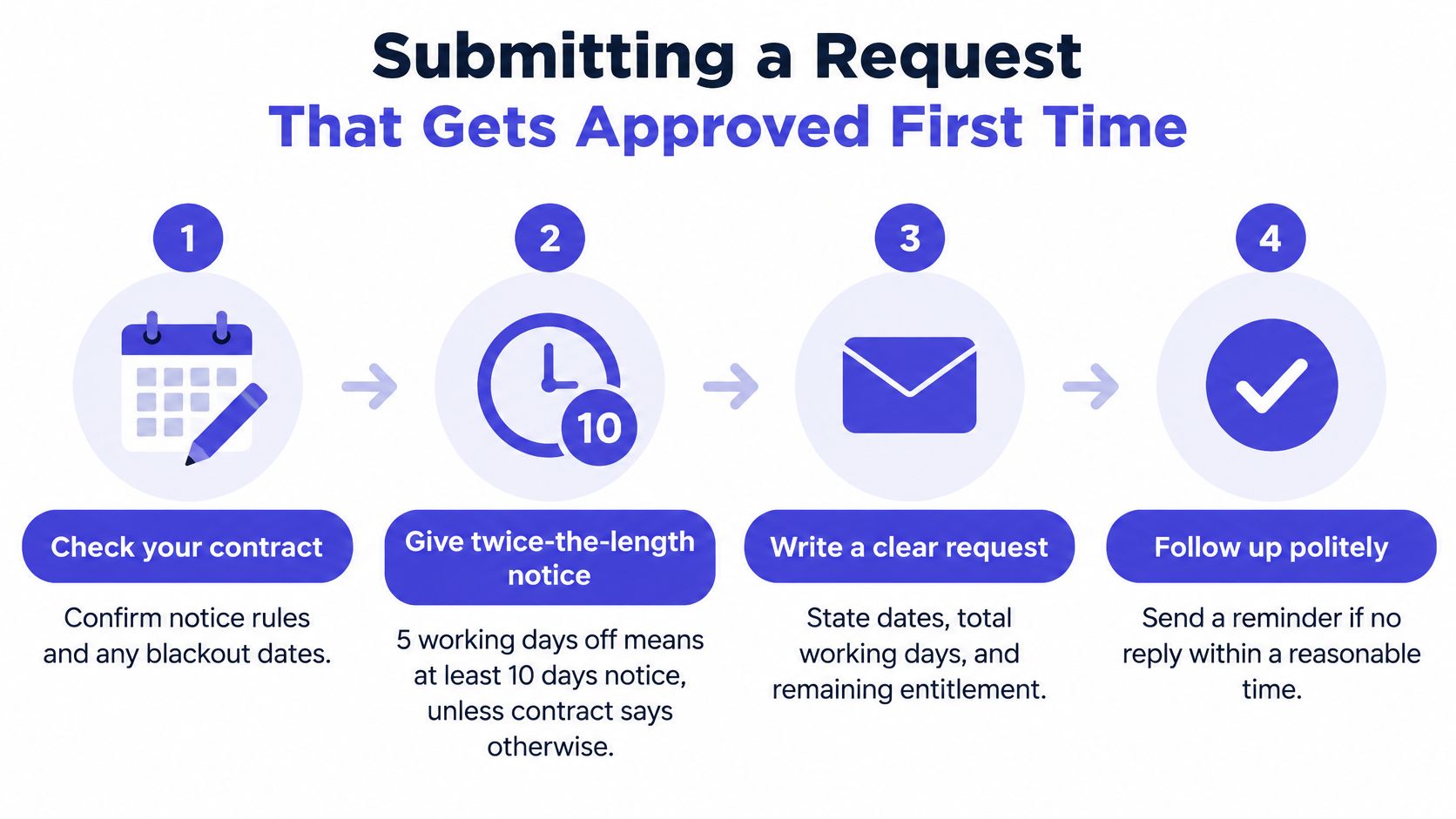
Unless a relevant agreement sets different rules, UK law requires a worker to give at least twice as much notice as the holiday requested, so five working days off normally means at least ten days' notice, as set out in Acas guidance on asking for and taking holiday. Your contract may demand more. The contract wins if it sets a longer procedure, so check it before you rely on the statutory minimum.
Check Before You Send
Confirm your leave year, your remaining balance, and whether your dates hit a blackout period or a minimum-staffing rule. Speak to your proposed cover person first, not after approval. A request that arrives with cover already agreed is easier to say yes to.
Count scheduled working days, not calendar days. A part-timer asking for Monday to Friday away may only be using three working days of entitlement. Counting calendar days overstates the request, understates the balance, and starts an avoidable argument with payroll.
What a Clean Submission Contains
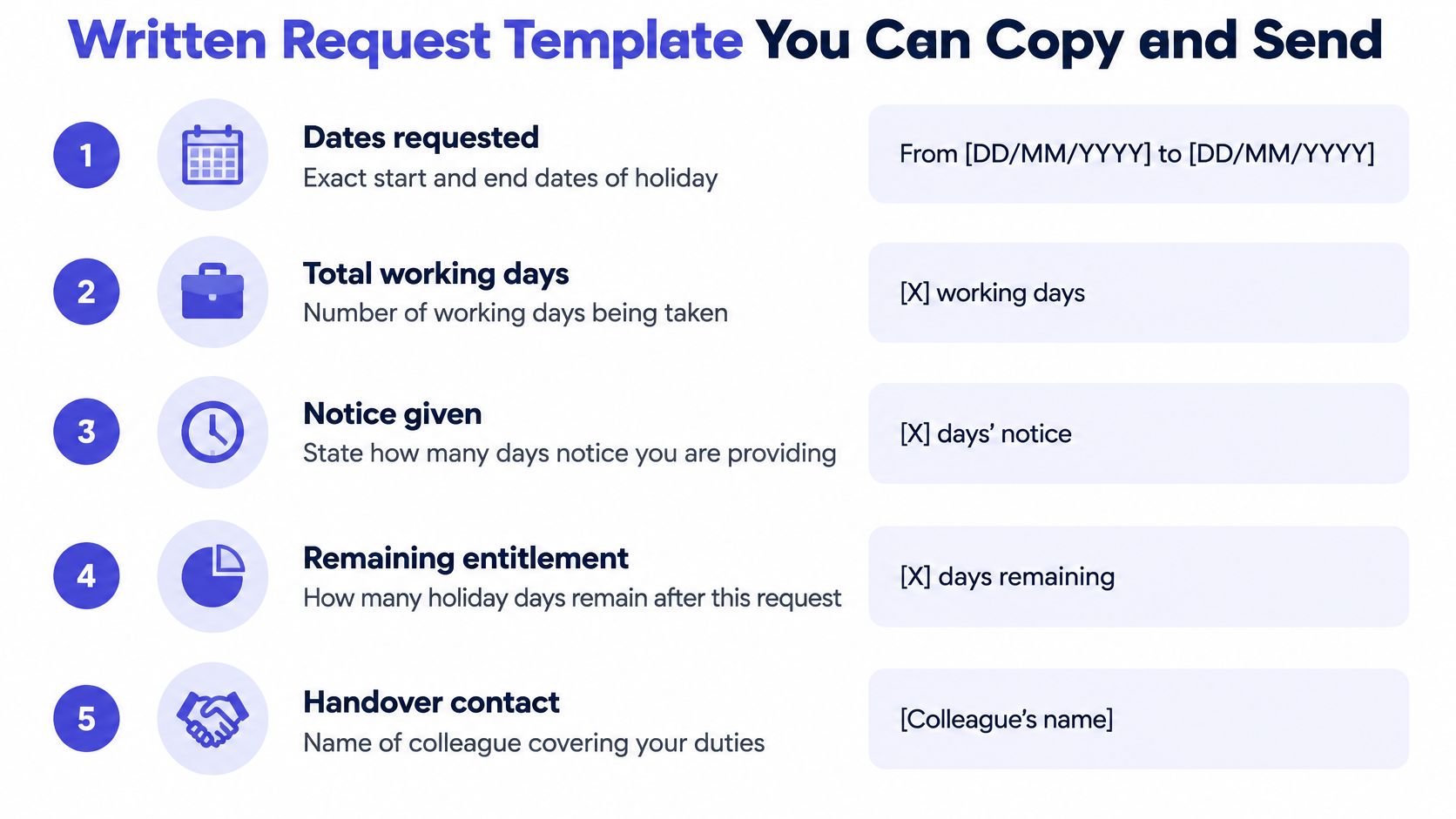
- Dates and amount: Start date, end date, and the number of working days or hours you are taking.
- Notice given: The submission date, so anyone can test it against the notice rule later.
- Remaining balance: What you believe you will have left after this leave, flagged for HR to confirm.
- Handover plan: Who covers what, where key information sits, and how urgent issues reach a decision-maker.
Submit through a timestamped HR portal where one exists. Email is acceptable if that's your approved route, and the examples in this annual leave request email guide show the level of detail managers expect. A corridor chat is not a submission. If it's disputed later, you'll have nothing to point to.
This short video walks through the submission mechanics before you draft your own version.
A vague message saying "off next week, ok?" forces your manager to do your admin. Do the admin yourself and approvals get faster.
One trap deserves emphasis. If you're off sick, you must request holiday if you want to take it, and an employer cannot force holiday during sickness absence, following the Acas guidance cited above. Don't let anyone burn your entitlement while you're unwell.
Written Request Template You Can Copy and Send
Keep the template short. Long, legalistic requests sit in inboxes because managers sense a dispute coming and defer them. A tight, complete note gets a decision.
Worker Request Template
Subject: Holiday request, [your name], [start date] to [end date]
Hi [manager name], I'd like to request paid annual leave from [start date] to [end date], totalling [number] working days. I'm submitting this on [today's date], giving notice under our policy. Based on my current balance, this would leave [number] days remaining this leave year, please confirm if your records differ. [Colleague name] has agreed to cover [key duties], and my handover notes will be in [location] before I leave. Please confirm approval in writing so payroll can record it. Thanks, [your name].
Swap in your own workplace language where it matters. Add your internal form number, cost centre or leave year reference if your policy uses them. Name your actual line manager, not a generic HR inbox, unless your procedure says otherwise.
Employer Reply Template
Hi [name], your leave from [start date] to [end date] is approved, totalling [number] working days. Your remaining balance after this leave is [number] days. This decision has been recorded against your leave record for payroll. [Manager name], [date].
For a refusal, the structure changes but the discipline doesn't.
Hi [name], I can't approve [start date] to [end date] because [operational reason in one sentence]. Your entitlement is unaffected. The following alternative dates would work operationally, [dates]. Please resubmit for one of those and I'll confirm promptly. This decision and reason have been recorded. [Manager name], [date].
Email Versus HR Portal
Both routes work because both create a timestamp. A portal is better because it holds the request, decision and balance in one record. Email is fine if you keep the thread intact and file it where payroll can find it. What doesn't work is a request split across a chat message, a verbal yes and a spreadsheet someone updates from memory. Pick one channel per business and enforce it.
How Managers Should Handle the Approval Decision
Managers, this is your workflow, and it's separate from the worker's. Your job isn't to be generous or strict. It's to produce a defensible decision that payroll can act on and an auditor can reconstruct.
The notice rules cut both ways. Under the Working Time Regulations 1998 amendments on legislation.gov.uk, an employer can refuse or cancel leave by giving notice at least equal to the amount of leave affected, and can require leave at particular times by giving notice at least twice the length of that leave, unless contract terms say otherwise.

Run These Checks Before You Decide
- Remaining entitlement: Does the worker have the balance, split between statutory and contractual leave?
- Minimum staffing: Do the dates breach cover rules, peak-season freezes or critical project milestones?
- Contractual notice: Has the worker met your policy's notice window, which may exceed the statutory rule?
- Handover credibility: Is the cover person named, briefed and available on those dates?
Then issue an explicit written decision. A verbal nod in a corridor is not an approval, because payroll cannot process it and the worker cannot rely on it. Don't change the rota or notify payroll until that decision exists.
When Refusal Is Lawful and How to Handle It
You can reject particular dates for legitimate operational reasons if you follow the statutory and contractual rules. Refusal does not delete the entitlement. Propose alternative dates in the same message, or you'll create a year-end pile-up where everyone demands leave at once and someone eventually loses leave they were entitled to take.
Cancellation is the ugliest scenario. Pulling approved leave back damages trust and can leave the worker out of pocket on bookings, so treat it as a last resort, give the required notice, explain the operational cause plainly, and agree replacement dates immediately. Document what compensation or reimbursement discussion you had, even if the outcome is that none applies under the contract.
Audit trail minimum: Dates requested, date submitted, decision, who decided, and the reason in one sentence. Missing any one of those weakens your position in a dispute.
Spreadsheets fail here because they record balances, not decisions. You need both. A leave system such as LeaveWizard records the request, the approver and the status change in one workflow, which is the factual record you'll wish you had when memories diverge.
Payroll-Side Calculations Without Costly Errors
Approval says the worker can go. Payroll decides what they're paid, and small businesses lose money in silence. Validate the calculation before payroll closes, not after a payslip complaint.
For statutory leave, workers are generally entitled to a week's pay for each week taken, and for regular-hours workers at least four weeks must be paid at the normal rate while the remaining 1.6 weeks are paid at the basic rate, according to GOV.UK holiday pay guidance. Normal pay can include relevant remuneration beyond basic salary. Paying basic salary only, across the whole entitlement, is the single most common regular-hours error I see.
The Irregular-Hours Calculation Routine
For irregular-hours and part-year workers, calculate average pay using the previous 52 weeks in which the worker earned pay, per the GOV.UK guidance cited above. Export qualifying pay and hours, exclude non-qualifying periods, and extend the look-back until you have the full set of paid weeks. Divide qualifying pay by qualifying weeks, multiply by the leave duration, reconcile to the payroll run, and retain the inputs.
Never shortcut this with a single recent payslip. One busy month overpays, one quiet month underpays, and neither survives scrutiny.
For leave years beginning on or after 1 April 2024, statutory accrual for irregular-hours and part-year workers is calculated at 12.07% of hours worked in each pay period, and employers may use rolled-up holiday pay at 12.07% of remuneration paid with regular wages, as set out in GOV.UK guidance on the holiday entitlement reforms from 1 January 2024. That method is permitted for that population. Applying it as a blanket shortcut to regular full-time staff is misuse, and it's the error most likely to surface in an audit.
Holiday Pay Calculation Methods at a Glance
| Worker type | Pay method | Look-back | Common error |
|---|---|---|---|
| Regular-hours | Normal rate, then basic rate for the remainder | Not applicable | Paying basic salary only |
| Irregular-hours | Average weekly pay | Previous paid weeks, extended if needed | Using a short recent average |
| Part-year | Average weekly pay or permitted accrual method | Previous paid weeks, extended if needed | Estimating from a fixed schedule |
| Any worker | Contractual extra above statutory floor | Per contract | Mixing statutory and contractual balances |
If your HR team answers the same holiday pay questions every payroll cycle, it's worth reviewing approaches to modernize HR with AI from Yellow.ai for handling routine employee queries consistently. Automation helps with answers, but it doesn't fix wrong inputs. Reconcile every calculation to source pay data before the run goes live.
Records, Carry-Over and Final Compliance Checklist
Good records turn a tribunal question into a five-minute file retrieval. GOV.UK states that detailed annual-leave and holiday-pay records must be kept for at least six years from 6 April 2026, as noted in the holiday pay guidance cited earlier. Keep entitlement, requests, approvals, leave taken and pay calculations together, because each document proves a different obligation.
Carry-Over Where Leave Was Not Taken
If sickness prevented leave, a regular-hours worker employed throughout the year may carry over up to 20 of the 28 statutory days, while an irregular-hours or part-year worker may carry over up to 28 days, according to GOV.UK guidance on calculating leave entitlement. A worker may carry over the whole entitlement where the employer failed to give a reasonable opportunity to take leave, failed to warn that untaken leave would be lost, or failed to provide rolled-up holiday pay where it was due, as the same guidance explains.
Read the detailed rules on carry-over of annual leave before your leave year ends, not after. Then document your warnings. An employer that never told staff leave would lapse has a weak argument that it has.
Pre-Payroll Compliance Checklist
- Written evidence: Every request and decision is timestamped and filed against the worker's record.
- Correct method per worker: Regular, irregular-hours and part-year staff are each calculated their own way.
- Retained inputs: Pay and hours data behind each calculation are saved, not just the final figure.
- Misuse scan: No standard full-time contract is sitting on the irregular-hours accrual method by accident.
- Carry-over review: Sickness-related and employer-failure cases are identified before balances are wiped.
Automated leave systems can hold this audit trail in one place, but only if your team uses them consistently. A system bypassed for "quick" verbal approvals is just an expensive spreadsheet.
Stop losing approvals in inboxes and balances in spreadsheets. LeaveWizard gives your team self-service holiday requests, visible remaining balances and a recorded approval workflow that payroll can rely on. Visit LeaveWizard today and put your next holiday request through a process that holds up.


