A valued team member calls in sick again, this time on a Monday. You rearrange the rota, cover the customer queue yourself, and wonder whether raising the pattern would be unfair. They may be unwell, yet the repeated disruption is starting to affect everyone else.
That's the difficulty behind the question how many sick days is too many. There isn't a universal number that automatically proves an employee's absence is unacceptable. Health, disability, caring responsibilities, workplace conditions, job demands, and the reliability of your records all matter.
A fair decision starts with context. National benchmarks can show whether absence is broadly typical or high, while the pattern tells you whether your team needs support, better planning, or a formal attendance conversation. By the end of this guide, you'll be able to compare absence with UK reference points, understand the relevant fit-note and Statutory Sick Pay rules, recognise warning signs, and respond without jumping straight to discipline.
Table of Contents
- Introduction Why This Question Feels So Tricky
- What Counts as Sick Leave and How It Is Measured
- UK Benchmarks for Typical and High Absence
- Legal Thresholds and Regional Differences That Shape Too Many
- Signs Your Team Absence Pattern Needs Attention
- How Managers Can Assess and Respond Fairly
- How Leave Management Tools Help You Stay Ahead
Introduction Why This Question Feels So Tricky
A small team feels every absence. If one person is away, colleagues may take over their calls, postpone work, or change shifts. When the same employee takes several isolated days off, the manager can feel trapped between two concerns: protecting the employee's wellbeing and protecting the team from constant disruption.
Suppose an employee has taken several single days of sickness across a few months. The total might not look dramatic beside a long-term illness, but the timing creates repeated work. Each event may require a new call, a rota change, a handover, and a conversation about returning. That makes frequency important, even when the total number of days sits near a wider benchmark.
The opposite can also happen. One continuous absence may involve more days overall but be easier to plan around. You might arrange temporary cover, redistribute work once, and maintain a stable routine. That doesn't make a long absence insignificant, but it shows why a simple annual count can miss the operational reality.
Practical rule: Treat the number of days as a prompt for questions, not as an automatic verdict.
UK data provides useful context, but it doesn't replace judgement. The Office for National Statistics recorded 4.4 working days lost per worker on average in 2024, while the CIPD reported a higher workplace survey average of 9.4 days in 2024. Those figures come from different measures and populations, so they shouldn't be treated as a single pass or fail line.
A sound approach asks four things:
- How often does absence happen? Look for repeated short spells and clustering.
- What effect does it have? Consider cover, handovers, customer service, and workload.
- Is there an underlying issue? Health, fatigue, workload, management, or working conditions may be relevant.
- Has the process been fair? Check records, apply the same policy consistently, and make reasonable support part of the discussion.
The right answer is rarely “any absence above this number is too much”. It's more useful to ask whether the pattern is becoming unmanageable, unexplained, or unsupported, then act proportionately.
What Counts as Sick Leave and How It Is Measured
A team member calls in unwell, another books annual leave, and a third takes time away for a medical appointment. All three create time away from work, but they are not the same type of leave. Sick leave means absence because an employee is ill or injured, recorded according to your policy and the relevant UK rules. Annual leave, parental leave, compassionate leave, appointments, and personal leave need their own categories and processes.
Accurate records are the foundation for fair decisions. For each sickness absence, record the absence event, its dates, whether it was sickness-related, and any documentation your policy requires. Keeping these categories separate prevents a holiday or personal day from being treated like sickness absence. It also makes recurring patterns easier to identify.
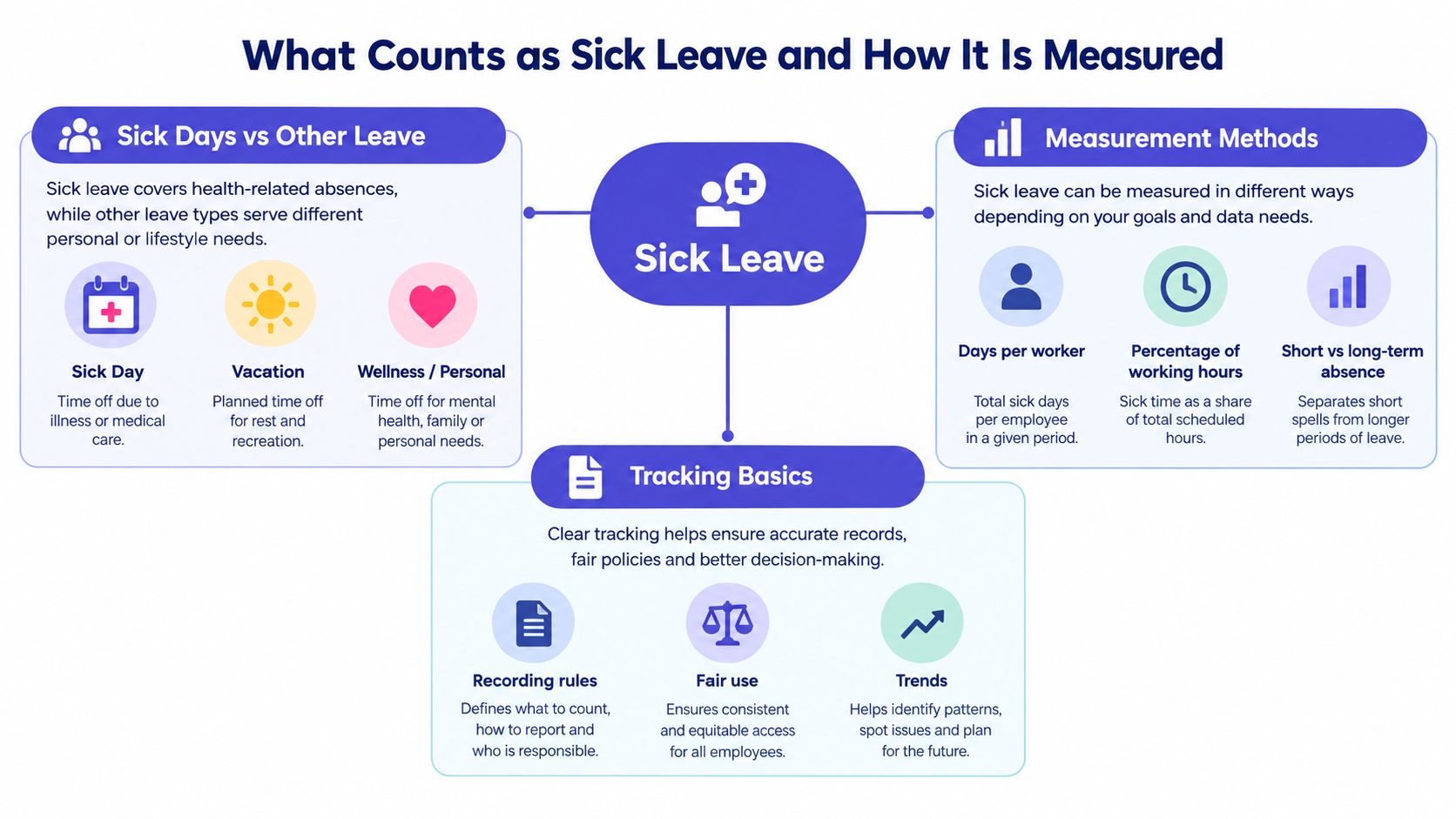
Three useful ways to measure absence
Days lost per worker provides a simple average. The ONS reported 4.4 days lost per worker in 2024 (Office for National Statistics sickness absence release). This gives a workforce or team a broad UK reference point, but averages can conceal very different experiences. One employee may have no absence while another has several short spells.
Percentage of working hours lost measures the share of available work time affected. The ONS estimated that sickness or injury represented 2.0% of working hours in 2024 (ONS labour-market analysis). It can help compare teams with different schedules, provided you consider role, hours, and local working conditions.
Short-term and long-term absence describes the shape of the record. The UK Civil Service classifies short-term sickness as 20 working days or fewer and long-term sickness as 21 working days or more. Government guidance may treat an absence lasting more than 4 weeks as long-term sick (GOV.UK guidance on taking sick leave). These are different reporting and management categories, so apply your own policy consistently and seek specialist advice where needed.
Frequency matters as much as the total. Repeated short absences can disrupt cover and handovers more than one continuous absence with a clear plan. Use the figures as signals for a supportive conversation, not as an automatic judgement. For help separating sickness from annual leave, browse the Benely employer leave guide.
UK Benchmarks for Typical and High Absence
A team can have the same annual total as another team and still face a very different workload. One employee may take a single continuous period of leave. Another may be absent for several isolated days during busy weeks. The pattern often matters more than the total.
The ONS provides a national reference point. In 2024, UK workers lost 148.9 million working days to sickness or injury, equal to 2.0% of working hours and 4.4 days per worker on average (ONS 2024 sickness absence data). The total was 14.9 million days lower than in 2023, but remained 9.9 million days above the 2019 pre-coronavirus level. National figures show the wider situation, not a required attendance target for each employee.
A quick comparison
| Benchmark Source | Average Days Lost | What It Signals |
|---|---|---|
| UK workers, ONS 2024 | 4.4 days | A broad national baseline |
| UK workplace survey, CIPD 2024 | 9.4 days (CIPD workplace absence survey) | A higher workplace benchmark |
| UK Civil Service, year ending 31 March 2024 | 7.8 days (Civil Service report) | A public-sector comparison |
The CIPD figure rose from 7.8 days in 2023 and 5.8 days in 2022, reaching the highest level recorded in that survey since tracking began in 2010. This helps put 8 to 10 days per employee a year into context. That total is not automatically unusual, although separate short spells may still create cover and scheduling problems.
For a wider explanation of UK comparisons, read this average sick days per year UK guide alongside your own records. Compare employees with similar roles, hours, and working conditions rather than applying one national figure to everyone.
Employee A has one illness that can be planned around. Employee B has several one-day absences spread across critical periods. Even with similar totals, Employee B may require more rota changes, urgent handovers, and supervisor time.
Use the benchmark as a prompt to examine frequency, timing, and support needs, not as a disciplinary threshold.
Legal Thresholds and Regional Differences That Shape Too Many
Legal thresholds answer a compliance question, while management thresholds answer an attendance question. They indicate when evidence may be required, when Statutory Sick Pay may apply, and how an absence is classified. They do not, by themselves, show that attendance is unacceptable.
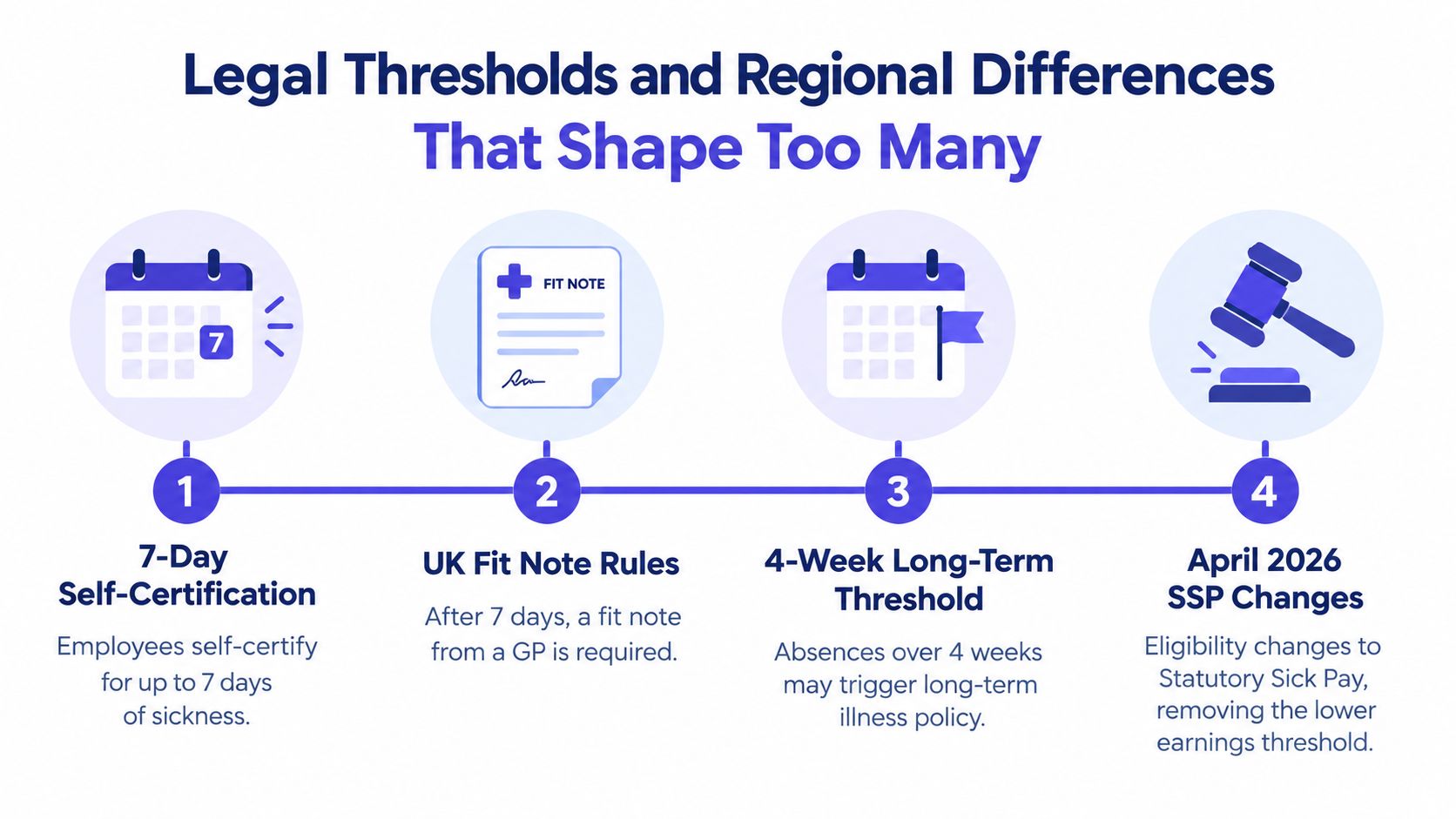
For sickness lasting 7 days or less, an employee does not need a fit note or other medical proof. They can self-certify, and the 7-day period includes weekends and bank holidays. If the illness continues beyond 7 consecutive days, a fit note is required under GOV.UK sick leave guidance.
A separate reference point applies to long-term absence. Government guidance may treat an employee away for more than 4 weeks as long-term sick. Your policy should explain how you maintain contact, review support, consider adjustments, and plan a possible return. The threshold is a prompt for support and review, not proof that an absence is excessive.
The SSP change from April 2026
From 6 April 2026, SSP is payable from the first full day of sickness absence. The lower earnings limit was removed, and the previous waiting-period requirement ended, according to ACAS Statutory Sick Pay guidance. SSP is capped at the lower of £123.25 per week or 80% of average weekly earnings, and it can be paid for up to 28 weeks, as explained in the GOV.UK Employer Bulletin.
For a small employer, this changes the practical effect of repeated short absences. Payroll and compliance work may begin immediately, so record the start date, qualifying days, and duration accurately. The operational impact depends on the pattern and frequency, not the yearly total. A Statutory Sick Pay explainer can provide further employer context.
Regional and sector differences also affect comparisons. Absence is not uniform across the UK or across demographic groups, so a national figure should not become an automatic local target. In 2025, public-sector sickness absence was reported at 2.9%, compared with 1.7% in the private sector, according to GOV.UK sickness absence guidance. Use those figures as context, then examine your own team's frequency, timing, and support needs.
Signs Your Team Absence Pattern Needs Attention
A concerning pattern usually reveals itself through repetition and impact. A single illness doesn't tell you much about future attendance, while several short spells can create a recurring operational problem even when the total remains near a benchmark.
Start with the calendar, but don't stop there. Look for events occurring close together, repeated one- or two-day absences, and a consistent Monday or Friday pattern. A pattern isn't proof of misconduct. It's a reason to check the facts and hold a supportive conversation.
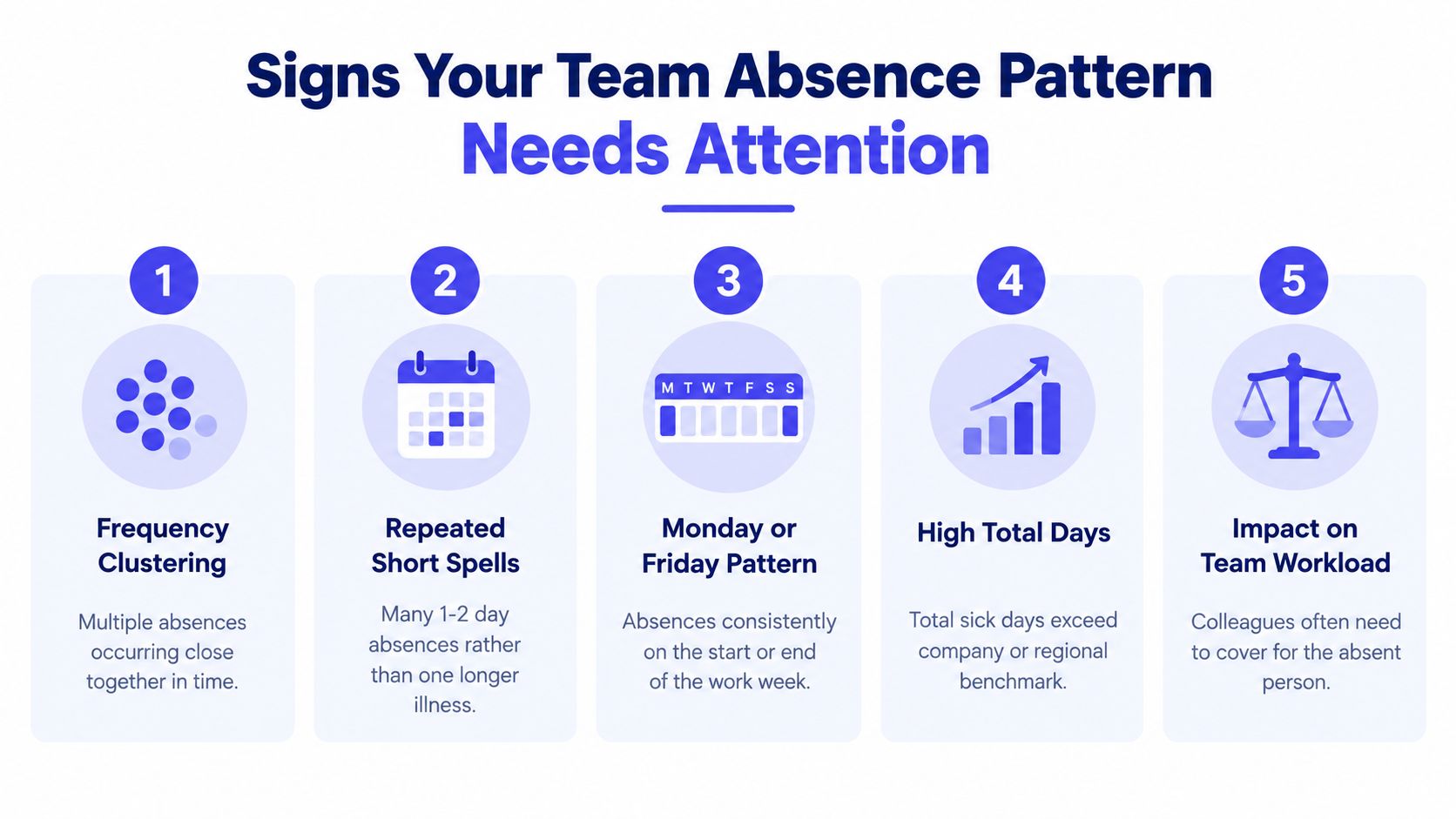
Five signals worth reviewing
- Frequency clustering: Several absences close together may indicate an unresolved health issue, a difficult workload period, or a problem with scheduling.
- Repeated short spells: A series of brief events repeatedly triggers cover and handover work. Review whether the employee receives an effective return-to-work check after each event.
- Monday or Friday pattern: A recurring start- or end-of-week pattern deserves neutral questions, not accusations. Check whether shifts, travel, caring responsibilities, or fatigue create a predictable difficulty.
- High total days: A total well above your chosen benchmark may justify a formal review, particularly when the pattern persists and affects service delivery.
- Team workload impact: If colleagues regularly absorb the person's tasks, the business may need both an attendance response and a workload plan.
Small teams make the impact easy to see. A shop may need to find cover at short notice. A consultancy may delay a client deliverable because one specialist is unavailable. A care or hospitality rota may require a colleague to change shifts repeatedly. These examples don't establish blame, but they show why operational effect belongs in the assessment.
Health concerns can be less visible than rota disruption. Fatigue, hormonal changes, mental health difficulties, or a developing condition may affect attendance. Employees looking for practical information about fighting tiredness with Lila may also need an employer who listens rather than assumes.
Use frequency and impact together, rather than relying on a fixed trigger. A Bradford Factor trigger-points guide can help you understand why repeated spells receive attention, but any scoring method should support a fair review, not replace human judgement or consideration of disability-related absence.
How Managers Can Assess and Respond Fairly
A good response begins with records, not suspicion. Check the dates, absence categories, self-certification, fit notes, previous conversations, and the effect on work. Correct errors before discussing attendance with the employee, especially where a spreadsheet may have merged sickness with holiday or another approved absence.
Start with a private conversation
Arrange a confidential return-to-work discussion or attendance review. Use open questions such as:
- What has been affecting your ability to attend?
- Is there any workplace factor making the situation harder?
- Do you need temporary support or an adjustment?
- Is there anything we should consider when planning your work or shifts?
Keep the focus on fitness for work, support, and attendance expectations. Don't ask for unnecessary medical details. If the employee mentions a possible disability or ongoing condition, seek appropriate HR or occupational-health advice before making decisions.

Agree what happens next
A proportionate plan might include a review date, clearer absence notification steps, a temporary change to duties, or an agreed method for checking in. Set expectations in writing, but keep the language factual and respectful. Document what was discussed, what support was offered, and what the employee agreed to do.
If the pattern continues, follow your written policy consistently. Explain the next stage, give the employee a chance to respond, and consider whether any absences need to be treated differently for legal or equality reasons. A disciplinary route shouldn't be the first response to unexplained concern.
For wider guidance on handling challenging workplace situations, this framework for difficult employees may help managers prepare for a calm, structured conversation. The essential test is consistency: would you apply the same process to another employee in a comparable situation?
Support before escalation: A fair attendance process asks what would help the employee attend reliably before it asks what sanction might follow.
How Leave Management Tools Help You Stay Ahead
Manual records make patterns difficult to spot. A spreadsheet may show a total at the end of the year, but it can miss how often absences occur, whether a fit note is due, or how availability affects a particular rota. Small businesses need a record that turns individual events into a usable operational picture.
A dedicated absence system can help by:
- Recording sickness events consistently: Employees and managers can enter absence dates using the same process, reducing gaps between a phone call and the formal record.
- Tracking documentation: A system can help teams record whether a self-certification or fit note is needed, while managers still handle sensitive information carefully.
- Showing availability in real time: Calendars and dashboards make it easier to plan cover before a short absence becomes a wider service problem.
- Flagging patterns for review: Frequency, repeated short spells, and clustering can prompt a conversation earlier, without declaring that an employee has done anything wrong.
- Supporting reports: Managers can compare teams, locations, and periods using consistent records, while taking regional and sector differences into account.
LeaveWizard is one option for small businesses moving beyond spreadsheet tracking. Its absence-management tools let employees and managers record sickness events and upload sick notes through a browser or smartphone app, while leave calculations, approvals, calendars, and reports support more consistent administration. That can be particularly useful as SSP rules change and short absences require accurate payroll handling.
Technology doesn't decide whether absence is acceptable. It gives managers a clearer starting point, helps employees follow the same process, and creates an audit trail for return-to-work conversations. The human work remains essential: listen carefully, check for support needs, apply policy consistently, and plan cover realistically.
The practical answer to how many sick days is too many is therefore a pattern-based one. Use the benchmark as a signpost, examine frequency and impact, and intervene early with empathy and clear expectations.