
Almost all UK workers are legally entitled to 5.6 weeks of paid annual leave each leave year. For someone who works five days a week, that is 28 days, because days worked per week multiplied by 5.6 gives the annual figure.
That tidy sum is only the starting point. Entitlement (how much leave builds) and holiday pay (what that leave is worth) are two different calculations, and a spreadsheet that stores one number for the year will mix them up. The gap shows up fastest with irregular hours, sickness weeks and people who join mid-year.
Table of Contents
- Holiday Days and Hours by Working Pattern
- Accrual Rules for Irregular-Hours and Part-Year Workers
- How to Calculate Holiday Pay Step by Step
- Worked Examples for Part-Time and Irregular Staff
- Holiday Rules Outside the UK
- Common Mistakes and a Pre-Payday Audit
Holiday Days and Hours by Working Pattern
GOV.UK guidance says almost all workers are legally entitled to 5.6 weeks of paid annual leave each leave year. That covers agency workers, zero-hours workers, workers with irregular hours and part-year workers. In 2024 the UK government stated that most workers on a five-day week must receive at least 28 days of paid annual leave, equivalent to 5.6 weeks, as set out on holiday entitlement rights.
The law does not create a separate right to paid bank holidays. An employer offering 20 days plus the eight usual bank holidays meets the 28-day minimum, provided the worker can take the leave. Part-time staff get a share of the same 5.6 weeks. A three-day worker receives 16.8 days, commonly rounded under a lawful written policy. How those bank holidays fall on a part-time pattern is covered in bank holiday entitlements for part-time staff.
The table below uses a 7.5-hour day. Annual days equal days worked per week multiplied by 5.6. Annual hours equal contracted hours per week multiplied by 5.6.
| Days worked per week | Statutory entitlement (days) | Contracted hours per week | Annual entitlement (hours) |
|---|---|---|---|
| 1 | 5.6 | 7.5 | 42 |
| 2 | 11.2 | 15 | 84 |
| 3 | 16.8 | 22.5 | 126 |
| 4 | 22.4 | 30 | 168 |
| 5 | 28 | 37.5 | 210 |
| 6 | 33.6 | 45 | 252 |
The same hours sum works for other contracts. 15 hours gives 84 hours a year, 20 gives 112, 25 gives 140, 30 gives 168 and 40 gives 224. This table is the statutory floor. A contract can give more.
A method you can repeat
- Confirm the leave-year start date in the contract.
- Record contracted days or hours per week.
- Multiply by 5.6 for the annual entitlement.
- Convert hours to days using normal daily hours.
- Round according to the written policy.
- For starters and leavers, multiply the annual figure by completed months left and divide by 12.
A worker who moves from 37.5 to 30 hours mid-year needs a fresh calculation from the change date, not one figure for the whole year.
Practical rule: Multiply the regular days per week by 5.6 and compare the result with the contract. If they differ, review the contract before you run payroll.
Accrual Rules for Irregular-Hours and Part-Year Workers
For eligible irregular-hours and part-year workers, holiday entitlement builds from hours worked. Holiday pay is a separate calculation, based on an average of paid weeks.

For leave years beginning on or after 1 April 2024, these workers generally accrue statutory leave at 12.07% of hours worked in each pay period. The rate comes from 5.6 weeks of leave divided by 46.4 working weeks. For example, 160 hours worked in a month earns 160 × 0.1207, or 19.3 hours of leave before rounding. Apply the applicable rounding rules consistently and record the rounded entitlement in the worker's balance.
Which weeks count
There is no 52-week look-back for calculating this entitlement. Add the hours worked in each pay period, then apply 12.07%. For instance, 80 hours worked in one period earns 80 × 0.1207, or 9.656 hours before rounding. Sick leave and statutory leave do not turn the period into zero entitlement. Workers continue to build leave during these absences, as Acas guidance on other leave and sickness explains.
The 52-week reference period belongs to holiday pay, not entitlement. When averaging pay, exclude weeks in which the worker was on sick leave or statutory leave, and use earlier relevant weeks instead. This distinction matters: a spreadsheet that averages hours over 52 weeks and then applies 12.07% mixes the two calculations and can misstate leave.
A recent drop in hours does not erase leave already accrued. Parental leave, long-term sickness and seasonal gaps can also make a single-month spreadsheet an incomplete record, so track hours and absence dates by pay period.
Workers with enhanced contractual leave may need a different accrual rate. Leave years that began on or before 31 March 2024 follow transition rules rather than the new method.
Keep records of hours, pay periods and absence dates. A current-month total alone cannot show the full entitlement or supply the relevant history for holiday pay.
How to Calculate Holiday Pay Step by Step
The earlier sections say how much leave builds. This section says what that leave is worth. A day count on its own does not set the money.
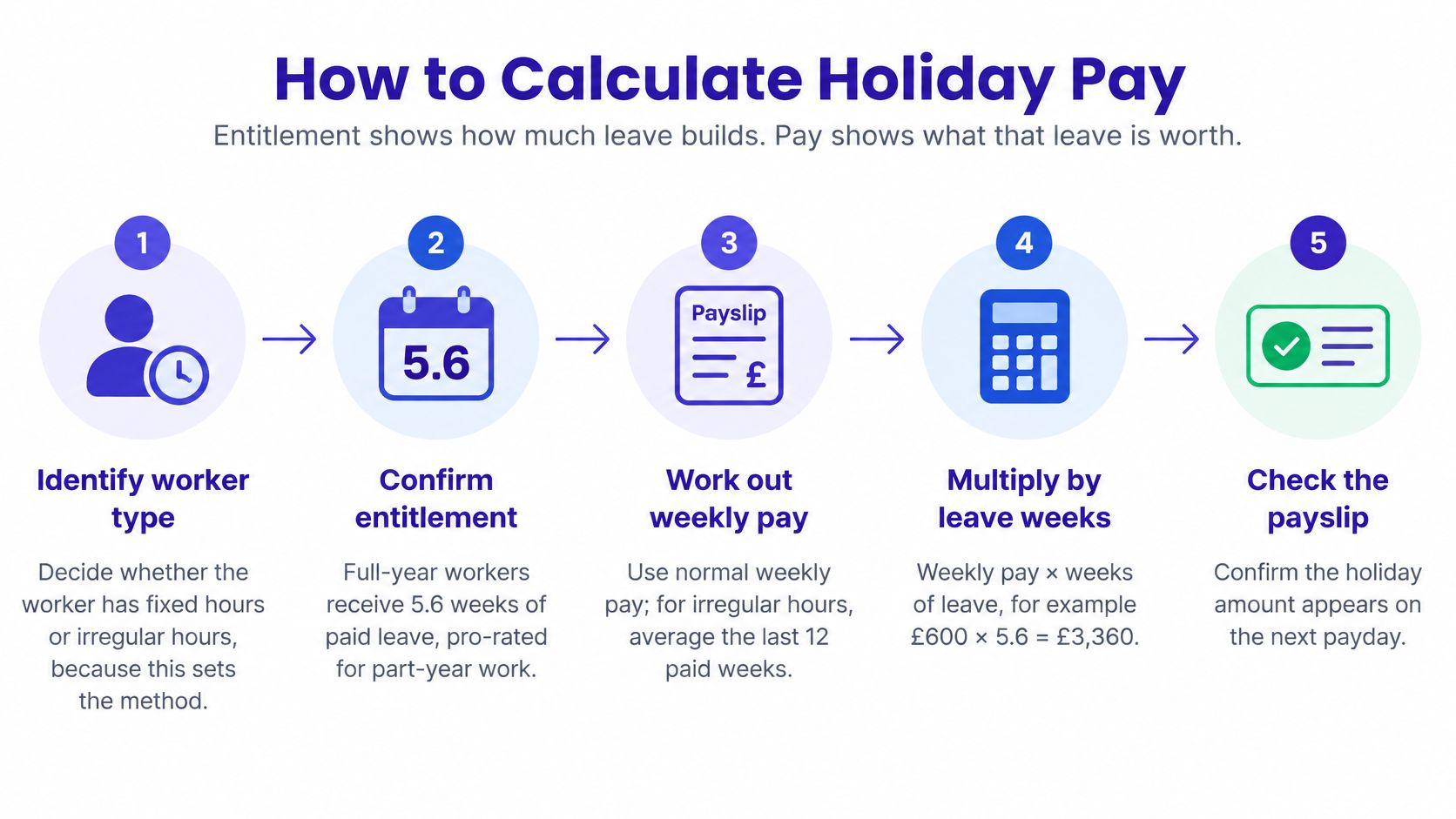
GOV.UK holiday pay guidance says irregular-hours and part-year workers' holiday pay is generally based on average pay over the previous 52 weeks, counting only weeks in which they were paid. Weeks with no pay are left out. For these workers, all leave must be paid at their normal rate of pay.
- Identify the pay pattern. Fixed pay and variable pay use different methods, so decide this before you touch a calculator.
- Fixed pay. Multiply normal weekly pay by the number of weeks of leave being taken.
- Variable pay. Take the previous 52 weeks, drop any week with no pay, add the pay received and divide by the number of paid weeks. You may need to look further back to gather 52 paid weeks.
- Add relevant payments. Acas states that employers must include relevant payments in at least 4 weeks of a worker's paid holiday entitlement. Regular overtime, commission and shift allowances belong in that calculation.
- Apply the average. Multiply the average week by the weeks taken, or the average day by the days taken.
- Pay at the normal rate, then check rolled-up pay. Rolled-up holiday pay is allowed for irregular-hours and part-year workers only in specified circumstances. It is not allowed where the leave year began on or before 31 March 2024. Read what rolled-up holiday pay is before you add a percentage to each payslip.
A calculator that only counts days will get the pay wrong for variable earners even when the entitlement is right.
You need hours worked, pay periods, paid weeks, leave taken and the leave-year start date. Lose any one of those and the average can't be checked.
Worked Examples for Part-Time and Irregular Staff
Priya starts as a receptionist on 1 October in an April to March leave year and works three days a week. Her full-year figure is 16.8 days. Six of the twelve months remain, so 16.8 × 6 ÷ 12 = 8.4 days. Time served sets the allowance, not a guess at how busy October will be.
Tom works variable warehouse shifts. Over 44 paid weeks in the last 52 he earned £18,128, so £18,128 ÷ 44 = £412 a week. One week of his leave is worth £412, regardless of how quiet the latest rota looks. In the same month he worked 160 hours, which accrues 19.3 hours of leave at 12.07%. His hours answer "how much leave", and his paid-week average answers "how much money".
Starters in a 28-day year
Pro-rating by completed months is a common method. Rounding should follow one written policy, and you should check your own leave-year start before you copy these dates.
| Start date | Months left in leave year | Pro-rata days (from 28) |
|---|---|---|
| 1 April | 12 | 28 |
| 1 July | 9 | 21 |
| 1 October | 6 | 14 |
| 1 January | 3 | 7 |
| 1 March | 1 | 2.3 |
Priya's case teaches that pro-rata works on time served. Tom's case teaches that irregular pay works on what was actually earned.
Holiday Rules Outside the UK
The 5.6-week figure and the 12.07% accrual rate are UK rules. A small business with staff in other countries needs the local minimum, not a copied UK formula. Many countries set a floor in weeks or days. The EU Working Time Directive sets a minimum of four weeks' paid annual leave for member states, and Australia's National Employment Standards provide four weeks for full-time employees. A wider picture of how paid leave developed is in paid leave, its origins and how it varies across the globe.
Check three things locally before you use any formula.
- Statutory minimum: days or weeks, not a UK percentage.
- Leave year: when it starts and how a partial year is cut.
- Public holidays: whether they sit inside annual leave or sit on top.
Where local law sets a floor, multiply days worked per week by the local weeks figure, pro-rate starters and leavers by completed months, and round under a written policy. Holiday pay for variable earners may use a different averaging period from the UK 52-week reference. Do not copy a UK percentage or pay method to an overseas employee. Where staff work across borders, keep separate leave rules per country and confirm them with local employment advice or the relevant government labour department before you run payroll.
Common Mistakes and a Pre-Payday Audit
Holiday entitlement and holiday pay are separate calculations. The 12.07% accrual rate is not a universal formula: GOV.UK guidance depends on worker status and other details, including the leave-year start date, pay frequency and contractual entitlement. If a contract offers more leave than the statutory minimum, the calculation must reflect that entitlement. For example, if a worker accrues leave using 12.07% of hours worked, that rate does not tell you how much to pay when they take leave. Holiday pay for variable earners generally uses their average pay over the previous 52 paid weeks. If they have fewer than 52 paid weeks, look back further until you have gathered 52 paid weeks.
Fixes for the usual slips
- Wrong average. Fixed-salary workers do not need the variable-pay average. For variable earners, calculate the average from the relevant paid weeks.
- Sick weeks left in. Sick or statutory-leave weeks can distort the hours reference. Exclude them and look further back to gather the required paid weeks.
- Current month only. A quiet month does not mean a worker earns no leave. Use the relevant earlier weeks rather than treating one month as the whole picture.
- Full 28 days for part-time staff. Calculate entitlement from their working pattern. For example, a worker who works fewer days each week receives a proportionate number of days.
- Bank holidays added on top. If the contract includes bank holidays in annual leave, count them within the entitlement, not twice.
- Uneven rounding. Set one rounding rule and apply it consistently.
- Days mixed with money. Track leave entitlement in days or hours, then calculate holiday pay separately.
Before each payroll
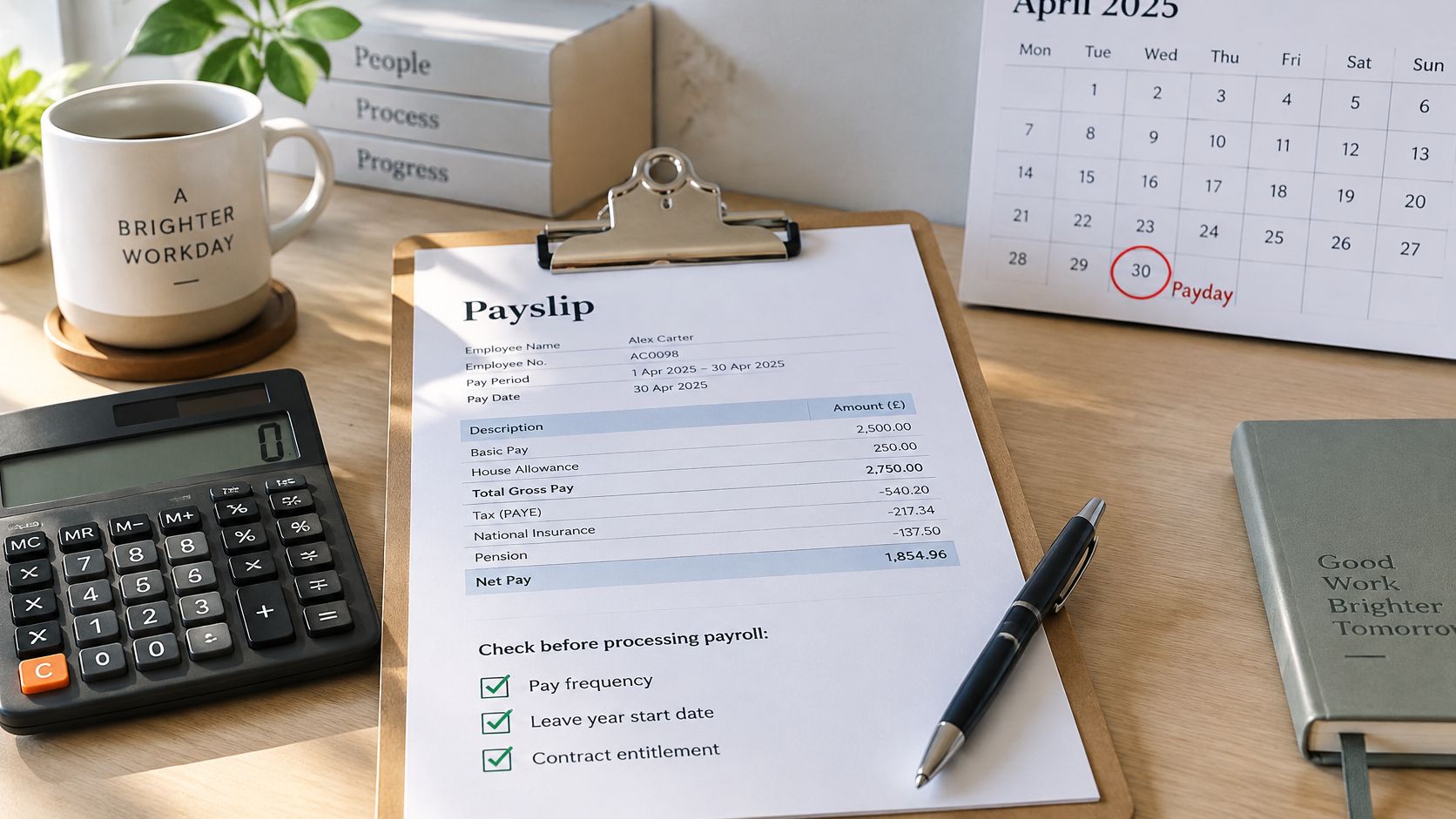
Check each worker's leave-year start date, contracted days or hours, and any change to their working pattern. Confirm starters and leavers are pro-rated by completed months. Then review the hours reference: exclude sick and statutory-leave weeks, count the relevant paid weeks and payments, and apply the same rounding rule to every worker. Finally, compare leave taken with the remaining balance.
Spreadsheets can lose the pay-period history needed to calculate averages, particularly when records cross leave years or staff have irregular hours. A starter's first weeks, a sickness absence and changing hours can each leave gaps in a simple monthly total. Keep the underlying periods and payments, not only a running balance. LeaveWizard can keep that history alongside leave balances, while you check the sums yourself.
Run the checklist on one worker this week, then decide whether the process stays manual.
LeaveWizard provides small businesses with a holiday entitlement calculator and automated leave balances for part-time patterns, irregular hours and carry-over. If you are replacing manual tracking, see how records and approvals fit your leave year at LeaveWizard.


