Holiday paid in lieu means receiving cash instead of taking holiday, but UK statutory holiday cannot generally be converted into cash during employment. When employment ends, any untaken statutory leave must be paid in the final pay packet, including where dismissal is for gross misconduct.
That distinction matters on an ordinary working day. A senior designer might ask to work through August and receive the value of a week's leave, while an office manager may be preparing final pay for someone with ten unused days. Both requests sound straightforward, but treating them alike can create unlawful payments, incorrect payroll and difficult conversations with staff.
Table of Contents
- The Moment a Simple Holiday Request Becomes a Legal Question
- What Holiday Paid in Lieu Actually Means
- When UK Law Allows and Forbids Paying Out Holiday
- How to Calculate Holiday Paid in Lieu Step by Step
- Choosing the Right Outcome for Each Situation
- Recording and Automating Payment in Lieu in Your Leave System
- Common Misconceptions That Cost Small Businesses Money
- Your Action Checklist Before the Next Payout Request
The Moment a Simple Holiday Request Becomes a Legal Question
The owner of a 12-person design studio is halfway through a busy client launch when a Slack message arrives from a senior employee: “Could I take the cash instead of booking a week off in August?” The employee has deadlines, the studio needs their input and the request seems practical.
Across town, an office manager in another small firm has a different problem. A team member is leaving, and the manager wants to know whether ten unused holiday days should appear in the final payslip.
The two situations look similar because both involve unused leave. They aren't legally interchangeable.
The first instinct is often, “Yes, of course. We can agree whatever works.” That answer can unlawfully turn statutory holiday into cash while the person remains employed. The opposite instinct, “No, never,” is also incomplete, because untaken statutory leave generally must be paid when employment ends.
The operational challenge is to identify the event before calculating anything. Is the worker asking to avoid taking leave while remaining employed? Is the business agreeing that leave will move into a later period? Or has the employment ended, making payment in lieu part of final pay?
Practical rule: Decide whether there is a termination before you decide whether there is a payout.
A reliable process also needs to handle everyday requests that aren't payouts at all. A worker might want to swap a bank holiday for another day, carry leave forward or change the date of an approved absence. Those actions affect scheduling and records, but they don't automatically create a right to cash.
The rest of the issue becomes much easier once the business separates taking leave, moving leave and paying out leave. That separation gives managers a procedure they can follow instead of relying on an instinctive yes or no.
What Holiday Paid in Lieu Actually Means
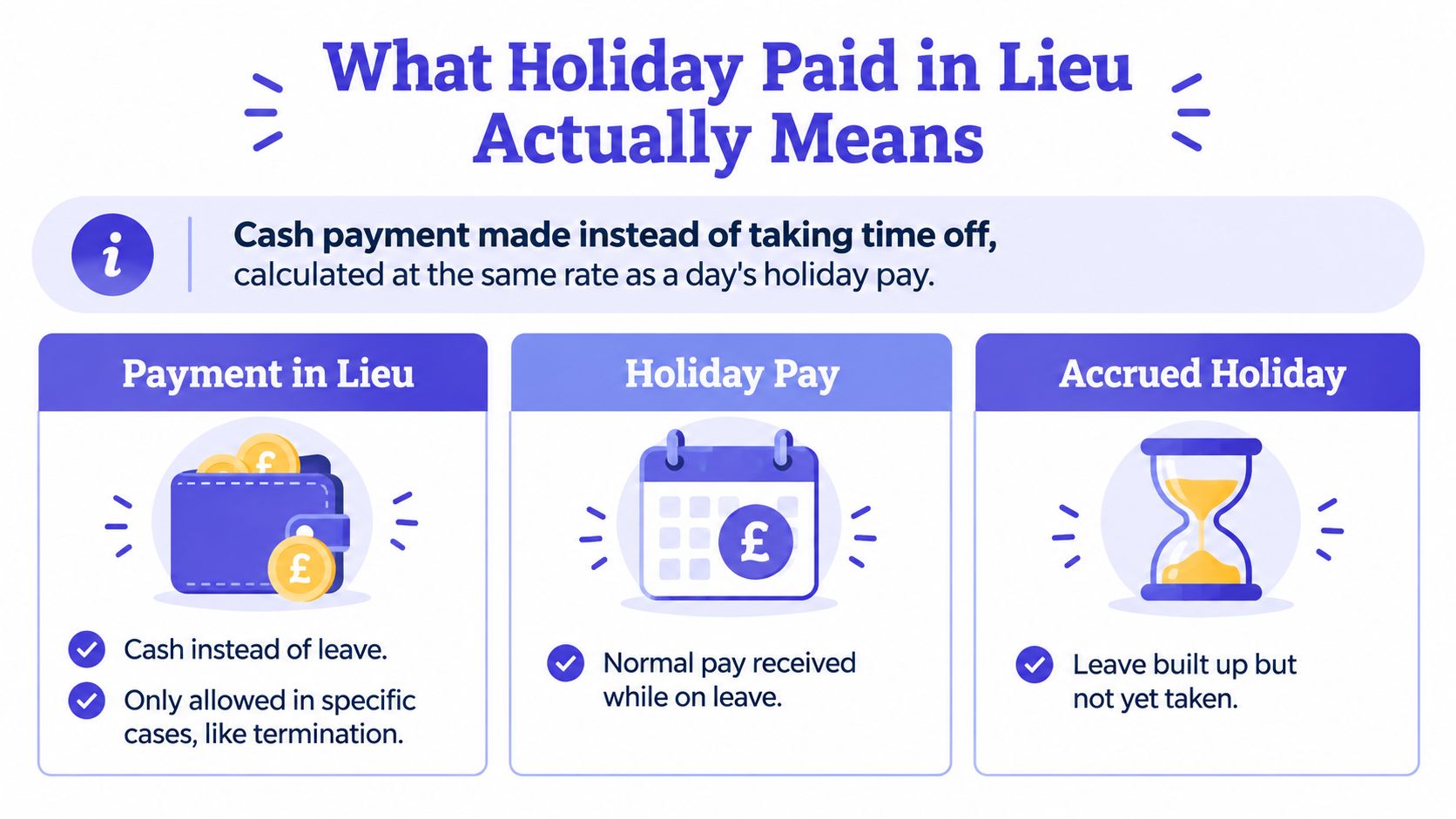
A worker asks to turn unused holiday into money, even though they are staying in the job. The request sounds simple, but holiday paid in lieu has a specific meaning. It is cash paid instead of untaken leave, normally because employment has ended and the worker can no longer use that leave in the usual way.
Three arrangements are often confused:
- Payment in lieu of holiday: Cash replaces untaken leave, usually in the final pay when employment ends.
- Carry-over: Untaken leave moves into a later leave year under the applicable legal or contractual rules. The worker keeps time off to take, rather than gaining an immediate cash entitlement.
- Holiday swap: The employer and worker agree a different date arrangement, such as working on a bank holiday and taking another day off. The worker still receives time away from work, so no leave is being converted into cash.
Holiday works like a bucket of available time off. Some of its contents may move into another period where the rules allow it. The balance cannot be poured into payroll whenever a worker asks, unless the situation falls within a lawful payment arrangement.
The statutory minimum is 5.6 weeks of paid annual leave. The government's holiday entitlement guidance explains how entitlement operates before a worker leaves a job. An employment contract may offer additional contractual leave. Its wording should set out how that extra leave is taken, carried over or treated when employment ends.
Record statutory and contractual leave separately where different rules apply. A single spreadsheet balance can hide which days may be carried forward, which must be taken, and which could be included in final pay.
Normal holiday pay and payment in lieu serve different purposes. Normal holiday pay is received while the worker takes time away from work. Payment in lieu is made because the employment relationship has ended and outstanding leave can no longer be used in the ordinary way. For a wider explanation of how holiday pay relates to earnings, see understanding your holiday pay.
When UK Law Allows and Forbids Paying Out Holiday
A team member asks to swap unused holiday for cash while still working. The request may look like a simple payroll adjustment, but statutory leave is designed to provide actual time away from work. A small business needs a clear process that protects that purpose while dealing sensibly with contractual leave, bank holidays and leavers.
During employment
An employer generally cannot pay an employee cash instead of statutory holiday while the employment continues. Paying the balance does not provide the rest the leave is meant to provide, so payroll cannot replace the time off.
Extra contractual leave above the statutory minimum may follow different rules. A contract or written agreement might allow a buy-back, but the wording must be checked first. Extra days do not automatically become available for cash conversion. Record statutory and contractual balances separately when their carry-over, booking or payment rules differ.
A practical system should route an in-work cash request to a manager or HR review, rather than sending it straight to payroll. The usual outcome is to arrange leave, carry it forward where the rules allow, or explain why payment is unavailable.
When employment ends
Termination changes the position. Untaken statutory leave must be paid in the final pay packet, including where the dismissal is for gross misconduct, as set out in the government's guidance on holiday before leaving a job.
Acas also confirms that unused statutory holiday should be included in final pay. If the worker has taken more leave than accrued, the employer may deduct the excess only when a deduction clause was agreed in the contract or in writing beforehand. The Acas guidance on how holidays affect final pay explains this position.
Bank and public holidays
A bank holiday can count towards statutory annual leave. It does not automatically create an additional day. A worker may ask to work that day and take another day instead, but the employer does not have to agree. Working on a bank holiday does not reduce the worker's full statutory entitlement. Payment is available only for unused holiday included in the final settlement when employment ends. See the Acas guidance on bank holidays and Christmas for the relevant rules.
| Situation | Can it be paid in lieu? | Source of the rule |
|---|---|---|
| Worker remains employed and asks for cash instead of statutory leave | Generally no | Statutory holiday rules |
| Employment ends with statutory leave untaken | Yes, and it must be included in final pay | Acas final-pay guidance |
| Extra contractual leave above the statutory minimum | Check the contract and any written agreement | Contract terms and workplace policy |
| Worker works a bank holiday and requests another day | Only if the employer agrees to the swap | Acas bank-holiday guidance |
Use this desk-side rule: while employed, protect the time off; when employment ends, calculate and pay the outstanding entitlement.
How to Calculate Holiday Paid in Lieu Step by Step
The calculation should reflect what the worker earned during the relevant reference period, not just a convenient contractual daily rate. This matters most for workers whose hours or pay vary.
For irregular-hours and part-year workers, the government's holiday-pay and entitlement reforms guidance explains that termination pay is based on accrued but untaken entitlement. Employers deduct leave already taken and use the worker's average weekly pay over the relevant 52 paid weeks.
If a week contains no pay, it isn't treated as an ordinary paid week in the average. The employer looks back to earlier paid weeks so the reference period reflects the worker's actual paid work.
A worked example
A part-time retail assistant has relevant pay totalling £9,880 over 52 paid weeks. The weekly average is:
£9,880 ÷ 52 = £190
The government's calculation guidance for workers without fixed hours or pay uses 5.6 weeks as the annual statutory entitlement. If the worker has the full entitlement outstanding for the calculation, the value is:
£190 × 5.6 = £1,064
The actual termination calculation still needs the worker's accrued entitlement and leave already taken. The example demonstrates the weekly-value stage, not a universal payout for every worker.
The government's worked example also shows how an accrued entitlement can be derived from the proportion of the leave year worked. In that example, 29.51% of the year worked produces 1.66 weeks of holiday entitlement. The employer then subtracts leave already taken.
What earnings belong in the reference period?
Relevant holiday pay can include pay linked to working time, such as overtime and commission, where the applicable rules require it. Payroll should therefore gather the actual paid history rather than relying on basic salary alone.
The Supreme Court's Brazel line of authority rejected a flat 12.07% prorating approach for irregular-hours and part-year workers. The statutory entitlement must drive the calculation, not a percentage selected because it is easy to put into a spreadsheet.
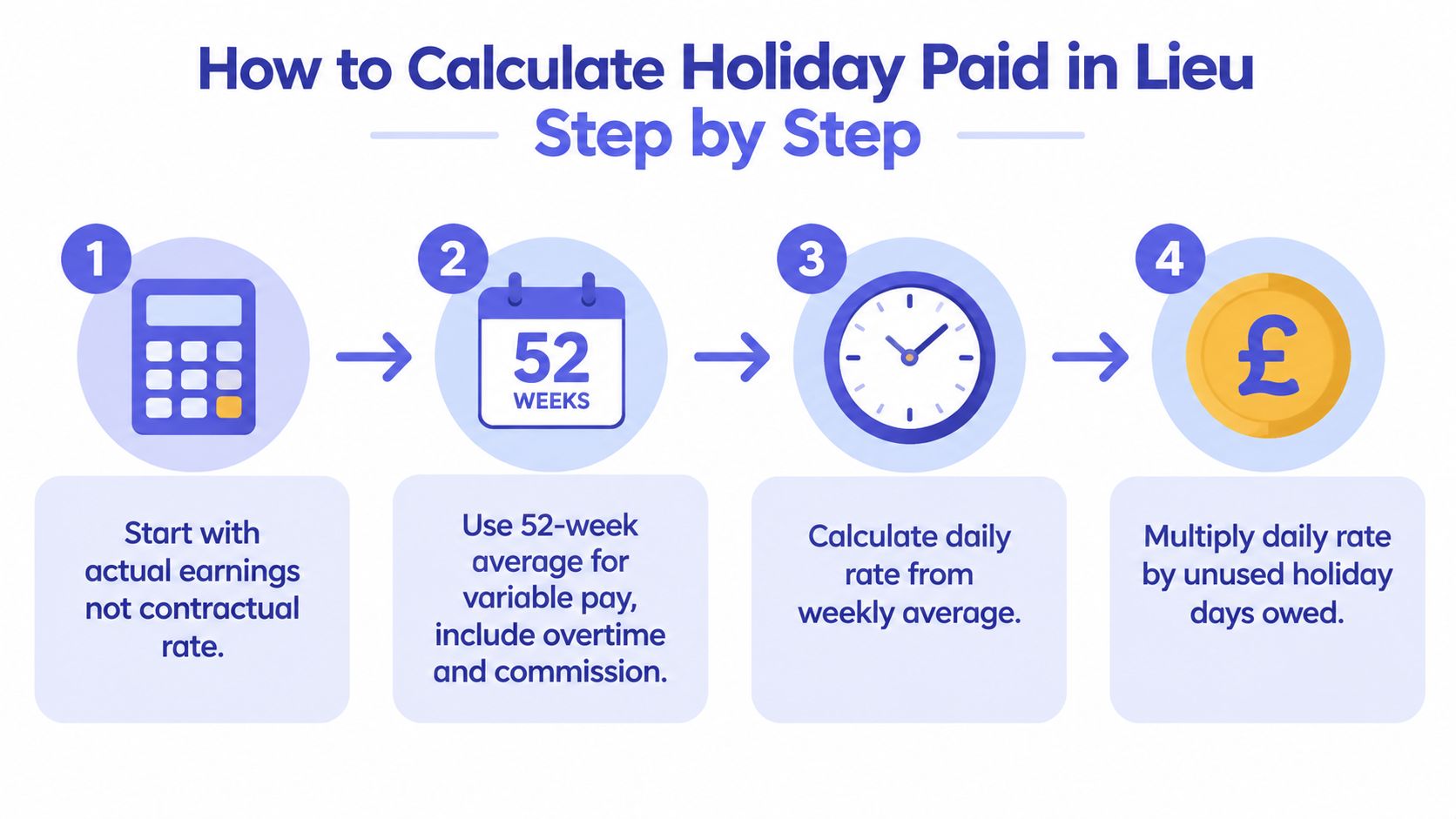
A payroll novice can use this structure as a starting point:
Average weekly pay = relevant pay in the reference period ÷ paid weeks used
Outstanding holiday value = average weekly pay ÷ working days in the worker's usual week × unused holiday days
The number of working days must match the worker's working pattern. For a worker whose entitlement is measured in weeks, calculate the outstanding weeks directly rather than forcing the balance into an inaccurate daily model. A guide to accrued holiday pay can provide a further reference point when setting up the spreadsheet or payroll workflow.
A short video can help managers see how the calculation fits together in practice:
Choosing the Right Outcome for Each Situation
A manager often needs an answer during a team meeting, not after a lengthy policy review. The table below turns the legal distinctions into a practical default.
| Scenario | Legally allowed? | Correct outcome | Payroll treatment |
|---|---|---|---|
| Worker asks for cash instead of taking statutory leave while still employed | Generally no | Offer time off, or consider permitted carry-over where applicable | Don't create a payout line |
| Leave remains untaken at year end | Depends on the statutory and contractual rules | Take leave, carry it over where permitted, or address any employer failure to provide leave | Keep the balance visible and document the decision |
| Leave remains untaken when employment ends | Yes, statutory entitlement must be paid | Pay accrued but untaken entitlement in final pay | Use a clearly labelled holiday payment-in-lieu line |
| Role involves fixed bank holidays | Working the day doesn't remove statutory entitlement | Agree another day only if the employer accepts the swap | Record the replacement day as leave, not as cash |
| Worker has irregular hours or pay | Yes on termination, but calculation needs care | Use accrued entitlement, deduct leave taken and apply the relevant paid-week average | Feed the calculation into payroll with supporting records |
The answer for a worker who asks for cash is therefore not a straightforward “no”. The manager can ask whether the worker wants different dates, whether an approved carry-over arrangement applies or whether a calendar swap would solve the operational problem. Those alternatives preserve the distinction between time off and payment.
A worker with irregular hours needs a separate payroll review because the value of leave can vary with actual earnings. The government's reform guidance should be the reference point for that calculation rather than an automatic percentage.
A bank holiday also needs careful wording. A fixed-bank-holiday contract may require the worker to reserve particular dates, but the day still sits within the overall holiday entitlement. Time off in lieu is a different arrangement from holiday paid in lieu. It usually concerns time granted for working additional time, not cashing out statutory annual leave.
This table is a default operating tool, not a replacement for the employment contract, written policies or professional advice. A balance carried over lawfully still represents leave. If it later becomes payable on termination, the business must value it under the applicable holiday-pay rules.
Recording and Automating Payment in Lieu in Your Leave System
A small business needs three layers working together: the contract, the leave rules and the payroll trigger. If one layer is missing, a clean-looking balance can still produce the wrong result.
Start with the written rules
The employment contract should identify statutory entitlement and any additional contractual leave. It should also explain the leave year, the process for requesting leave and the circumstances in which carry-over applies.
The business should record carried-over balances separately from the current-year balance. That makes it easier to identify why leave remains open and whether the worker has a contractual or statutory route for using it.
The payout condition should be explicit in the internal process. A termination date is the key trigger for statutory payment in lieu. A year-end balance above zero should normally create a management prompt, not an automatic cash payment.

Configure the workflow
A leave platform should capture the event that changes the treatment. For a leaver, the workflow can:
- Record the termination date.
- Freeze the entitlement at the correct point.
- Show accrued leave and leave already taken.
- Identify the remaining balance.
- Send the balance and calculation inputs to payroll.
- Preserve the approval and adjustment history.
The system shouldn't invent the worker's average weekly pay. Payroll needs to provide or validate the relevant paid history, including variable earnings that belong in the calculation. Automation should reduce repeated data entry and expose exceptions, not hide judgement behind a single button.
Reports should show opening entitlement, leave booked, leave taken, carried-over leave, adjustments and the reason for any payout. A reason code such as “termination payment in lieu” helps finance distinguish a lawful final-pay transaction from an attempted in-work cash-out.
Keep an audit trail
Store the contract rule, the approved leave records, the termination date, the calculation period and the payroll confirmation together. If a manager changes a balance, require a note explaining why. That record gives the business a defensible history when the final payslip is reviewed later.
LeaveWizard can be considered as one leave-management option for implementing a new leave management system. Its relevant workflow should be configured around the business's own contract terms, carry-over policy, approval process and payroll controls, rather than treated as a substitute for checking the underlying rules.
Common Misconceptions That Cost Small Businesses Money
Myth one means any remaining leave can be paid on request
An employee may prefer cash, and a manager may want to help. That does not make an in-work payment lawful where the balance is statutory leave. The practical answer is to agree time off, apply a valid carry-over arrangement, or adjust the calendar within the rules.
If payroll approves the request, the business may pay money without removing its continuing obligation to provide statutory rest. The apparent shortcut can leave both the payment record and the leave balance needing correction.
Myth two means 12.07% works for everyone
The 12.07% method is not a universal shortcut. The reforms and the Brazel authority mean that irregular-hours and part-year workers need entitlement calculated under the applicable statutory rules and relevant pay history, rather than a flat percentage selected for convenience.
A wrong method can create a balance that looks precise but does not match the worker's accrued entitlement. Payroll may then need to revisit calculations, payslips and records.
Myth three means bank holidays sit outside annual leave
Bank holidays can form part of the 5.6-week statutory minimum. A business may require a worker to take leave on a bank holiday if its arrangements permit this, but working that day does not remove the wider entitlement.
Treating a bank holiday as a cash item while the worker remains employed can confuse a calendar arrangement with payment in lieu. The payroll result may then understate the leave the worker still needs to take.
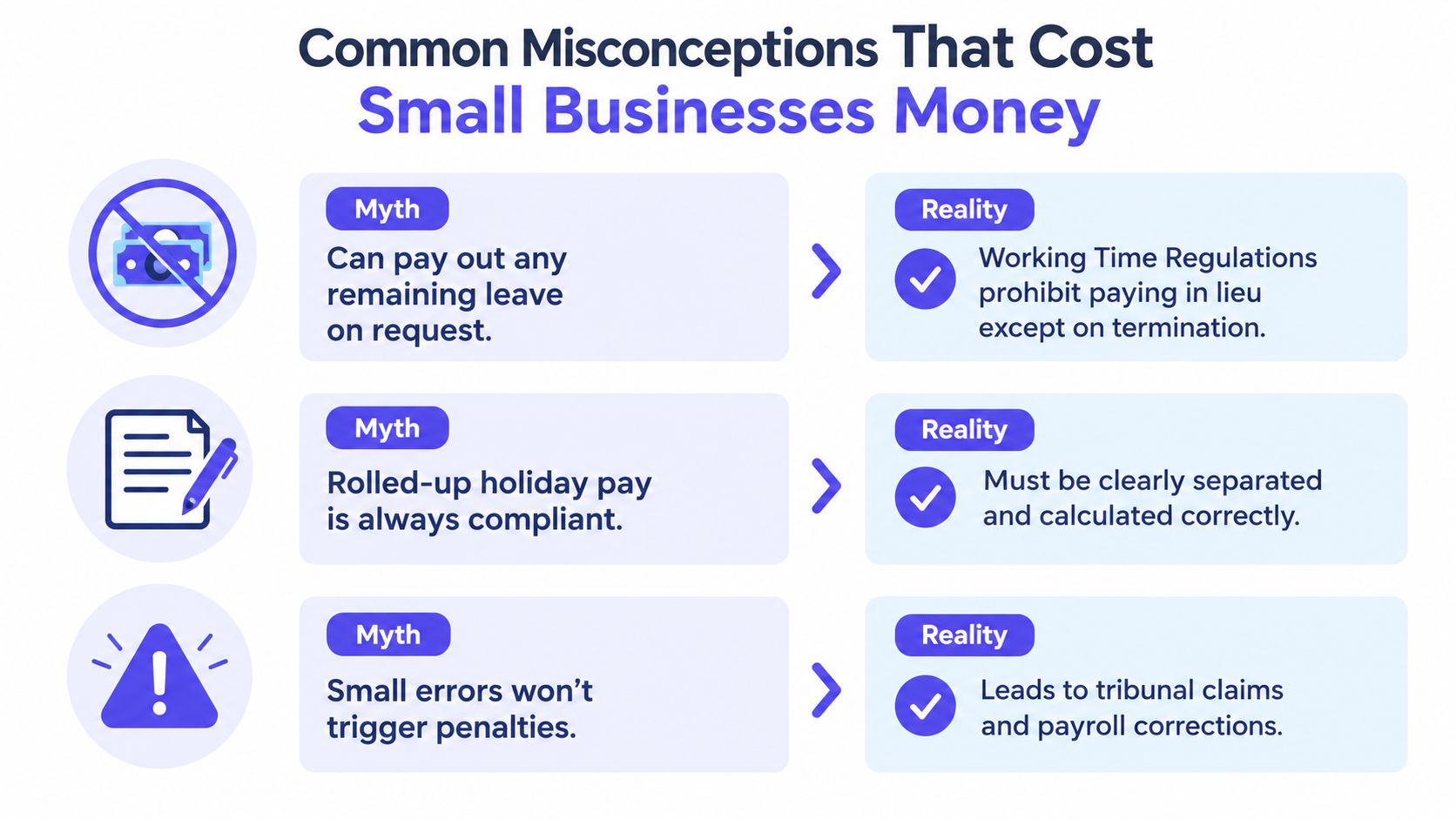
The common thread is poor classification. Before approving a request, identify whether it concerns normal holiday pay, a leave movement, a calendar swap, or final-pay holiday paid in lieu. That classification lets a small business handle everyday scheduling requests while keeping the legal exception for termination separate.
Your Action Checklist Before the Next Payout Request
Run this checklist before approving the next request:
- Confirm employment status: Check whether the worker is leaving. A termination is the event that normally turns outstanding statutory leave into a lawful payment.
- Check the balance: Separate accrued entitlement, leave already taken and any carried-over amount.
- Review the worker's pattern: For irregular-hours or variable-pay workers, collect the relevant paid weeks and apply the average-pay method.
- Read the contract: Confirm the statutory entitlement, extra contractual leave, carry-over terms and any written rules for swaps.
- Add a reason code: Record whether the transaction is a termination payment, a leave adjustment or a calendar change.
- Brief line managers: Give them a simple script: decline in-work cash-outs, then offer lawful alternatives such as time off or permitted carry-over.
- Review before year-end: Check balances early enough to help workers take leave and prevent unresolved records becoming payroll surprises.
Keep the calculation and approval evidence with the final payroll record. A spreadsheet can support the process, but it shouldn't be the only place where the business stores the decision.