
An employee leans over your desk and asks a simple question. How many days have I got left? You open the spreadsheet, find a single number, and hesitate. Does that figure already include bank holidays, add them again, or ignore them altogether? If you can't answer that in one breath, the number isn't ready to share. A reliable holiday calculator including bank holidays doesn't start with subtraction. It starts with policy, nation, leave year and work pattern, then shows its working.
Table of Contents
- What the Calculator Should Show Before Anyone Books
- Why the Bank Holiday Count Changes by Nation
- How to Work Out Remaining Leave With Bank Holidays
- Build the Working Day Logic in a Spreadsheet
- Pro Rata and Irregular Hours With Bank Holidays
- Keep Every Balance Auditable
- Move From Manual Checks to a Live Balance
What the Calculator Should Show Before Anyone Books
Most spreadsheet errors begin before anyone books leave. One cell says 28 days, another person reads that as 28 days they can choose, and payroll reads it as 28 days in total. Both readings are plausible until you label what's inside the pot. Your first job is to split the balance into its parts, so the employee sees the same figure you see.
Start With the Statutory Floor
Under the Working Time Regulations 1998, almost all workers are legally entitled to 5.6 weeks of paid statutory annual leave each year, and for someone working five days per week this equals 28 paid days annually, as the GOV.UK holiday entitlement guidance explains. That entitlement is capped at 28 days. A six day week doesn't automatically become 33.6 statutory days, because the cap stops the formula at five days.
Bank holidays aren't an extra legal entitlement on top of that floor. You may count them within the 5.6 weeks, provided the employee still receives the full statutory minimum. So a contract offering 20 days plus bank holidays can already meet the 28 day minimum for a five day worker in England. A different contract might offer bank holidays in addition, and that's a contractual benefit, not a legal default.
If the contract doesn't say whether bank holidays are included or extra, stop and fix the wording before you fix the calculator.
Match the Contract to a Pattern
Use this table to find your own arrangement before you touch any dates. The annual pot, the bank holiday treatment and the display figure are three different things, and confusing them is how balances drift.
How bank holidays sit inside common UK allowances
| Working pattern | Annual pot | Bank holiday treatment | What to display |
|---|---|---|---|
| Five days, holidays included | 28 days statutory cap | Usual 8 England and Wales dates inside the 28 | About 20 days before bookings if all 8 fall on working days |
| Five days, holidays on top | 28 days plus bank holidays | 8 dates added as a contractual benefit | 28 days of annual leave still available around those dates |
| Six days a week | Statutory cap remains 28 days | Contract decides inclusion | No automatic extra statutory day for the sixth day |
| Three days a week, included | 16.8 days (3 × 5.6) | Only bank holidays on their working days | Do not deduct a flat 8 |
| Irregular hours, leave year after 31 March 2024 | 12.07% of hours worked | May sit inside the 5.6 week accrual | No fixed annual day balance |
The three day row catches people out. A part time deduction isn't a slice of the national list, and it isn't the full list either. Only a bank holiday that falls on one of that employee's normal working days reduces an included allowance. If they work Tuesday to Thursday, a Monday bank holiday doesn't touch their balance, while a Wednesday one does.
The Four Inputs Every Calculation Needs
Before anyone books, your calculator should show four inputs beside the balance.
- Working pattern: Which days, or how many hours, this person normally works each week.
- Leave year dates: The exact start and end dates that define this year's window.
- Contractual total: The full annual pot in days or hours, not just the statutory minimum.
- Bank holiday rule: Included in that total, or given on top of it.
If you display one blended balance without those four fields, you'll under allocate some people and double count others. Show the pot, show what's been reserved for bank holidays, and show what's left to choose. That separation is the whole point of the calculator.
Why the Bank Holiday Count Changes by Nation
Don't hard code eight. It's the most common shortcut in UK leave spreadsheets, and it's wrong for a large part of the country. The count changes because the lists themselves are different, and because some dates move.
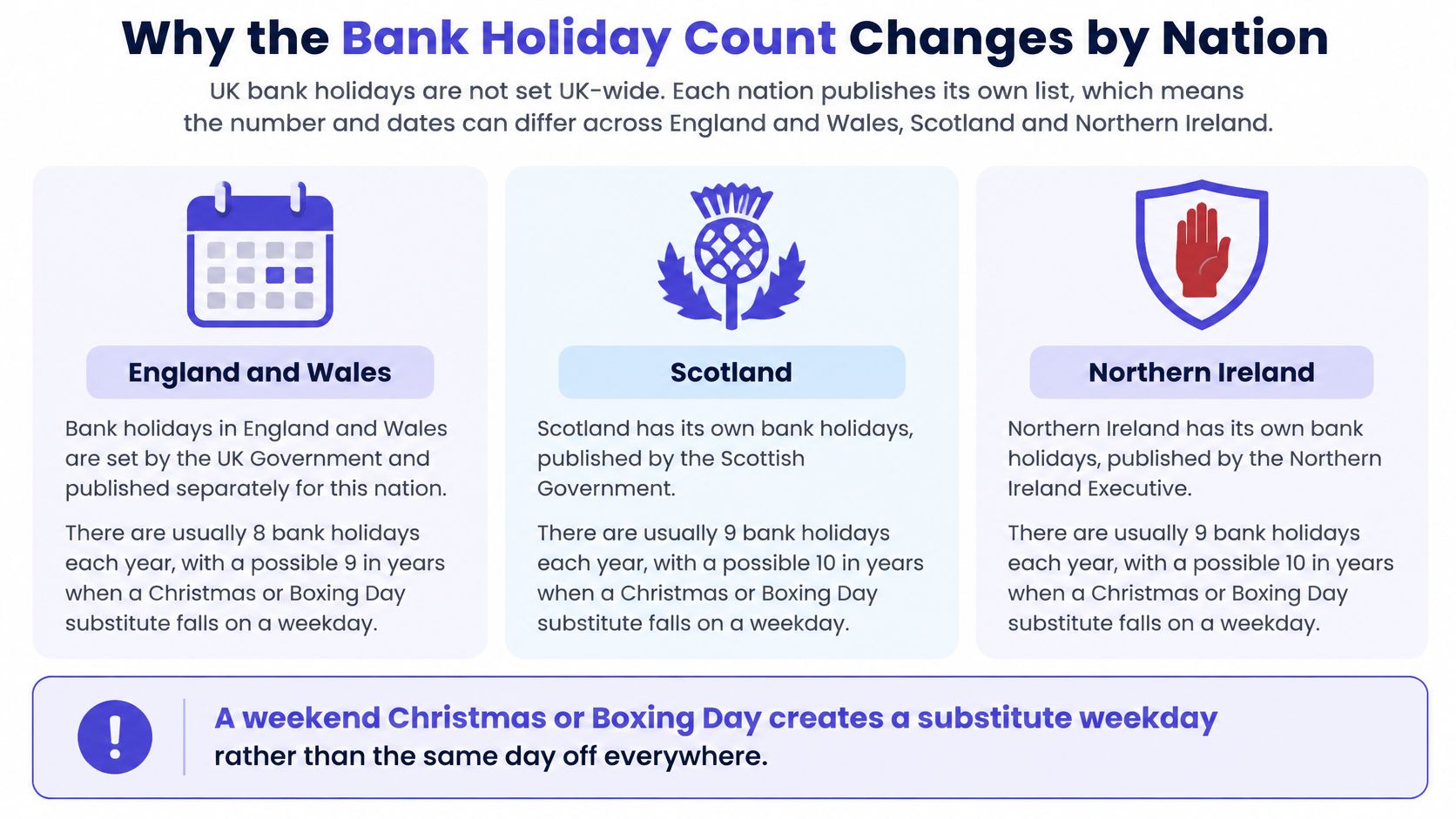
The comparison below sets out the usual sets, and the infographic that follows shows why one UK wide template can't cover them.
Usual UK bank holiday sets by nation
| Nation | Usual count | Dates that differ from England and Wales | Watch outs |
|---|---|---|---|
| England and Wales | 8 | Baseline for comparison | Substitute Monday when Christmas or Boxing Day is a weekend |
| Scotland | 9 | Adds 2 January and St Andrew's Day, usually no Easter Monday, summer holiday is the first Monday in August | St Andrew's Day moves to the next Monday if 30 November is a weekend |
| Northern Ireland | 10 | Adds St Patrick's Day and Battle of the Boyne (12 July), and keeps Easter Monday | If 12 July is a weekend the holiday moves to the following Monday |
Three Lists, Not One
UK bank holidays are not identical across all nations, and the official government calendar publishes separate dates for England and Wales, Scotland, and Northern Ireland, while substitute days are used when a bank holiday falls on a weekend, as the Acas guidance on bank holidays and Christmas sets out. In England and Wales the standard list normally runs to 8 dates, from New Year's Day through to Boxing Day. Scotland and Northern Ireland build on a different base, with their own additional days and, in Scotland's case, a different summer date.
A weekend Christmas Day or Boxing Day doesn't create a second holiday. It creates a substitute weekday, usually the following Monday, and that substitute is the date your calculator should use. Keep a current calendar of bank holidays beside your tracker so you're checking named dates rather than copying last year's count.
Why Easter Breaks a Fixed Template
Easter moves every year, so Good Friday and Easter Monday move with it. That matters most when your leave year doesn't run January to December. An April to March leave year can contain a different Easter pair from the calendar year it overlaps, because an early or late Easter falls either side of the April boundary. Copy a calendar year list onto an April start and you may count Easter twice, or not at all.
One off holidays make the same point. The Platinum Jubilee bank holiday on 3 June 2022 and the State Funeral bank holiday on 19 September 2022 were exceptional additions, not permanent fixtures. Last year's total is never a safe template for this year.
Pick the nation where the employee works, not from your head office postcode. A remote team spread across Cardiff, Glasgow and Belfast needs three calendars running side by side, and each person's balance should only count holidays inside their leave year and on their working days.
How to Work Out Remaining Leave With Bank Holidays
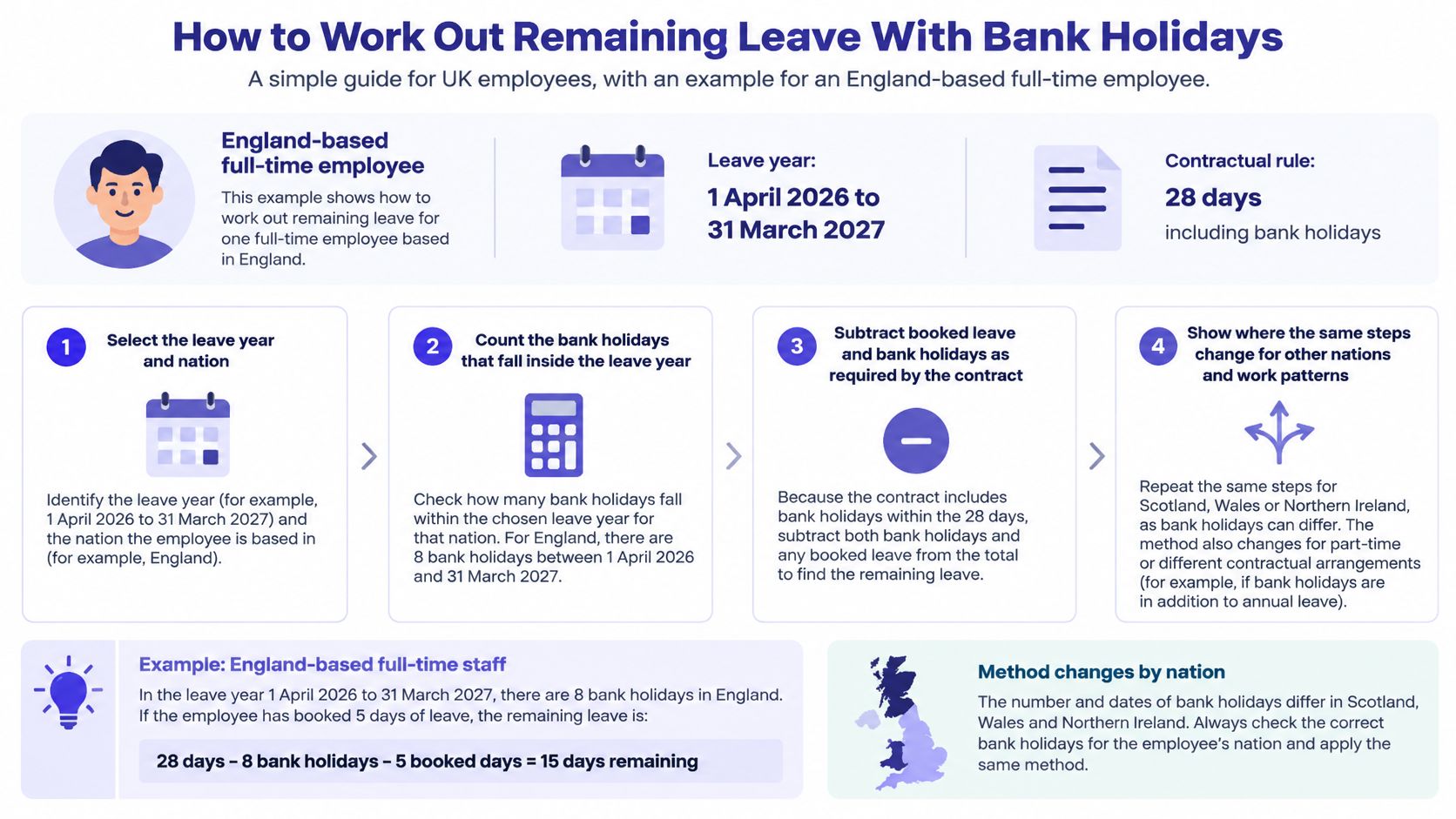
A manager checking an employee's balance needs more than a bank holiday total. The answer depends on the employee's nation, leave year, working pattern and contract: the same date may reduce one person's allowance but have no effect on another's.
Take an England-based employee who works Monday to Friday. Their leave year runs 1 April 2026 to 31 March 2027, and their contract provides 28 days including bank holidays. Use those details to calculate the balance, rather than assuming bank holidays are always a fixed number of days.
The process flow shows the order of operations.
The Six Steps in Order
- Select the worker's UK nation. Load the official bank holiday dates for that nation and leave year. The GOV.UK bank holidays calendar lists dates for England and Wales, Scotland, and Northern Ireland, including substitute days.
- Keep dates inside the relevant window. A bank holiday counts only if it falls within both the leave year and the employee's employment dates. For example, don't deduct Christmas from someone leaving in June, or an August bank holiday from someone who joined in October.
- Apply the contract. If bank holidays are included in the allowance, eligible dates reduce the balance. If they are provided on top, record them as non-working days, but don't deduct them from annual leave.
- Count only dates that match the working pattern. A bank holiday on a day the employee doesn't normally work doesn't reduce their allowance. Someone who never works Fridays, for instance, doesn't lose leave for Good Friday.
- Subtract leave taken or approved. Keep the units consistent. If the allowance is in hours, record bookings in hours too.
- Keep an audit line for each date. Record the holiday name and date, whether it is a substitute day, and whether it reduced the employee's balance.
The order matters. Deducting every national bank holiday for every employee overstates leave used by part-time staff. Counting both a weekend holiday and its substitute weekday can double-count the date it replaces. Check each date against the employee's contract and work pattern.
The video below illustrates the same deduction process, which can help when explaining a balance to a manager.
The Balance the Employee Should See
For this example, assume eight England and Wales bank holidays fall on working days within the leave-year window. The calculation also assumes five days of annual leave have already been taken or approved, to show how bookings affect the final balance.
Worked balance for one England-based full-time employee, 1 April 2026 to 31 March 2027
| Line | Days | Source or rule |
|---|---|---|
| Total allowance, bank holidays included | 28 | Contract, five-day week at 5.6 weeks |
| Bank holidays falling on working days | 8 | England and Wales calendar, within the leave year |
| Remaining before bookings | 20 | 28 minus 8 |
| Annual leave taken or approved | 5 | Booking record, same unit as the allowance |
| Left to take | 15 | Remaining before bookings minus leave taken |
The eight bank holidays are specific to this example's leave-year window, not a permanent setting. Recount the dates if the window changes or a bank holiday falls outside it. Show the employee four figures: entitlement, bank holidays deducted, leave booked and remaining balance. That gives a manager a clear audit trail, so any query can be traced to the date or booking that changed the total.
Build the Working Day Logic in a Spreadsheet
You can reproduce that worked balance in a spreadsheet, provided you stop asking one cell to do everything. The trick is to let the spreadsheet count working days twice, once with bank holidays removed and once without, then use the difference. That's your deduction, with no manual tallying.
Set Up the Named Inputs
Create a named range called BankHolidays holding the official dates for the employee's nation. List substitute days as their own rows, using the substitute date itself, and refresh the list each year. Don't type a count into a cell and hope it stays true.
Put the leave year start in StartDate and the end in EndDate. Clip both to employment dates, so a joiner's window starts on their first day and a leaver's window stops on their last. That one habit removes most pro rata arguments before they start.
Use the Weekend Code to Describe the Pattern
Excel's NETWORKDAYS.INTL function takes a weekend code that describes which days are non working. Use the seven character string form, starting on Monday, where 1 marks a non working day and 0 marks a working day. A standard Monday to Friday pattern is 0000011. A part timer who's off every Friday as well as the weekend is 0000111.
- Working days in the window: NETWORKDAYS.INTL(StartDate,EndDate,WeekendCode,BankHolidays)
- Working days ignoring bank holidays: NETWORKDAYS.INTL(StartDate,EndDate,WeekendCode)
- Bank holidays on working days: The second result minus the first result
That difference is the deduction you need. A bank holiday landing on a non working day changes neither count, so it correctly deducts nothing. You don't need a separate lookup for each date, and you don't need to eyeball a calendar.
Spreadsheet check: If your deduction equals the full national list for a part timer, your weekend code is wrong, not their entitlement.
Remaining leave is then the included allowance, minus that deduction, minus leave taken. Keep holidays given on top in a separate row that never feeds the subtraction, so the policy choice stays visible. Keep the working day count and the deduction in their own columns too. A manager who can see the arithmetic stops querying the answer.
Once that logic works for one person, you can copy the structure across the team, changing only the nation list, the weekend code and the leave year dates. Our guide to building a holiday tracker in Excel covers the surrounding workbook layout, including how to keep those inputs on a settings sheet rather than buried inside formulas. The same four inputs can also drive an embedded calculator that returns the audit values directly, which is where a workbook starts to earn its keep.
Pro Rata and Irregular Hours With Bank Holidays
A fixed 28 day calculator misleads anyone whose year is incomplete or whose hours move. That's not a fringe group. It includes most part timers, every mid year joiner and leaver, and everyone on variable hours. Each group needs its own method, and mixing them up produces confident, wrong answers.
Regular Part Timers and Mid Year Changes
For a regular part timer, multiply 5.6 by the number of days they work each week. Three days gives 16.8 days. If their contract includes bank holidays, deduct only the ones falling on their working days. That might be two dates one year and five the next, because Easter and substitute days shift around a fixed pattern. Our explainer on bank holiday entitlements for part time staff works through that fairness question in more detail.
Say someone joins on 1 October 2026 in an April to March leave year. Count only the portion of the year they'll be employed, and only bank holidays on or after their start date. A leaver is the mirror image. Stop the window at the leaving date, and don't remove Christmas from the balance of someone who left in the summer. Their final entitlement covers the period they worked, and any difference between leave accrued and leave taken is settled from that figure.
Irregular Hours and Part Year Workers
The method changes completely for people whose hours vary. For leave years beginning after 31 March 2024, irregular hours and part year workers generally accrue statutory leave based on hours worked in each pay period, using 12.07% of hours worked, and the entitlement must be rounded up when the fraction reaches at least half an hour, as the GOV.UK guidance on calculating leave entitlement confirms. This group includes workers whose hours often or always change and workers with unpaid periods of at least a week.
Work it once with real numbers. Someone works 80 hours in a pay period. 80 × 12.07% gives 9.656 hours, which rounds up to 10 hours of accrued leave. Bank holidays may still sit inside the overall 5.6 week entitlement for this group, rather than being added on top, so check the contract before you reserve any dates.
Don't average a busy month back across a quiet one. A December spike in hours accrues leave in that pay period, at that period's hours. Spreading it backwards flatters the spring balance and short changes the winter one, and neither figure can be defended later.
The Audit Line These Workers Need
For zero hours staff, seasonal workers and school term employees, an annual total is meaningless without the history behind it. Record these fields for every pay period.
- Hours worked: The actual hours in that pay period, not contracted hours.
- Leave accrued: The 12.07% calculation and any rounding you applied.
- Bank holiday deduction: Any date deducted, with the working day or shift match that justified it.
- Carry over and rule applied: What moved forward, and which leave year rule governed the period.
Apply the same working day test to rotas. A bank holiday deducts only when it matches a shift the person was due to work that week. Never run rotating staff through a Monday to Friday template and hope it evens out. It doesn't, and the person who loses out is usually the one with the least predictable pattern.
Keep Every Balance Auditable
A balance without a clear trail can be hard to explain during a dispute or payroll query. Record the supporting details as you go, so you do not have to reconstruct them later. Use this checklist to decide what belongs beside each balance.
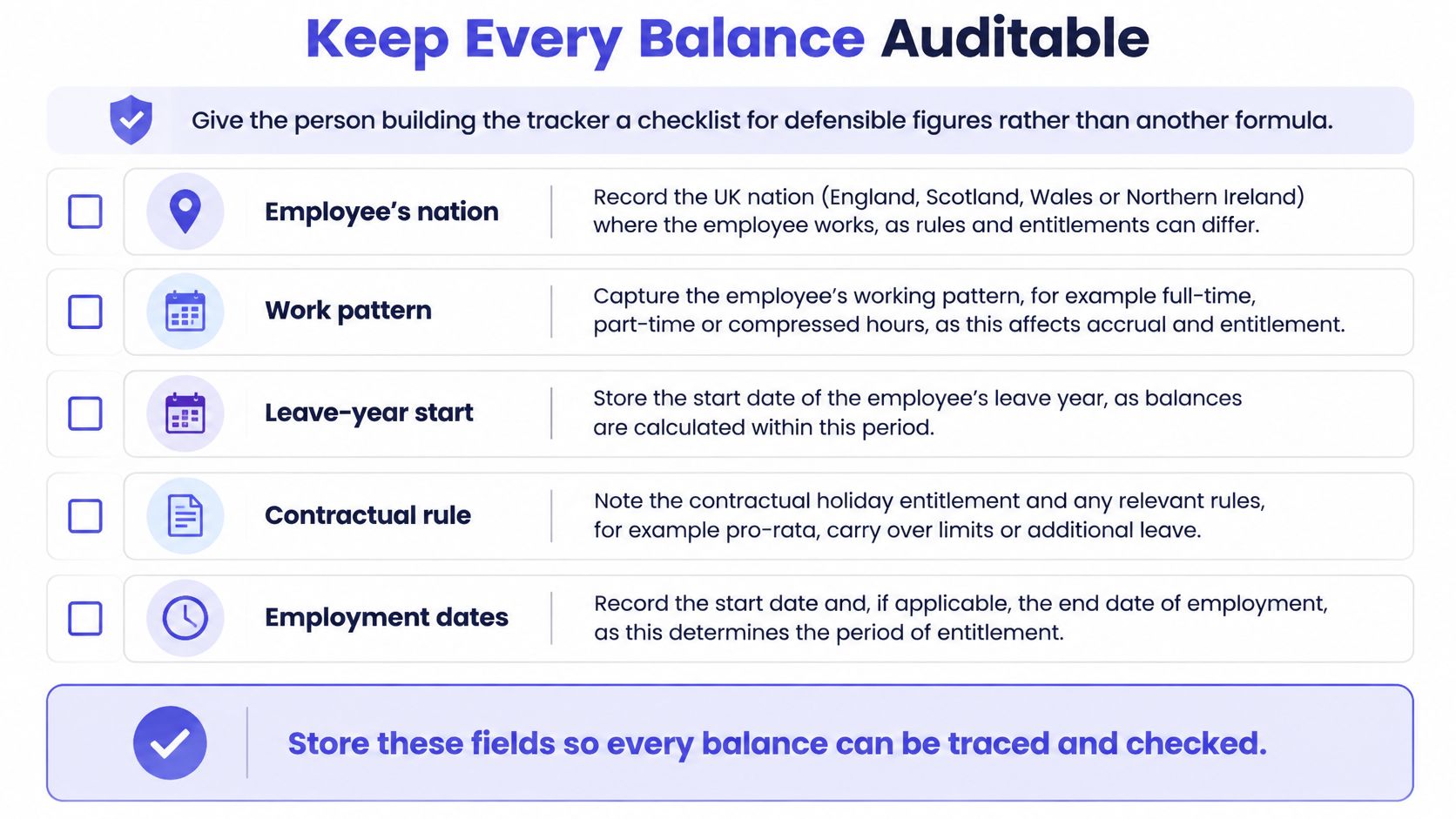
For each employee, store their nation, work pattern, leave year start, contractual rule and employment dates. Keep the balance in hours as well as days when shifts do not equal a whole day. For rotating patterns, record whether a bank holiday matched a shift the employee was due to work. List carry over separately, including any expiry date, so it does not disappear into the new leave-year total.
Keep records that show the employee's entitlement, leave taken, adjustments and how bank holidays were treated. A calendar of approved absences alone may not explain how the balance was calculated. The Working Time Regulations 1998 do not establish the specific six-year retention period sometimes attributed to them, so avoid treating that figure as a requirement under these regulations.
Before sharing balances, check your tracker against common errors: deducting every national holiday for every employee, counting both a substitute Monday and the original weekend date, or applying one company leave year to employees whose contracts start in different months. Each check tests a different part of the calculation: location, date handling and individual leave-year rules.
If you cannot explain a balance with a date, a name and a working-day match, do not publish it.
Move From Manual Checks to a Live Balance
Before automating leave, settle the policy: are bank holidays included in each employee's allowance or additional to it? Record each employee's nation and work pattern, set their leave year, and decide whether to track balances in days or hours. These choices determine the balance; software can apply them consistently, but it cannot choose the policy for you.
Use the April 2026 example to check two cases, one full-time employee and one part-time employee. Confirm that only bank holidays falling on their working days affect their balances. Then check that you can explain each deduction using the relevant date and work pattern. If the two results match your policy, the calculation is working as intended. Keep in mind that dates change, employees join during the year, and rotas can change too.
Try the free Holiday Entitlement Calculator at leavewizard.com to work through your include-or-extra policy before updating live records. It is available with or without a LeaveWizard subscription. LeaveWizard automatically allocates local public holidays according to whether they count towards the employee's allowance and their work pattern. Its location-aware public holiday calendars update automatically.
As a team moves beyond a workbook, keeping leave records together can reduce repeated manual checks. LeaveWizard holds holiday, sickness and other absence records alongside leave allowances and employment dates. Employees can check their entitlement and allowance in the smartphone app, so they can see what remains without asking HR to rebuild the balance.
Stop rebuilding balances by hand each time someone asks what's left. LeaveWizard allocates local public holidays against each employee's allowance and work pattern, and staff can check their remaining entitlement and allowance in the smartphone app. Visit LeaveWizard to try the free Holiday Entitlement Calculator and work through your own include-or-extra policy.


