
A trip can look affordable when the booking page shows flights and a hotel, then become a different proposition once you add getting to the airport, baggage, meals while waiting and the costs at your destination. For an HR lead helping a colleague plan time off, there's another practical question: can the employee afford the trip, and can the team cover the absence?
A useful holiday budget calculator answers both questions without confusing travel costs with leave entitlement. It starts at the front door, counts costs that are easy to overlook, and gives employees and managers a clearer basis for planning.
Table of Contents
- Why a Holiday Budget Calculator Needs to Do More Than Add Flights and Hotels
- The Core Cost Categories Every Calculator Must Capture
- Adding Contingency and Insurance as Risk-Adjusted Costs
- Turning the Trip Total into a Realistic Savings Plan
- The Door-to-Door Costs Most Calculators Forget
- Connecting Personal Holiday Budgets to UK Leave Entitlement
- Template, Checklist and Common Questions
Why a Holiday Budget Calculator Needs to Do More Than Add Flights and Hotels
An employee books a trip using the headline price, then discovers the total also includes airport parking, baggage, transfers and everyday spending money. None of those costs is surprising on its own. The problem is that a single total makes it easy to miss them until the money is already committed.
That's why a calculator should build a door-to-door budget, not repeat the advertised price. In 2023, UK residents spent £50.0 billion specifically on overseas holidays, part of £72.4 billion on visits abroad, according to Office for National Statistics Travel Trends. Those totals put individual holiday decisions in context. For a household or a small business helping staff plan leave, an underestimated trip budget can mean financial strain, changed plans or time off that feels less restorative than it should.

A calculator separates the costs people can confirm before departure from those that depend on how the trip unfolds. Transport, accommodation and prepaid activities may be known early. Food, local travel and shopping depend on the itinerary and daily choices. Insurance, foreign-exchange charges and a contingency reserve deserve their own lines too.
Practical rule: If a cost is part of getting away, getting around or returning home, it belongs in the budget, even if it isn't included in the booking confirmation.
For someone organising a European itinerary, a backpacker guide to planning Europe can help surface practical decisions to consider while planning. The calculator's job is to turn those choices into an honest estimate rather than one attractive headline figure.
The Core Cost Categories Every Calculator Must Capture
Start with two groups: fixed costs and variable daily costs. Fixed costs are confirmed or prepaid expenses, such as transport, accommodation, visas, insurance and booked activities. Variable costs are incurred along the way, including meals, local transport, attractions and shopping.
The distinction matters because prices don't move in lockstep. In the year ending March 2024, average weekly UK spending on international flights rose by £2.70, or 37%, in real terms; package holidays abroad rose by £3.30, or 14%; and holiday spending money increased by £2.00, or 35%, according to the ONS Family Spending bulletin. A calculator that lets users change each line separately is more useful than one that applies a single blanket adjustment.
| Category | Type | Typical UK default | Common error |
|---|---|---|---|
| Flights, rail or other main transport | Fixed | Enter a current quote | Leaving out baggage or seat charges |
| Accommodation | Fixed | Enter the booked price | Missing fees or splitting costs incorrectly |
| Visas and travel insurance | Fixed | Use the traveller's quote | Treating insurance as an afterthought |
| Prepaid activities | Fixed | Add booked tickets | Counting only the headline package |
| Food and drink | Variable | Set a daily allowance per traveller | Forgetting arrival and travel days |
| Local transport and attractions | Variable | Estimate by destination and itinerary | Assuming transfers are included |
| Shopping and discretionary spending | Variable | Set a personal limit | Leaving spending money undefined |
Calculate daily costs with a simple method: travellers × days × daily allowance. Keep the number of travellers and days editable, and make the allowance specific to the destination and travel style. A family that plans to eat out regularly shouldn't inherit the same default as a solo traveller who expects to prepare some meals.
For destination-specific planning, Italy daily travel budget tips can help travellers think through daily expenses before entering their own estimates. For UK trips, remember that bank holidays can affect both travel demand and staffing plans, so check the business calendar alongside the itinerary using this guide to UK bank holiday facts.
Adding Contingency and Insurance as Risk-Adjusted Costs
A budget that includes only expected costs isn't a safe plan. Travellers also need to see what happens if prices shift, a payment attracts fees or a disruption creates an unexpected expense. Display three figures: the planned trip total, the contingency as a separate line and the risk-adjusted total with the reserve included.
Post Office Travel Money's 2025 UK survey found that 82% of holidaymakers set a budget averaging £377, while 71% exceeded it by an average of £140, or 37%. These are survey benchmarks, not rules for every destination or trip, but they make a strong case for showing a buffer instead of pretending the planned figure is guaranteed. You might test a reserve using a chosen share of variable costs or compare it with the survey's overspend benchmark, then adjust it to suit the itinerary.
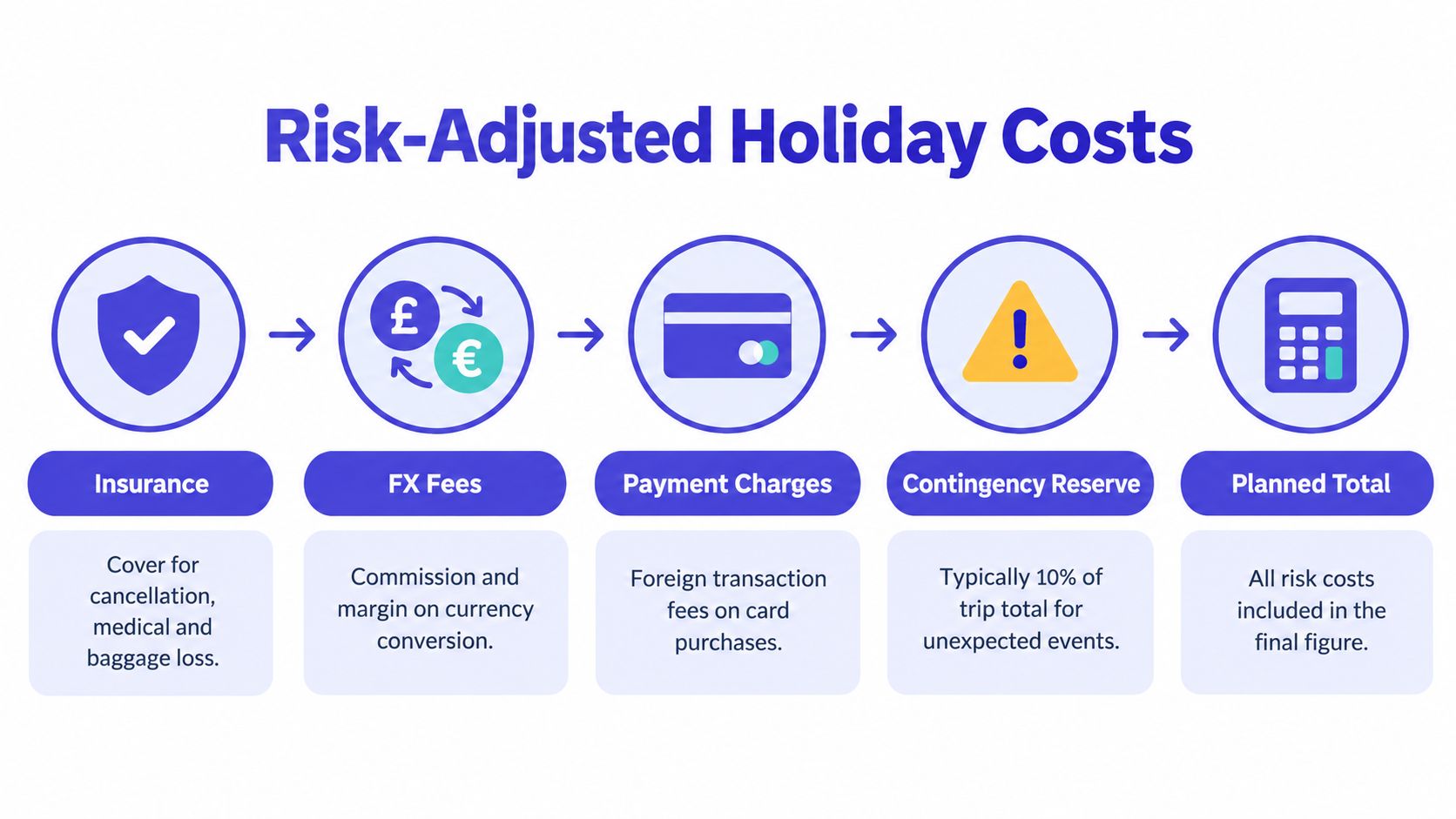
Insurance needs its own required decision field, not a vague allowance buried in “other”. Ask whether the trip is domestic or international, whether the traveller has single-trip or annual cover, and whether the policy includes medical expenses, cancellation, baggage and relevant pre-existing conditions. Aviva's 2025 research found that 11% of British holidaymakers never buy travel insurance for overseas trips, while the average reported cancellation cost exceeded £900. See the Aviva research on holiday budgets and insurance. The calculator shouldn't pretend it can price an individual's chance of cancellation. It should show the traveller what cover costs and what risks remain uninsured.
Check for duplication before adding premiums or protections. A package may already include selected cover, and a card benefit may only apply under particular conditions. Travellers considering a cross-border drive can also use Mexico insurance guidance for Tijuana road trips to see why vehicle cover is a separate question from general travel insurance.
Turning the Trip Total into a Realistic Savings Plan
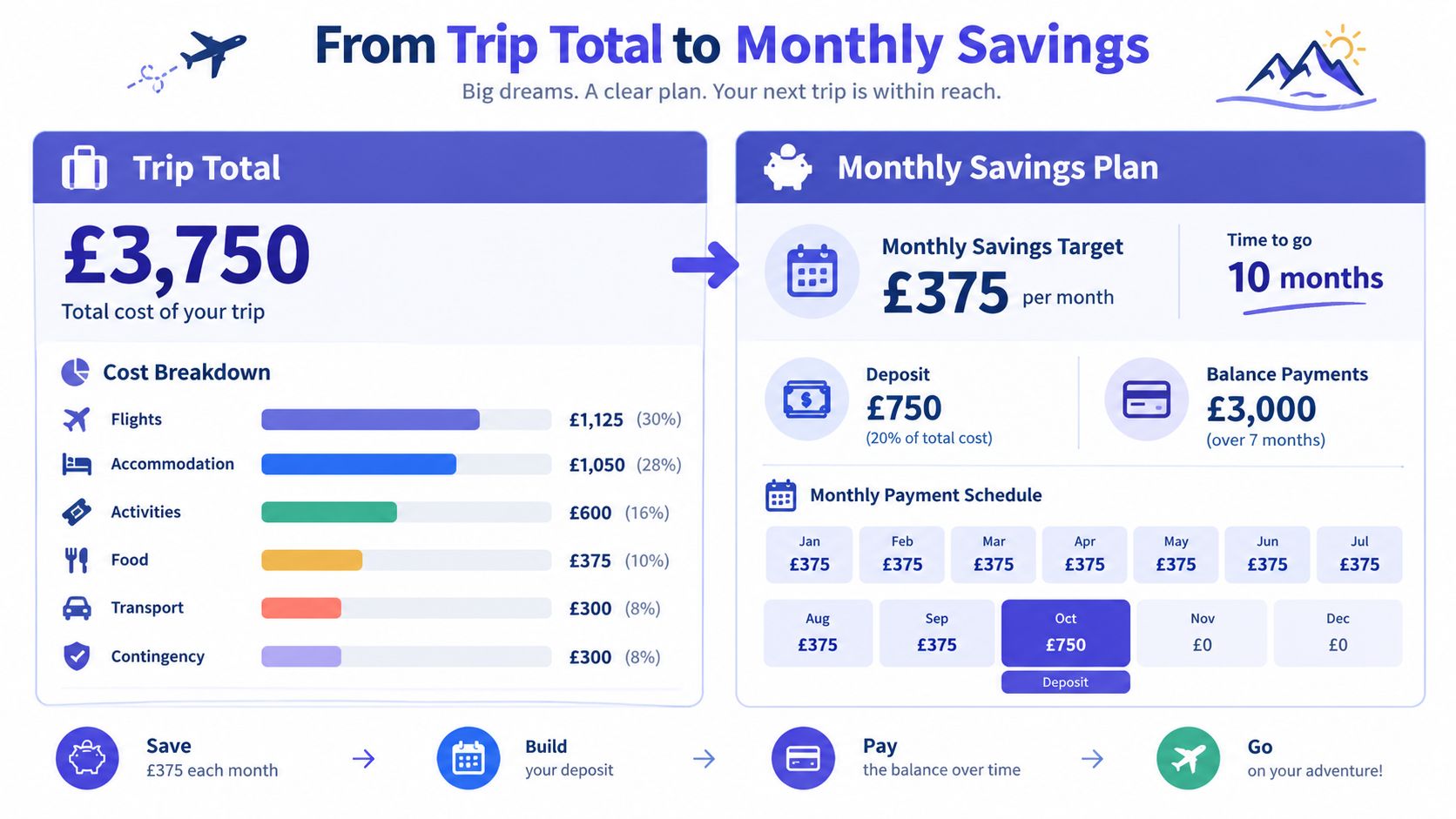
A trip total is useful only if it tells someone what to do next. Convert it into a savings target by subtracting money already set aside, then dividing the remaining amount by the months until it's needed. Track deposits and final balances separately, since a trip may demand cash well before departure.
A basic calculator can show the monthly amount for any chosen saving period without prescribing a universal timeline. Add the deposit due date and balance due date as separate inputs. If the target feels unaffordable, test a later date, a shorter trip, fewer paid activities or a different balance between one larger holiday and several smaller breaks.
Nationwide's 2026 spending-trends research recorded average planned annual UK spending of £5,517 on long trips and £2,348 on short trips, while 54% of consumers were concerned about the rising cost of living. The findings, reported in Nationwide's 2026 spending trends research, underline why a single annual allowance doesn't fit every household. The choice isn't always between an expensive destination and a cheap one. People can also change how often they travel, how long they stay or when they go.
Make the plan respond to changes
Build a small scenario comparison into the spreadsheet. Keep the destination and trip dates fixed, then adjust one choice at a time: duration, accommodation, transport or discretionary spending. For overseas travel, include an editable allowance for exchange-rate movement and card charges. That makes the calculator useful when a traveller wants to understand whether a change makes the trip more affordable.
For employees, affordability and leave availability should be considered together, but kept as separate outputs. A staff member can use a guide to planning annual leave for a relaxing break while checking dates with their manager before paying a deposit. That's better than booking first and discovering the absence clashes with a coverage need.
The Door-to-Door Costs Most Calculators Forget
An advertised flight-and-hotel price isn't the same as the cost of making the journey. Travellers still need to reach the airport, manage their bags and eat along the way. Once they land, transfers and local travel can add another layer of spending.
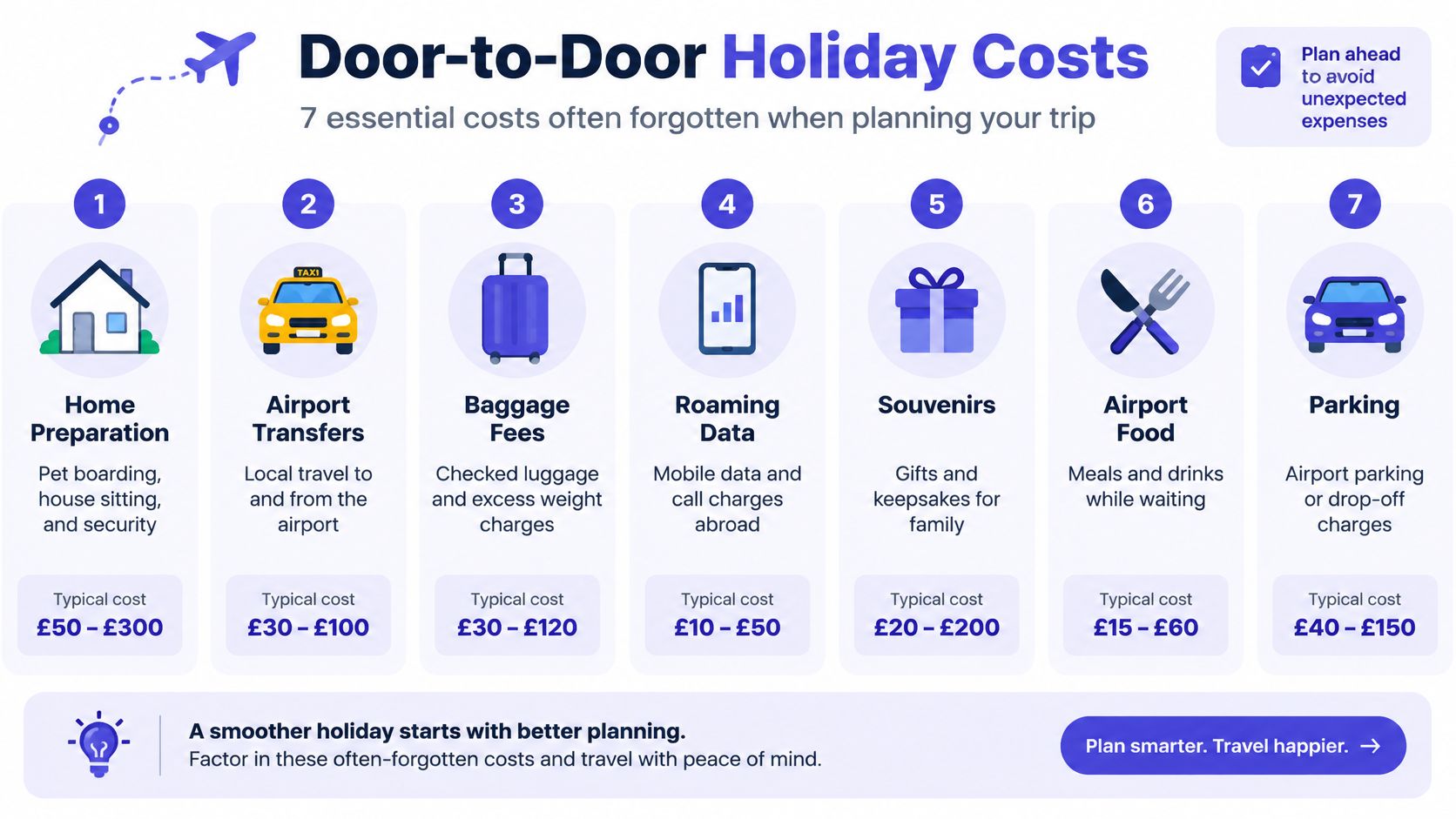
Travelex's UK survey found that the average person budgets £1,694 but overspends by £205. It also found that 43% forget airport parking, which averages £35.32, while 60% fail to budget for pre-departure spending and 59% omit socialising costs. See the Travelex analysis of the true cost of a holiday. That's why a calculator should offer prompts for overlooked costs rather than depend on a traveller remembering every line unaided.
Compare the whole journey, not one price
Include airport parking or rail fares, airport food, baggage, mobile roaming, currency fees, pet boarding or childcare, and transfers to accommodation. Add return-home costs where they apply, such as laundry or dry cleaning. Give each field a clear choice to enter an amount or mark it as not applicable.
Then compare realistic alternatives: driving versus flying, checked baggage versus cabin baggage, airport parking versus public transport, and a package versus independent bookings. A cheaper flight may lose its advantage once transfers and baggage are counted. Likewise, public transport isn't automatically cheaper if it doesn't fit the household's travel times or luggage needs. Use current quotes rather than invented defaults, and make the assumptions visible so a traveller can replace them.
For a quick visual reminder of what to include in a total journey estimate, use this video alongside the checklist:
Connecting Personal Holiday Budgets to UK Leave Entitlement
A holiday budget calculator for a small business should keep two questions distinct: what can the employee afford, and how much leave can they take? Almost all UK workers are legally entitled to 5.6 weeks of paid annual leave each year, subject to a statutory cap of 28 days for workers employed throughout a full leave year. Employers can include bank and public holidays within that allowance, and part-time workers generally receive a pro-rata entitlement. Check the UK government's holiday entitlement guidance.
Don't assign every employee the same allowance. A part-time worker's working pattern matters, and so does the employer's policy. The calculator should show the contractual allowance and whether bank holidays are included, alongside the employee's planned dates and the team's availability.
Irregular-hours and part-year workers need a different calculation. For leave years beginning on or after 1 April 2024, statutory entitlement accrues at 12.07% of actual hours worked in each pay period, up to a maximum of 5.6 weeks' paid leave per year. The method applies to qualifying workers whose hours vary substantially or who have unpaid gaps during the year. Capture actual hours, pay-period boundaries, worker classification and the leave-year start date, and follow government guidance on holiday entitlement reforms.
Keep entitlement and holiday pay separate
Leave hours or days aren't the same as their cash cost. For irregular-hours and part-year workers, holiday pay uses average pay over the previous 52 weeks, counting only weeks in which the worker received pay. Government guidance also allows rolled-up holiday pay for qualifying workers for leave years beginning on or after 1 April 2024. Don't estimate the cost by multiplying leave days by a single headline hourly rate when earnings vary; use the relevant paid-week history and seek payroll advice where needed.
A shared planning view can show a person's budget and available leave alongside team coverage. LeaveWizard's holiday entitlement calculator can support entitlement calculations, while managers still need to check operational availability before approving dates.
Template, Checklist and Common Questions
Build a spreadsheet with these tabs: Inputs, Fixed Costs, Daily Costs, Insurance and Risk, Door-to-Door, Monthly Savings and Leave Check. Add traveller numbers, trip days and destination allowances as editable inputs. Keep planned costs, contingency and risk-adjusted total visible rather than hiding the reserve in a miscellaneous line.
Before relying on it, check that it:
- Includes the full journey: Add transport to the airport, baggage, food, transfers and home-related costs.
- Separates known and variable spending: Use quotes for fixed items and editable daily allowances for variable costs.
- Shows affordability and leave separately: Confirm dates and coverage with a manager before booking.
Can rolled-up holiday pay be included? Yes, for qualifying irregular-hours and part-year workers where the relevant rules apply. Keep it distinct from the employee's leave balance.
What if the manager's availability view conflicts with the budget plan? Treat the budget as a personal planning tool, not approval. Resolve staffing coverage before the employee commits to dates.
Should the budget use GBP abroad? Yes. Keep GBP as the household or business planning currency, and show foreign-currency estimates and conversion fees separately.
LeaveWizard helps small businesses calculate employee leave allowances, manage requests and see availability for team planning. If you're replacing spreadsheets, visit LeaveWizard to explore its leave management tools and connect clearer holiday planning with day-to-day staffing.


