You've got a booking change arriving by text, a walker asking for the dog's medication notes, and a client waiting for confirmation that the visit happened. Meanwhile, an invoice still needs sending and tomorrow's route has already moved twice. A spreadsheet, calendar and messaging app can handle isolated tasks, but together they often create a second administrative job.
The strongest dog walking software connects scheduling, field updates, payments and team visibility in one working routine. This comparison looks at how each option performs in practice, including recurring bookings, visit verification, client communication, invoicing, staff management, pricing transparency, device support, UK usability, limitations and implementation effort.
The shortlist includes ten distinct choices, from UK-oriented platforms and lightweight solo tools to broader pet-care systems for businesses combining walking with sitting, boarding or daycare. The right option depends less on the longest feature list than on the work you need to complete reliably every day.
Table of Contents
- 1. Scritches
- 2. Pet Sitter Plus
- 3. Time To Pet
- 4. Scout for Pet Sitters
- 5. Precise Petcare
- 6. DoTimely
- 7. PetPocketbook
- 8. KennelBooker
- 9. Pet Check Technology
- 10. LeashTime
- 11. PetSitterPro
- Top 11 Dog-Walking Software Comparison
- Turn the Shortlist Into a Working System
1. Scritches
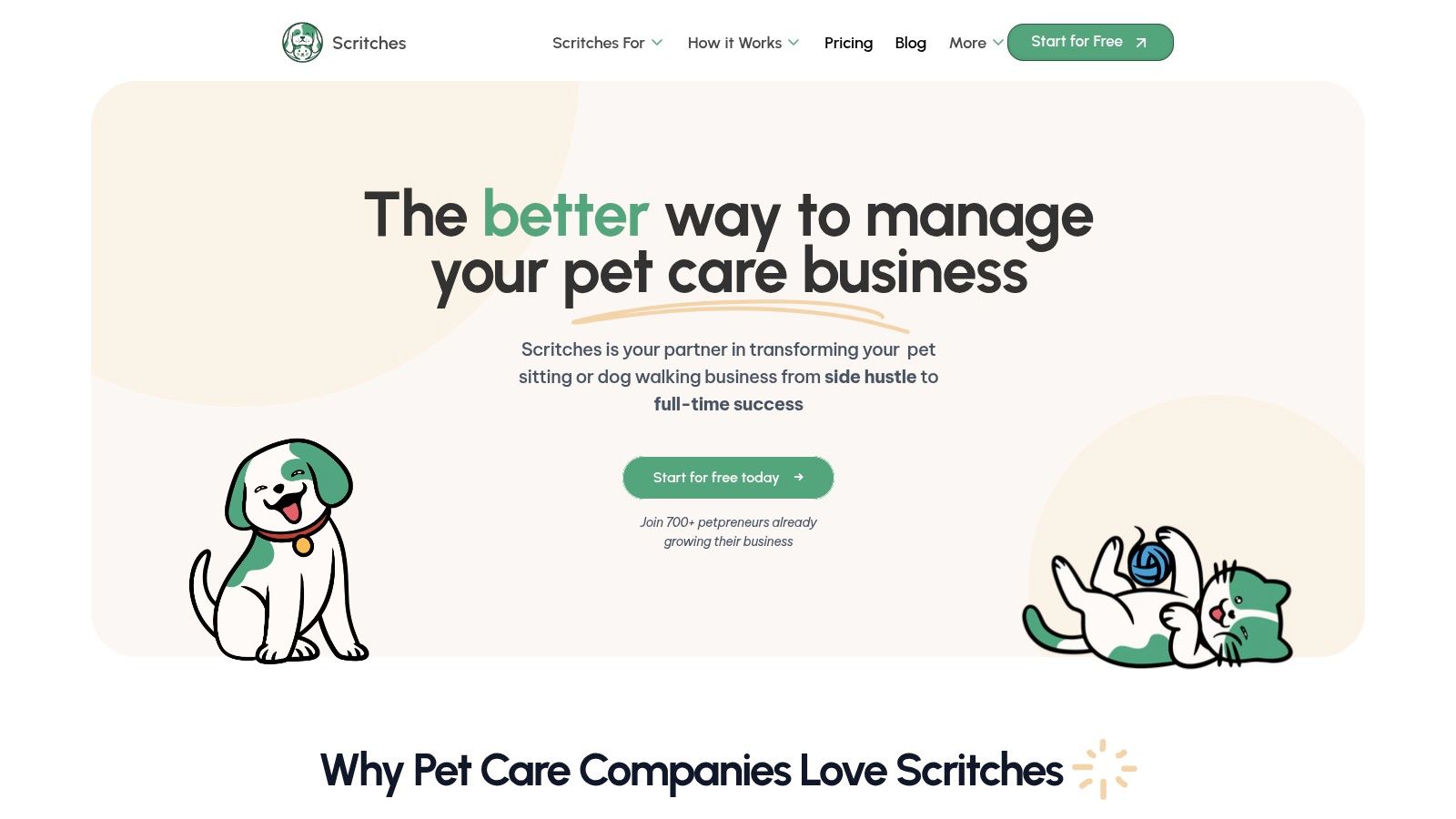
Scritches is particularly well matched to a solo walker or small pet-care business that wants clients to book directly without forcing them through a complicated account setup. Its central strength is the connection between the booking page, availability, pet records, invoices and visit updates.
Clients can submit requests through an online booking portal without logging in. You can choose whether requests are confirmed automatically or held for manual approval, which is useful when route geography, dog compatibility or staffing still needs a human decision. Availability rules and calendar synchronisation with Google, Outlook and Apple calendars, available on Solo Pro and above, help keep external commitments from creating conflicts.
Where Scritches reduces daily admin
The intake process is more useful than a basic contact form. Configurable fields can collect care instructions, veterinary information, medication details and other notes during booking, then place that information in the client and pet CRM. Digital agreements with e-signatures keep documents attached to the relevant record rather than buried in email.
Payments are similarly consolidated. Stripe supports online payments, while cash, Venmo, Zelle and cheque payments can also be tracked in the same system. Invoices, deposits, automated surcharges and rule-based fee adjustments reduce the need to calculate every unusual booking manually.
Practical rule: A booking system earns its place when the information entered by the client becomes usable operational data, not another form you still have to retype.
Visit report cards support photos and videos, and the Pet Parent Portal gives clients access to bookings and updates. Review Booster can automate post-service review requests, closing the loop between a completed walk, a client update and future social proof.
Plans and best fit
Scritches offers a Starter free tier, followed by Solo, Solo Pro and Growth. Growth adds staff scheduling, roles, profiles and pay reports, with an active-staff add-on model. Migration assistance for client and pet imports is helpful if you're leaving spreadsheets or another platform.
The trade-off is scale. A larger, multi-location operation may eventually need deeper workforce controls than a platform focused on solo providers and small teams. For a new independent walker, however, the low learning curve, branded booking page, Google Maps integration and conflict-aware scheduling make Scritches a practical starting point, especially when client experience matters as much as internal administration.
2. Pet Sitter Plus
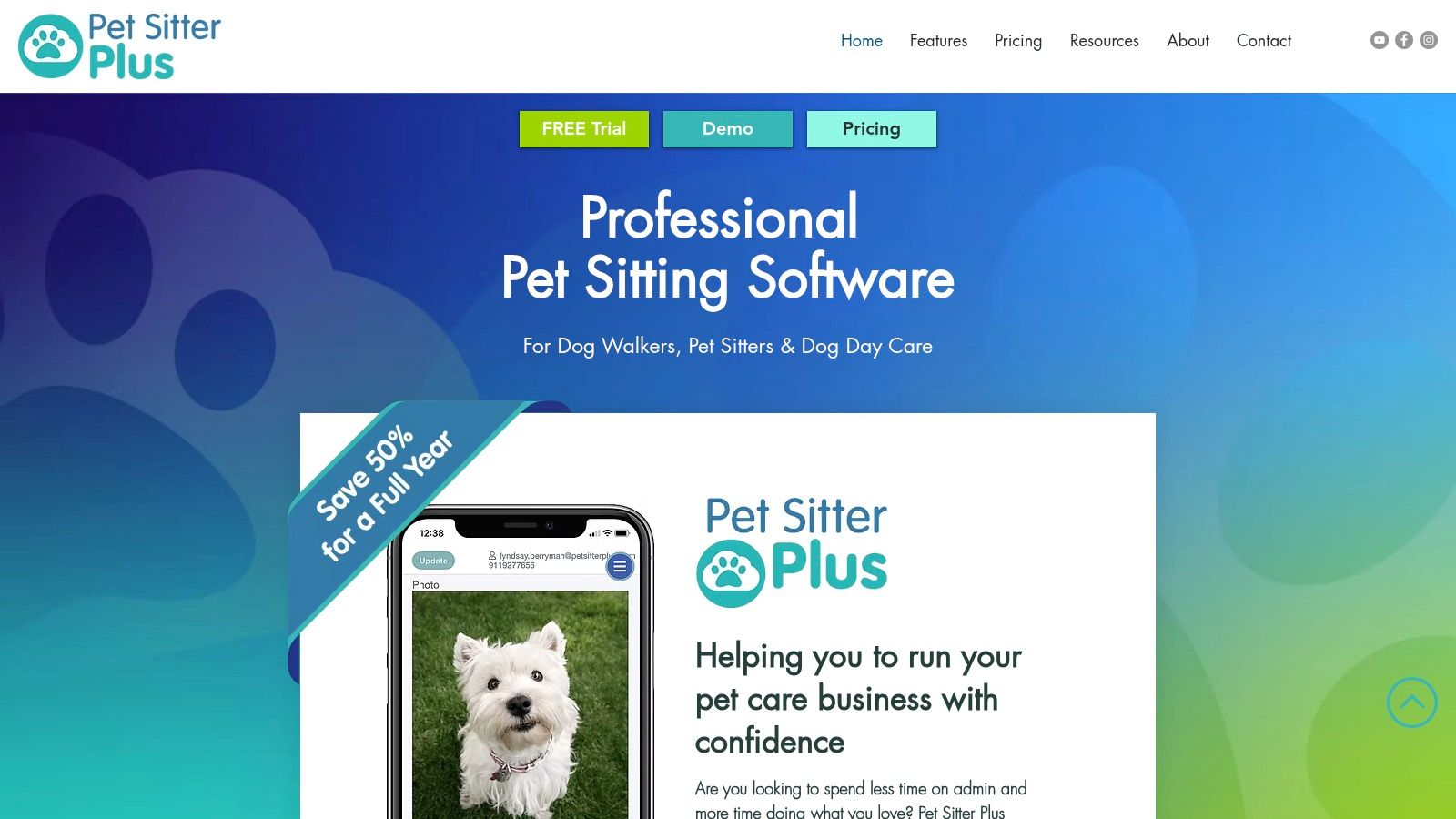
Pet Sitter Plus is a strong candidate for UK operators who want a mature end-to-end system with pricing published in pounds and UK phone support listed. It covers the operational chain from booking and pet profiles through GPS check-in and check-out, visit reports, invoicing and reporting.
The client portal gives owners access to relevant information, while staff permissions help control what walkers can see and change. Stripe and QuickBooks Online integrations support payment collection and accounting workflows, and pay reporting is useful when the owner needs to reconcile completed visits with staff compensation.
What works well
Pet Sitter Plus uses the same features across its plans rather than locking important capabilities behind different tiers. That makes comparison easier and avoids an awkward situation where a business chooses a cheaper plan only to discover that a core reporting or communication function is unavailable.
The platform also offers a 30-day free trial and extensive onboarding support. Those resources matter because the interface can feel busy to someone moving directly from a paper diary or simple calendar.
Trade-offs
The Team plan charges by active user, so the total cost needs checking against seasonal staffing and occasional walkers. A small team may find the model sensible because inactive staff needn't be treated like regular users, but a larger crew should model its actual staffing pattern before committing.
For UK businesses that value local context, transparent GBP pricing and support, Pet Sitter Plus is one of the more straightforward options to investigate. It's less compelling if you want an extremely minimal solo tool with almost no setup, because its breadth brings a learning curve.
3. Time To Pet
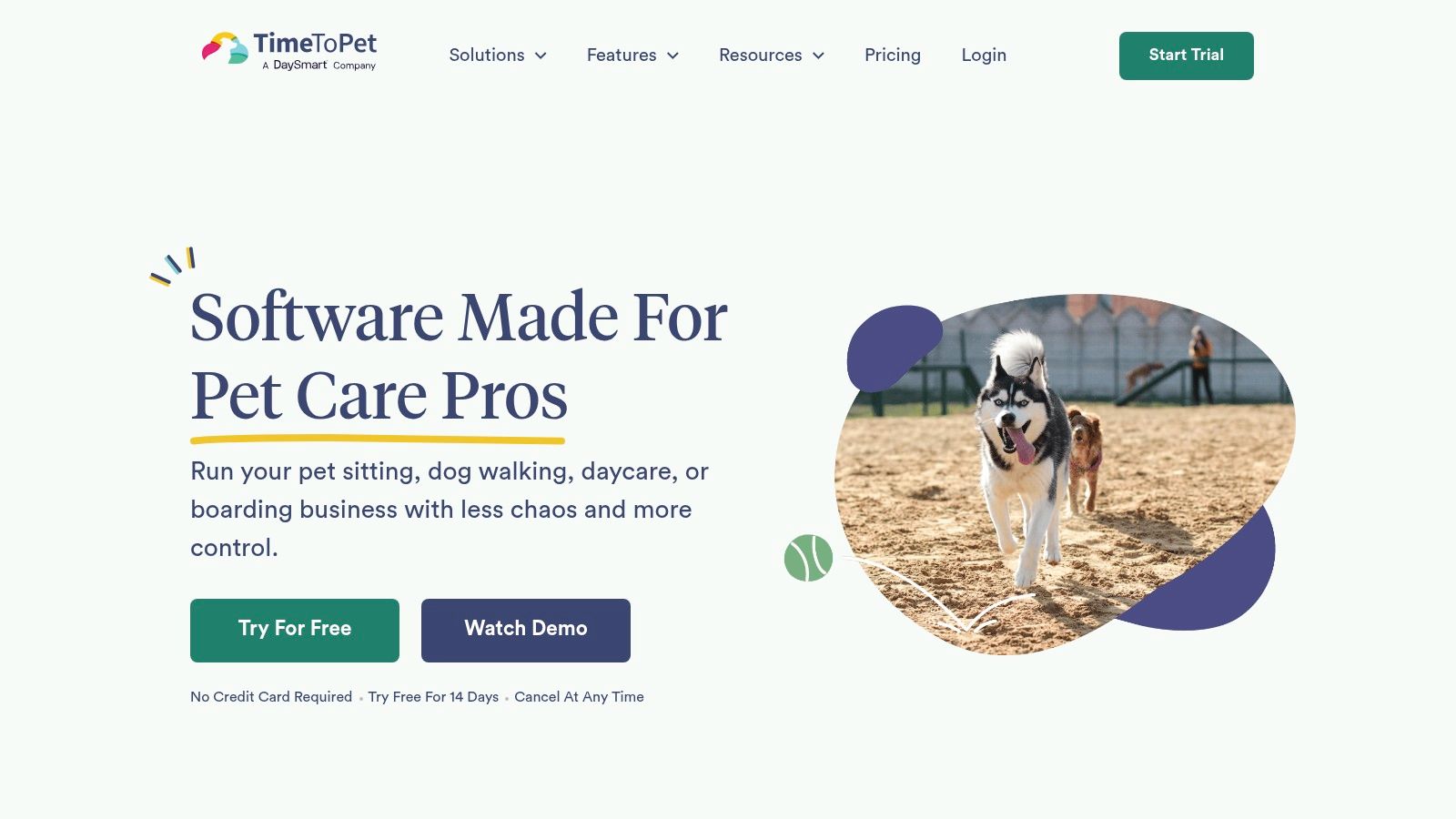
Time To Pet suits a business that has outgrown a simple diary and needs recurring, bulk and multi-day scheduling handled with more control. Client and staff mobile apps support GPS, photos and videos, while roles, permissions, time-off and payroll tools address the coordination problems that appear once several walkers share the same client base.
Its payment workflow supports cards, ACH, Apple Pay and Google Pay, with QuickBooks integration for businesses that want completed service and financial records connected. The scheduling depth is especially useful when one change affects several recurring visits or when a manager needs to assign work across multiple neighbourhoods.
Operational strength
Time To Pet's mature ecosystem includes extensive documentation and demos, which can reduce the risk of adopting a powerful system without understanding how it will affect your routines. A team can set permissions, manage availability and keep visit information in a shared environment rather than passing updates through personal messages.
Managers should still design the workflow before enabling every automation. Staff need a clear expectation for when they check in, where they record notes and how they handle a cancelled or shortened visit.
For broader guidance on organising staff availability, see this practical resource on scheduling employees effectively. LeaveWizard isn't dog walking software, but the planning principles are relevant when employee availability becomes part of route coverage.
Limitations
Pricing is published in US dollars, which creates exchange-rate and payment-cost considerations for UK businesses. Larger teams may also need to contact sales to clarify Large Team pricing. That lack of immediate UK price certainty is a disadvantage beside UK-native alternatives.
Choose Time To Pet when scheduling depth, team controls and a mature documentation base outweigh the desire for a very simple interface. A solo walker with uncomplicated recurring work may find it broader than necessary.
4. Scout for Pet Sitters
Scout for Pet Sitters focuses on the client-facing and mobile parts of dog-walking operations. GPS tracking, photo check-ins, notifications and report cards give owners a clear record of the visit, while client and staff mobile apps let the business work away from a desk.
The base plans include unlimited clients and invoices, so a growing solo operator doesn't have to treat every new customer as a separate cost event. The per-staff add-on is clear enough to model, although the business should calculate the total once additional walkers join.
A premium presentation option
Scout's optional branded client app can give a larger or more design-conscious operation a stronger customer experience. An SEO website add-on provides another route to presenting services under the company's own identity rather than relying on a generic booking page.
That premium layer isn't automatically worthwhile. A branded app adds a significant monthly cost, and it won't solve a weak cancellation policy, poor route planning or incomplete pet records. It makes more sense after the basic workflow is already reliable and the business has a reason to invest in a more distinctive client channel.
Pros and cons
Pros
- Mobile delivery: GPS and photo check-ins are built around field work.
- Client experience: Notifications, report cards and an optional branded app support professional communication.
- Plan clarity: Base pricing and per-staff additions are easier to evaluate than an entirely bespoke quote.
Cons
- Currency: Base pricing is published in US dollars.
- Premium add-ons: The branded app can materially change the monthly commitment.
- Feature selection: Smaller operators may pay for presentation features before they need them.
Scout is a sensible fit for businesses that see client communication and brand presentation as competitive advantages. It's less suitable for an operator who only needs a basic recurring calendar and invoice register.
5. Precise Petcare
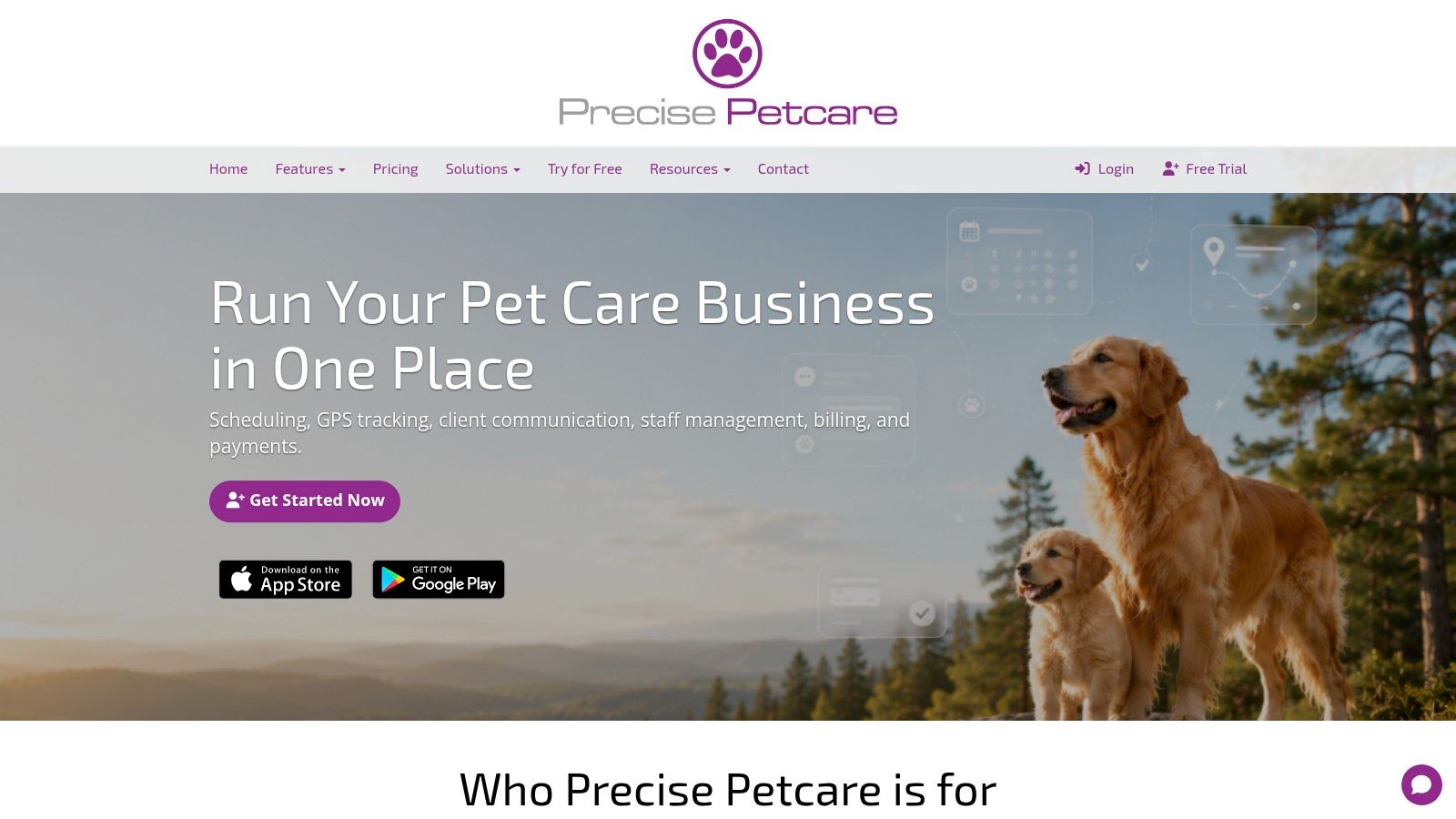
Precise Petcare takes a management and oversight approach to dog walking software. Alongside scheduling, client and staff apps, GPS, billing and communications, it offers late-arrival alerts and a live sitter map. Those features are valuable when an owner needs visibility into service delivery rather than just a list of upcoming appointments.
Plans are based on active staff count rather than feature gates. That gives a growing operator access to the same core toolkit while the team expands, and multi-location discounts may help businesses operating across separate areas.
The practical benefit is accountability. A manager can identify a late arrival, review a location update and keep communication moving without waiting for a walker to return to the office. Reporting also supports conversations about reliability and workload, provided the business has agreed in advance what data is used for.
A live map is useful only when staff use the mobile workflow consistently. Test the app in the places where your walkers actually work, not just on a strong office connection.
The main limitation for UK buyers is that pricing is published in US dollars and the UK user community is smaller than that of UK-oriented tools. The interface may also feel less immediately modern than newer products, so onboarding deserves attention.
Precise Petcare fits a data-focused operation with multiple walkers, late-arrival concerns or more than one location. A solo provider with a stable route will probably gain more from simple booking and billing than from live operational oversight.
6. DoTimely
DoTimely is built around reducing manual contact with clients. Customers can submit booking requests and change requests themselves, while GPS tracking, real-time notifications, messaging and automated invoicing keep the service record moving after a request is accepted.
The payment and business integrations are a useful differentiator for operators with an existing back office. Stripe, QuickBooks, Xero and Mailchimp connections can support payment collection, accounting and customer communication without requiring every update to be copied between systems.
Where automation helps
Custom client rates and discounts are important for businesses with different pricing arrangements, recurring customers or negotiated service packages. Automating those rules can prevent the owner from applying the wrong amount when a familiar booking pattern changes.
The Essential or free entry path also makes DoTimely approachable for a solo walker who wants to test self-service booking before taking on a full subscription. That lower barrier doesn't remove the need to inspect the actual workflow. A free plan is useful only if the booking, invoice and notification sequence matches how you operate.
A documentation caution
DoTimely's pricing pages are split across products, and finding the exact tier may require digging. Documentation style also varies across the site, so buyers should ask specific questions about the features they consider essential rather than assuming every plan detail is obvious.
Use a trial or demonstration to test a real booking change, a custom discount, an invoice and a client notification. DoTimely is most attractive when automation and integrations are more important than a perfectly simple pricing page.
7. PetPocketbook
PetPocketbook is notable for a flat pricing approach with no per-staff add-ons. That makes the monthly cost easier to forecast for a business that uses several walkers, particularly when group walks are central to the service model.
The scheduling tools support group walks and repeat bookings, while automatic invoicing and reminders reduce the need to prepare recurring charges manually. A client portal, report cards and online payments complete the customer-facing workflow, so the platform isn't limited to internal calendar management.
Why group walks change the decision
Group walks create a different scheduling problem from one-dog visits. The operator needs to see which dogs belong together, which bookings repeat and whether a change affects the entire group or only one client. A system that handles those relationships clearly can prevent the owner from rebuilding the same route in several places.
Flat pricing also changes the scaling calculation. A solo walker may prefer a lower active-user model at the beginning, while a team can value the certainty of one subscription that doesn't rise with every additional staff login.
Limitations
PetPocketbook's pricing is published in US dollars, and its UK footprint is smaller than that of UK-native options. That doesn't prevent use in Britain, but it does mean you should check payment handling, date and currency presentation, customer support availability and accounting compatibility before migration.
Choose it when group-walk scheduling and predictable team pricing matter more than local market familiarity. It's less compelling for a UK solo operator who wants local pricing and support above all else.
8. KennelBooker
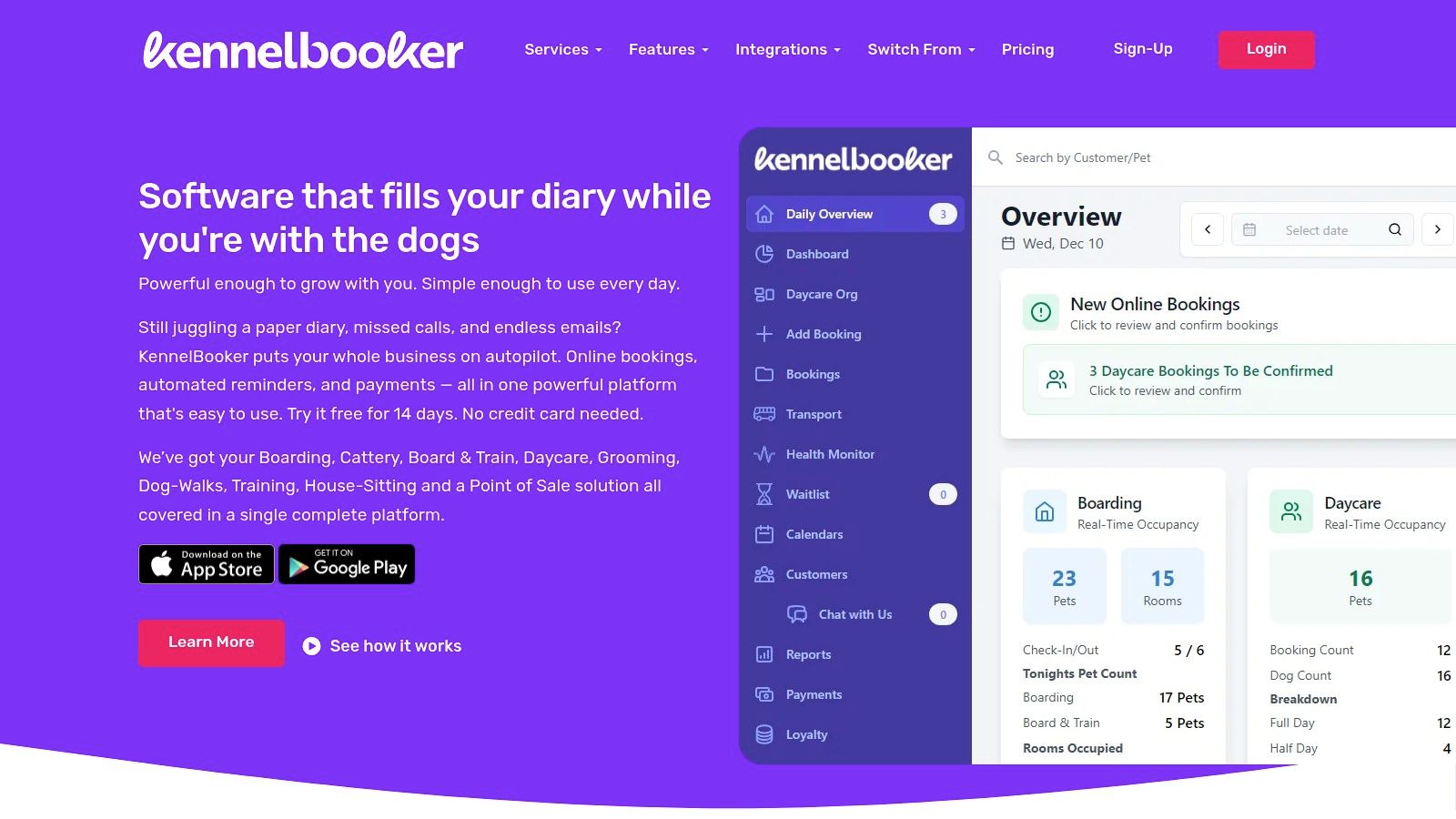
KennelBooker makes sense when dog walking is one service within a broader pet-care operation. It supports online booking through a website or Facebook and brings walking and homestay bookings into a platform that also handles boarding, daycare and training workflows.
That breadth can be valuable for an operator who wants one customer record and one financial process across several services. Capacity dashboards, arrival and departure views, reporting, multi-location support and enterprise capabilities provide room for a business that has moved beyond simple local walks.
The cost of breadth
A walking-only business may find KennelBooker's workflows wider than necessary. Boarding and daycare require different capacity, arrival and departure controls, so the interface can introduce decisions that a mobile walker doesn't need.
This is a good example of why the largest feature list isn't automatically the best choice. A mixed-service provider may save work by consolidating systems. A specialist dog walker may create work by adopting a platform designed around facilities and multiple service lines.
Pricing is published in US dollars, so UK and European operators should check currency settings and payment arrangements before signing up. The platform's walking capability is explicit, which makes it worth considering for UK, Irish and European businesses with mixed services, but the implementation plan should begin with the walking workflow rather than the full product catalogue.
9. Pet Check Technology
Pet Check Technology takes a different approach to proof of service. Instead of relying only on GPS, it uses barcode or QR-based check-ins and check-outs to record when a walker arrives and leaves. Clients receive a verification model that's easy to understand, and the business gets a clear visit trail.
The platform also includes scheduling, client management, iOS and Android apps, notifications, reporting and website capabilities. That combination makes it relevant to walking companies that want accountability to be visible at the point of service, not reconstructed later from location data.
When verification matters most
QR or barcode check-in can be useful when clients question arrival times, when several walkers cover the same area or when the business needs a consistent procedure for entering and leaving a property. It can also make staff expectations clear: the visit starts and ends through a defined action.
The method does introduce practical dependencies. Tags must be placed where walkers can access them, phones need to scan reliably and staff must remember the process. A GPS trail may be more natural for a mobile route, while QR verification can provide stronger evidence of the specific property visit.
Pricing isn't publicly listed, so a UK buyer needs a direct conversation about the quote, payment processing, SMS routing, data handling and support. Pet Check Technology is US-based, making those checks particularly important.
Choose it when visit verification is the primary operational concern and the company is willing to train staff around a defined check-in process.
10. LeashTime
LeashTime is a long-running option for established pet-sitting and dog-walking businesses that need client and pet records, scheduling, messaging, payroll support and mobile or website access in one environment.
Its broad core coverage can help a larger walking team keep customer information and staff work in the same system. The owner can manage schedules, communicate with clients and support payroll-related administration without assembling several separate tools.
Where it fits
LeashTime is better suited to an operation that values proven coverage of standard management tasks over a highly polished, modern interface. It can be a reasonable choice when the team already understands the workflow or when the platform's established feature set matches a business with several walkers.
The trade-off is adoption. The user experience is often perceived as older than newer alternatives, and pricing isn't clearly published online. You'll need to enquire directly and ask for a demonstration using your own common scenarios, including a recurring booking, staff reassignment, client message and payroll report.
For guidance on separating employee availability from service bookings, this shift planner app resource may help. LeaveWizard is an employee leave and absence-management product, not dog walking software, so it should be evaluated as a complementary staff administration tool rather than a replacement.
LeashTime works best when its established operational breadth outweighs the appeal of a cleaner interface and transparent self-service pricing.
11. PetSitterPro
PetSitterPro is aimed at independent pet sitters and dog walkers who want a focused set of daily tools without adopting a large operations platform. Scheduling, client management, invoicing, deposits, discounts, mobile access, notifications and visit logs cover the routine work most solo providers need.
The strength is focus. A walker can keep bookings, customer details, payment records and visit notes together without first building a complex staff structure. Deposit and discount tracking is particularly useful for businesses that use different arrangements for new customers, repeat clients or specific service packages.
What to check before choosing
The official site provides limited public pricing information, so confirm the current subscription, payment processing costs, user limits and support arrangements directly. The smaller ecosystem also means fewer third-party integrations than larger platforms, which could matter if your accounts, marketing or payment processes already depend on other services.
The mobile app and notifications should be tested with a real visit sequence. Record a visit log, send an update, issue an invoice and check how the client sees the information. A lightweight system only stays lightweight if it removes duplicate entry rather than shifting it into another application.
For solo operators, PetSitterPro is worth considering when the priority is accessible booking and billing rather than advanced reporting or multi-location management. This appointment-setting guidance is relevant to organising availability, but LeaveWizard itself remains a separate employee administration product.
Top 11 Dog-Walking Software Comparison
| Product | Core features ✨ | Quality / UX ★ | Price / Value 💰 | Target audience 👥 | Standout / USP 🏆 |
|---|---|---|---|---|---|
| Scritches | Online booking, CRM, payments, calendar sync, report cards | ★★★★☆ Modern, pet-parent friendly UX | 💰 Starter free; Solo → Growth (per-active-staff add-on) | 👥 Solo operators & small teams | 🏆 No-account booking; real-time availability; review automation |
| Pet Sitter Plus | GPS check-ins, client portal, invoicing, reporting | ★★★★ Mature UK-focused product (busy UI) | 💰 GBP pricing; per-active-staff billing | 👥 UK walkers → multi-site teams | 🏆 UK pricing/support; no feature gating across plans |
| Time To Pet | Mobile apps (staff/client), robust scheduling, payments, QuickBooks | ★★★★☆ Powerful scheduling & docs | 💰 USD; scales by active staff | 👥 Growing teams needing advanced scheduling | 🏆 Advanced recurring/bulk scheduling + payment flexibility |
| Scout for Pet Sitters | GPS tracking, unlimited clients, mobile apps, optional branded app | ★★★★ Strong mobile experience | 💰 USD base; branded app extra | 👥 Solo & teams wanting branded client experience | 🏆 Optional fully branded client app |
| Precise Petcare | GPS/live sitter map, client & staff apps, invoicing, reporting | ★★★★ Clean scaling & app parity | 💰 USD; priced by active staff; multi-location discounts | 👥 Small → multi-location walking businesses | 🏆 Live sitter map; clean active-staff scaling |
| DoTimely | Self-service bookings, GPS, automated invoicing, integrations | ★★★★ Emphasis on automation | 💰 Free Essential tier + paid upgrades | 👥 Solos & automation-focused operators | 🏆 Free entry path; strong automation & integrations |
| PetPocketbook | Group-walk scheduling, auto-invoicing, client portal, payments | ★★★★ Focused scheduling for group walks | 💰 Flat monthly price, no per-staff fees | 👥 Group-walk operators & small teams | 🏆 Predictable flat pricing; strong group scheduling |
| KennelBooker | Online booking, capacity dashboards, multi-service (boarding/walking) | ★★★★ Broad ops tool for mixed services | 💰 Published pricing; walking included (check currency) | 👥 Businesses offering mixed services (boarding + walks) | 🏆 All-in-one for boarding/daycare + walking operations |
| Pet Check Technology | Barcode/QR check-ins, mobile apps, scheduling, notifications | ★★★★ Clear visit-verification UX | 💰 Pricing by contact (not public) | 👥 Walking companies prioritizing visit proof | 🏆 QR/barcode-based arrival verification (non-GPS) |
| LeashTime | CRM, scheduling, messaging, staff/payroll tools, portals | ★★★★ Proven & feature-rich (older UI) | 💰 Requires inquiry for pricing | 👥 Established walking teams & larger operations | 🏆 Long-running platform with payroll & enterprise features |
| PetSitterPro | Scheduling, invoicing, deposits/discounts, mobile apps | ★★★★ Lightweight, practical UX | 💰 Cost-accessible (verify pricing) | 👥 Independent sitters & solo walkers | 🏆 Purpose-built, affordable for solo pros |
Turn the Shortlist Into a Working System
There isn't one universal winner. The best choice depends on where the operational pressure sits.
A UK business that wants published GBP pricing, UK-oriented support and a mature pet-care workflow should start with Pet Sitter Plus. Scritches is a strong fit for a solo operator or small team that values low-friction online booking, structured intake and a polished client experience. Time To Pet suits recurring and bulk scheduling with deeper team controls. PetPocketbook deserves attention when group walks and flat team pricing drive the decision.
The other options solve different problems. Scout is attractive for mobile updates and a premium branded client experience. Precise Petcare fits data-led oversight, late-arrival alerts and live staff visibility. DoTimely is built for self-service requests and integrations. KennelBooker is the logical direction for mixed pet-care services. Pet Check Technology stands out for QR or barcode visit verification, while LeashTime and PetSitterPro serve businesses that value broad or focused operational coverage respectively.
Pricing models need careful comparison. Some platforms use active-staff pricing, some use flat pricing without per-staff additions, and some offer a free or no-cost entry path. Pet Sitter Plus publishes pricing in GBP, while several alternatives publish pricing in USD. Pet Check Technology, LeashTime and PetSitterPro require direct pricing checks, and DoTimely's product-specific pricing pages may take additional investigation. Don't compare the headline subscription alone. Include payment processing, branded app add-ons, accounting integrations, extra staff, migration help and the cost of features you won't use.
Device support is just as important. A manager may work from a desktop, but walkers need fast access to pet instructions, bookings, check-in tools, photos and client messages on a phone. Native client and staff apps are useful, but a responsive portal can still work if it handles the field routine without awkward navigation. Test the exact devices your team uses.
A practical implementation sequence
Start with the booking-to-payment workflow. Write down what happens when a client requests a walk, when you approve or decline it, how the visit is assigned, what the walker records, when the invoice is created and how payment is reconciled. Configure the system around that sequence instead of recreating every old spreadsheet column.
Clean and import pet records before inviting clients. Remove duplicate contacts, standardise addresses, check emergency details and separate information clients should see from internal notes. Confirm that care instructions, medication information, access details and service history appear on the mobile screen where walkers need them.
Define staff permissions before the first live booking. Decide who can edit prices, approve requests, view financial information, change schedules and access sensitive client details. Then test mobile updates and client notifications using a limited pilot, preferably with a small group of cooperative customers and one or two walkers.
Confirm payment and accounting connections before the pilot ends. Run a real or controlled invoice, record an offline payment if your business accepts one, and check that the accounting destination receives the expected information. Train the team on only the essential workflow first. Add advanced automations after staff consistently complete the basics.
Three workable starting routines
- Solo walker: Clients submit requests through a branded booking page, the owner approves route-compatible visits, pet records supply care details in the field, the walker sends a report card, and the system invoices the client automatically.
- Small team: The manager reviews recurring demand, assigns visits according to staff availability, walkers check in through the mobile app, clients receive consistent updates, and the owner reviews payments and staff reports centrally.
- Mixed-service operator: Walking, sitting, boarding or daycare bookings share client records, while each service keeps its own capacity and scheduling rules. The business should test the most complicated service first rather than assuming a walking workflow will cover everything.
Avoid importing bad habits into better software. Recreating a messy spreadsheet, overlooking cancellation rules, failing to test location or QR check-ins, underestimating per-user fees and choosing a broad platform without needing its extra workflows can leave you with a more expensive version of the same disorder.
For growing teams that need separate employee availability and leave administration, LeaveWizard can complement dog walking software by managing staff leave and absences. It should remain a complementary employee-management system, not be treated as a booking, route or pet-care platform.
Review the shortlist against one week of real work, then book demonstrations or trials for the two options that match your operating model. Use actual client records, recurring bookings, payment scenarios and mobile visits in the test. Choose the platform your team can use consistently, and set a firm migration date once the booking-to-payment workflow has passed that test.