You're checking a spreadsheet while answering customer emails, and two employees have requested the same dates off. One person's allowance includes carried-over days, another works part-time hours, and nobody's quite sure whether the rota still has enough cover. By the time you've calculated the balances and replied to both requests, the afternoon has disappeared.
Choosing the best staff leave planner for small business shouldn't create another administrative project. The right tool depends on your team size, shift complexity, approval process, mobile self-service requirements, policy controls and whether you need a focused leave system or a wider HR platform. UK employers also need to track statutory holiday accurately. Most workers are entitled to 5.6 weeks of paid leave, with part-time and irregular-hours workers receiving an entitlement based on their working pattern, as set out by GOV.UK holiday entitlement guidance.
The comparison below evaluates ten tools by the operational problem they solve. Each entry covers everyday use, key capabilities, pricing approach, trade-offs and setup considerations, so you can judge what will help your managers make better decisions rather than add another dashboard.
Table of Contents
- 1. LeaveWizard
- 2. Timetastic
- 3. Breathe
- 4. CharlieHR
- 5. BrightHR
- 6. Sage HR
- 7. RotaCloud
- 8. Factorial
- 9. BambooHR
- 10. WhosOff
- Top 10 Staff Leave Planners: Small Business Comparison
- Match the Planner to the Work You Need to Control
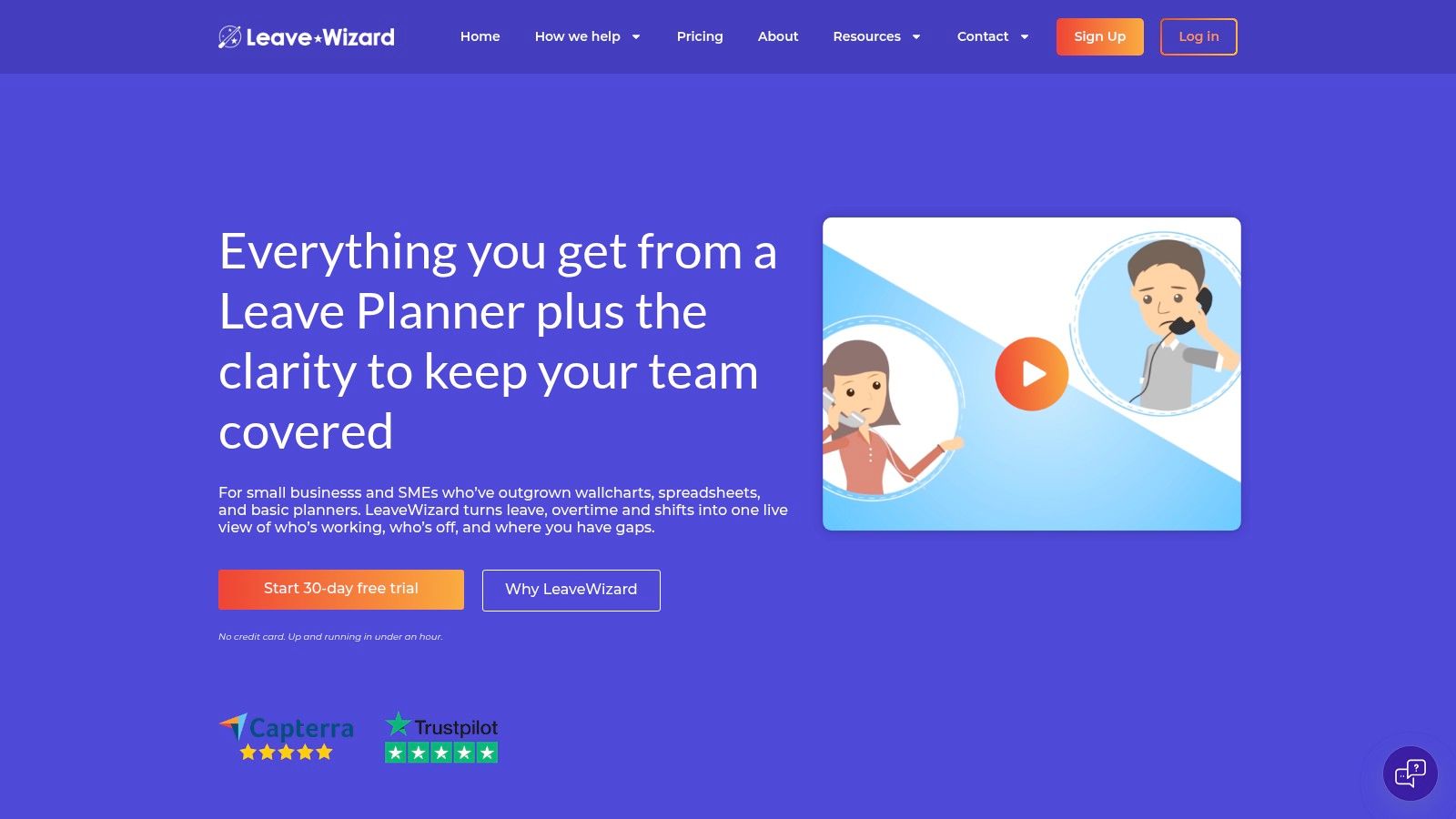
1. LeaveWizard
LeaveWizard suits a growing small business that has outgrown spreadsheets but does not need a full corporate HR suite. It brings holiday, sickness and other absence records together, so managers can see who is working, who is away and where cover may become difficult.
Its main operational benefit is reducing manual calculations. LeaveWizard handles leave calculations, accruals, carryovers and overtime, helping prevent disputed or incorrect balances. Policies can be configured for different working patterns, and bookings can be made in increments as short as 15 minutes. That fits businesses managing appointments, short shifts, school-hour arrangements or part-day absences.
Employees submit requests through web and smartphone apps. Managers can review them through calendar, email and mobile views, with approval workflows reducing the risk of requests being missed in an inbox. Configurable privacy controls determine which absence details employees and managers can see. The provider states that teams can typically set it up in under an hour without IT support.
Best for replacing manual calculations
The system also supports planning beyond individual approvals. Exportable reports and analytics provide cleaner absence data for forecasting and payroll, while team calendars show possible understaffing before a holiday is approved.
Practical rule: A leave planner should calculate the balance and show the coverage consequence. A calendar alone only solves half the problem.
Cost is the main point to clarify before choosing it. LeaveWizard does not publish public per-user or tiered pricing, so businesses need to contact sales for a quote. It is aimed at small and medium-sized teams, meaning organisations that later need extensive enterprise HR functions may outgrow it.
For its intended audience, the combination of quick setup, flexible policy rules and employee self-service is useful. LeaveWizard reports over 6,000 customers worldwide and offers a 30-day free trial without requiring a credit card. Visit LeaveWizard to test the approval and calculation workflow directly.
2. Timetastic
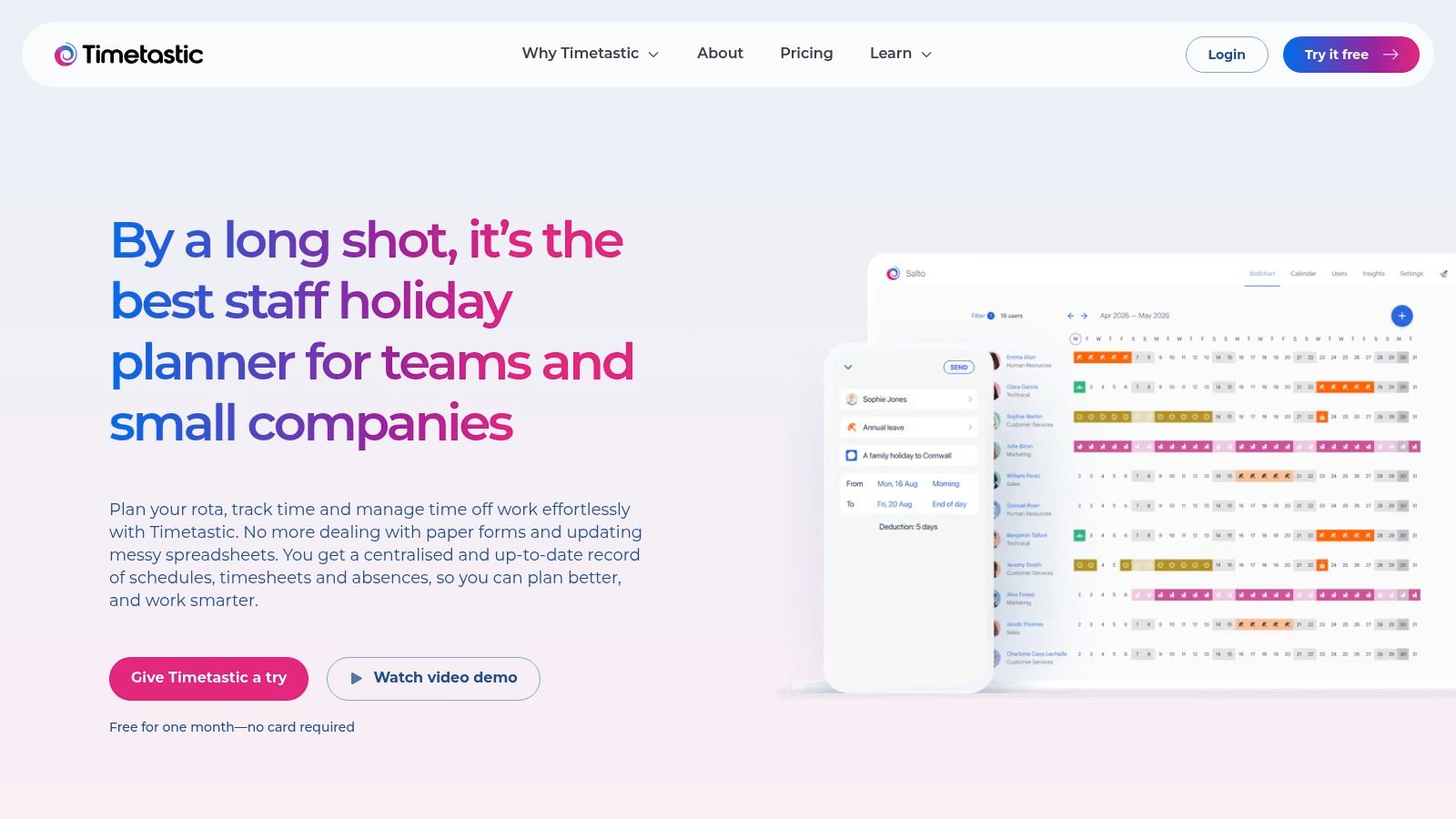
Timetastic is a dedicated UK staff leave planner built around speed and clarity. It suits a small team that mainly needs a shared calendar, straightforward approvals and an easy replacement for a spreadsheet.
The central view shows who's away and when, with allowances and departments available to managers. Employees can request leave from desktop or mobile apps, and integrations with Slack, Teams and calendar services help keep approved absence visible in the tools people already use. Timetastic also supports unlimited users and departments, which makes the structure easier to manage as the business grows.
Pricing is one of its clearest advantages. The product uses low per-user pricing and offers a 30-day free trial, so it's relatively easy to test without committing to a wider HR transformation. For a manager who needs to stop chasing email approvals and spot overlapping holidays quickly, that simplicity is useful. A staff holidays planner can offer a similar leave-first approach when the business wants more configurable calculations and absence logic.
Best for fast adoption
Timetastic has recently introduced rota and time-clock features in early access. That gives shift-based teams a possible route into broader workforce planning, but the newer module is still evolving. Businesses with complex scheduling requirements should test the rota workflow carefully rather than assume the leave calendar will cover every operational need.
The other trade-off is scope. Timetastic focuses on leave, so performance management, document storage and wider HR administration will need separate tools. Its Pro plan includes ISO/IEC 27001:2022 and 27701:2019 compliance, which may matter to organisations assessing security controls, but the best choice still depends on whether your priority is a clean leave calendar or a consolidated HR system.
3. Breathe
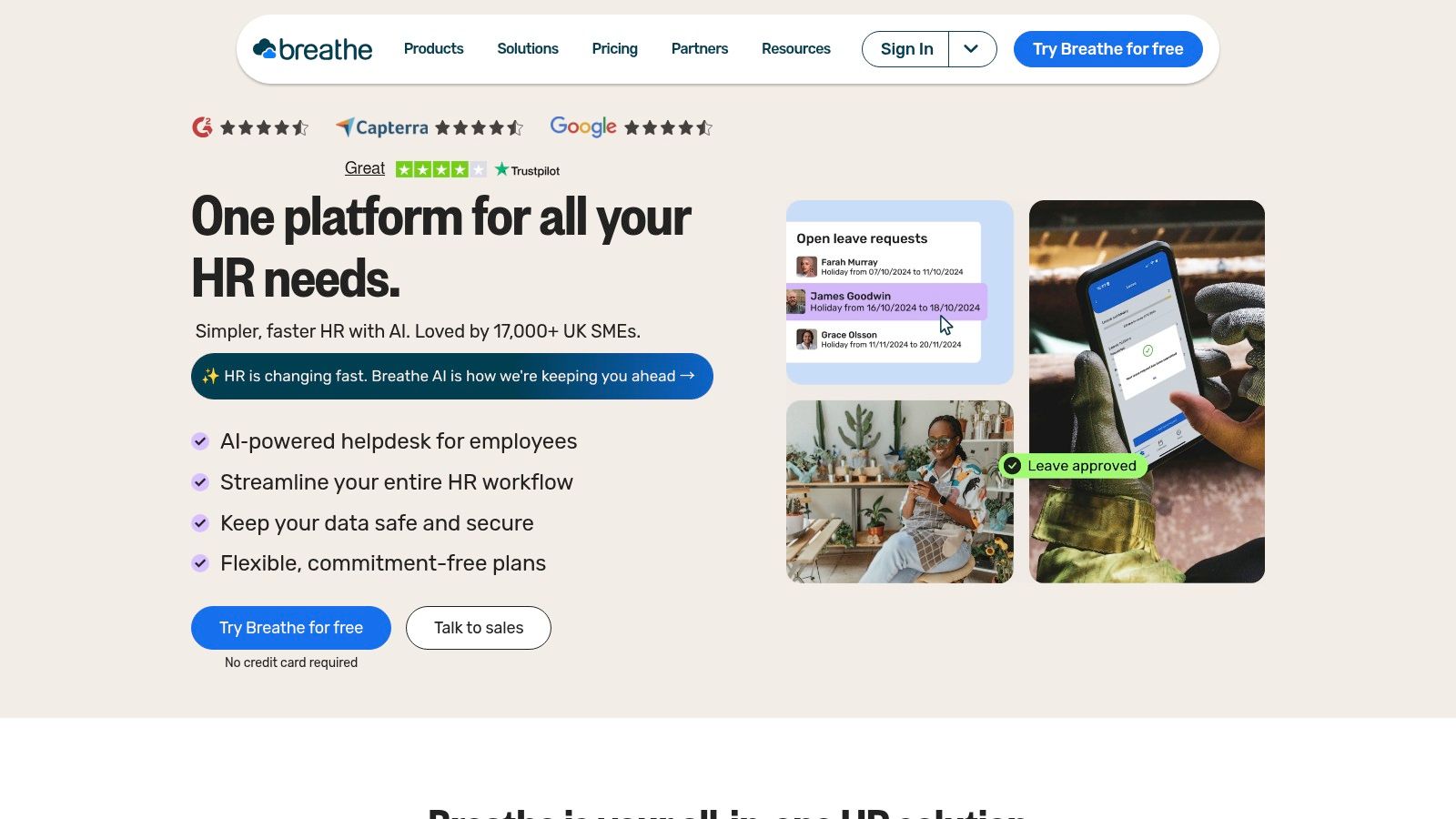
Breathe makes sense when leave planning is only one part of a small business's HR workload. Its holiday and absence tools sit within a wider UK-focused HR suite that also supports documents, policies and performance processes.
Managers can review holiday requests, monitor absence and use dashboards and reports to understand what's happening across the team. Employees get a more structured route for requesting time away, while administrators can keep employment documents and policies closer to the people records they relate to. That reduces the need to maintain separate spreadsheets for leave, policy acknowledgements and basic HR administration.
The pricing model is based on the business rather than a simple per-user charge, with headcount bands helping the cost scale as the organisation changes. Breathe offers a 14-day free trial and allows customers to cancel at any time. It also provides UK-oriented resources and support, with a UK data centre, which can be reassuring for an employer that wants local context rather than a generic global workflow.
Best for broader HR consolidation
The drawback is modular expansion. Rota, Time & Attendance, Recruitment, Expenses, Health and Safety and Learn are available as optional add-ons, but each addition can increase the total cost and administrative footprint. A business that only needs holiday approvals may find the suite broader than necessary.
Breathe is less suited to complex mid-market or multinational arrangements requiring extensive configuration across jurisdictions. For a UK SME that wants leave, policies and employee records in one approachable system, though, it's a sensible middle ground. Before choosing, compare the total package against a focused product and use this small business HR software guide to identify which modules you'll use.
4. CharlieHR
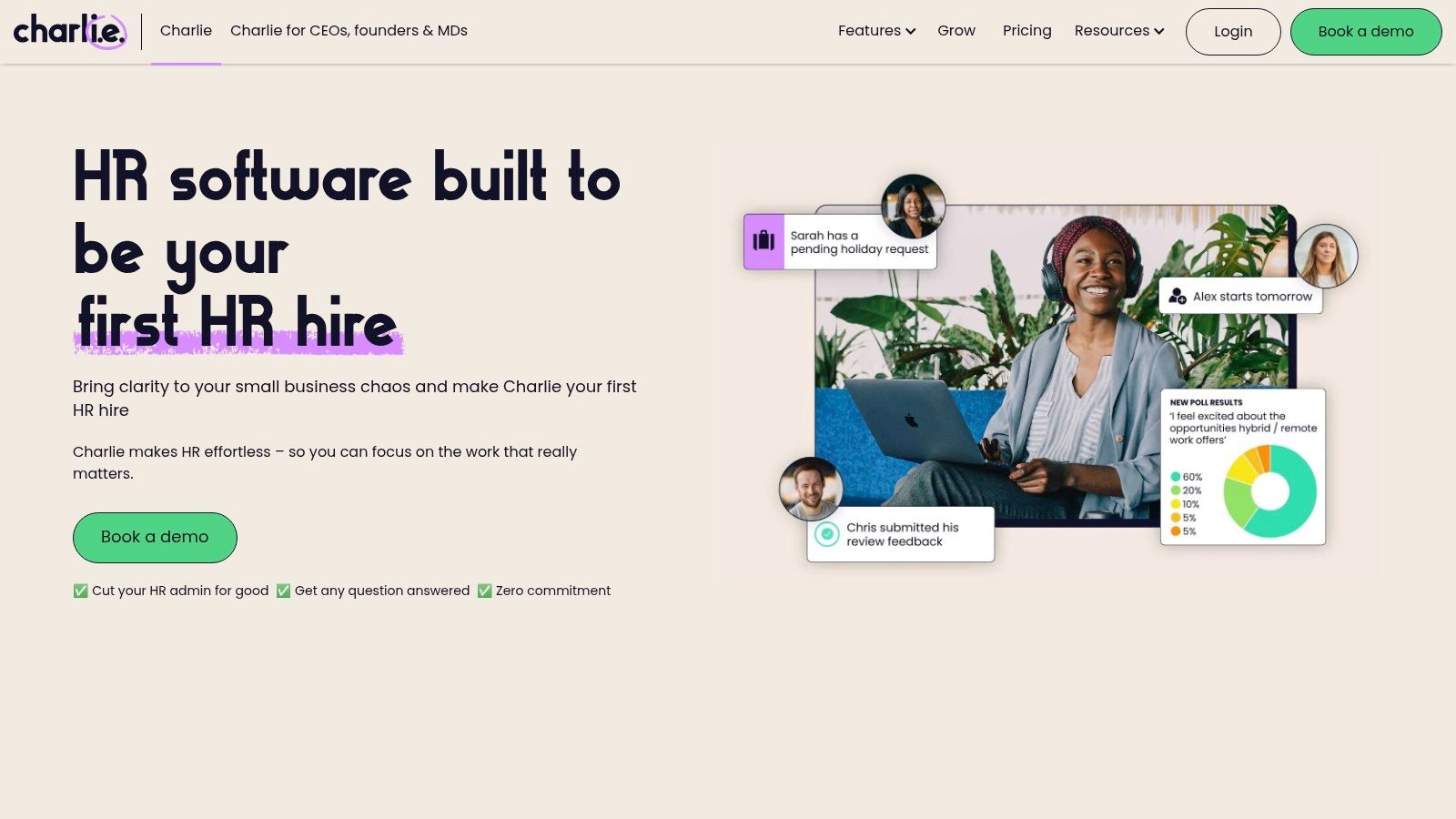
CharlieHR is designed for UK startups and SMEs that want a straightforward people system rather than a heavily configurable HR platform. Its time-off function covers holiday tracking, requests and approvals, while the wider system provides a central employee database, onboarding and basic review workflows.
The experience is intentionally simple. Employees can submit time-off requests without learning a complicated HR interface, and administrators can manage core records in the same environment. UK-centric workflows and policy awareness make it more relevant to local employers than a generic international calendar, particularly where managers need a consistent process for approving leave.
CharlieHR uses clear banded pricing based on headcount. That makes budgeting easier than a bespoke quote, although you should still confirm which features are included in the core package and which require an add-on. Charlie Advice provides HR guidance, while Recruit supports recruitment workflows.
Best for startup-friendly administration
Its limitation is configurability. A small business with unusual accrual rules, intricate shift patterns or several separate absence policies may reach the product's boundaries sooner than it would with a specialist leave platform. Advanced functions can also require additional modules, increasing the cost beyond the simple time-off use case.
CharlieHR works best when the business wants leave management alongside basic HR foundations, and values a clean employee experience over deep workforce planning. It won't replace a dedicated rota platform for a shift-heavy operation, and it isn't the obvious choice for an employer seeking detailed absence analytics. For a growing office-based SME, however, its focused UK approach can remove much of the friction from everyday approvals without overwhelming managers.
5. BrightHR
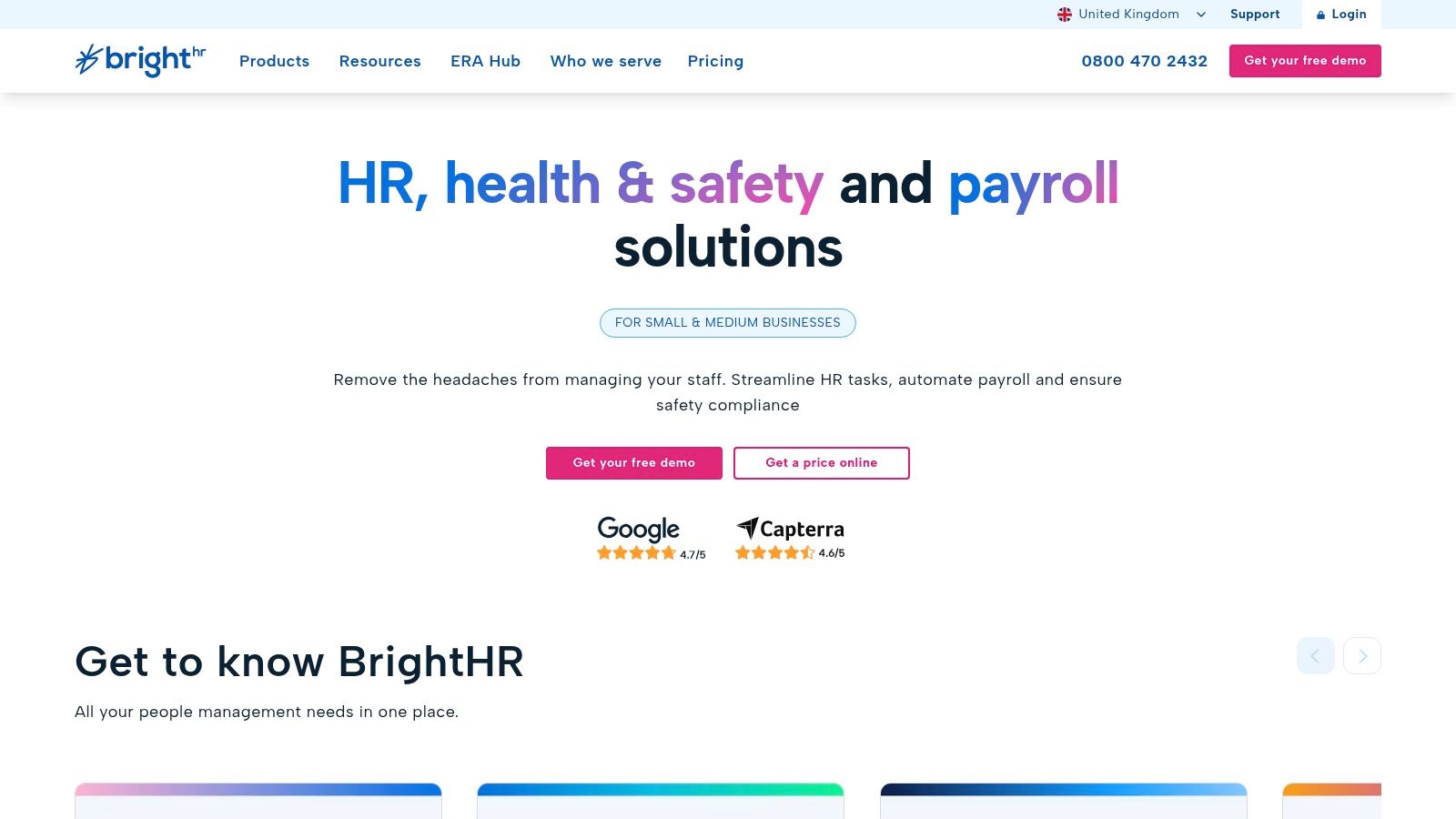
BrightHR is aimed at businesses that want holiday and absence management connected to rotas, timesheets and clocking-in. It's a broader people-management platform, so its value increases when the same managers are also responsible for shifts, attendance records and basic HR compliance tasks.
The staff holiday planner handles leave and sickness tracking, while shifts, rotas, timesheets and clock-in apps help managers compare planned availability with actual attendance. Optional HR advice, document templates, Health and Safety and wellbeing modules extend the platform beyond leave administration.
BrightHR offers packages ranging from software-only options to broader HR and Health and Safety support. Fixed pricing protection and defined contract terms can help with budgeting, but package and contract choices need careful review. Pricing often requires a sales conversation, and longer fixed-term arrangements may not suit a very small business whose headcount or requirements are changing quickly.
Best for an all-in-one operational package
The key question is whether you'll use the surrounding tools. If your problem is holiday clashes, BrightHR may feel heavier than necessary. If you're already coordinating rotas, attendance, policy documents and HR advice, the consolidation can reduce the number of systems managers have to check.
Small businesses should ask for a complete cost comparison, including any advice or Health and Safety components they might need later. Don't compare the entry package with a specialist leave tool and assume the workflows are equivalent. BrightHR's strength is breadth, but breadth only pays off when it replaces genuine work rather than adding unused modules.
6. Sage HR
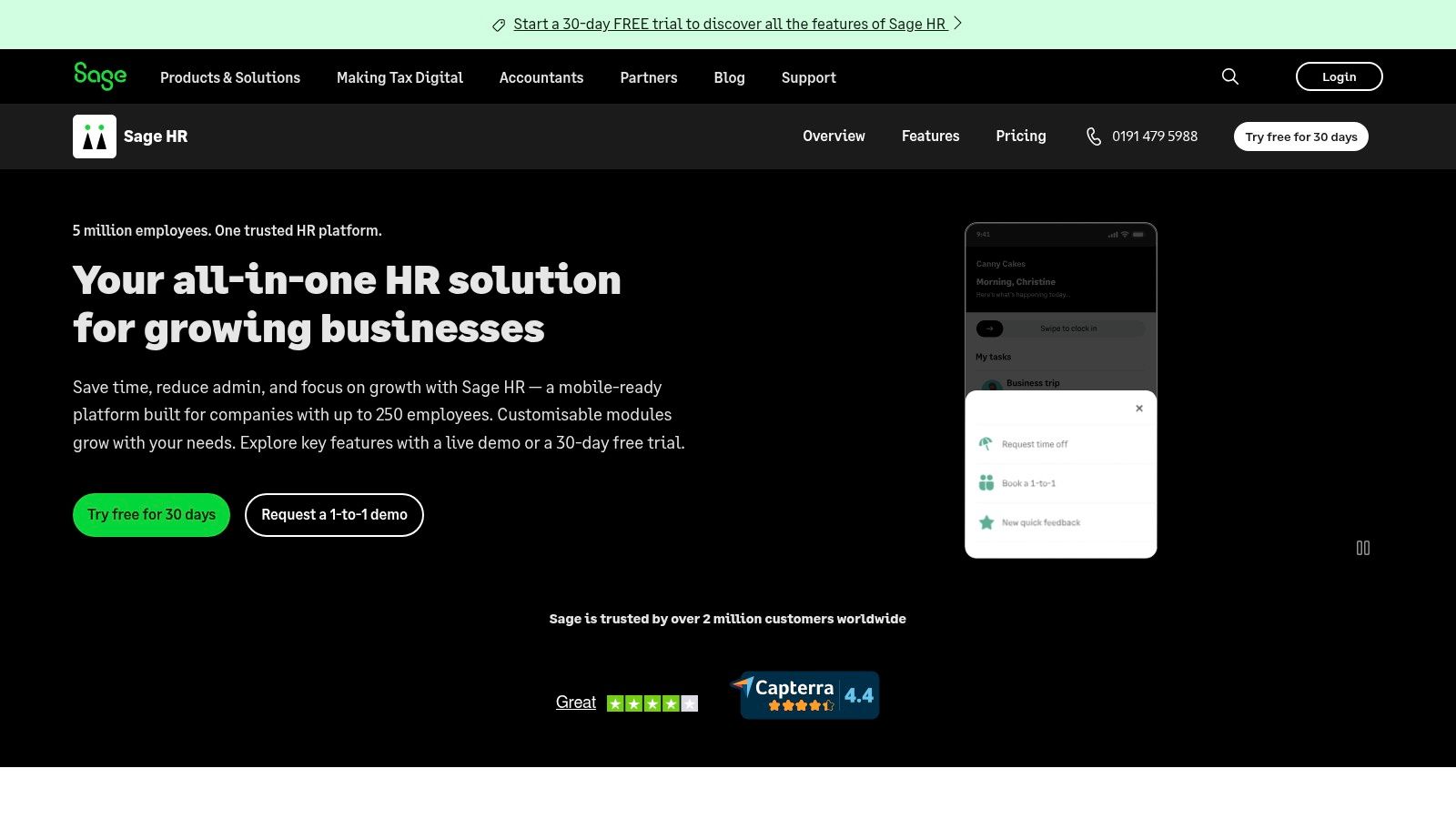
Sage HR is a modular option for SMEs that want to build HR capability around a familiar Sage environment. Core HR and Leave Management provide requests, approvals and calendars, while Timesheets, Shift Scheduling, Performance, Expenses and Recruitment can be added as the business needs them.
That menu-style approach is useful for a company that doesn't want to pay for every function on day one. A finance or payroll team already using Sage may also value the ecosystem connection, particularly when employee records and reporting need to sit alongside existing business processes. Mobile apps and reporting support managers who aren't always at a desk.
Sage HR offers a 30-day free trial, and its module structure makes it possible to start with leave management before expanding. The trade-off is that pricing is per employee per month, so the total rises as headcount and modules increase. The Recruitment module uses a flat monthly add-on, which may be more than a micro-business needs if it only hires occasionally.
Best for businesses already using Sage
Sage HR is a stronger choice when integration and incremental expansion matter more than having the lowest possible leave-only cost. It can support a business moving from basic holiday tracking into timesheets or shift scheduling without immediately replacing its broader finance setup.
It isn't automatically the best fit for a tiny team with no Sage connection. In that situation, a specialist planner may be quicker to deploy and easier for employees to understand. Ask for the price of the exact modules you'll use, then test an approval, a part-time entitlement and a carried-over balance before signing up.
7. RotaCloud
RotaCloud solves a different problem from a simple holiday calendar. It's built for shift-based businesses that need to plan rotas, record leave and sickness, and understand whether the available workforce can cover the operation.
Managers can drag and drop shifts into a rota, track holidays, TOIL and sickness, and use labour-cost controls while building the schedule. Employees can access the system through mobile apps, while optional Time & Attendance adds a route to comparing scheduled work with clocked hours. That makes RotaCloud particularly relevant to hospitality, retail and care businesses where absence affects a live rota rather than just a desk calendar.
Pricing has a low entry point, with a 30-day free trial, no long-term contracts and a structure that can scale as requirements change. UK-based support is another practical advantage for small operators who need help configuring the system around real schedules rather than abstract HR workflows.
A leave request is only safe to approve when the rota still works after the employee is removed.
The limitation is scope. RotaCloud is primarily a workforce-management and scheduling product, so performance, document management and wider HR records are lighter than in a full HR suite. Advanced compliance automation may also be less extensive than in a dedicated HR platform.
Choose RotaCloud when shifts and cover are the central operational concern. If most employees work regular office hours and the main pain is entitlement calculation, the rota-first interface may be more than you need.
8. Factorial
Factorial combines time off with time tracking, shift management and a wider HR suite. It's a good option for a growing SME that wants to connect leave planning with performance, recruitment and expenses rather than maintain separate systems.
The Time Off module supports unlimited policies and custom absence types. That matters when a business needs to distinguish holiday, sickness, TOIL or other policy categories instead of placing every absence into one generic bucket. Time Tracking and Shift Management add operational context, while the integration marketplace can connect Factorial with other business systems.
Factorial presents a modern EU data and security posture, including ISO 27001 and SOC badges on its site. It also receives regular product updates, which can benefit growing companies that expect their HR requirements to develop. Entry pricing is competitive for the breadth of functionality, but published pricing is shown as “from” and customized, so the final quote requires a sales discussion.
Best for a balanced HR and workforce setup
The most important UK limitation is payroll. UK payroll isn't native, so businesses may depend on exports or integrations. That isn't necessarily a problem, but it introduces another hand-off that should be tested before implementation.
Factorial suits an organisation that wants more than leave booking and is prepared to configure a broader platform. It may be unnecessary for a small team looking only to replace a holiday spreadsheet. Ask the vendor to demonstrate a complete journey from request to approval, rota visibility, reporting and payroll export, rather than judging the product from its calendar alone.
9. BambooHR
BambooHR is a mature global HR suite with a substantial Time-Off module. It supports accruals, approvals, calendars, custom policies and reporting, then extends into hiring, onboarding and performance at higher tiers.
The platform is suited to organisations that expect leave management to become part of a broader employee lifecycle system. HR teams can connect time-off workflows to employee data, approval processes and reporting, while add-ons provide a route into more advanced people operations. Its integration marketplace also helps businesses connect HR with other systems.
BambooHR offers unlimited custom policies and calendars, which can help businesses with different teams or locations. Global data centres, including Ireland, may be relevant to organisations assessing GDPR alignment. The platform also offers volume and nonprofit discounts, although smaller teams should check the commercial model carefully because pricing varies by headcount and plan, and a flat monthly minimum may apply.
Best for organisations outgrowing a leave-only tool
The breadth is also the main drawback. If you only need holiday requests and a clear team calendar, BambooHR may introduce more functionality, configuration and cost than the business needs. Implementation should include permission design, policy mapping and reporting decisions, rather than treating the system as a simple calendar purchase.
BambooHR makes most sense when the business wants a long-term HR foundation. For a smaller employer focused on practical absence workflows, employee leave management software may provide a more direct route to the operational result without the wider suite.
10. WhosOff
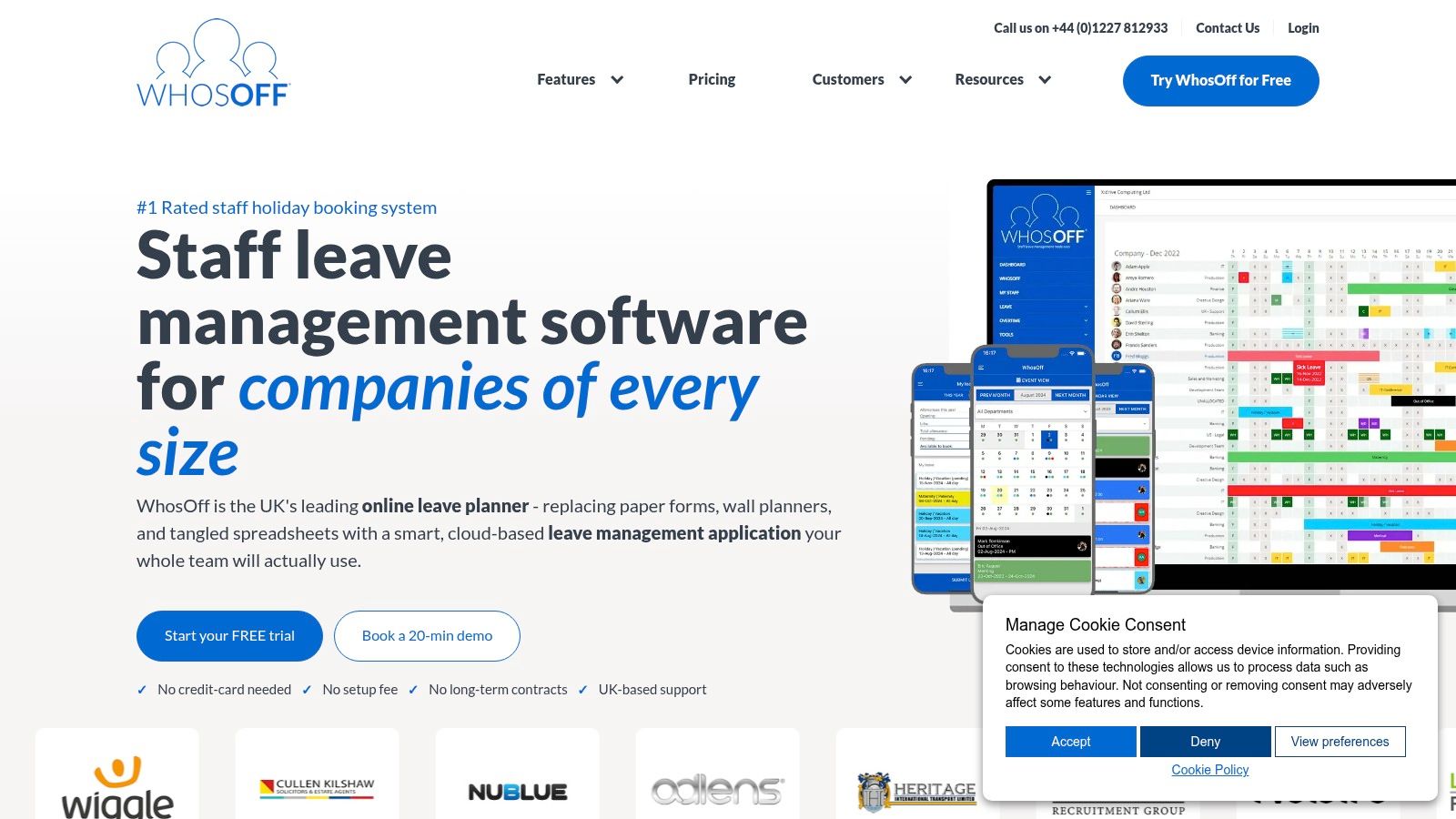
WhosOff is a long-standing UK leave planner focused on holiday and absence workflows. It covers annual leave, sickness, TOIL and multiple leave types, with manager approvals, conflict checks and wall-chart style views that will feel familiar to teams moving from a spreadsheet.
Its UK orientation is useful for businesses managing bank holidays, part-time entitlements and varied working arrangements. Reporting and exports give administrators a way to review absence records, while UK phone and email support can be valuable during setup. The product uses per-user pricing, has no minimum contract and is designed to remain focused rather than expand into a large HR ecosystem.
That focus keeps adoption straightforward. Managers can see clashes before approving requests, and employees get a defined process instead of sending informal messages. For a small team, that alone can remove recurring confusion around who is away and which leave category should be used.
Best for a traditional leave-first workflow
WhosOff's interface and integrations are simpler than those of newer HR suites. Businesses seeking performance management, onboarding, recruitment or extensive automation will need additional tools. It also may not feel as modern as platforms built around mobile-first employee experiences.
Choose WhosOff when policy depth and a focused UK leave system matter more than a broad HR roadmap. Before importing your spreadsheet, agree how to represent historic absence, TOIL, part-time balances and approval permissions. A clean initial setup will matter more than the number of features you never use.
Top 10 Staff Leave Planners: Small Business Comparison
| Product | Core features | UX / Quality | Pricing / Value | 👥 Target audience | ✨ Unique selling points |
|---|---|---|---|---|---|
| LeaveWizard 🏆 | Automated accruals, 15‑min bookings, approvals, calendars, reports | ★★★★☆ Real-time mobile & web; intuitive | 💰 30‑day trial; contact sales (no public per-user) | 👥 SMEs & growing teams needing robust leave management | ✨ Fast setup <1hr, granular rules, real‑time visibility, 6k+ customers |
| Timetastic | Team calendar, approvals, allowances, integrations | ★★★★☆ Simple, fast adoption | 💰 Low per-user pricing; 30‑day trial | 👥 SMEs moving off spreadsheets | ✨ Extremely easy UI; early-access rota/time clock |
| Breathe | Holiday & absence, dashboards, docs, add-ons (Rota, T&A) | ★★★☆☆ Clear UK-focused UX & support | 💰 Per-business banded pricing; 14‑day trial | 👥 UK SMEs wanting core HR + leave | ✨ Per-business pricing, UK support & resources |
| CharlieHR | Time-off, core HR database, onboarding, add-ons | ★★★☆☆ Simple UI tuned to UK policy | 💰 Banded pricing by headcount | 👥 UK startups & SMEs | ✨ Easy HR basics + optional HR advice & recruit |
| BrightHR | Leave, rotas, timesheets, H&S, HR/legal add-ons | ★★★☆☆ All‑in‑one but heavier footprint | 💰 Package/term pricing; sales call often needed | 👥 SMEs needing full HR/H&S packages | ✨ Tiered packages from software-only to full support |
| Sage HR | Core HR + Leave, modular add-ons (timesheets, shifts) | ★★★☆☆ Scalable modules; enterprise pedigree | 💰 Per-employee/month; add‑ons raise cost | 👥 SMEs up to ~250, Sage payroll users | ✨ Menu-style modules; integrates with Sage ecosystem |
| RotaCloud | Drag‑drop rotas, holiday/sickness, labour cost control | ★★★★☆ Scheduling-first; friendly UK support | 💰 Transparent low entry; 30‑day trial | 👥 Shift-based SMBs (hospitality/retail/care) | ✨ Strong rota features, no long contracts |
| Factorial | Time off (unlimited policies), time tracking, shifts, HR suite | ★★★★☆ Modern UI; rapid updates; EU security | 💰 Competitive entry; quote-based final pricing | 👥 Growing EU SMEs | ✨ Unlimited policies, ISO/SOC security posture |
| BambooHR | Time-off, accruals, approvals, hiring/onboarding, performance | ★★★★☆ Deep feature set; proven at scale | 💰 Tiered/headcount pricing; possible monthly minimums | 👥 Scaling orgs needing broad HR suite | ✨ Large integrations & AI-assisted HR features |
| WhosOff | Annual leave, sickness, TOIL, manager approvals, exports | ★★★☆☆ Focused, established UK tool | 💰 Per-user pricing; no minimum contract | 👥 UK teams wanting purpose-built leave planner | ✨ Strong UK policy depth, phone/email support |
Match the Planner to the Work You Need to Control
The best staff leave planner for small business depends on the failure you're trying to prevent. If managers are repeatedly correcting balances, chasing approvals and checking several calendars, a leave-first system such as LeaveWizard, Timetastic or WhosOff should be the starting point. These tools keep the central workflow clear: employees request leave, managers check availability, the system applies the relevant rules and everyone sees the approved result.
Choose LeaveWizard when the business needs automated calculations, carryovers, overtime handling, flexible policies and detailed absence visibility without taking on a full HR suite. Its quick setup and mobile self-service are useful for growing teams that need better control now, not after a lengthy implementation. Timetastic is attractive when simplicity and low per-user pricing are the priority, while WhosOff suits employers that want an established UK leave-focused product with support for varied entitlements.
A rota-led operation should look first at RotaCloud or BrightHR. RotaCloud is the more direct scheduling choice for hospitality, retail, care and other shift-based businesses where one absence changes the day's rota. BrightHR is broader, with rotas, clocking, documents, HR advice and Health and Safety options. The trade-off is that broader packages and fixed-term arrangements need closer commercial scrutiny.
Businesses wanting wider HR consolidation should compare Breathe, CharlieHR, Factorial and BambooHR. Breathe and CharlieHR are particularly approachable for UK SMEs, while Factorial balances time management with a broader modern HR platform. BambooHR is more appropriate when the organisation expects to build a substantial HR foundation and can justify the wider scope. Sage HR is the natural contender when payroll or accounting already runs through Sage and modular expansion is important.
UK leave planning needs more than an annual holiday number. Most workers are entitled to 5.6 weeks of paid leave, and GOV.UK explains that irregular-hours workers may have entitlement calculated at 12.07% of hours worked in a pay period, subject to the applicable rounding rule in its guidance. Use a system that can reflect your actual contracts and policies, not one that forces every employee into the same calculation.
A practical implementation sequence
- Document the rules first. Record holiday years, bank-holiday treatment, carryovers, sickness categories, TOIL, part-time arrangements and approval conditions.
- Map approval responsibility. Decide which manager approves each team, who covers during absence and who can amend a record.
- Test calculations and carryovers. Use representative employee records, including part-time and irregular working patterns, before importing the full team.
- Confirm visibility permissions. Employees need to see relevant availability, but sensitive absence information should only be visible to authorised people.
- Train employees on self-service. Show staff how to request leave, check balances, record sickness and view approvals from the web or mobile app.
- Review reporting after launch. Check whether managers can identify coverage risks and whether finance or payroll can export the records they need.
The right tool reduces manual work without adding unnecessary modules. For many growing small businesses, LeaveWizard is a relevant option because it combines automated calculations, configurable policies, real-time availability and quick implementation in one focused system.