Almost all UK workers are legally entitled to 5.6 weeks of paid annual leave, usually 28 days for someone working a five-day week, so LeaveWizard is the strongest starting point for small and growing businesses moving away from spreadsheets. Organisations needing broader HRIS depth or highly complex compliance workflows may prefer a platform such as edays, BambooHR or Personio.
A manager shouldn't have to approve a holiday request in one system, check staffing in a spreadsheet and confirm a regional bank holiday through scattered messages. Yet that's still a familiar working day for small and medium-sized businesses. One missed absence, outdated allowance or overlapping request can leave a team under-covered and create avoidable payroll or compliance work.
The best employee holiday planner should improve daily decisions, not just store holiday dates. Employees need clear self-service visibility, managers need live team calendars and approvers need policy-aware workflows that reflect full-time, part-time, irregular-hours and part-year arrangements. The UK's statutory framework comes from the government's holiday entitlement guidance, while sickness absence is tracked separately by the Office for National Statistics, making reliable visibility useful for both leave administration and capacity planning.
This ranking focuses on practical usability, policy flexibility, calendars and approvals, reporting, integrations, pricing signals, implementation effort and growth fit. It covers the introduction, comparison framework, ten ranked tools, usage guidance, pricing analysis and a final recommendation. Businesses working on wider employee retention strategies should treat holiday planning as part of the employee experience, not just an HR back-office task.
Table of Contents
- How to compare the best employee holiday planner
- 1. LeaveWizard
- 2. Timetastic
- 3. Breathe HR
- 4. CharlieHR
- 5. Sage HR
- 6. BrightHR
- 7. edays
- 8. Factorial HR
- 9. BambooHR UK
- 10. Personio
- Top 10 Employee Holiday Planners: Feature Comparison
- Use a holiday planner to manage coverage, not just requests
- Pricing and implementation trade-offs
- Choose the Planner That Matches Your Work
How to compare the best employee holiday planner
A holiday planner earns its place when it answers operational questions quickly. Who's away next week? Can this request be approved without leaving a shift uncovered? Has the employee accrued enough leave? Which rule applies to an irregular-hours worker? Can finance reconcile approved absence with payroll records?
The legal baseline matters. UK workers are generally entitled to 5.6 weeks of paid annual leave, normally 28 days for a five-day week, and the statutory entitlement is capped at 28 days, even for someone working six days a week, according to UK government guidance. Since 1 January 2024, the rules also clarify that four weeks of the statutory entitlement must be paid at the worker's normal rate under Regulation 13 of the Working Time Regulations, as explained in the holiday pay and entitlement reforms.
That means a useful tool must separate leave entitlement from holiday pay calculation. A calendar that only counts days can look simple while hiding the harder work.
The practical comparison points
- Implementation effort: Can an administrator configure the system without specialist IT support, or will it need a structured project?
- Policy complexity: Can it handle accruals, carryovers, shift patterns, custom absence types and variable working arrangements?
- Coverage visibility: Does it show who's off, who's working and where approval could create a bottleneck?
- Reporting: Can managers identify absence patterns, balances and capacity risks?
- Integration depth: Will it connect with calendars, payroll, HRIS, collaboration tools or an API?
- Pricing transparency: Can you estimate the cost from published information, or must you request a quote?
- Growth fit: Does it remain useful as the business adds teams, locations, entities or HR processes?
Bank holidays deserve separate attention. In 2026, England and Wales have 8 bank holidays, Scotland has 9 and Northern Ireland has 10, with regional differences including Scotland's 2 January holiday and Northern Ireland's 17 March St Patrick's Day holiday, according to GOV.UK's regional bank-holiday information. A strong planner should let the business apply the correct regional calendar rather than assume every UK employee follows the same list.
1. LeaveWizard
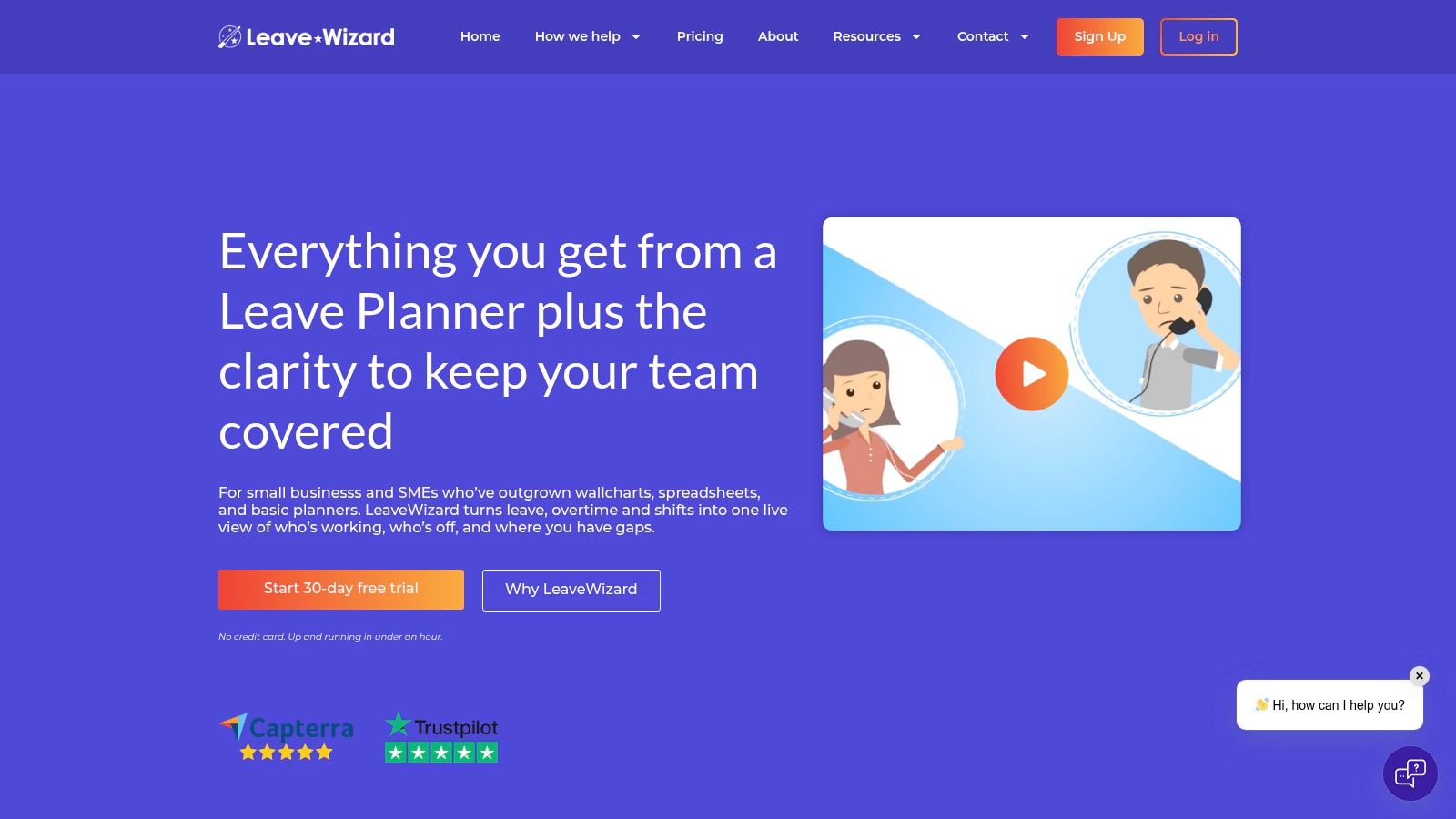
LeaveWizard is the strongest fit for a small or growing business that wants to replace spreadsheets without taking on a heavy HRIS implementation. It focuses on the daily problem managers face, tracking leave and absence while keeping a live view of team availability.
Setup is designed to be low friction, with no IT team required. Administrators can configure accruals, carryovers, shift patterns, overtime and flexible booking rules, while built-in calculators reduce the manual work involved in maintaining balances. The ability to book leave in 15-minute increments is useful for organisations that need more precision than a simple full-day holiday tracker.
Practical rule: Choose a planner that reflects how people actually work. A day-only system can become awkward when employees have shifts, partial-day leave or variable schedules.
Why it ranks first for growing SMEs
LeaveWizard combines employee self-service with manager control. Employees can submit requests through web and smartphone apps, check allowances and follow approval progress. Managers get calendars, notifications and integrations that provide a single view of who's in and who's away, which makes coverage conversations more immediate.
Reporting is another differentiator for a spreadsheet replacement. Administrators can use analytics and built-in calculators to review leave usage, identify capacity pressure and support more proactive planning. The platform also extends beyond holiday tracking with overtime recording, employee information and document management.
The main trade-off is pricing transparency. LeaveWizard offers a 30-day free trial with no credit card required, but subscription pricing isn't published and must be requested. That makes early cost comparison less convenient than with a transparent, lightweight product. It's also more naturally suited to small and medium-sized organisations than to enterprises seeking a full HRIS and detailed payroll architecture.
Customer feedback supplied for the platform includes comments such as “saved us days of time” and “easy and reliable” from Brymec, Truvision and Eagle Eye Solutions. LeaveWizard also states that it serves over 6,000 customers worldwide, claims that should be assessed alongside the buyer's own trial and implementation requirements. For more detail on the small-business use case, see how LeaveWizard makes life easier for small businesses.
2. Timetastic
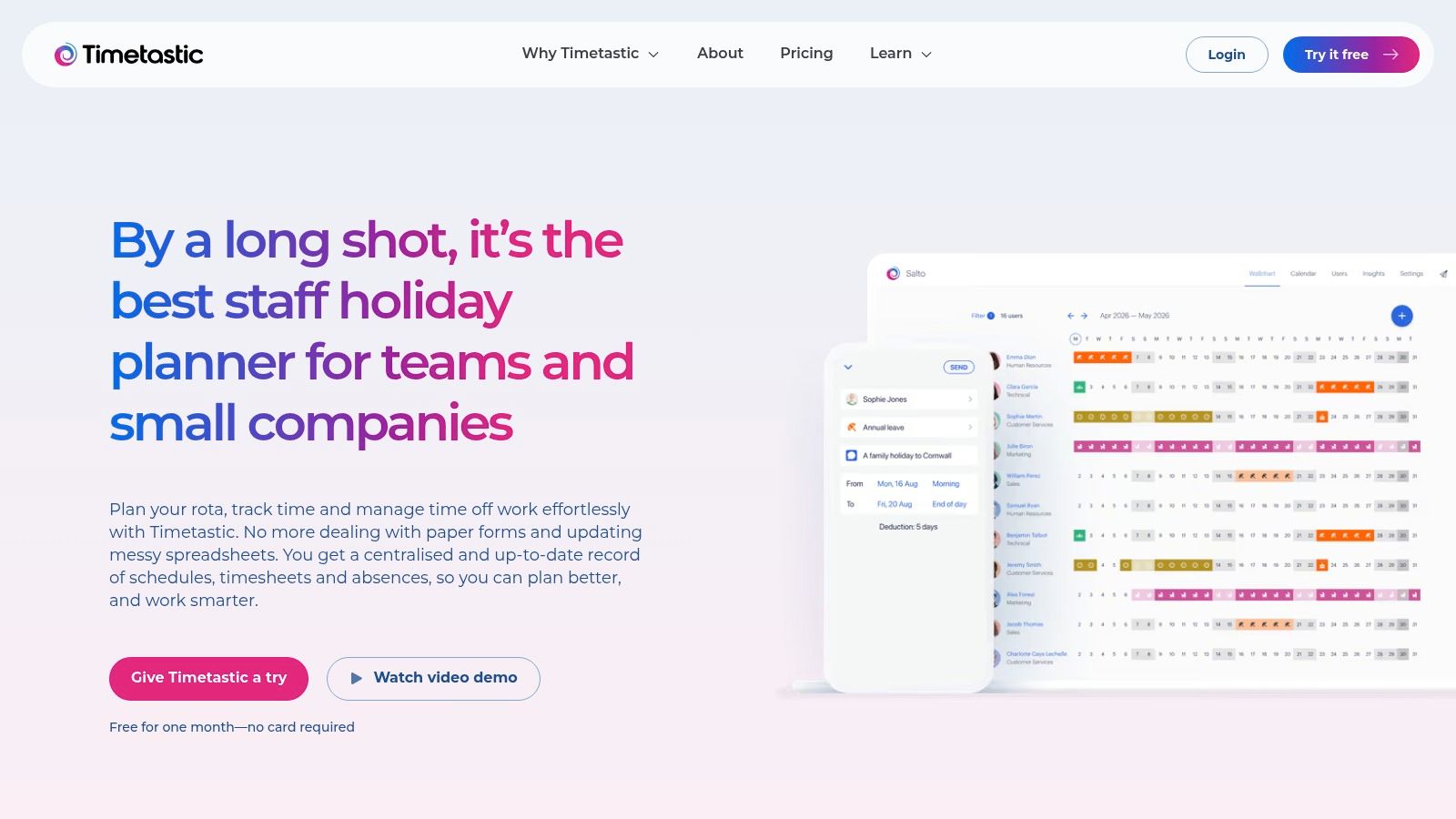
Timetastic is the practical choice for teams that mainly need a shared holiday calendar, allowance tracking and straightforward approvals. It's deliberately lighter than a broad HR suite, which is precisely why it can work well for a business that wants to stop emailing spreadsheets without redesigning every HR process.
Employees can submit holiday requests through web and mobile tools, while managers approve them against shared calendars and wallcharts. Outlook, Google and Apple calendar synchronisation helps employees see absence alongside their existing schedules. Slack and Teams integrations also reduce the need to move between systems for routine visibility.
The implementation advantage is clear. Teams with standard leave policies can get started quickly, and public-holiday packs and templates reduce initial configuration effort. Month-to-month billing and no-contract positioning make it easier to test the fit before committing to a longer arrangement.
Where the trade-off appears
Timetastic is strongest when the problem is basic leave coordination. It's less suitable when the business needs employee documents, performance processes, detailed absence workflows or a broader HR record. Some advanced controls, including allowance rules, accruals and booking limits, are associated with the Pro tier, so the apparently simple product still needs a careful plan comparison.
For a spreadsheet replacement with modest policy complexity, that trade-off is often acceptable. For a business managing variable hours, multiple absence types or deeper payroll processes, the team should test whether the higher tier handles the required rules rather than assuming the wallchart solves the whole problem. A closer comparison is available in this Timetastic review.
3. Breathe HR
Breathe HR suits UK small organisations that want holiday and absence management inside a broader employee record. It combines leave requests and reporting dashboards with employee information, documents, policies and basic performance tools, so the planner doesn't sit in isolation from everyday HR administration.
Its modular approach is helpful for businesses that don't want to buy every feature at the start. Rota and time attendance, expenses, recruitment, learning and health and safety can be added as requirements develop. UK data hosting and UK-focused calculators and resources also make it easier for administrators to keep local considerations in view.
The product's commercial structure is comparatively approachable for micro teams, with per-business pricing that starts low according to the supplied product notes. That's useful when a manager needs to forecast costs before building a full HR technology budget. Optional modules can, however, change the total quickly, particularly if the organisation expects the system to cover more than leave.
Best use case
Breathe HR is a sensible middle ground between a leave-only planner and a larger HRIS. It offers more context than a shared holiday calendar, but the business may need add-ons to achieve the depth expected by a growing or operationally complex workforce.
The mobile experience is functional rather than especially advanced. That may not matter for office-based teams, but distributed or deskless employees should test request, approval and balance-checking workflows on their actual devices before selecting it.
4. CharlieHR
CharlieHR is built around the needs of UK startups and small businesses that want time-off management alongside core people processes. Its shared calendars, onboarding, reviews, engagement surveys and employee essentials create a broader people-management environment than a dedicated holiday tracker.
The interface and setup are designed to be straightforward, which helps a small HR team introduce self-service without asking managers to learn a complex system. Optional services and products, including Charlie Recruit and HR Advice, give the platform an expansion path when recruitment or HR support becomes a more pressing need.
A good fit for simple HR consolidation
CharlieHR works best when the business wants one approachable place for basic HR administration. It can reduce the number of disconnected tools used for holidays, onboarding and reviews, but the organisation should be realistic about the point at which it may need additional systems.
Some users report needing extra tools as they scale, and total pricing varies with headcount and add-ons. That makes the buying decision less about the calendar itself and more about the likely shape of the wider HR stack. Ask whether the company wants a simple planner, a small-business HR hub or a foundation for more complex workflows.
5. Sage HR
Sage HR is a strong candidate for SMBs that want leave management connected to a modular HR platform and Sage payroll products. Formerly known as CakeHR, it combines core HR and leave with optional performance, timesheets, shift scheduling, expenses and recruitment modules.
The mobile app supports requests and approvals, while shared calendars give managers a common view of absence. The modular structure lets a business start with the workflows it needs and add capabilities as operational requirements develop. That can be more efficient than implementing a full suite before the HR team has established its processes.
Consider the total module cost
Sage HR's per-employee pricing model and modular structure provide a useful starting point for comparison. Recruitment is priced separately and may become expensive for organisations that need a full applicant-tracking workflow. Annual contracts may offer better value, but they reduce flexibility compared with a month-to-month pilot.
Sage HR makes particular sense when the finance or payroll team already works within the Sage ecosystem. If the only requirement is holiday visibility, a lighter planner may be easier to implement. If the business needs leave, shifts, time records and payroll-adjacent workflows, Sage HR deserves closer testing.
6. BrightHR
BrightHR takes an all-in-one approach for small employers. Leave and absence management sits alongside rota planning, timekeeping, clock-in features, expenses, document storage and centralised HR information.
That breadth can simplify vendor selection. A manager can handle annual leave, rota coordination and employee documents through one supplier instead of stitching together separate tools. The platform also positions itself around UK legislation awareness and regular product updates, which is relevant in a regulated environment where leave and absence rules need ongoing attention.
Convenience versus depth
BrightHR's fixed-price messaging and price-protection approach may appeal to buyers who want predictable commercial terms. Exact pricing is generally provided by quote, however, and contract terms may be firm. Ask for the full cost, renewal position, implementation support and any limits on users or modules before comparing it with a transparent subscription product.
The main functional compromise is depth. A broad bundle can cover many everyday needs without providing the specialist configuration found in a dedicated absence platform. BrightHR is therefore a reasonable choice for an employer that values consolidation, but a less obvious choice for a business with highly unusual shift, accrual or compliance rules.
7. edays
edays is designed for organisations where absence management is more complicated than annual leave requests. It supports annual leave, sickness, statutory sick pay, time off in lieu, custom absence types, Bradford Factor reporting, alerts, triggers and return-to-work forms.
That depth makes it a natural fit for organisations with 50 or more employees, multi-site operations or policies that need extensive configuration. It also supports payroll and HRIS integrations through integrations and an API, alongside mobile access and rules for shifts and part-time arrangements.
The platform's strongest quality is its focus. Rather than treating absence as one small feature inside a general HR suite, edays gives HR and operations teams tools for managing different kinds of absence and the follow-up work attached to them.
Absence planning is operational planning. A request calendar alone won't explain return-to-work actions, sickness patterns or the effect of repeated short absences on staffing.
The cost of that capability is implementation effort. There's no free trial, pricing is quote-only and annual contracts apply. Smaller businesses with uncomplicated policies may find the configuration heavier than necessary. Organisations with multi-country requirements, complex shifts or a need for proactive compliance updates may consider that effort justified.
8. Factorial HR
Factorial HR is a broad European HR suite with a UK presence. It brings time off, time tracking, shift management, performance, expenses and recruitment into a modular platform with a modern interface.
For a growing SMB, the appeal is the possibility of expanding beyond holiday management without changing systems. Custom absence types and unlimited policies provide room for different departments, locations and working arrangements. Approval workflows and administrative automation can help centralise the work that otherwise spreads across email, spreadsheets and separate finance or HR tools.
When breadth becomes the deciding factor
Factorial HR is a strong option when the business wants HR, time and finance-related workflows to develop together. Its integration marketplace can support a wider technology environment, but the total price depends on the selected modules and the final configuration. Entry pricing may look competitive while the budget requirement emerges only after the business adds time tracking, recruitment or expense functionality.
UK-specific compliance depth may also require configuration. That isn't necessarily a weakness, but it means the implementation team should document regional calendars, entitlement policies and approval rules before launch. Factorial suits a business willing to invest in a configurable HR platform, rather than one seeking the fastest possible holiday-only deployment.
9. BambooHR UK
BambooHR UK is a mature global HRIS with a UK-specific offering that includes time-off requests, approvals, accruals, reporting and employee self-service. It's the better fit when holiday management is one part of a wider people system rather than the main reason for buying software.
The platform provides calendar views, custom policies, HR reporting and workflows, with recruitment and performance modules available on higher plans. Its integration marketplace and EU or data-centre options can matter to organisations that need a broader technology and data-management framework.
Choose it for the HRIS, not just the calendar
BambooHR can be excessive for a small team that only wants to replace a holiday spreadsheet. The value becomes clearer when the organisation also needs employee records, structured workflows, reporting and integrations across a wider HR operation. UK payroll and benefits administration may still require integrations because some capabilities are more US-focused.
Pricing can rise as advanced modules are added, so the evaluation should start with the full target state rather than the entry configuration. Businesses comparing the best HR software for small businesses should separate “best leave planner” from “best HRIS” because those are different buying decisions.
10. Personio
Personio is aimed at SMB and mid-market organisations that expect their HR requirements to grow. Its time-off and absence tools sit alongside time and attendance, overtime calculations, work-schedule compliance, reporting, workflows and API integrations.
The European compliance orientation is relevant for organisations operating across entities or countries. Recruiting and performance apps provide further expansion options, while reporting and workflow tools support a more structured HR operating model than a standalone holiday calendar.
Personio's strength is its ability to bring leave into a wider HR architecture. That makes it attractive when the company needs more than annual leave tracking and wants to plan for growth, multiple entities or more formal people operations.
The trade-off is proportionality. Pricing is quote-based, and implementation and configuration may be excessive for a very small business with standard policies. Before choosing it, the buying team should define which workflows need the platform immediately and which can wait. Otherwise, the organisation may pay for breadth before it has the internal processes to use it well.
Top 10 Employee Holiday Planners: Feature Comparison
| Product | Core features ✨ | UX / Quality ★ | Pricing / Value 💰 | Target audience 👥 |
|---|---|---|---|---|
| LeaveWizard 🏆 | Automated calculations, flexible accruals & carryovers, 15‑min booking, reports & calendar integrations | ★★★★★ Fast setup (<1hr), intuitive web & mobile apps | 💰 30‑day free trial; pricing on request | 👥 Small & growing businesses replacing spreadsheets |
| Timetastic | Shared/team calendars, allowance rules, public holiday packs, mobile & Slack/Teams sync | ★★★★ Quick to implement; very intuitive | 💰 Transparent, low monthly pricing; no contract | 👥 SMBs (UK-focused) wanting simple leave planning |
| Breathe HR | Holiday & absence, employee records, dashboards; optional rota, T&A, expenses | ★★★★ Predictable UI; UK resources & calculators | 💰 Per-business pricing; starts low for micro teams | 👥 Small UK organisations needing HR basics |
| CharlieHR | Time-off, onboarding, reviews, engagement tools; optional ATS/advice | ★★★★ Simple, startup-friendly UI | 💰 Headcount-based pricing; add-ons vary | 👥 UK startups & small teams |
| Sage HR | Leave + modules (performance, timesheets, shifts), Sage payroll integration | ★★★★ Established brand; mobile workflows | 💰 Per-employee modular pricing; annual options | 👥 SMBs wanting modular HR + payroll links |
| BrightHR | Leave/absence, rota/scheduling, timekeeping, document storage (bundle) | ★★★★ All-in-one simplicity; UK compliance focus | 💰 Fixed-price / quote; price-protection messaging | 👥 Small employers wanting bundled HR tools |
| edays | Deep absence features (SSP, Bradford Factor), return-to-work, payroll/API integrations | ★★★★☆ Highly configurable; suited to complex policies | 💰 Quote-only; no free trial; annual contracts common | 👥 50+ employees, multi-site or multi-country teams |
| Factorial HR | Time off, shift & time tracking, performance, expenses, integrations marketplace | ★★★★ Modern UI; admin automation | 💰 Competitive entry pricing; modules add cost | 👥 Growing SMBs across Europe seeking modular HR |
| BambooHR (UK) | Time-off requests/approvals, accruals, reporting, integration marketplace | ★★★★ Mature HRIS; wide integrations | 💰 UK pricing published; costs rise with modules | 👥 Companies wanting a full HRIS + leave management |
| Personio | Absence/time-off, time & attendance, workflows, reporting, API integrations | ★★★★ Robust for scale; configuration-heavy | 💰 Quote-based; geared to scaling teams | 👥 Scaling SMBs / mid-market with multi-entity needs |
Use a holiday planner to manage coverage, not just requests
The best employee holiday planner should help a manager decide whether leave can be approved safely. That means combining employee preference with team capacity, regional calendars, working patterns and existing absence.
The need is particularly clear because the CIPD and Simplyhealth employer survey reports an average of 9.4 absence days per UK employee in the past year, compared with 7.8 days in 2023 and 5.8 days pre-pandemic, based on responses from more than 1,100 employers. This is an employer-reported benchmark, not a universal measure for every sector, but it shows why managers need visibility beyond annual leave balances.
Start with the team's actual operating model. Identify roles that must be covered, periods when demand rises, employees who can backfill each other and approval limits for overlapping absence. Then configure the planner so it reflects those decisions rather than treating every request as an isolated transaction.
Put the policy into the workflow
For full-year workers, the statutory framework is familiar. Irregular-hours and part-year workers require more care because the government's calculation guidance uses a 12.07% accrual rate of hours worked in a pay period for relevant contract types, as set out in the official leave calculation guidance.
That rule should shape the product test. Create sample policies for:
- Standard full-time staff: Check annual allowance, carryover and public-holiday treatment.
- Part-time staff: Confirm that working patterns produce the intended entitlement.
- Irregular-hours staff: Test accrual from hours worked rather than a fixed annual day count.
- Part-year staff: Confirm that the system separates entitlement, accrual and pay handling.
- Regional teams: Apply the correct England and Wales, Scotland or Northern Ireland calendar.
Public holidays also need a written decision. They may be included in statutory entitlement or provided separately depending on the contract and employer policy. A planner should make that treatment visible to administrators and employees instead of leaving the rule buried in a policy document.
Pricing and implementation trade-offs
Pricing transparency is one of the clearest differences between these platforms. Timetastic offers the most straightforward route for a small team wanting a lightweight planner, while Breathe HR, Sage HR and some other modular tools provide a clearer starting structure but require the buyer to account for add-ons. LeaveWizard offers a 30-day free trial without a credit card, but subscription pricing is supplied on request.
Quote-based products, including edays, BrightHR, Factorial HR and Personio, need a more disciplined comparison. A quote isn't automatically poor value, especially when configuration, support and integrations are part of the service. It does mean the buyer should request the same information from each vendor.
Ask for the complete commercial picture:
- Core subscription: Which employees, administrators and locations are included?
- Modules: Are recruitment, time tracking, performance or expenses charged separately?
- Implementation: Is configuration support included, and who imports existing balances?
- Integrations: Are payroll, calendar, API or collaboration connections included?
- Contract terms: Is monthly billing available, or is an annual commitment expected?
- Renewal costs: What changes after the initial term?
- Exit requirements: Can the organisation export balances, requests and absence history?
A short implementation checklist
Before signing, document the current process and test the highest-risk workflow. The checklist should cover:
- Current policies: Record entitlement, carryovers, blackout periods and approval rules.
- Approval ownership: Name each manager or delegate responsible for decisions.
- Public holidays: Configure regional calendars and contract-specific treatment.
- Team calendars: Define which teams need visibility across locations or shifts.
- Employee communication: Explain how requests, balances and approvals will work.
- Data migration: Reconcile current allowances, booked leave and absence records.
- Reporting needs: Decide what line managers, HR, operations and finance need to see.
- Integration requirements: Confirm calendar, payroll, HRIS, API and collaboration connections.
- Total cost: Include modules, support, implementation and contract commitments.
Before you commit: Ask the vendor to demonstrate one real request from submission through approval, calendar visibility, balance update and reporting. A polished feature tour won't expose the awkward part of your policy.
Choose the Planner That Matches Your Work
For a small or growing business leaving spreadsheets behind, LeaveWizard is the most balanced starting point. It combines quick setup, flexible leave rules, employee self-service, real-time visibility and reporting without forcing the organisation to begin with a full HRIS implementation. Its lack of public subscription pricing is a drawback, so use the free trial and request a complete quote before making a final decision.
Choose Timetastic when the main requirement is lightweight holiday planning with shared calendars, approvals and useful integrations. It's a better match for straightforward policies than for complex absence management or a broad employee record.
Choose Breathe HR, CharlieHR, Sage HR, BrightHR or Factorial HR when leave is only one part of the problem. These platforms make more sense when the business also needs documents, onboarding, performance, rotas, time tracking, expenses, recruitment or wider HR workflows. The right choice depends on which adjacent process is most urgent and whether the organisation prefers modular expansion or an all-in-one bundle.
Assess edays, BambooHR or Personio when compliance complexity, integrations or wider HRIS requirements justify a deeper platform. edays is the specialist absence option, BambooHR suits organisations seeking a mature HRIS and Personio is aimed at businesses planning for more structured, multi-entity growth. Their implementation effort and quote-based pricing make them less suitable for a simple holiday spreadsheet replacement.
The ranking shouldn't replace a workflow test. A planner can look excellent in a product demo and still fail when an irregular-hours employee accrues leave, a Scottish site follows a different bank-holiday calendar or a manager needs to approve partial-day absence against a coverage rule.
Run the evaluation with your own data and policies. Import representative employees, configure the relevant working patterns, add regional holidays, submit overlapping requests and check what the manager, employee, HR administrator and finance team each see. Review the report output and confirm how data reaches payroll or the wider HRIS.
Finally, compare the total cost against the operational problem being solved. A low-cost calendar may be sufficient for simple leave coordination, while a configurable platform can justify additional effort when the business is dealing with absence reporting, shifts, multiple regions or a growing approval structure. Test the highest-priority workflow during a trial or product evaluation before committing.